
BLR-120 · Lesson 11 of 12 · 20 min
Critical lift planning
Two weeks before the turnaround starts, Kiera sits in on a lift planning session in Ironbridge's site trailer at Northgate. On the table are the drawings of the coker structure, the crane company's draft plans for the coker drum and a dozen smaller critical lifts, and a printed copy of Northgate's lifting procedure. Wade Kozak and Sunita Rao go through the plans one at a time with Corinne Masse, the owner's lift coordinator. Most of the questions are not about cranes at all. They are about weights and where they came from, about what is under the mats, about what is still running in the unit next door, about who signals whom, and about what will make the crew stop. This lesson draws the course together into the critical lift plan: what makes a lift critical, what the plan contains, how it is reviewed and approved, and how it is carried out on the day.
What makes a lift critical
Lesson 1 introduced lift categories. A critical lift is one where the consequences of failure are severe or the margin for error is small, and it is defined in the owner's procedure, in the law and in the standards. The usual triggers are the same everywhere, although the numbers vary.
| Trigger | Why it matters |
|---|---|
| Load at 75 percent of chart or more | Little margin for errors in weight, radius or ground |
| More than one crane on the load | Load shares shift during the lift |
| Load passes over live process equipment or occupied buildings | A dropped load could cause a release, fire or casualties |
| Personnel lifted in a basket or platform | People are the load |
| Crane, load or rigging near energized power lines | Contact can kill riggers instantly |
| Very heavy, high-value or irreplaceable loads | The cost of failure is large even if no one is hurt |
| Blind lifts, unusual rigging, upending, cranes on barges or structures | Complex conditions with more ways to go wrong |
ASME P30.1, the standard for planning load handling activities, describes how a lift is classified as standard or critical and what a critical lift plan should contain, and OSHA's 1926.1432 requires a qualified person's plan for every lift with more than one crane. Northgate's procedure turns any lift meeting one of its critical triggers into an engineered lift with a full plan, reviewed by the crane company's engineer and approved by Corinne's office.
The coker drum top head lift shows how a lift can be critical without being large. The head weighs only a tenth of the drum, but it will be lifted over a live line on the coker structure, the crane available for it is small for the radius, and the operator cannot see the deck where it lands. Kiera runs it through Northgate's screen.
# Critical lift screen for a single lift (Northgate procedure, illustrative)
lift = {
    "load incl. rigging (lb)": 56_400, "chart gross at radius (lb)": 65_000,
    "cranes": 1, "over live process": True, "personnel": False,
    "near power lines": False, "blind to the operator": True, "wind forecast (mph)": 13,
}
pct = 100 * lift["load incl. rigging (lb)"] / lift["chart gross at radius (lb)"]
triggers = []
if pct >= 75: triggers.append(f"{pct:.0f} % of chart (lift calculation required at 75 %)")
if lift["cranes"] > 1: triggers.append("more than one crane")
if lift["over live process"]: triggers.append("load passes over live process equipment")
if lift["personnel"]: triggers.append("personnel platform")
if lift["near power lines"]: triggers.append("within the power line approach zone")
if lift["blind to the operator"]: triggers.append("blind lift: signal person and radio required")
if lift["wind forecast (mph)"] > 20: triggers.append("forecast wind above the site limit")
print(f"load at {pct:.1f} % of chart")
print("critical lift" if triggers else "not critical", "-", len(triggers), "trigger(s)")
for t in triggers:
    print("  -", t)
plan = ["load weight and CG with source", "crane configuration and chart page", "rigging list with ratings",
        "ground and mats", "radius at pick and set, swing path", "signals and radio channel",
        "exclusion zone", "wind and weather limits", "stop-work conditions", "sign-offs"]
print("lift plan sections:", ", ".join(plan))load at 86.8 % of chart critical lift - 3 trigger(s) - 87 % of chart (lift calculation required at 75 %) - load passes over live process equipment - blind lift: signal person and radio required lift plan sections: load weight and CG with source, crane configuration and chart page, rigging list with ratings, ground and mats, radius at pick and set, swing path, signals and radio channel, exclusion zone, wind and weather limits, stop-work conditions, sign-offs
The head trips three triggers: it is at 87 percent of chart, it passes over live equipment, and it is blind to the operator. Any one would make it critical. The plan for the head will be shorter than the drum's, but it will have every section the procedure requires.
What a critical lift plan contains
A critical lift plan is a document that a competent person who was not involved in writing it could read and use to carry out the lift. It answers, in writing and in drawings, every question that could otherwise be answered on the day by guesswork.
- The load: its description, weight with the source and contingency, center of gravity, lifting points and their capacities.
- The crane or cranes: make, model and configuration, counterweight, boom and jib lengths, outrigger or track arrangement, the chart page, and the radius at the pick, at the set and at the worst point of the swing.
- The percentage of chart at each critical point, and the site's limits.
- The rigging: every sling, shackle, beam and device, with its rating, its weight and its inspection status.
- The ground: allowable bearing, the mats and their arrangement, outrigger or track loads, and buried services.
- Drawings: a plan view showing the crane position, the swing path, the exclusion zone and nearby hazards, and an elevation showing the boom and the load clearances at the critical points.
- Communication: the signal persons, the radio channels and the handovers.
- Limits: wind, visibility, temperature and any other conditions under which the lift will not start or will stop.
- The sequence: step by step, including trial lifts, hold points and, for tandem lifts, the upending table.
- The team and sign-offs: the lift director, operators, riggers, signal persons, engineer and owner's approval.
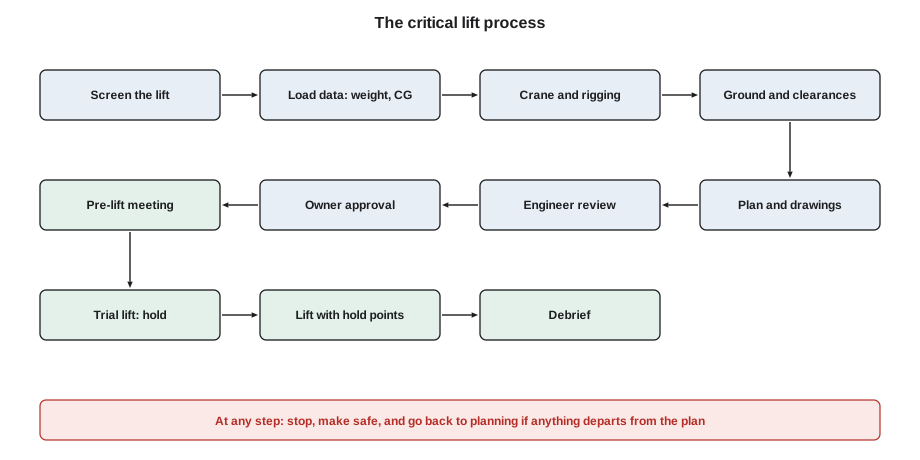
The crane company's engineer checks the calculations, the crane's capacity at every point, the ground bearing and the rigging; for lifts with engineered lugs or lifting beams, the designs and inspection records are attached. ASME P30.1 and most owner procedures also ask the planner to think about what could go wrong and what the team would do: what if a crane faults with the load in the air, what if the wind rises during the upending, what if the trial lift reads high?
Contingencies and hold points
Good plans include planned pauses, called hold points, where the lift stops and the team confirms that everything is as expected before going on. On the coker drum lift, the hold points are after the trial lift, at 45 degrees of upending, when the drum is vertical before the tail rigging is released, at the top of the hoist before the swing, and above the foundation before the set. At each, the lift director asks for the load readings, the radius, the wind, the ground and anything anyone has seen.
The plan also says what to do if something goes wrong. If a crane faults with the drum in the air, the drum is held in place and the crane company's technician brought in; the plan identifies where the drum can be safely lowered at each stage if the fault cannot be fixed. If the wind rises beyond the limit, the drum is lowered to the nearest safe resting point in the sequence. If a load reading exceeds the plan by more than the contingency, the drum is set back down and the weight reviewed.
Review and approval
A critical lift plan is reviewed by people who did not write it. At Northgate, the crane company's engineer reviews the crane and ground calculations, Ironbridge's rigging superintendent reviews the rigging and sequence, the owner's lift coordinator reviews the plan against the plant's hazards and other work, and the owner's safety group reviews the exclusion zones and emergency arrangements. Each signs the plan. The signed plan goes to the crane, and any change after approval, a different crane position, a different sling, a different day with a different forecast, goes back through review.
Kiera notices how often the review changes something. The first draft of the drum plan had the main crane's assembly area overlapping a laydown area booked by another contractor; the second moved a mat over an unrecorded drain found by the civil group; the third changed the tail crane's travel path when the plant asked to keep a fire lane open. None of these was a crane problem, but any of them could have stopped the lift on the day.
Personnel lifts
Lifting people with a crane is the most strictly controlled kind of lift, because the load is a person. It is allowed only when there is no safer way to reach the work, such as a scaffold or an aerial platform, and it requires an engineered platform attached to the crane, a lower percentage of chart, a trial lift with the platform loaded and unoccupied, workers tied off to the platform, and a dedicated signal person. OSHA's 1926.1431 sets the requirements, including the limit of 50 percent of the crane's rated capacity for the platform and its load and a trial lift, and Northgate's procedure treats every personnel lift as critical.
Carrying out the plan
On the day of a critical lift, the plan is in the hands of the lift director. The day begins with checks: the crane's daily inspection, the rigging laid out and inspected, the mats and ground checked, the wind and forecast read, the exclusion zone set up, the radios tested. Then comes the pre-lift meeting at the crane, with every team member present, where the lift director goes through the plan, the hold points and the stop conditions, and each person confirms their role. Nobody joins the lift without attending the meeting.
The lift proceeds through its steps and hold points. The lift director watches the whole operation rather than any one part of it, and keeps the team informed. If anything departs from the plan, the lift stops. When the load is set and the rigging released, the lift director closes the lift, and the team holds a short debrief.
Stop work
Every Northgate lift plan ends with the same box, which Kiera now knows by heart: stop the lift if the load does something unexpected; if the load readings exceed the plan; if the wind passes the limit; if anyone enters the exclusion zone; if communication is lost; if the ground or mats move; if a crane faults; or if anyone on the team is unsure. Stopping is not a failure. A stop costs minutes or hours; a dropped coker drum would cost lives, the unit and months of production.
Worked problem
Screening a lift
A crane will lift a 35,000 lb pump skid with 1,800 lb of rigging at a radius where the chart gives 62,000 lb. The skid passes over a pipe rack carrying live hydrocarbon lines. The wind forecast is light. Is the lift critical, and what must the plan include?
Show solution
- Percentage of chart: 36,800 / 62,000 = 59 percent, below the 75 percent line.
- The skid passes over live hydrocarbon lines: that is a critical trigger under Northgate's procedure.
- So the lift is critical, and needs the full plan: load data, crane configuration and chart, rigging list, ground, drawings showing the swing over the rack, signals, limits, sequence and sign-offs.
- The owner may also require the lines to be isolated or the swing path changed to avoid the rack.
Answer: Critical, because of the live lines under the swing path, even though the percentage of chart is moderate.
Common mistakes
MistakeTreating a lift as routine because it is light.
InsteadScreen every lift against all the triggers, not just percentage of chart.
MistakeWriting a plan that only its author can follow.
InsteadA plan should be usable by a competent person who did not write it.
MistakeChanging the crane position or rigging on the day without review.
InsteadAny change after approval goes back through review.
MistakeSkipping hold points when the lift is going well.
InsteadHold points are where problems are found before they grow.
MistakeLetting someone join the lift who missed the pre-lift meeting.
InsteadEveryone on the lift attends the meeting.
Summary and key terms
- A critical lift is defined by the owner's procedure, the law and the standards; percentage of chart is only one trigger.
- ASME P30.1 describes critical lift classification and plans; OSHA requires a qualified person's plan for multiple-crane lifts.
- A critical lift plan covers the load, crane, chart, rigging, ground, drawings, communication, limits, sequence, team and sign-offs.
- Hold points and contingencies are planned in advance, with safe set-down positions identified.
- Plans are reviewed and signed by people who did not write them, and any change goes back through review.
- On the day, the pre-lift meeting, the hold points and the stop-work conditions control the lift.
- Critical lift plan
- A written plan, with drawings, for a lift that meets a critical lift trigger.
- Hold point
- A planned pause in a lift at which the team confirms conditions before continuing.
- Exclusion zone
- The area around a lift that no one may enter except those assigned to it.
- Personnel platform
- An engineered platform for lifting workers with a crane.
- Contingency plan
- The planned response to a fault or change during a lift.
- Debrief
- A short review after a lift to record lessons.
Practice problems
Work each problem on paper first, then reveal the answer to check.
A lift is at 55 percent of chart with one crane, but the operator cannot see the landing and the load passes over live lines. Is it critical under Northgate's rules?
Show answer
Yes, because it passes over live lines.
Name four sections of a critical lift plan.
Show answer
Load data, crane configuration and chart, rigging list, ground and mats, drawings, communication, limits, sequence, sign-offs.
What is a hold point?
Show answer
A planned pause where the lift stops and the team confirms conditions before continuing.
What percentage of the crane's rated capacity does OSHA allow for a personnel platform and its load?
Show answer
50 percent.
Lesson quiz · 5 questions
Score 60% or more to complete this lesson.
Create a free account to save your progress, take quizzes and earn a certificate.