
BLR-120 · Lesson 1 of 12 · 23 min
Heavy rigging on industrial projects
Six months after the Riverbend outage, Kiera Lafontaine is back at Ironbridge Industrial's yard in Port Allen, this time with a new line on her schedule: the heavy-lift crew for the fall turnaround at the Northgate Refinery. The turnaround's biggest job is the replacement of one of the delayed coker drums, a steel vessel taller than a ten-story building that weighs close to 650,000 lb. Around that one lift sit dozens of smaller ones: heat exchanger bundles pulled and reset, a reboiler shell replaced, top heads and valves changed on the coker structure, and tube panels hoisted into a boiler at Riverbend on the same contract. Rosa Delgado, the general foreman, has put Kiera with Dale Whitford, who has rigged vessels for thirty years, and with Wade Kozak, Ironbridge's rigging superintendent, who will direct the big lifts.
Kiera learned the basics of rigging in her trades core course: slings, hitches, sling angles, shackles, hand signals and the idea of a lift plan. This course builds on that base and turns it toward the work boilermakers do: lifting, upending, jacking and setting vessels, drums, exchangers and boiler components that are heavy, awkward and often going into a plant that is still partly running. This first lesson describes how heavy rigging is organized on an industrial project: who does what, how lifts are classified, and why the boilermaker's part of the job is larger than it first appears.
What makes industrial rigging different
On a building site, most lifts are repetitive: bundles of steel, formwork, mechanical units, each similar to the last. Industrial rigging is different in several ways. The loads are one of a kind; a coker drum or a reactor is lifted once in its life, and nobody has handled one exactly like it before. The loads are heavy and often tall, so they must be upended from horizontal to vertical. The site is congested, with pipe racks, live process units and other cranes all around. The equipment being lifted is valuable, often worth millions of dollars and months of fabrication, and the plant may be losing production every day it is down. And much of the rigging is done in places a crane cannot reach: inside boilers, under pipe racks and inside structures where the boilermakers rig chain falls, jacks and skid tracks by hand.
Boilermakers take a large share of this work. On many turnarounds the crane company supplies the crane and the operator, and the boilermakers do everything below the hook: they rig the load, attach to the lugs and trunnions, set up tailing gear, guide the load, set it on its foundation or saddles, and release the rigging. In tight spaces they use their own equipment entirely. The trade's Red Seal and apprenticeship standards treat rigging as one of its core skills, alongside layout, fitting and welding.
| Work | Typical equipment | Who usually provides it |
|---|---|---|
| Lifting vessels and drums | Mobile or crawler cranes, lifting beams, trunnion slings | Crane company with boilermaker riggers |
| Upending tall vessels | Main crane plus tailing crane, tail lug and frame | Crane company and boilermakers, engineered plan |
| Setting exchangers under pipe racks | Hydraulic gantry, skid track, jacks | Rigging contractor or boilermakers |
| Pulling exchanger bundles | Bundle extractor on a crane, or a cable puller | Specialty contractor with boilermakers |
| Rigging inside boilers | Beam clamps, chain falls, lever hoists, wire rope hoists | Boilermakers |
| Lifting tank shells for floor work | Hydraulic jacks around the shell | Tank contractor with boilermakers |
The lift team
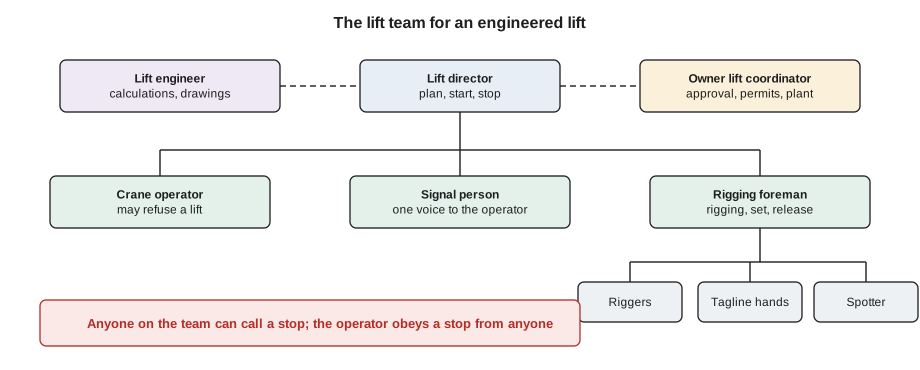
Every lift has a team, even a small one, and the bigger the lift the more formal the roles become. The same names appear in the standards, in OSHA's crane rules and in the owner's site rules, although the titles vary from company to company.
The lift director, sometimes called the person in charge of the lift, has overall responsibility for the lift: the plan, the team, the decision to start and the decision to stop. On the Northgate drum lift this is Wade Kozak. The crane operator controls the crane and has the authority, and the duty, to refuse a lift he or she believes is unsafe. The riggers prepare and attach the rigging, and on a heavy lift at least one rigger is designated as qualified for that lift. The signal person directs the operator when the operator cannot see the load or the landing area, using hand signals or a radio. The lift engineer, who usually works for the crane company or an engineering firm, prepares the lift calculations and drawings for engineered lifts. The owner's lift coordinator, for Northgate a turnaround planner named Corinne Masse, approves lifts over the plant's equipment, coordinates the cranes with the rest of the turnaround and controls the permits.
In the United States, OSHA's cranes and derricks standard for construction, 29 CFR 1926 Subpart CC, requires crane operators to be certified or qualified under 1926.1427, requires a qualified rigger whenever workers are engaged in hooking, unhooking or guiding a load in the crane's fall zone, and requires signal persons to be qualified under 1926.1428. For a lift with more than one crane, 1926.1432 requires a plan developed by a qualified person, a lift director and a meeting to review the plan with everyone involved. Turnaround maintenance in an operating plant is often treated as general industry work, but Northgate, like most refineries, applies the Subpart CC rules to all crane work on site.
Kiera's job on the team is the oldest one in rigging: she is a hand. She carries shackles, threads slings, holds a tagline, watches clearances and listens. Dale tells her that a good rigging hand learns two things before anything else: never to stand under a load or between a load and something solid, and that anyone on the team, including the newest apprentice, can call a stop.
Lift categories
Not every lift needs an engineer, and treating every lift the same would either bury the small ones in paperwork or leave the big ones under-planned. Owners and contractors therefore sort lifts into categories, each with its own level of planning. The details vary, but most systems use three levels.
| Category | Typical triggers | Planning required |
|---|---|---|
| Routine | Under about half of chart capacity, single crane, known weight, clear area | Rigger's checklist and the crew's hazard assessment |
| Planned | About 50 to 75 percent of chart, or a load of uncertain weight or shape | Lift worksheet: weight, radius, chart value, rigging, signed by the lift supervisor |
| Critical | 75 percent of chart or more, two cranes, over live plant, personnel, near power lines, very heavy or high-value loads | Written lift plan and drawings, engineer's review, pre-lift meeting, owner's approval |
The 75 percent line is not arbitrary. OSHA's rules do not set a percentage, but ASME P30.1, the American standard for planning load handling activities, describes how to classify lifts and what a critical lift plan should contain, and most owners and crane companies use 75 percent of chart as one of their critical lift triggers. Northgate's procedure adds its own triggers on top of the law: any lift with two cranes, any load over 220,000 lb, any load passing over equipment that contains hydrocarbons, any personnel platform and any lift within the power line approach zone is critical, whatever its percentage.
Wade has Kiera run the turnaround's list of planned lifts through the classification rules, so that she sees how a lift moves from one category to another. The list below is a small part of the real one.
# Lift categories for the Northgate turnaround (Northgate Refinery rules, illustrative)
# name, load lb, chart capacity at the planned radius lb, cranes, over live plant, personnel
lifts = [
    ("exchanger bundle to laydown", 40_600, 136_700, 1, False, False),
    ("reboiler shell onto saddles", 90_400, 173_100, 1, True, False),
    ("coker drum top head", 52_900, 65_000, 1, False, False),
    ("new coker drum", 675_000, 926_000, 2, False, False),
    ("work basket on the drum deck", 2_000, 26_500, 1, False, True),
]
for name, load, cap, cranes, live, people in lifts:
    pct = 100 * load / cap
    why = []
    if pct >= 75: why.append(f"{pct:.0f} % of chart")
    if cranes > 1: why.append("two cranes")
    if live: why.append("over live equipment")
    if people: why.append("personnel")
    if load >= 220_000: why.append("heavy load")
    if why:
        cat = "CRITICAL"
    elif pct >= 50:
        cat = "PLANNED"
    else:
        cat = "ROUTINE"
print(f"{name:<29} {pct:5.1f} % of chart {cat:<8} {', '.join(why)}")exchanger bundle to laydown 29.7 % of chart ROUTINE reboiler shell onto saddles 52.2 % of chart CRITICAL over live equipment coker drum top head 81.4 % of chart CRITICAL 81 % of chart new coker drum 72.9 % of chart CRITICAL two cranes, heavy load work basket on the drum deck 7.5 % of chart CRITICAL personnel
Only one lift on the list is routine. The reboiler shell is at only half of the chart, but it passes over a live line, so it is critical. The coker drum top head is light compared with the drum, but the crane chosen for it is small for the radius, and at 81 percent of chart it crosses the company's critical line. The new coker drum is under 75 percent, yet it is the most critical lift of the turnaround, because it uses two cranes and weighs over 650,000 lb. The work basket is tiny, but it carries people. Kiera's lesson from the exercise is that a lift's percentage of chart is only one of the things that make it dangerous.
Where heavy lifts go wrong
Dale has seen several heavy lifts go wrong, and he tells Kiera that none of them failed because of something nobody could have known. The causes repeat. A load weighed more than the drawing said, because of internals, refractory, residue or water nobody accounted for. The center of gravity was in a different place from where it was assumed, so the load tilted when it left the ground and the slings took loads they were not chosen for. The crane was set on ground that could not carry the outrigger or track loads. The radius grew during the lift as the load swung out, taking the crane past its chart. Wind caught a large, light load. Two cranes were not kept in step. Signals were misunderstood. Somebody stood where they should not have been.
Every one of those causes has a lesson in this course. Lesson 2 covers weights and centers of gravity, lesson 3 the rigging between the load and the hook, lessons 4 to 6 the crane, its chart and the ground under it, lessons 7 to 9 tandem lifts, upending, jacking and rigging by hand, lesson 10 signals and the weather, and lesson 11 the critical lift plan that ties them together. The capstone in lesson 12 follows the Northgate coker drum from the laydown yard to its foundation.
| Cause | Typical result | Control |
|---|---|---|
| Weight underestimated | Crane overloaded, rigging overloaded | Weight from the fabricator's records, contingency, load indicator |
| Center of gravity misjudged | Load tilts, slings overloaded, load swings | Calculate the CG; trial lift a few centimeters off the ground |
| Poor ground | Outrigger or track sinks, crane tips | Ground assessment, mats, known buried services |
| Radius grows | Crane exceeds chart, boom failure or tip-over | Plan for the largest radius, slow swing, taglines |
| Wind | Load out of control, side load on the boom | Wind limits from the crane maker, anemometer, stop rules |
| Communication failure | Wrong motion, struck workers | One signal person, dedicated radio channel, pre-lift meeting |
| People in the wrong place | Crush and struck-by injuries | Exclusion zone, no one under the load, taglines |
The rigging loft and the gear
Ironbridge keeps its rigging gear in a loft at the yard: wire rope slings from small chokers to 3 in diameter grommets, synthetic roundslings, alloy chain slings, shackles up to 85 ton capacity, spreader bars and lifting beams, beam clamps, chain falls, lever hoists, hydraulic jacks, cribbing, skid track and a load cell. Every item has an identification tag, a rated capacity and an inspection record. Before a job, the rigging foreman pulls the gear for each lift from the loft, checks it and logs it out to the job; after the job, it comes back for inspection. Gear that is damaged, missing its tag or overdue for inspection goes in a red-tagged cage and does not leave the yard.
Kiera spends part of her first week in the loft with Dale, going through the gear for the Northgate lifts. He shows her how to read the tags, how to match a shackle to a sling eye, and how the heavy equipment differs from the small gear she used in her core course: the shackles are too heavy to lift by hand, the grommets are handled with a forklift, and the lifting beam for the coker drum arrives on its own truck. Heavy gear is still inspected the same way, against the same removal criteria, before every use.
The plan, the meeting and the stop
Every lift starts with a plan, scaled to its category, and ends with a debrief. In between there is one more step that Dale considers the most important: the meeting at the crane before the lift, where the lift director goes through the plan with everyone involved. The operator confirms the configuration and the chart; the riggers confirm the gear; the signal person confirms the signals and the radio channel; the spotter confirms the exclusion zone. Anyone who is not sure of their part says so, and the lift waits until they are.
The other step is the stop. On every lift, any member of the team who sees something wrong can stop the work, and the operator must respond to a stop signal from anyone. At Northgate the stop is a standing rule written on the back of every lift plan: if the load does something unexpected, or someone is where they should not be, or the plan no longer matches what is happening, stop, make it safe and work it out before going on.
Worked problem
Classifying a lift
A crane will set a 26,000 lb exchanger head on a deck inside the coker structure. The crane's chart gives 44,000 lb at the radius, and the rigging weighs 1,300 lb. The operator cannot see the deck. Is the lift critical under Northgate's rules?
Show solution
- Total load: 26,000 + 1,300 = 27,300 lb.
- Percentage of chart: 27,300 / 44,000 = 62 percent.
- The percentage alone makes it a planned lift, below the 75 percent line.
- The operator cannot see the landing, so it is a blind lift; Northgate's rules require a signal person and a radio, but blind lifts alone do not make a lift critical.
- Unless the load passes over live equipment or another trigger applies, it is a planned lift with a worksheet and a signal person.
Answer: Planned, not critical, but with a designated signal person because the lift is blind. The category sets the minimum planning; the hazards of the lift add to it.
Common mistakes
MistakeTreating percentage of chart as the only measure of risk.
InsteadCheck every trigger: two cranes, live plant, personnel, power lines, weight, value, blind lifts.
MistakeAssuming the crane company handles everything below the hook.
InsteadOn most industrial jobs the boilermakers rig, guide and set the load.
MistakeThinking an apprentice cannot stop a lift.
InsteadAnyone can stop a lift, and the operator must respond to a stop signal from anyone.
MistakeUsing gear without a tag or inspection record.
InsteadUntagged or overdue gear goes in the red-tagged cage.
MistakeSkipping the pre-lift meeting for a familiar lift.
InsteadEvery lift is reviewed with everyone involved; familiar lifts go wrong too.
Summary and key terms
- Industrial lifts are often one of a kind, heavy, tall, valuable and made in congested, partly live plants.
- Boilermakers rig, guide, set and release the load, and do the hand rigging where cranes cannot reach.
- The lift team includes the lift director, operator, riggers, signal person, lift engineer and the owner's lift coordinator.
- OSHA requires qualified riggers and signal persons and a qualified person's plan for multiple-crane lifts; owners classify lifts using ASME P30.1 and their own triggers.
- Most heavy lift accidents come from known causes: wrong weight or center of gravity, poor ground, growing radius, wind, poor communication and people in the wrong place.
- Every lift has a plan, a pre-lift meeting and a stop rule that anyone can use.
- Lift director
- The person with overall responsibility for planning and carrying out a lift.
- Critical lift
- A lift that, because of its weight, percentage of capacity, location or other factors, requires a written plan and approval.
- Qualified rigger
- A rigger who has the knowledge and experience to rig a particular load and has been designated for it.
- Signal person
- The person who directs the crane operator by hand signals or radio.
- Below the hook
- Everything between the crane hook and the load: slings, shackles, beams and other devices.
- Percentage of chart
- The total load lifted divided by the crane chart value for the configuration and radius.
Practice problems
Work each problem on paper first, then reveal the answer to check.
A lift of 40,000 lb including rigging is planned where the chart gives 48,000 lb. What percentage of chart is it, and is it over the common critical lift line?
Show answer
40,000 / 48,000 = 83 percent; it is over the 75 percent line.
Name three triggers other than percentage of chart that make a Northgate lift critical.
Show answer
Two cranes, loads over 220,000 lb, loads over live hydrocarbon equipment, personnel platforms, lifts within the power line approach zone.
Who has the authority to stop a lift?
Show answer
Anyone on the team; the operator must respond to a stop signal from anyone.
Which OSHA section sets the planning rules for lifts with more than one crane?
Show answer
29 CFR 1926.1432.
Lesson quiz · 5 questions
Score 60% or more to complete this lesson.
Create a free account to save your progress, take quizzes and earn a certificate.