
BLR-110 · Lesson 9 of 12 · 19 min
Scaffolds, aerial lifts and access in boilers
When the burners are cold and the furnace doors are open, a scaffold crew spends four days building a tower inside the Unit 2 furnace that fills it from the ash hopper throat to the superheater, about 100 ft up. Every few levels the scaffold steps out to a full working deck across the furnace, so that boilermakers can reach the waterwalls on all four sides. Kiera climbs it on her second Monday to help replace a section of tube on the rear wall at the eighth level. The scaffold is her work platform, her fall protection and her escape route, and the habits she learns on it apply to every elevated platform she will use in the trade: scaffolds, ladders, aerial lifts and the suspended platforms some plants hang in their furnaces.
Scaffolds and who builds them
Scaffolds on industrial sites are built, altered and dismantled by trained scaffolders under the supervision of a competent person, and they are designed for the loads they will carry. Boilermakers use scaffolds; they do not modify them. OSHA's scaffold standard for construction, 29 CFR 1926 Subpart L, requires each scaffold to support its own weight and at least four times the maximum intended load, to be designed by a qualified person, and to be erected, moved, altered and dismantled only under the supervision of a competent person, who also inspects it before each shift and after any event that could affect it. General industry rules in 1910.29 cover scaffolds used for maintenance. Scaffolds are rated by duty, and the platform must be designed for the duty rating posted on its tag.
| Duty rating | Uniform load on the platform | Typical use |
|---|---|---|
| Light | 25 lb/ft² | Inspection, painting, light tools, no material storage |
| Medium | 50 lb/ft² | General trades work, light materials |
| Heavy | 75 lb/ft² | Plate, tube, brick and refractory, heavy tools |
A heavy-duty rating is not a license to stack anything anywhere. The rating assumes the load is spread over the platform. A pallet of firebrick, a stack of tube lengths or a welding machine puts a concentrated load on a small area, often near the middle of a span where the planks are weakest. Anything heavier than a few workers and their tools is placed where the scaffold designer says it can go, usually close to the standards, the vertical tubes of the scaffold, and the loads are recorded on the scaffold request.
Tags and inspections
Every scaffold on the outage carries a tag at its access point that tells the user whether it may be used. Ironbridge's sites use the common three-color system. A green tag means the scaffold has been inspected by a competent person, is complete and may be used for the duty and purpose shown, with the date and inspector's initials for the current shift or day. A yellow tag means the scaffold may be used only with additional precautions written on the tag, usually because a guardrail has been left off for access to the work, so that users must tie off. A red tag means the scaffold is incomplete or unsafe, and nobody but the scaffolders may go on it.
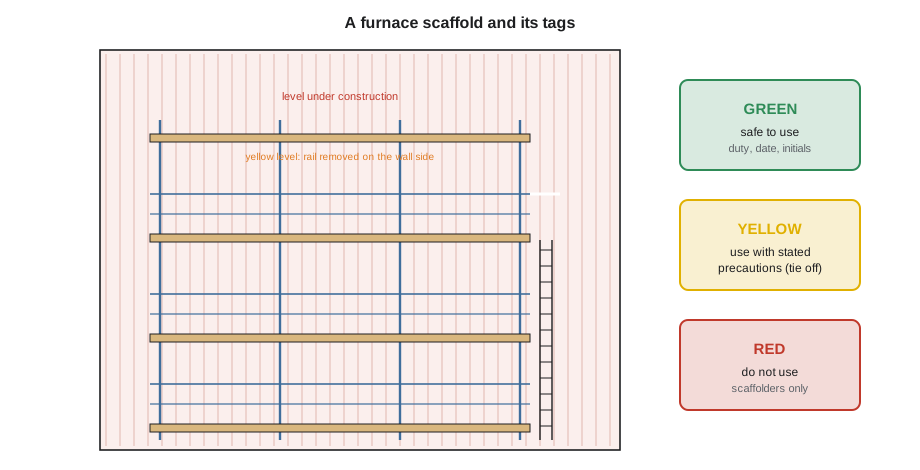
Kiera checks the tag every time she goes up, not just on the first day: a tag that was green this morning may have been changed at noon because a plank was moved by another crew. She also looks for herself: the base plates sitting on firm ground or on the hopper beams the scaffold was designed for, the planks fully decked with no gaps, guardrails at the top and middle on every open side, toe boards in place, ladders secured and extending above the landing, and nothing hanging off the scaffold that should not be. If she sees a problem, she gets off, tells her foreman and the scaffold supervisor, and does not use the scaffold until it is fixed.
The most common scaffold fault on an outage is one that a user created. A trade removes a guardrail to pass in a tube panel and does not put it back. A plank is pulled to give a welding lead a path. A tie that holds the scaffold to the structure is cut to clear a pipe. Each of these turns a green-tagged scaffold into a hazard that the next user does not know about. Rosa's rule for her crews is short: if you need the scaffold changed, ask the scaffolders, and if you find it changed, report it.
Falling objects
In a furnace with workers at several levels, a dropped tool or a falling piece of slag is as dangerous as a fall. A 2 lb wrench dropped from the eighth level strikes the deck below with enough energy to crack a hard hat and kill. Furnace scaffolds have overhead protection at intervals, solid decks rather than open grating, toe boards and, in many plants, debris netting. Tools used at height are tethered to the worker or the structure. Before work starts, the waterwalls above the work area are cleaned of loose slag and ash, a dirty and dusty job but one that removes the biggest falling-object hazard in a coal-fired or converted boiler. Work directly above another crew is not allowed unless the deck between them is solid and rated to stop what might fall.
Ladders
Ladders are for access and for short tasks, not for long work. A portable ladder is set at a slope of about four up to one out, extends about 3 ft above the landing it serves, is tied or held at the top, and is climbed facing it with three points of contact. Tools are hauled up on a line rather than carried. OSHA's ladder rules set similar requirements, including side rails extending 3 ft above a landing, and since 2018 new fixed ladders over 24 ft must have a ladder safety system or personal fall arrest system rather than a cage, with existing cages to be replaced by 2036.
Aerial work platforms
Boom lifts and scissor lifts, known as mobile elevating work platforms or aerial lifts, are used outside boilers and in large open areas such as turbine halls and tank sites. They are operated only by workers trained on the type of machine, after a pre-use inspection and a check of the ground, the overhead hazards and the wind. On a boom lift, the worker wears a harness attached to the anchor point in the platform with a short lanyard, because a boom can catapult a worker out if it is struck or snaps back. In the United States the design, safe use and training requirements are set by the ANSI/SAIA A92 standards, revised in 2018, and OSHA's aerial lift rules.
Heat in the boiler
A boiler that was firing a week ago is still warm inside. Its refractory and casing hold heat, and on a summer outage the temperature inside the furnace and back pass can be uncomfortable or dangerous, especially for workers in flame-resistant coveralls, respirators and harnesses doing heavy work. Heat stress starts with heavy sweating, cramps and fatigue, progresses to heat exhaustion, with dizziness, nausea and weakness, and can end in heat stroke, a medical emergency in which the body's temperature control fails. Confusion, collapse and hot dry skin mean call for help immediately and start cooling the worker.
Heat stress is assessed with the wet bulb globe temperature, WBGT, an index that combines air temperature, humidity, air movement and radiant heat. The WBGT is compared with limits that depend on how hard the work is and whether the workers are acclimatized, and the result is a work-rest schedule: so many minutes of work in each hour, with the rest in a cooler place. The code below uses a simplified version of the published threshold limit values for acclimatized workers; the numbers are illustrative, and the site's heat stress program decides the real schedule.
# Work-rest schedule from WBGT (illustrative limits for acclimatized workers, moderate work)
wbgt_limits = [(28.0, "continuous work"), (29.0, "75 % work, 25 % rest each hour"),
               (30.0, "50 % work, 50 % rest each hour"), (31.0, "25 % work, 75 % rest each hour")]
def schedule(wbgt_c):
    for limit, plan in wbgt_limits:
        if wbgt_c <= limit:
            return plan
    return "stop work: cooling or other controls needed"
readings = [("furnace level 2", 81.5), ("furnace level 8", 86.7), ("back pass", 89.6)]
for place, w in readings:
    c = (w - 32) / 1.8
    print(f"{place:<16} WBGT {w:5.1f} F -> {schedule(c)}")
print("controls: cooling fans or chilled air, shade, water, rotate crews, early starts")furnace level 2 WBGT 81.5 F -> continuous work furnace level 8 WBGT 86.7 F -> 25 % work, 75 % rest each hour back pass WBGT 89.6 F -> stop work: cooling or other controls needed controls: cooling fans or chilled air, shade, water, rotate crews, early starts
The results matter more than the arithmetic. At the higher levels of the furnace, where heat rises and the air is still, the same task needs far more rest than it does at the bottom. Riverbend's outage team responds with engineering controls first: cooling air ducted to the upper levels, fans at the access doors, scheduling the hottest work for night shift. Then come administrative controls: water stations at every level, crew rotation, a buddy system to watch for symptoms and a cool rest area at the furnace doors.
Worked problem
A yellow tag on the eighth level
When Kiera and Dale reach the eighth level, the tag reads yellow: tie-off required, guardrail removed on the rear wall side for tube access. The tube section they will replace is on the rear wall, and their work will put them at the open edge. How should they work?
Show solution
- Read the tag fully: it names the open side and the precaution, tie-off to the scaffold's designated anchor rail installed by the scaffolders.
- Check the anchor rail and its tag; never tie off to a scaffold component that has not been designated as an anchor.
- Use lanyards short enough to act as travel restraint where possible, so that they cannot step off the open edge.
- Tether their tools and keep material back from the open edge, with the toe board in place on the other sides.
- When they finish, they tell the scaffold supervisor so that the guardrail is reinstalled and the tag returned to green.
Answer: A yellow tag is a scaffold with a known gap in its protection. The tag says what replaces it.
Suspended platforms and access doors
Some plants use a suspended platform in the furnace instead of a full scaffold. The platform hangs from cables run down through the roof tubes or from the penthouse steel, and is raised and lowered by hoists so that the crew can work up and down the walls. It is quicker to install than a scaffold, but it brings its own rules: the rigging is designed and inspected by the platform supplier, workers on it wear harnesses tied to independent lifelines rather than to the platform, the hoist operators are trained, and the platform is loaded only to its rated capacity. Kiera will see one at the pulp mill later in the year.
Getting materials into a furnace is part of the access plan. Tube sections, tools and scaffold planks pass through the furnace access doors, which are often small and at awkward heights, and through temporary openings cut in the casing and waterwall for the outage. Material is lifted onto the scaffold decks with hoists or gin wheels, not carried up ladders, and loads are landed close to the scaffold standards where the designer allowed. Every temporary opening in a waterwall is recorded, because it must be closed and inspected before the boiler is refilled.
The scaffold is also the escape route. Each level has two ways down where the design allows, the ladder openings are kept clear, and the crew knows the way out of the furnace from wherever it is working. In an alarm, workers leave by the nearest route and go to the muster point; they do not wait to lower their tools.
Common mistakes
MistakeMoving a plank or guardrail to make room for the work.
InsteadAsk the scaffolders to modify the scaffold; users never alter it.
MistakeChecking the tag only on the first day.
InsteadCheck the tag every time; scaffolds change during the day.
MistakeStacking material in the middle of a span.
InsteadPlace heavy loads where the designer allows, close to the standards.
MistakeWorking directly above another crew.
InsteadOnly with a solid, rated deck between, and with coordination.
MistakeTreating heat as discomfort.
InsteadHeat stress is a hazard; follow the work-rest schedule and watch each other.
Summary and key terms
- Scaffolds must support four times the intended load, are built and altered only under a competent person and are inspected each shift.
- Green tags allow use, yellow tags allow use with stated precautions, red tags allow no use.
- Falling objects are controlled by solid decks, toe boards, overhead protection, tool tethers and cleaning slag before work.
- Ladders are for access and short tasks; aerial lifts need trained operators and a harness in boom lifts.
- Heat stress is assessed by WBGT and controlled by cooling, scheduling, water and work-rest cycles.
- Scaffold tag
- A tag at the access point showing whether a scaffold may be used, with what precautions and when it was inspected.
- Duty rating
- The design load class of a scaffold platform: light, medium or heavy.
- Standard
- A vertical tube of a scaffold that carries load to the base.
- Toe board
- A barrier at the edge of a platform that stops tools and material from falling off.
- MEWP
- Mobile elevating work platform, such as a boom lift or scissor lift.
- WBGT
- Wet bulb globe temperature, an index of heat stress.
- Heat stroke
- A life-threatening failure of the body's temperature control.
Practice problems
Work each problem on paper first, then reveal the answer to check.
A platform 6 ft by 10 ft is rated at 50 lb/ft². What uniform load may it carry?
Show answer
60 ft² × 50 = 3,000 lb.
What does a yellow scaffold tag mean?
Show answer
The scaffold may be used only with the extra precautions written on the tag.
Why are tools tethered at height?
Show answer
A dropped tool can kill a worker below.
At a WBGT of 86.7 °F, what schedule does the illustrative table give?
Show answer
25 % work and 75 % rest each hour.
Lesson quiz · 5 questions
Score 60% or more to complete this lesson.
Create a free account to save your progress, take quizzes and earn a certificate.