
BLR-110 · Lesson 12 of 12 · 21 min
Capstone: planning safe entry for a boiler outage
Three weeks into the Riverbend outage, the owner's inspector, Peg Lindqvist, finishes her inspection of the Unit 2 boiler bank and finds six tubes thinned by erosion where they enter the mud drum. They must be replaced before the boiler goes back into service, and the outage has nine days left. Rosa gives the job to Dale's crew, and she gives Kiera a task of her own: to work with Dale and Imran on the entry plan, the package of permits, assessments and arrangements that has to be in place before anyone climbs into the mud drum. Rosa's reasoning is that an apprentice who has helped build an entry plan from scratch will never again treat one as paperwork. This capstone follows that plan, and it draws on every lesson in the course.
The job
The six tubes run from the steam drum down to the mud drum through the boiler bank, a dense nest of tubes between the two drums. Replacing them takes three kinds of work. Outside the drums, in the boiler bank, the crew cuts the old tubes out and fits the new ones, working from a scaffold built into the bank. Inside the mud drum, the crew removes the old tube ends from the drum's tube holes, cleans and gauges the holes, and expands the new tubes into them with a roller expander. Inside the steam drum, the same is done at the top ends. Each drum entry is a confined space entry; the cutting is hot work; the scaffold in the bank is work at height; and the whole job is surrounded by a busy outage with other crews close by.
| Item | Mud drum | Steam drum |
|---|---|---|
| Inside diameter | 3 ft 3 in | 5 ft |
| Length | 40 ft | 40 ft |
| Volume | about 330 ft³ | about 785 ft³ |
| Manways | one at each end, about 12 by 16 in | one at each end, about 12 by 16 in |
| Work inside | Remove tube ends, clean and expand six tubes | Remove tube ends, clean and expand six tubes |
| Entrants per shift | Two | Two |
Step 1: the spaces and their hazards
Kiera starts with Imran's confined space inventory and the plant's drawings and lists every space the job will touch: the mud drum, the steam drum and the boiler bank itself, which is enclosed by the casing and accessed through doors in the side wall. For each one she writes down what makes it hazardous. Both drums can receive water, steam and chemicals through more than thirty connections; the mud drum also has the bottom blowdown lines and is where any leaking water ends up. The boiler bank is a restricted space whose access is through 24 in doors, but the hot work and the scaffold add hazards, so it is treated as a confined space as well.
The health hazards come next. The boiler bank holds old fly ash from the coal years, packed between the tubes; cutting tubes there will release it. The tube ends in the drums are coated with sludge and scale. The roller expander is noisy, and the drums ring like bells. Heat is moderate in spring but rises during the day as the sun warms the casing. The hazard list for the job runs to two pages before any controls are written, and the crew's daily JSA will add the conditions of each shift.
Step 2: isolation
Tyrone, the station's permit issuer, already has an isolation list for both drums from the start of the outage. Kiera and Dale walk it against the drums, as Dale did at the steam drum in the first week. They find the list is complete for the drums themselves, but the boiler bank work needs two extra isolations: the sootblowers that run through the bank, which are driven by electric motors and blow steam or air, and the bank's casing seal air supply. Both are added, locked out and verified. Every Ironbridge worker on the job applies a personal lock to the group lock box before the drums are entered, and the plan notes that the drums share some isolation points with the furnace crew's job, so the station must not remove any shared isolation until both groups' locks are off.
Step 3: atmosphere and ventilation
The atmospheric plan sets where and when each space is tested. The mud drum is tested from outside through each manway with a pump and hose, at the floor of the drum and at its top, at both ends and at the middle; the steam drum the same way. Continuous monitoring is required during work, because the roller expander and any torch work inside can change conditions, and the drum is the lowest point where gas from anywhere in the boiler could collect. Every entrant wears a four-gas monitor; the attendant at each drum has one at the manway.
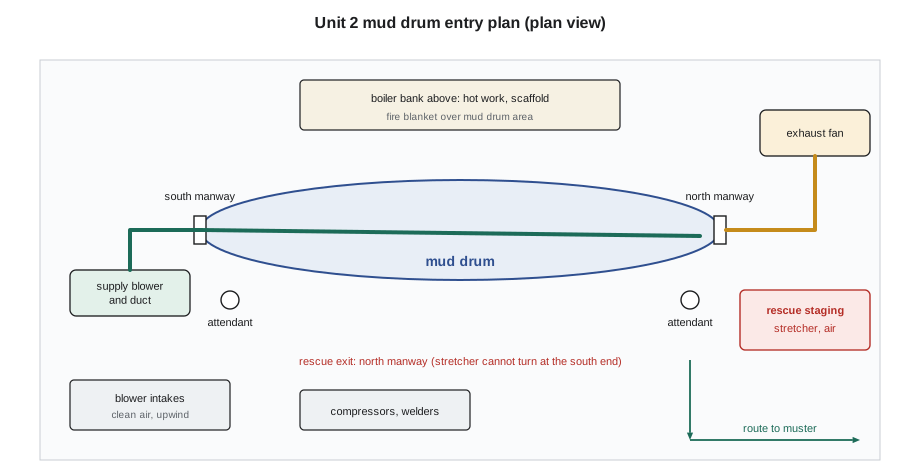
For ventilation, Kiera sizes the blowers using the method from lesson 6. The mud drum is small, so a modest blower with a duct to the far end and an exhaust fan at the near manway clears it quickly; the steam drum, bigger and full of internals, needs a larger blower and a longer duct threaded past the separators. Both blower intakes are placed on the boiler house floor upwind of the station's main doors and well away from the rental compressors and the welding machines, and each blower has a flow alarm that sounds at the manway if it stops.
Step 4: hot work and health controls
Peg and Dale agree that the tube ends inside the drums will be removed by cold methods, cutting them with a tube cutter and driving them out, so that there is no torch work inside either drum. That one decision, made at the planning stage, removes oxygen enrichment, fuel gas leaks and most of the fume from the drum entries. The hot work is confined to the boiler bank, where the tubes are cut with plasma and the new ones are welded at the bank joints. The hot work permit for the bank requires the ash between the tubes to be vacuumed out first, fire blankets over the mud drum manway below the work, a fire watch at the bank door and continuous monitoring.
For dust, the ash is removed with a HEPA vacuum before cutting, and the plasma cutting uses a local exhaust nozzle; the workers in the bank wear half-face respirators with P100 filters, and each has been fit tested this year. For noise, the crew wears earplugs and earmuffs together inside the drums during expanding. For heat, the work-rest schedule is set from WBGT readings taken at the start of each shift, with cooling air ducted to the bank.
Step 5: heights
The boiler bank scaffold is built by the scaffold contractor to a heavy duty rating, with a deck at each of the three levels where the tubes are cut. Two levels have guardrails removed on the tube side for access to the tubes, so their tags will be yellow, with tie-off to a designated anchor rail. Kiera calculates the fall clearance at the highest level using the method from lesson 8 and finds that a standard lanyard would not stop a fall before the deck below, so the plan specifies self-retracting devices on the anchor rail at that level. Tools are tethered, and nobody works in the bank directly above the mud drum manway while the drum is occupied.
Step 6: rescue and communication
The rescue plan is the step Rosa checks most closely. The mud drum has no internals, so a casualty can be reached in a straight line, but the drum is only 3 ft 3 in across and lies on its side; a retrieval line pulled from the manway would drag an unconscious worker along the floor and jam them in the opening. The plan therefore calls for an entry rescue by the station's industrial rescue team, with a flexible stretcher sized for the manway staged at the north end. Because the mud drum is the lowest point in the boiler and the atmosphere could change suddenly if an isolation leaked, two rescue team members are staged at the boiler house floor for the duration of each mud drum entry, and each entrant carries an escape respirator. The steam drum, with its internals, follows the same plan.
Communication is by radio, with a check-in every ten minutes, and the expanding stops for each check-in. The attendants' boards are at the manways. The plan lists the station's emergency number, the radio channel, the muster point and the location of the nearest windsock, and notes that the attendant at each drum has no other duty.
Step 7: putting the plan together
The last step is to put the numbers in one place, so that the permit issuer, the rescue team and the crew can all see them. Kiera writes the summary as a short script that checks each part of the plan against the site's rules and prints the result. It reuses the calculations from the earlier lessons: the ventilation time from lesson 6, the gas limits from lesson 6, the fall clearance from lesson 8, the rescue timing from lesson 7 and the heat schedule from lesson 9.
# Unit 2 mud drum entry plan summary (Gulf Coast; values from the plan, illustrative)
import math
plan_ok = True
def check(name, ok, detail):
    global plan_ok
    plan_ok = plan_ok and ok
    print(f"[{'OK' if ok else 'FIX'}] {name:<26} {detail}")

# 1 ventilation: mud drum
V, Q, k = 330, 500, 0.5                      # volume, blower flow, mixing factor
t_purge = V / (k * Q) * math.log(50 / 2)       # minutes to dilute 50 ppm to 2 ppm
changes = Q * 30 / V                           # air changes in a 30-minute pre-entry purge
check("ventilation", changes >= 10, f"{changes:.0f} air changes in 30 min; dilution time {t_purge:.1f} min")

# 2 atmosphere: worst reading from the pre-entry test
o2, lel, h2s, co = 20.7, 0, 0, 3
check("atmosphere", 19.5 <= o2 <= 23.5 and lel < 10 and h2s < 10 and co < 25,
      f"O2 {o2} %, LEL {lel} %, H2S {h2s} ppm, CO {co} ppm")

# 3 hot work: none inside the drum by plan
check("hot work in drum", True, "cold cutting of tube ends; torches excluded from drum")

# 4 fall clearance at bank level 3 with a self-retracting device
srd_arrest, dring, margin, deck = 2.0, 5.0, 3.0, 8
need = srd_arrest + dring + margin - 3.0
check("fall clearance level 3", need <= deck, f"needs {need:.1f} ft below the deck edge, has {deck} ft")

# 5 rescue: time for a rescuer to reach a casualty with the team staged at the boiler
reach = 0.5 + 0.5 + 1.0 + 1.0                   # alarm, move, final checks (escape sets worn), enter and reach
check("rescue response", reach <= 4.0, f"rescuer reaches casualty in about {reach:.1f} min")

# 6 heat: WBGT at the bank door at shift start
wbgt = 79.7
c = (wbgt - 32) / 1.8
check("heat", c <= 30.0, f"WBGT {wbgt} F -> {'normal' if c <= 28 else 'work-rest schedule'}")

print("ENTRY PLAN READY FOR PERMIT REVIEW" if plan_ok else "PLAN NOT READY: resolve the items marked FIX")[OK] ventilation 45 air changes in 30 min; dilution time 4.2 min [OK] atmosphere O2 20.7 %, LEL 0 %, H2S 0 ppm, CO 3 ppm [OK] hot work in drum cold cutting of tube ends; torches excluded from drum [OK] fall clearance level 3 needs 7.0 ft below the deck edge, has 8 ft [OK] rescue response rescuer reaches casualty in about 3.0 min [OK] heat WBGT 79.7 F -> normal ENTRY PLAN READY FOR PERMIT REVIEW
In the script the mud drum blower moves 500 ft³ per minute, enough for many more than the ten air changes Ironbridge's procedure requires in a thirty-minute purge. The fall clearance check assumes a self-retracting device that arrests within a short distance and an anchor rail above the D-ring. The rescue time assumes the team is staged at the boiler and the entrants wear escape sets. If any of those assumptions changes on the day, the script and the plan are rerun before the permit is renewed.
The review
Before the first entry, Rosa, Imran, Dale, Tyrone and the rescue team leader meet at the mud drum with the plan. They walk the isolations, check the blower and duct, look at the stretcher staged at the manway and talk through the rescue. The rescue team leader asks one question nobody had asked: whether the stretcher, with a casualty in it, can make the turn from the manway onto the narrow platform outside. They try it with a volunteer. It does not fit at the south manway, where a pipe support blocks the turn, so the plan is changed to make the north manway the rescue exit and the south manway the ventilation inlet. The change takes ten minutes. Finding it during a real rescue would have cost much more.
Then the permits are issued: the confined space entry permits for both drums, the hot work permit for the boiler bank, the scaffold tags checked, the crew's JSA written at the drum and signed. Kiera signs on as the attendant for the first mud drum entry and logs Dale in at 07:10. The job takes six shifts, and on the last one Peg inspects the expanded tubes from inside the drum, accepts them and signs them off for the hydrostatic test. Kiera's entry plan, with the stretcher change marked in red, goes into the outage file as a model for the next one.
Her first year has a long way still to run: rigging and lifting, layout and fitting, welding and cutting are all ahead of her. But she now knows what Dale meant on the first morning about the trade's safety side. Every task in it, from expanding a tube to erecting a tank, will be done inside a system of permits, assessments, isolations, tests, protection and rescue, and the people who build that system well are the ones who come home.
Worked problem
A change on day four
On the fourth day, the station tells Rosa that the furnace crew needs to remove one of the shared isolation points, a drain valve below the mud drum, to repair it. The mud drum entry is in progress. What should happen?
Show solution
- The permit issuer cannot remove a shared isolation while Ironbridge's locks are on the group box; the furnace crew's request goes to Tyrone, who involves Rosa.
- The mud drum entry is suspended and the entrants come out; the attendant logs them out and the permit is suspended.
- The station installs an alternative isolation upstream of the drain valve, a blind, and verifies it; the isolation list is updated and Dale walks it.
- Only then is the drain valve released to the furnace crew. The mud drum is re-ventilated and retested, the permit is revalidated and the JSA updated before re-entry.
Answer: A change to an isolation in the middle of an entry is exactly the kind of change that kills. It is handled by stopping, re-isolating, verifying and re-starting the entry from the beginning.
Common mistakes
MistakeTreating the entry plan as paperwork for the permit office.
InsteadThe plan is how the crew finds the problems before the entry, like the stretcher that would not turn.
MistakePlanning hot work inside a drum when cold methods would do.
InsteadDecide at the planning stage to keep heat out of the space where possible.
MistakeAssuming a retrieval line will work in a horizontal drum.
InsteadPlan the rescue for the actual shape of the space and its openings.
MistakeLetting another crew remove a shared isolation during an entry.
InsteadStop the entry, re-isolate, verify and restart.
MistakeLeaving the plan unchanged when conditions change.
InsteadRerun the checks and update the permits whenever an assumption changes.
Summary and key terms
- An entry plan starts with an inventory of the spaces and their hazards, including health hazards and the work's own hazards.
- Isolations are walked against the equipment and extended for the actual work; shared isolations need the locks of every group.
- The atmospheric plan sets test locations and continuous monitoring; ventilation is sized and placed to sweep the space from a clean source.
- Hot work is kept out of the drums by choosing cold methods; dust, noise and heat controls follow the hierarchy.
- Fall clearance, tags and tool tethering are planned for each scaffold level.
- Rescue is planned for the real geometry, staged close by and tested by walking it through; communication and attendants have no other duties.
- A walk-through review with everyone involved finds problems a desk review misses.
- Entry plan
- The package of assessments, isolations, tests, ventilation, protection and rescue arrangements prepared before a confined space entry.
- Boiler bank
- The nest of tubes connecting the steam drum and mud drum in a two-drum boiler.
- Roller expander
- A tool that expands a tube end into a drum or tube sheet hole to make a tight joint.
- Shared isolation
- An isolation point that protects more than one job or crew.
- Hydrostatic test
- A pressure test of a boiler or vessel with water after repairs.
- Walk-through review
- A review of a plan at the work site with the people who will carry it out.
Practice problems
Work each problem on paper first, then reveal the answer to check.
A mud drum of 330 ft³ is ventilated at 500 cfm. How many air changes does a 30-minute purge give?
Show answer
500 × 30 / 330 = about 45.
Why did the plan exclude torch work from inside the drums?
Show answer
To remove oxygen enrichment, fuel gas leaks and most fume from the confined space.
What did the walk-through find, and why would a desk review have missed it?
Show answer
The stretcher could not make the turn at the south manway; only trying it at the site showed the obstruction.
What must happen before a shared isolation is removed during an entry?
Show answer
Stop the entry, provide and verify an alternative isolation, update the list, re-ventilate, retest and revalidate the permit.
Lesson quiz · 5 questions
Score 60% or more to complete this lesson.
Create a free account to save your progress, take quizzes and earn a certificate.