
BLR-110 · Lesson 8 of 12 · 19 min
Working at heights and fall protection
The steel structure of Unit 2 rises about 130 ft from the boiler house floor to the roof, and on an outage it is full of open edges. Grating sections are lifted to pass tube panels through the floors, casing panels are removed to reach the waterwalls, and temporary platforms hang off the drum. Kiera's second week takes her from the drum platform to the penthouse at the top of the boiler, where the superheater headers come out through the roof, and back down to the burner decks. Every one of those places is a fall hazard, and falls kill more construction and maintenance workers than any other single cause. This lesson covers the rules for working at height and the equipment that keeps a fall from ending on the floor below.
When fall protection is required
OSHA's general industry rules, which cover most maintenance work in an operating plant, require fall protection where a worker is exposed to a fall of 4 ft or more to a lower level, under 29 CFR 1910.28. Construction work, such as erecting a new boiler or a tank, falls under 29 CFR 1926 Subpart M, which sets the trigger at 6 ft, and scaffolds under Subpart L at 10 ft. Work over dangerous equipment or into a tank needs protection at any height. Ironbridge and the plant owners use the strictest of these on their sites and write a fall protection plan for every job with fall hazards. The plan identifies the fall hazards, the fall protection system to be used, the anchors, the clearance, the procedures for assembling, maintaining and inspecting the equipment, and the procedures for rescuing a worker who has fallen and is suspended in a harness.
The choice of protection follows the same hierarchy as every other hazard. The best answer is to eliminate the work at height: assemble a tube panel on the ground and lift it into place, or use tools with extensions so that a valve can be reached from the floor. Next come passive systems that protect without any action by the worker, such as guardrails, covers over openings and safety nets. After that come personal systems that the worker must use correctly: travel restraint, which keeps the worker from reaching the edge; fall restriction, which limits a fall on a sloped surface; and fall arrest, which stops a fall after it has begun. Administrative controls, such as controlled access zones and safety monitors, are the weakest and are used only where nothing else is practical.
| Method | How it protects | Example on Unit 2 |
|---|---|---|
| Elimination | Removes the need to work at height | Pre-assembling tube panels at grade |
| Guardrails and covers | Physically prevent a fall | Rails around the drum platform, bolted covers on grating openings |
| Travel restraint | Lanyard too short to reach the edge | Working near the roof edge of the penthouse |
| Fall arrest | Stops a fall after it starts | Lanyard to a beam clamp while setting a header |
| Administrative | Control zones, safety monitors, procedures | Barricade tape and a spotter at a temporary opening |
The personal fall arrest system
A personal fall arrest system has three parts, often remembered as A, B, C: an anchor, body support and connectors. The body support is a full-body harness, which spreads the arrest force across the thighs, pelvis, chest and shoulders and keeps the worker upright after a fall. A belt is never used for fall arrest. The connector links the harness's back D-ring to the anchor: a lanyard with an energy absorber, which tears open to slow the fall, or a self-retracting device that pays out line as the worker moves and locks when the line moves suddenly, like a car seat belt. The anchor is the point the system is attached to, and it has to be strong enough to hold the arrest forces.
Every component must be marked as meeting a recognized standard. In the United States, harnesses, lanyards and connectors are made to the ANSI/ASSP Z359 family of standards: Z359.11 for harnesses, Z359.13 for energy-absorbing lanyards and Z359.14 for self-retracting devices. OSHA's rules limit the maximum arresting force on a worker in a harness to 1,800 lb, limit free fall to 6 ft, and require the system to stop the worker before they contact any lower level, with a maximum deceleration distance of 3.5 ft.
Kiera inspects her harness and lanyard before every use: the webbing for cuts, burns, frays and chemical damage; the stitching; the D-rings and buckles for cracks, distortion and corrosion; the energy absorber pack for signs that it has started to deploy; the labels for legibility and the date. Any harness or lanyard that has arrested a fall is removed from service. Welding is hard on harnesses, because spatter burns the webbing, so boilermakers often use harnesses and lanyards with heat-resistant webbing or wire-rope lanyards rated for hot work.
Anchors
An anchor for fall arrest must be able to hold the forces of a fall with a margin. OSHA requires an anchor used for fall arrest to support at least 5,000 lb per worker attached, or to be designed, installed and used under the supervision of a qualified person as part of a complete system with a safety factor of at least two. On a boiler structure, approved anchors include beam clamps on structural steel, slings choked around beams with protection over sharp edges, engineered anchor points installed for the outage, and horizontal lifelines designed by an engineer.
Some things that look solid are not anchors. Boiler tubes, handrails, small pipes, cable trays, conduit, ladders and scaffold components not designed for the purpose can fail under an arrest load, or be damaged by it. Waterwall tubes in particular are thin and pressure-retaining; a fall arrest load on a tube can kink or crack it and turn a fall into a tube leak later. Anchors should be overhead where possible, because an anchor at the feet doubles the free fall and greatly increases the arrest force and clearance needed.
Clearance and swing
A fall arrest system only works if the worker stops before hitting anything below. The clearance needed below the anchor is the sum of the lanyard length, the deceleration distance of the energy absorber, the stretch of the harness and the shift of the D-ring, the height of the D-ring above the worker's feet, and a safety margin.
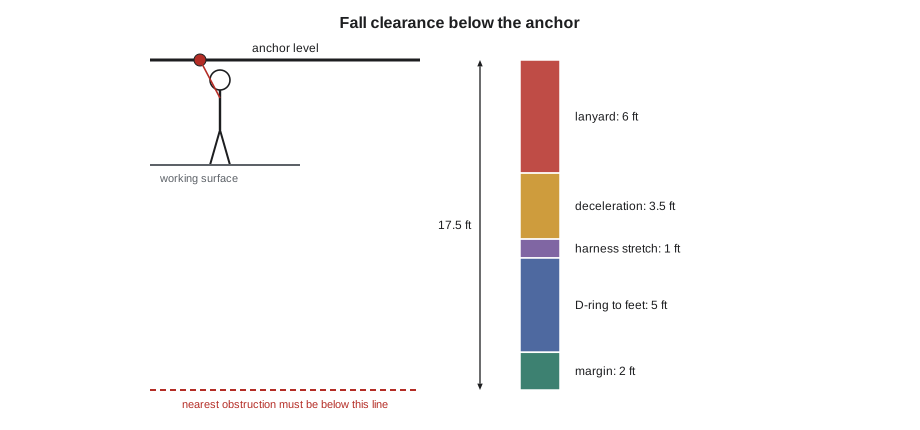
# Fall clearance and anchor check (US units)
lanyard = 6.0       # lanyard length
decel = 3.5         # maximum energy absorber deceleration distance
harness = 1.0       # harness stretch and D-ring shift
dring = 5.0         # height of D-ring above the feet
margin = 2.0        # safety margin
below_anchor = lanyard + decel + harness + dring + margin
print(f"clearance needed below the anchor: {below_anchor:.1f} ft")
deck = 11         # drop from the drum platform to the scaffold deck below
for where, anchor_h in (("anchor at D-ring height", dring), ("beam clamp overhead", 10.0)):
    free_fall = lanyard - (anchor_h - dring)
    below_surface = below_anchor - anchor_h
    ok = "OK" if below_surface <= deck else "NOT ENOUGH"
    print(f"{where:<24} free fall {free_fall:4.1f} ft, needs {below_surface:4.1f} ft below the platform, deck is {deck} ft down: {ok}")
force = 1800        # maximum arrest force with this absorber
print(f"anchor must hold at least 5,000 lb per worker, or 2 x {force} = {2 * force} lb if engineered")clearance needed below the anchor: 17.5 ft anchor at D-ring height free fall 6.0 ft, needs 12.5 ft below the platform, deck is 11 ft down: NOT ENOUGH beam clamp overhead free fall 1.0 ft, needs 7.5 ft below the platform, deck is 11 ft down: OK anchor must hold at least 5,000 lb per worker, or 2 x 1800 = 3600 lb if engineered
With the anchor at D-ring height, a 6 ft lanyard needs 17.5 ft of clear space below the anchor, or 12.5 ft below the platform, and the scaffold deck is only 11 ft down. Kiera would hit it. Dale's crew has two choices: move the anchor overhead, which reduces the free fall, or switch to a self-retracting device, which locks within a short distance. They rig a beam clamp on the steel above the drum, which puts the anchor well above Kiera's D-ring, cuts the free fall to a fraction of the lanyard length and brings the clearance inside the space available. Fall protection trainers often quote 18 to 20 ft as the clearance a 6 ft lanyard needs, which matches the calculation.
Swing falls are the other geometry problem. A worker tied off to an anchor that is not directly overhead swings like a pendulum after a fall and can strike the structure, or be dropped further as the line slides along an edge. Anchors are placed as nearly overhead as possible, and the horizontal distance to the anchor is limited so that any swing is small.
After a fall
A worker who has been stopped by a harness is not safe yet. Hanging motionless in a harness restricts blood flow in the legs, and within minutes a suspended worker can faint and suffer serious harm, a condition called suspension trauma or orthostatic intolerance. Fall protection guidance puts the onset at as little as a few minutes of motionless suspension. Every fall protection plan includes a rescue plan that can reach a suspended worker quickly: a rescue from the platform above using a pre-rigged haul system, a man-lift or aerial platform that can reach the worker, or a self-rescue device built into the lanyard. Workers wear harnesses with suspension relief straps, which let a conscious worker stand in a loop and take the pressure off their legs while waiting.
Worked problem
Planning tie-off for the penthouse roof
Kiera and Dale are to remove insulation from a superheater header on the penthouse roof, 5 ft from an unguarded edge with a 115 ft drop. There is a roof beam overhead. How should they be protected?
Show solution
- Eliminate if possible: can the insulation be removed from inside the penthouse? No, the header passes through the roof.
- A guardrail is not practical in the time available, so they use travel restraint: lanyards attached to the beam, adjusted so that they cannot reach within 3 ft of the edge.
- Because the beam is overhead and the restraint keeps them from the edge, a fall cannot happen; the system does not need to arrest one.
- The fall protection plan lists the anchor, the lanyard lengths, the inspection and the rescue arrangements for any worker who goes near the edge.
Answer: Travel restraint is preferred over fall arrest when it is practical: it prevents the fall instead of stopping it.
Openings in floors and grating
During an outage, holes appear in floors that are normally solid. Grating panels are lifted to lower tube panels through the boiler, floor plates are removed to reach valves, and hatches are left open for hoses and leads. Every opening that a worker could fall through, or that a tool could drop through onto someone below, is either guarded with a temporary guardrail or covered with a cover strong enough to carry the loads that will cross it, secured so that it cannot slide or be kicked aside, and marked so that nobody lifts it without knowing what is under it. A sheet of plywood laid loosely over a hole is not a cover. The crew that opens a hole is responsible for guarding it until it is closed again, and an opening that has to be left open briefly while a load passes through is attended by someone whose only job is to keep people away from it.
Common mistakes
MistakeAnchoring to a boiler tube or handrail.
InsteadUse a designed anchor: structural steel, a beam clamp, an engineered point.
MistakeTying off at the feet.
InsteadAnchor overhead to limit free fall, arrest force and clearance.
MistakeAssuming a 6-foot or 1.8-meter lanyard needs 6 feet or 1.8 meters of clearance.
InsteadAdd deceleration, stretch, D-ring height and a margin; it needs several times the lanyard length.
MistakeUsing a harness that has arrested a fall.
InsteadRemove it from service and have it inspected or destroyed.
MistakeHaving no plan to rescue a suspended worker.
InsteadSuspension can injure within minutes; plan and stage the rescue before work starts.
Summary and key terms
- OSHA requires fall protection at 4 ft in general industry, 6 ft in construction and 10 ft on scaffolds; owners usually apply the strictest rule.
- Eliminate the work at height first, then use guardrails and covers, then personal systems.
- A personal fall arrest system needs an anchor, a full-body harness and connectors, all marked to recognized standards and inspected before use.
- Anchors must hold 5,000 lb per worker, or twice the arrest force if designed by a qualified person; the arrest force is limited to 1,800 lb.
- Clearance below the anchor includes the lanyard, deceleration, stretch, D-ring height and a margin.
- Plan the rescue of a suspended worker; suspension trauma can begin within minutes.
- Travel restraint
- A system that keeps a worker from reaching a fall hazard.
- Fall arrest
- A system that stops a worker after a fall has begun.
- Energy absorber
- A component that limits the arrest force by tearing or deforming as it extends.
- Self-retracting device
- A device that pays out and retracts line as the worker moves and locks during a fall.
- Free fall
- The distance a worker falls before the system starts to slow them.
- Clearance
- The distance needed below the anchor or working surface for a fall to be arrested without striking anything.
- Suspension trauma
- Fainting and circulatory harm from hanging motionless in a harness.
Practice problems
Work each problem on paper first, then reveal the answer to check.
A worker uses a 4 ft lanyard with an anchor at D-ring height. Using 3.5 ft deceleration, 1 ft stretch, 5 ft D-ring height and 2 ft margin, what clearance is needed?
Show answer
4 + 3.5 + 1 + 5 + 2 = 15.5 ft.
Why is a waterwall tube not an anchor?
Show answer
It is thin, pressure-retaining and not designed for the load; it may fail or be damaged.
What is the difference between travel restraint and fall arrest?
Show answer
Restraint keeps the worker from reaching the edge; arrest stops a fall that has started.
What load must a fall arrest anchor hold for one worker under OSHA if not designed by a qualified person?
Show answer
5,000 lb.
Lesson quiz · 5 questions
Score 60% or more to complete this lesson.
Create a free account to save your progress, take quizzes and earn a certificate.