
BLR-110 · Lesson 5 of 12 · 20 min
Confined spaces in vessels and boilers
With the covers off, the Unit 2 steam drum is an open steel tube about 5 ft across and 40 ft long, with a manway at each end barely wider than Kiera's shoulders. Inside it is dark, damp and full of the separators, baffles and feed pipes that the inspectors want to see. Dale shines his light through the manway and tells her that the drum is, in a sense, the most dangerous place on the outage, not because of anything in it today, but because it is the kind of space where people die quietly. A worker who collapses inside a drum is out of sight, cannot be reached quickly, and is often followed in by a friend who collapses too. This lesson covers what makes a space confined, which spaces in boilers and vessels are confined, and how entry is organized.
What makes a space confined
OSHA's general industry standard, 29 CFR 1910.146, defines a confined space as one that is large enough for a worker to bodily enter and perform work, has limited or restricted means of entry or exit, and is not designed for continuous occupancy. A permit-required confined space is a confined space that also has one or more of these characteristics: it contains or may contain a hazardous atmosphere; it contains a material that could engulf an entrant; its internal shape could trap or asphyxiate an entrant, such as inwardly converging walls or a floor that slopes to a smaller section; or it contains any other recognized serious hazard. Permit spaces need the full system of entry permits, atmospheric testing, attendants and rescue. A confined space with none of those hazards is a non-permit space. Construction work in confined spaces is covered by a parallel standard, 29 CFR 1926 Subpart AA, and power plants also have enclosed space rules in 29 CFR 1910.269.
Entry is defined carefully too. Under OSHA's rule, entry occurs as soon as any part of the entrant's body breaks the plane of the opening. Putting a hand and a flashlight into a manway is entry. The employer must evaluate the workplace for permit spaces, inform workers of them, usually with danger signs, and, if workers will enter, have a written permit space program. Owners and contractors on the same site must coordinate their programs, and the owner must tell the contractor what it knows about each space's hazards.
Why confined spaces kill
The deaths in confined spaces follow a few patterns. The most common is the atmosphere. Air is about 20.9 % oxygen by volume. A space can lose oxygen because it has been purged with nitrogen, because rusting steel in a closed vessel has consumed it, because a fire or engine has burned it, or because another gas has displaced it. A worker breathing air with too little oxygen may feel nothing before losing consciousness. Nitrogen, used to purge process equipment of hydrocarbons, is especially treacherous because it has no color, no smell and no taste, and a breath or two of pure nitrogen can cause collapse. Toxic gases, such as hydrogen sulfide from refinery deposits or carbon monoxide from combustion, and flammable gases and vapors are the other atmospheric killers.
The second pattern is engulfment: being buried or drowned by a material that flows. Ash in the hoppers under a boiler, coke in a coker drum, sand in an oil sands surge bin, grain, water and sludge can all bridge over a void and then collapse onto a worker below or swallow a worker standing on them. The third is the shape of the space: hoppers and cones with sloping walls, small diameter sections and internal baffles that trap a worker who slips or becomes wedged. The rest are the hazards found elsewhere, made worse because the worker is enclosed: heat, moving equipment such as agitators or fans, steam or chemicals entering through a line that was not isolated, falls inside tall vessels, falling objects, electrical equipment, noise that drowns out communication.
Rescuers make the numbers worse. A worker sees a colleague collapse in a vessel and goes in to help, without knowing why the first person collapsed, and is overcome by the same atmosphere. Studies of confined space deaths have repeatedly found that a large share of the dead were would-be rescuers. Lesson 7 covers rescue planning. The rule Kiera learns on her first day is simpler: never enter a space to rescue someone unless you are part of the planned rescue and equipped for it.
Confined spaces in boilers and vessels
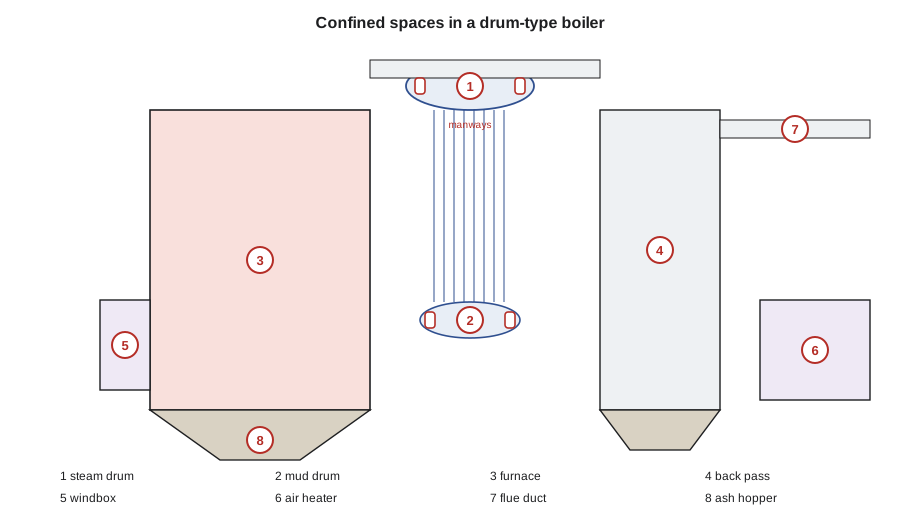
On Unit 2, Imran's confined space inventory lists more than twenty spaces. The steam drum and the mud drum are the obvious ones. The furnace is a confined space despite its size, because it has limited entry through access doors, can hold combustion gases if the fuel isolation fails, and is the scene of work at height on its internal scaffold. The back pass, with its economizer and superheater banks, has narrow lanes and hot surfaces. The windbox, which supplies combustion air to the burners, the air heater, the flue gas ducts and the ash hoppers below the furnace and economizer are all on the list, as are the deaerator and feedwater tanks in the turbine hall.
| Space | Main hazards | Typical controls |
|---|---|---|
| Steam and mud drums | Low oxygen if not ventilated, steam or water from an unisolated line, heat, tight access | Full isolation, forced ventilation, atmospheric testing, attendant, rescue retrieval plan |
| Furnace | Combustion gases if fuel not isolated, falls, falling slag and ash, heat | Fuel isolation and purge, scaffold, overhead protection, ventilation, testing |
| Back pass and economizer | Narrow lanes, hot tubes, ash dust | Cool-down, dust control, respirators, communication plan |
| Ash hoppers | Engulfment by bridged ash, hot ash, sloped walls | Empty and inspect from outside first, no entry onto bridged material, lifelines |
| Coker drums at Northgate | Hydrogen sulfide, steam, hot coke, falls | Isolation of steam and process lines, gas testing, scaffold, rescue team on standby |
| Storage tanks | Residual vapors and sludge, low oxygen, heat in summer | Cleaning, ventilation, continuous monitoring |
The entry system
Entry into a confined space is organized around a permit and three roles. The entrant is the worker who goes in. The attendant, often called the hole watch, stays outside at the entry point, keeps track of who is inside, stays in contact with them and summons help if anything goes wrong. The attendant never enters. The entry supervisor authorizes the entry by signing the permit after checking the isolations, ventilation and atmospheric tests, and is responsible for terminating the entry if conditions change. Under 1910.146 the permit must identify the space, the purpose of entry, the date and authorized duration, the entrants, the attendants and the entry supervisor, the hazards, the measures used to isolate and control them, the acceptable entry conditions, the test results with the tester's initials, the rescue services and how to summon them, the communication method, the equipment provided and any other permits, such as a hot work permit. The permit is posted at the entry point and kept for at least a year after the entry for review.
Before the steam drum entry, the permit issuer checks every point on the isolation list, confirms the drum has been ventilated for the required time, has the atmosphere tested at both manways and at several depths inside, sets the retest interval, names the attendant, confirms the rescue plan and equipment are in place, and signs. Kiera, as an entrant, signs the entry log at the manway each time she goes in and signs out each time she leaves. The attendant's board at the manway shows, at any moment, exactly who is inside.
The code below takes a short description of each space on the outage and works out which category it falls into and what the entry requires. It is a simplified version of the screening Imran's team does when they build the inventory; the real decision for each space is made by a competent person with the site's code of practice in hand.
# Screening spaces on the outage (simplified; the competent person decides)
spaces = [
    # name, restricted access, hazardous atmosphere possible, engulfment/entrapment, other serious hazard
    ("steam drum",        True,  True,  False, True),
    ("ash hopper",        True,  True,  True,  True),
    ("burner front deck", False, False, False, False),
    ("cable tunnel",      True,  False, False, False),
    ("windbox",           True,  True,  False, False),
]
for name, restricted, atm, engulf, other in spaces:
    if not restricted:
        cls, need = "not a confined space", "normal hazard assessment"
    elif atm or engulf or other:
        cls, need = "permit-required space", "entry permit, testing, ventilation, attendant, rescue plan"
    else:
        cls, need = "non-permit space", "hazard assessment, emergency plan, re-evaluate if work adds hazards"
print(f"{name:<18} {cls:<28} {need}")steam drum permit-required space entry permit, testing, ventilation, attendant, rescue plan ash hopper permit-required space entry permit, testing, ventilation, attendant, rescue plan burner front deck not a confined space normal hazard assessment cable tunnel non-permit space hazard assessment, emergency plan, re-evaluate if work adds hazards windbox permit-required space entry permit, testing, ventilation, attendant, rescue plan
The cable tunnel shows why classification is not permanent. It is a non-permit space today because it has none of the permit space hazards. If someone starts welding in it, or a sump pump fails and it begins to fill with water, a hazard has appeared and it becomes a permit space. OSHA allows a permit space to be reclassified as non-permit only if all its hazards are eliminated, and the reclassification must be documented. Any change in the work or conditions sends the space back for reassessment.
Worked problem
Is the windbox a confined space?
The Unit 2 windbox is a large duct along the front of the furnace, about 6 ft high, that feeds air to the burners. Its access doors are 24 in square, and the burner fuel lines enter it. The crew needs to replace a damaged air register inside. Is it a confined space, and what controls apply?
Show solution
- Access is restricted by the small doors and the space is not designed for occupancy, so it is at least a restricted space.
- The fuel lines entering it mean a fuel leak could create a flammable or toxic atmosphere, and the forced draft fan could blow air or flue gas through it if started.
- Those are hazards beyond the access, so it is a permit-required confined space.
- Controls: isolate and lock out the fuel supply to all burners with positive isolation, lock out the fans and dampers, ventilate, test the atmosphere, issue an entry permit, post an attendant at the door and put a rescue plan in place before entry.
Answer: Any space that fuel, steam, gas or air can enter is a permit space until those sources are isolated and the atmosphere is proven.
Other spaces on Ironbridge's jobs
The same principles apply on every site, but each kind of space has its own traps. A storage tank that has held crude oil holds sludge on its floor that releases vapor and hydrogen sulfide when it is disturbed, and a tank in summer sun can become dangerously hot inside. A coker drum at Northgate is a vertical vessel more than 80 ft tall with only top and bottom openings, filled with coke that can hold pockets of steam and gas. An HRSG has narrow access lanes between tube modules and drums high in its structure. Ducts and precipitators can hold dust that can explode or engulf. A pulp mill digester or a black liquor tank can hold caustic residues and gases such as hydrogen sulfide and methyl mercaptan. Each one goes on the site's inventory with its own entry procedure.
Openings that are left unattended
Once a manway is open, the space is open to anyone who walks by. When no entry is in progress, the opening is closed, covered or barricaded, and a sign at the opening states that it is a confined space and that entry is by permit only. An open manway with no attendant and no barrier is an invitation to the curious, and to the worker who drops a glove inside and reaches in to get it. At the end of each shift, Dale checks that both steam drum manways are barricaded and tagged before the crew leaves.
Common mistakes
MistakePutting your head into a manway to have a look.
InsteadThat is entry; it needs the permit, testing and an attendant.
MistakeAssuming a large space like a furnace is not confined.
InsteadSize does not matter; limited access and potential hazards do.
MistakeGoing in to help a collapsed worker.
InsteadRaise the alarm and follow the rescue plan; untrained rescuers die too.
MistakeTreating a classification as permanent.
InsteadReassess the space whenever the work or conditions change.
MistakeStanding on bridged ash or coke.
InsteadMaterial can collapse under a worker; never stand on or below a bridge.
Summary and key terms
- A confined space is large enough to enter, has limited access and is not designed for occupancy; a permit space also has a hazardous atmosphere, engulfment, entrapment or another serious hazard.
- Oxygen deficiency, toxic and flammable atmospheres, engulfment and entrapment cause most confined space deaths; would-be rescuers are a large share of them.
- Boilers contain many confined spaces: drums, furnace, back pass, windbox, air heater, ducts and ash hoppers.
- Entry is controlled by a permit signed by the entry supervisor, with an attendant outside and rescue arranged.
- Classification changes when the work or the conditions change.
- Confined space
- A space large enough to enter, with limited entry or exit, not designed for continuous occupancy.
- Permit-required confined space
- A confined space with a hazardous atmosphere, engulfment, entrapment or another serious hazard.
- Attendant
- The worker who stays outside a permit space, tracks and communicates with the entrants and summons rescue.
- Entry supervisor
- The person who authorizes entry by signing the permit and can terminate it.
- Entry
- The moment any part of a worker's body breaks the plane of the opening.
- Engulfment
- Being surrounded and buried or drowned by a material such as ash, coke, sand or liquid.
Practice problems
Work each problem on paper first, then reveal the answer to check.
Why is nitrogen so dangerous in confined spaces?
Show answer
It displaces oxygen and cannot be seen, smelled or tasted; a few breaths of pure nitrogen can cause collapse.
Name four confined spaces in a drum boiler.
Show answer
Steam drum, mud drum, furnace, windbox, back pass, air heater, ducts or ash hoppers.
What does the tending worker or attendant do if an entrant collapses?
Show answer
Summons the rescue team and starts the planned rescue from outside, without entering.
A cable tunnel is reclassified because welding will be done in it. Why?
Show answer
Welding adds fume and fire hazards, so the space is no longer hazardous only because of its access.
Lesson quiz · 5 questions
Score 60% or more to complete this lesson.
Create a free account to save your progress, take quizzes and earn a certificate.