
BLR-110 · Lesson 4 of 12 · 19 min
Hazard assessment and the job safety analysis
The steam drum crew's first task on Unit 2 is to remove the two drum manway covers so that the inspectors can get inside. Before anyone touches a wrench, Dale gathers the crew at the drum platform, pulls out a pad of forms and starts writing. The form is a job safety analysis, the JSA, and every crew at Riverbend fills one in at the work site for every task, every shift. Kiera has seen it in the orientation as a box on a flow chart. Here she sees what it is for: five people looking at the same piece of equipment and saying out loud what could hurt them and what they will do about it.
Why hazards are assessed
OSHA has no single general standard for hazard assessment, but many of its rules depend on one. The personal protective equipment standard, 29 CFR 1910.132(d), requires the employer to assess the workplace for hazards that call for PPE and to certify in writing that the assessment was done. The confined space, lockout and process safety standards all require hazards to be identified before work starts, and the general duty clause covers recognized hazards that no standard addresses. Plant owners and contractors along the Gulf Coast meet these duties with a written job safety analysis, a JSA, sometimes called a job hazard analysis, prepared for each task and reviewed with the crew at the work site before the shift's work begins.
There are usually two levels. A formal hazard assessment is prepared in advance for each type of work, by the contractor's supervisors and safety staff, often with the owner. It looks at the job as planned: the equipment, the methods, the tools, the expected hazards and the controls. The task-level assessment is done by the crew on the day, at the work site, looking at the job as it actually is. The two are different because the plan and the reality are different. The formal assessment for removing manway covers does not know that this morning there is a scaffold crew working directly below the drum platform, or that the drum is still warm because the cooldown ran late.
The steps of a task-level assessment
Whatever the form looks like, the assessment follows the same steps. Dale's crew works through them in about ten minutes:
- Describe the task and break it into steps. Removing a manway cover: confirm the permit and isolations; check the drum is cool and vented; loosen the cover nuts; support the cover; remove the yoke and bolts; swing or lower the cover clear; secure it.
- For each step, identify what could go wrong. Residual pressure or hot water behind the cover; a burn from hot metal; the cover dropping onto hands or feet; a strain from handling a 150 lb cover; a wrench slipping; a fall from the platform; objects falling onto the scaffold crew below.
- Decide on controls for each hazard, using the most effective control that is practical. Verify the drum vent is open and the drain shows nothing; measure the surface temperature; use a chain hoist from the beam over the manway rather than lifting by hand; keep hands out of the pinch point; barricade the area below; tie off tools.
- Assign who does what, and record it. Each crew member reads the assessment and signs it.
- Review it when anything changes. If the scaffold crew below leaves, or the drum turns out to be wetter than expected, the crew stops and updates the form.
Rating the risk
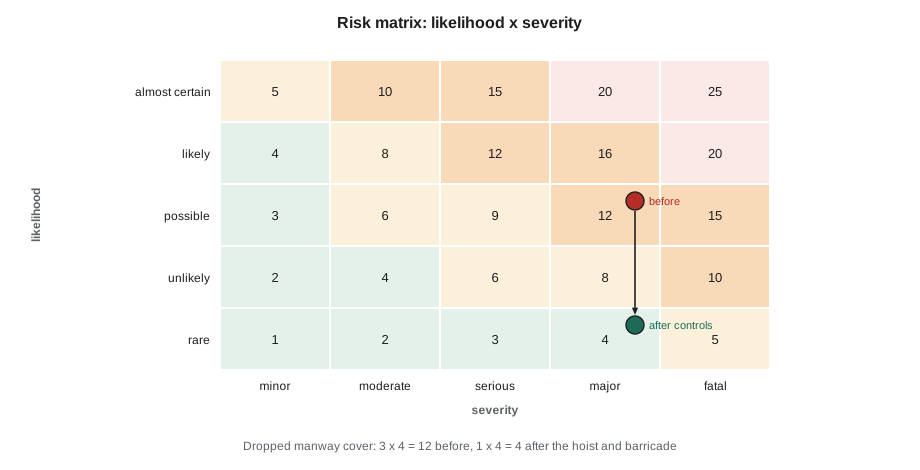
Many forms ask the crew to rate each hazard. A common method multiplies a likelihood score by a severity score, each from 1 to 5, to give a risk score from 1 to 25. The score is worked out twice, once with no controls in place, the inherent risk, and once with the planned controls, the residual risk. If the residual risk is still high, the job cannot go ahead as planned. Ironbridge's form uses the bands below, which are typical of the industry but not universal.
| Score | Band | What it means |
|---|---|---|
| 1 to 4 | Low | Proceed with normal controls |
| 5 to 9 | Medium | Proceed with the listed controls; the foreman checks them |
| 10 to 16 | High | Additional controls needed; the general foreman reviews before work starts |
| 20 to 25 | Extreme | Do not proceed; the job must be replanned |
The score is not the point. The value of the rating is that it makes the crew argue about how likely and how bad each hazard is, and whether the controls really change those answers. A barricade below the platform reduces the likelihood that someone below is struck. A chain hoist reduces the likelihood of a strain or a dropped cover. Neither changes the severity of a cover landing on a foot, which is why the crew also keeps feet clear of the swing path. The code below scores the hazards from Dale's form before and after the controls.
# Risk scores for the manway cover task, before and after controls (likelihood x severity, 1 to 5 each)
hazards = [
    ("residual pressure or hot water", 2, 5, 1, 5),
    ("burn from hot metal",            3, 3, 1, 3),
    ("cover drops on hands or feet",   3, 4, 1, 4),
    ("back strain handling cover",     4, 3, 2, 2),
    ("tool falls on crew below",       3, 4, 1, 4),
]
def band(score):
    return "low" if score <= 4 else "medium" if score <= 9 else "high" if score <= 16 else "extreme"
for name, l0, s0, l1, s1 in hazards:
    r0, r1 = l0 * s0, l1 * s1
    print(f"{name:<34} before {r0:2d} ({band(r0):<7}) after {r1:2d} ({band(r1)})")
worst = max(l1 * s1 for _, _, _, l1, s1 in hazards)
print("residual risk acceptable" if worst <= 9 else "replan the task")residual pressure or hot water before 10 (high ) after 5 (medium) burn from hot metal before 9 (medium ) after 3 (low) cover drops on hands or feet before 12 (high ) after 4 (low) back strain handling cover before 12 (high ) after 4 (low) tool falls on crew below before 12 (high ) after 4 (low) residual risk acceptable
The hierarchy of controls
Controls are not all equal. The hierarchy of controls ranks them from most to least effective. Elimination removes the hazard: if the cover can be opened by the hydraulic davit the plant installed last year, nobody handles it. Substitution replaces the hazard with a lesser one: a battery torque tool instead of a sledge and a slugging wrench. Engineering controls separate people from the hazard: a guardrail, a barricade, a ventilation fan, a hoist. Administrative controls change how people work: procedures, permits, training, warning signs, rotating workers out of the heat. Personal protective equipment, at the bottom, protects the individual when everything above it has not been enough.
Crews drift toward the bottom of the hierarchy because it is the easiest to write down. Wear gloves is quicker to write than rig a hoist. Imran reviews a sample of each crew's forms every day and sends back those that list only PPE for a serious hazard. In later lessons, the same hierarchy appears again for confined spaces, falls, hot work and health hazards, and in every case the strongest controls are the ones that change the work rather than the worker.
Stopping the job
Every worker on an Ironbridge crew has the authority to stop work if they believe it has become unsafe, and to have the concern looked at before work resumes. It is the practical form of the right to refuse. Rosa tells new apprentices that nobody on her crews has ever been disciplined for stopping a job, and that the only wrong answer is to keep working while worried. When work is stopped, the crew makes the area safe, tells the foreman, reviews the hazard assessment, and resumes only when the concern has been resolved and the form updated.
A formal refusal is a stronger step. Under OSHA's rules a worker may refuse work that presents an imminent danger of death or serious injury when there is not enough time to have it corrected through normal channels, and is protected from retaliation for doing so. Most Gulf Coast owners and contractors go further in their own programs, giving every worker stop-work authority for any task they believe is unsafe, and the union agreement backs that up.
Worked problem
Updating the assessment
Halfway through removing the second cover, the scaffold crew below the drum platform leaves for lunch, and an insulation crew arrives to work in the same space. At the same time, Kiera notices a trickle of water from the bottom of the cover joint. What should the crew do?
Show solution
- Stop work and make the cover safe: leave it supported on the hoist with the remaining nuts in place.
- Check the barricade below; the insulation crew must be kept out of the drop zone or the work must wait until they have left.
- Investigate the water: confirm with Tyrone that the drum is drained and vented, check the drain and vent, and look for a leaking feedwater or downcomer isolation.
- Update the JSA with the two new conditions and their controls, and have the crew re-sign it before resuming.
Answer: Water at the joint turned out to be a small amount left in the drum below the manway; the drain was partly plugged with sludge. The crew resumed after the drain was cleared and the insulation crew was moved.
A completed assessment
The table below is a shortened copy of the assessment Dale's crew wrote for the manway covers. On the real form each step has its own row, and the bottom of the page holds the signatures of everyone on the crew, the foreman's review and the time.
| Step | Hazard | Control | Who |
|---|---|---|---|
| Confirm permit and isolations | Unisolated line into drum | Walk the isolation list against the drum; open vent and drain checked | Dale |
| Check drum is cool and vented | Burns, hot water | Surface temperature measured; gloves; vent confirmed open | Kiera |
| Loosen cover nuts | Wrench slip, pinch points, residual pressure | Crack nuts on the far side first and watch for leakage; hands clear | Dale |
| Support the cover | Dropped cover | Chain hoist from beam over the manway, rated and inspected | Crew |
| Remove yoke and lower cover | Crushed fingers or feet, back strain | Hoist takes the weight; feet clear of swing path | Crew |
| Secure the cover | Trip hazard, falling tools | Cover lashed to platform; tools tethered; barricade below | Kiera |
Common weaknesses
Imran's daily review of the forms finds the same few problems over and over. The first is vagueness: a hazard written as be careful or a control written as use caution, which tells nobody what to do. The second is the missing step: the form covers the main work but not the setup, the cleanup or the trip up the stairs with the tools. The third is the copied form, word for word the same as yesterday's, which shows that nobody looked at the job again. The fourth is the form that nobody discussed: one person filled it in and the others signed without reading it. Each of these turns the assessment back into paperwork. A good assessment is short, specific and argued over, and every name at the bottom belongs to someone who could explain it.
The task-level assessment also connects to the larger systems. If it finds a hazard the permit did not address, such as an isolation missing from the list, the work stops until the permit is corrected. If it finds a hazard beyond the crew's ability to control, such as a scaffold that has been altered, the crew calls the people who can fix it. The form is where the crew notices; the fixes come from the whole site.
Common mistakes
MistakeFilling in the form in the trailer before going to the job.
InsteadThe task-level assessment is done at the work site, looking at the actual conditions.
MistakeCopying yesterday's form.
InsteadConditions change every shift; write the assessment fresh.
MistakeListing only PPE as a control.
InsteadLook for elimination, substitution and engineering controls first.
MistakeNot re-signing after a change.
InsteadWhen conditions change, stop, update the form and have everyone sign again.
MistakeTreating the risk score as the answer.
InsteadThe score is a prompt for discussion; the controls are what matter.
Summary and key terms
- OSHA rules, including the PPE hazard assessment certification, require hazards to be identified before work; the JSA is how plants and contractors do it.
- A formal assessment covers the planned job; the task-level assessment covers the job as it is on the day.
- The steps are to break the task down, identify hazards, choose controls, assign and sign, and review when anything changes.
- Risk matrices rate likelihood and severity before and after controls.
- The hierarchy of controls runs from elimination to PPE; the strongest controls change the work, not the worker.
- Every worker can stop a job, and has a protected right to refuse dangerous work.
- JSA
- Job safety analysis: a written breakdown of a task into steps, hazards and controls, reviewed by the crew before the work starts.
- Inherent risk
- The risk of a hazard before any controls are applied.
- Residual risk
- The risk that remains after the planned controls are in place.
- Hierarchy of controls
- Elimination, substitution, engineering controls, administrative controls and PPE, in order of effectiveness.
- Stop-work authority
- Every worker's authority to stop a task they believe is unsafe until the concern is resolved.
- Right to refuse
- The legal right to refuse work that presents a serious danger, with protection from reprisal.
Practice problems
Work each problem on paper first, then reveal the answer to check.
A hazard scores 4 for likelihood and 4 for severity. What band is it in on Ironbridge's form?
Show answer
16, high: additional controls and a general foreman review are needed.
Give an engineering control and an administrative control for a dropped manway cover.
Show answer
Engineering: a chain hoist or davit supporting the cover. Administrative: a procedure that keeps hands and feet out of the swing path.
Name two changes that require the task-level assessment to be updated.
Show answer
A new crew working nearby, a change in the equipment's condition, a new tool or method, a change in weather or a change of shift.
Why is the task-level assessment written by the crew?
Show answer
They are the ones who see the actual conditions and will do the work.
Lesson quiz · 5 questions
Score 60% or more to complete this lesson.
Create a free account to save your progress, take quizzes and earn a certificate.