
BLR-110 · Lesson 3 of 12 · 20 min
Industrial site safety and permits
At six o'clock on Kiera's first morning at Riverbend, Dale takes her to the permit office before he takes her to the boiler. A line of foremen is already waiting at the window, where the station's permit issuer, an experienced operator named Tyrone Beaulieu, is checking each permit against the isolation board behind him. Nothing Ironbridge's crews do inside the station fence happens without a permit, and nothing happens on a piece of equipment until the station has isolated it, proved the isolation and handed it over in writing. Dale tells Kiera that the permit window is where the plant and the contractor shake hands, and that most of the worst accidents in industry started with a handshake that was not done properly.
The legal framework
In the United States, workplace safety is governed by the Occupational Safety and Health Act of 1970 and the standards OSHA issues under it. General industry rules, which cover most maintenance work in operating plants, are in 29 CFR 1910; construction rules are in 29 CFR 1926. Louisiana has no state plan, so federal OSHA enforces the rules at plants along the river. Where no specific standard applies, the general duty clause requires every employer to keep the workplace free of recognized hazards likely to cause death or serious harm. Workers have the right to information and training about hazards, to raise concerns without retaliation, and to refuse work that presents an imminent danger when there is no time to fix it by other means. On a multi-employer site, OSHA can hold the employer that created, controlled, exposed workers to or should have corrected a hazard responsible for it.
Under any of these frameworks, a worker has duties too: to work safely, to use the protective equipment and procedures provided, to report hazards and incidents, and not to put others at risk. Imran's orientation puts it simply. Ironbridge must give Kiera a safe system of work, the training to use it and the equipment it needs. Kiera must use all three, and she must speak up when something is wrong.
The permit-to-work system
A permit to work is a written authorization to do a defined job, on defined equipment, for a defined time, under defined precautions. It is the plant's way of controlling which work happens where and of making sure the people doing it know what the plant has done to make the equipment safe. Most industrial sites issue several types of permit. A general or cold work permit covers work that does not create a source of ignition. A hot work permit covers cutting, welding, grinding and other work that does. A confined space entry permit covers entry into a confined space, and is usually issued alongside a work permit for the work done inside. Other permits cover excavation, critical lifts, work on electrical equipment and the breaking of process lines.
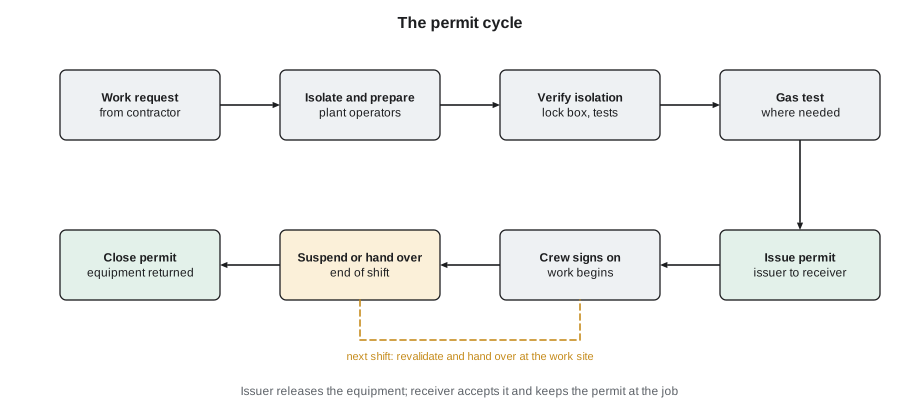
Each permit has two key people. The permit issuer, an authorized person employed by the owner, prepares the equipment and authorizes the work. The permit receiver, usually the contractor's foreman, accepts the permit on behalf of the crew, confirms the precautions are in place and understood, and keeps the permit at the work site. Every worker on the crew signs on to the permit before starting and signs off when leaving. Kiera's name goes on the steam drum permit at 06:30, and if she leaves the work area for another task, her name comes off it.
| Permit section | What it records |
|---|---|
| Equipment and location | The tag number, description and exact work area |
| Scope | The work to be done, so that nothing else is done under the permit |
| Isolations | The isolation list or certificate number, and the locks applied |
| Hazards and precautions | Atmosphere, temperature, residues, adjacent work, required PPE |
| Gas tests | Readings, times, the tester's name and the retest interval |
| Validity | The start and end of the permit, usually one shift |
| Signatures | Issuer, receiver, each worker on, and the handback at the end |
Permits expire. At Riverbend a work permit is valid for one twelve-hour shift and must be revalidated by the issuer at the start of the next. A confined space entry permit is suspended if the space is left unattended, if an alarm sounds or if conditions change. When the night shift takes over a job, the outgoing receiver hands it over to the incoming one face to face, at the work site, with the permit in hand. The handover is where many incidents begin, because the people who knew about a problem go home and the people who did not know take over.
Isolation and lockout
Before any boilermaker opens a manway on Unit 2, the station has to make sure nothing can enter the drum: no steam, no water, no chemicals, no electrical energy to the drum level instruments or the sootblowers, and no movement of fans or dampers in the furnace. Isolation is the process of separating equipment from every source of energy and material, and holding it separated. The station's operators close and lock valves, open and lock breakers, and, for process lines, install blinds, solid plates bolted between flanges, or remove a spool piece so there is a visible gap. A double block and bleed, two closed valves with an open drain between them, is used where a blind is not practical.
Every person who works under the isolation puts a personal lock on it, usually through a group lock box. The station's operators apply their locks to the isolation points and put the keys in the box; each worker then applies a personal lock to the box. No one can remove the isolations until every worker's lock is off the box. OSHA's control of hazardous energy standard, 29 CFR 1910.147, sets out the lockout and tagout requirements for general industry, including group lockout, shift change procedures and periodic inspection of the procedures.
Isolation is only as good as its verification. After the isolations are applied, the station tries to start the equipment, checks that drains show no flow, and measures for pressure, voltage or temperature as appropriate. Tyrone's isolation list for the steam drum has thirty-four points, from the main steam stop valves and the feedwater isolation to the chemical injection lines and the drum level transmitters, and each is ticked as applied and verified. Dale checks the list against the drum before he signs as receiver, looking for anything that enters the drum but is not on the list.
Worked problem
A gap in the isolation list
Before signing the steam drum permit, Dale walks the drum and notices a small line entering the end of the drum near the manway. It is not on Tyrone's isolation list. What should he do?
Show solution
- He does not sign the permit or open the manway.
- He traces the line, which turns out to be a continuous blowdown sample line that runs to the station's laboratory.
- He tells Tyrone, who checks the drawings, adds the sample line isolation valve and its drain to the list, closes and locks the valve, opens the drain and verifies that no water or steam is coming through.
- With the updated list verified, Dale signs as receiver and the crew signs on.
Answer: The receiver's walk-down is part of the isolation. Anything that enters the space and is not on the list stops the job until it is.
Working alongside other crews
On a large outage several crews work in the same area at once: boilermakers on the waterwalls, insulators on the casing, electricians on the burner management system, scaffolders building the next level. Each crew is on its own permit, but their hazards overlap. A grinder on the scaffold sends sparks onto insulators working below. A crane lift passes over another crew's work area. Plants manage this through daily coordination meetings, a permit board that shows all active permits in an area, and rules such as no work directly beneath other work unless the lower level is protected. Simultaneous operations, sometimes called SIMOPS, are reviewed by the issuer before permits in the same area are issued.
The site's emergency arrangements also overlap. Every site has its own alarms: a general evacuation, a toxic gas release, sometimes a separate alarm for a fire in one unit. Kiera learns the station's alarm tones in orientation and where her muster point is, and she checks the wind direction on the nearest windsock each morning, because a gas release is escaped by moving crosswind and upwind, not just away from the source.
Noise on site
Some hazards affect the whole site rather than one job. Noise is the most common. Grinders, gouging, air arc, impact wrenches, fans and steam venting can push sound levels above 90 dBA across large parts of a plant during an outage, and long exposure causes permanent hearing loss. Noise exposure is measured as a dose: the fraction of the allowed exposure a worker has received. The allowed time halves for each increase in level by the exchange rate.
Here T is the allowed time in hours at sound level L, under OSHA's noise standard for general industry, 29 CFR 1910.95, the criterion level is 90 dBA and the exchange rate q is 5 dB; a dose of 50 %, equivalent to 85 dBA for eight hours, is the action level at which a hearing conservation program is required; C is the time actually spent at each level and D is the dose in percent. A dose above 100 % means the worker has exceeded the limit, and hearing protection must bring the level at the ear below it. The code below works out a day's dose for Kiera from the levels Imran measured on the outage.
# Daily noise dose for one shift (OSHA: 90 dBA, 5 dB exchange)
import math
Lc, q = 90, 5           # criterion level dBA and exchange rate dB
tasks = [("toolbox meeting and permit", 85, 1.0),
         ("grinding tube ends", 98, 2.5),
         ("fitting and tacking", 88, 4.0),
         ("near gouging crew", 102, 1.0),
         ("lunch and breaks", 70, 1.5)]
dose = 0.0
for name, level, hours in tasks:
    allowed = 8 / 2 ** ((level - Lc) / q)
    dose += 100 * hours / allowed
    print(f"{name:<28}{level:4d} dBA {hours:4.1f} h  allowed {allowed:6.2f} h")
print(f"daily dose: {dose:.0f} %")
twa = Lc + q * math.log2(dose / 100)
print(f"equivalent 8-hour level: {twa:.1f} dBA")toolbox meeting and permit 85 dBA 1.0 h allowed 16.00 h grinding tube ends 98 dBA 2.5 h allowed 2.64 h fitting and tacking 88 dBA 4.0 h allowed 10.56 h near gouging crew 102 dBA 1.0 h allowed 1.52 h lunch and breaks 70 dBA 1.5 h allowed 128.00 h daily dose: 206 % equivalent 8-hour level: 95.2 dBA
The result is far above 100 %, almost all of it from the grinding and the time near the gouging crew. Earplugs or earmuffs with a practical attenuation, used for the whole of those tasks, bring the dose under the limit, and Ironbridge's hearing conservation program adds annual hearing tests so that any loss is caught early. The difference between rules matters: Canadian provinces and many plant owners use the stricter 85 dBA and 3 dB rule, under which the same day gives a much higher dose, and some Gulf Coast owners apply it on their sites.
Reporting incidents and near misses
Every site expects incidents and near misses to be reported at once: injuries, however small, damage to equipment, spills, releases, fires, and events that could have hurt someone but did not. A near miss, such as a dropped wrench that lands a meter from someone, is reported because the next one might not miss. Reports go to the foreman first and then to the contractor's safety advisor and the owner. Serious incidents must also be reported to the regulator, and the scene is left undisturbed except to make it safe or help the injured until the investigators release it. The purpose of the investigation that follows is to find out why the incident happened and to fix the system, not to find someone to blame. Ironbridge shares the lessons from each investigation at the next morning's toolbox meetings across all its jobs.
Common mistakes
MistakeStarting work while the permit is still being signed.
InsteadWork starts only after the receiver has accepted the permit and the crew has signed on.
MistakeSigning a permit without walking the equipment.
InsteadThe receiver checks the isolations and precautions at the work site before signing.
MistakeLeaving a permit open in the office.
InsteadThe permit stays at the work site, visible to the crew.
MistakeHanding over a job by phone or a note.
InsteadHandovers are face to face, at the work site, with the permit.
MistakeRelying on someone else's lock.
InsteadEvery worker under an isolation applies a personal lock to the group box.
Summary and key terms
- OSHA's 1910 and 1926 standards and the general duty clause set the rules; federal OSHA enforces them in Louisiana.
- A permit to work authorizes defined work on defined equipment for a defined time under defined precautions.
- The issuer releases the equipment; the receiver accepts it, keeps the permit at the job and signs on the crew.
- Isolation uses locked valves and breakers, blinds and double block and bleed, verified before work and held by personal locks on a group box.
- Simultaneous operations, shift handovers and site alarms need as much attention as the job itself.
- Noise dose uses 90 dBA and a 5 dB exchange rate under OSHA, with an 85 dBA action level.
- Permit to work
- A written authorization for defined work on defined equipment for a defined time under defined precautions.
- Permit issuer
- The owner's authorized person who prepares equipment and authorizes work on it.
- Permit receiver
- The person who accepts a permit for a crew and is responsible for its precautions at the work site.
- Isolation
- Separating equipment from every source of energy and material, and holding it separated.
- Blind
- A solid plate bolted between flanges to positively isolate a line.
- Double block and bleed
- Two closed valves with an open drain between them.
- Group lock box
- A box holding the keys to isolation locks, to which each worker applies a personal lock.
- SIMOPS
- Simultaneous operations: separate jobs whose hazards overlap in place or time.
Practice problems
Work each problem on paper first, then reveal the answer to check.
Who keeps the permit during the work?
Show answer
The receiver, at the work site.
Name three ways to isolate a process line.
Show answer
A locked closed valve, a blind between flanges, removing a spool piece, or double block and bleed.
A worker spends 2 hours at 100 dBA. Under OSHA's 90 dBA, 5 dB rule, what dose is that?
Show answer
Allowed time = 8 / 2^2 = 2 h, so the dose is 100 %.
Why are handovers done face to face at the job?
Show answer
So the incoming crew learns what the outgoing crew knows about the equipment and its hazards.
Lesson quiz · 5 questions
Score 60% or more to complete this lesson.
Create a free account to save your progress, take quizzes and earn a certificate.