
BLR-110 · Lesson 11 of 12 · 20 min
Hazardous materials: asbestos, refractory, silica and chemicals
Not every hazard on an outage acts quickly. A fall or a gas release injures in seconds; the dust and fibers a boilermaker breathes while chipping refractory or cutting through old insulation may cause disease thirty years later. Kiera's grandfather was a pipefitter, and he died of mesothelioma, a cancer caused by asbestos he breathed in plants in the 1960s. When Imran's orientation reaches the health hazards, she is the one asking the questions. This lesson covers the materials boilermakers are most likely to meet: asbestos, refractory and its fibers, crystalline silica, ash and dusts, welding fume, and the chemicals of power plants, refineries and mills, with the controls that keep exposures down.
Knowing what you are working with
Workers have the right to know the hazards of the materials they work with. In the United States that right is delivered through OSHA's Hazard Communication Standard, 29 CFR 1910.1200, which since 2012 has followed the international Globally Harmonized System. Suppliers label hazardous products with pictograms, signal words and hazard statements, and provide a safety data sheet, an SDS, with sixteen standard sections covering hazards, composition, first aid, firefighting, handling, exposure controls and protective equipment. The employer must make the SDSs available, label products decanted on site and train workers to understand both. OSHA updated the standard in 2024 to align with a newer revision of the international system, with compliance dates phased in over the following years.
Some of the most important hazards have no label at all, because they are not products bought from a supplier. The asbestos in a 1970s boiler, the silica dust released when old refractory is broken out, the lead in old paint and the fume from a weld are all created or uncovered by the work. For these, the owner's records, sampling and the contractor's hazard assessment are what tell the crew what they face.
Asbestos
Asbestos is a group of natural mineral fibers that were used for decades in boiler insulation, pipe lagging, gaskets, rope packing, refractory, cement board and fire-resistant cloth because they resist heat and do not burn. When asbestos-containing material is disturbed, it releases fibers fine enough to reach deep into the lungs, where they stay. They cause asbestosis, a scarring of the lungs; lung cancer; and mesothelioma, a cancer of the lining of the chest or abdomen that is almost always caused by asbestos. These diseases appear decades after the exposure, and there is no known safe level.
Most plants built before about 1990 still contain some asbestos. Owners are required to know where it is, and a plant like Riverbend has an asbestos inventory showing which insulation, gaskets and refractories contain it. Removing asbestos is specialized work done by trained abatement contractors under strict controls, and is governed by OSHA's asbestos standards, 29 CFR 1926.1101 for construction work and 1910.1001 for general industry, with a permissible exposure limit of 0.1 fibers per cubic centimeter averaged over eight hours and an excursion limit of 1.0 f/cc over 30 minutes. The construction standard classes asbestos work from Class I, removing thermal system insulation, to Class IV, maintenance and custodial work, with controls and training matched to each class. Boilermakers do not remove asbestos unless they are trained and the work is planned as abatement.
The rule for Kiera is simple: if she finds material she suspects might contain asbestos, insulation with no label, an old gasket, a crumbling gray rope, she stops, does not disturb it further, keeps others away and reports it to her foreman. The material is sampled and tested before work resumes. This happens on almost every outage at older plants, usually when a crew opens a casing panel or a flange that the inventory missed.
Refractory and its fibers
Refractory is the heat-resistant lining of furnaces, burner throats, ducts, cyclones and coker drum skirts. It comes as firebrick, castables poured like concrete, plastic refractories rammed into place, and ceramic fiber blankets and boards. Boilermakers often break out old refractory to reach tubes and anchors, and install new refractory anchors before the refractory crew pours.
Refractory ceramic fibers, used in high-temperature insulation blankets, are a respiratory hazard in their own right and are classed as a possible human carcinogen. After long service at high temperature, some of the fiber changes to cristobalite, a form of crystalline silica, which makes the old blanket more hazardous to remove than the new blanket was to install. Castables and firebrick contain silica too, and chipping them out with a pneumatic hammer releases clouds of fine dust. On the Unit 2 burner throats, the refractory demolition is done wet, with local exhaust and respirators, and the debris is bagged rather than swept.
Crystalline silica and ash
Crystalline silica, mostly in the form of quartz, is in sand, concrete, many refractories, abrasive blasting media and the ash of many fuels. Breathing fine respirable silica dust causes silicosis, an incurable scarring of the lungs, and increases the risk of lung cancer, kidney disease and other illnesses. OSHA's silica standards, 29 CFR 1926.1153 for construction and 1910.1053 for general industry, set a permissible exposure limit of 50 µg/m³ averaged over eight hours, with an action level of 25 µg/m³ at which exposure monitoring and medical surveillance are required. The construction standard includes a table of specified controls for common tasks; following it is an alternative to measuring exposures.
Boiler ash adds metals to the mix. Ash from coal contains silica and trace metals; ash from oil firing contains vanadium and nickel compounds, which are toxic; and ash in the back pass of any boiler can be hot, caustic when wet and very fine. Riverbend burned coal for forty years before its conversion, and there is still old fly ash packed into corners of the economizer and the ash hoppers. Cleaning it out is done with vacuum trucks and wet methods, never by blowing it out with compressed air, which puts it into the air for everyone nearby.
Welding fume and metals
Welding and cutting produce fume, a cloud of fine metal oxide particles condensed from vaporized metal, and gases such as ozone, nitrogen oxides and carbon monoxide. Manganese in steel fume can cause nervous system damage with long exposure. Welding or cutting stainless steel and high-alloy tubes, common in superheaters, produces hexavalent chromium, a lung carcinogen with a very low exposure limit. Cutting or heating steel coated with old lead paint releases lead fume. Galvanized steel releases zinc oxide fume, which causes metal fume fever, a short flu-like illness. Fume is controlled by local exhaust ventilation at the arc, by positioning the head out of the plume, by general ventilation in enclosed spaces and by respirators where those are not enough. The welding courses later in the program cover fume control in detail.
Chemicals
Each kind of plant has its own chemicals. Power boilers are chemically cleaned from time to time with acid solutions that dissolve scale; the acid can release hydrogen, which is flammable, and the spent solution is corrosive. Boiler water treatment uses amines, phosphates and oxygen scavengers. Refineries and upgraders have hydrogen sulfide, benzene and other aromatic hydrocarbons, caustic, sulfuric acid and, in some units, hydrofluoric acid, which needs special protection and first aid. Pulp mills have caustic and sulfide-rich liquors, and chlorine dioxide in the bleach plant. Opening equipment that held any of these brings the risk of contact with residues, and the line-break permit that the owner issues before a flange is opened lists the chemical, the PPE and the first aid.
Benzene illustrates how low some limits are. It causes leukemia with long exposure, and the limits for it are measured in fractions of a part per million. OSHA's benzene standard sets a PEL of 1 ppm over eight hours and a short-term limit of 5 ppm, and many refineries work to lower internal limits. Before Kiera's crew opens an exchanger in benzene-bearing service at Northgate, the owner's industrial hygienist checks the atmosphere with a PID and, where needed, the crew wears supplied-air respirators for the opening.
Controlling exposures
The hierarchy of controls applies to health hazards exactly as to any other. Elimination and substitution come first: replacing asbestos gaskets with non-asbestos ones, using cold cutting rather than torch cutting on painted steel, choosing a low-silica refractory. Engineering controls come next: wet methods that keep dust out of the air, local exhaust ventilation and dust collectors, enclosures around demolition work, HEPA vacuums instead of brooms and compressed air. Administrative controls include limiting the time and number of workers in a dusty area, scheduling dusty work when fewer people are nearby, hygiene facilities and decontamination, and training. Respirators come last.
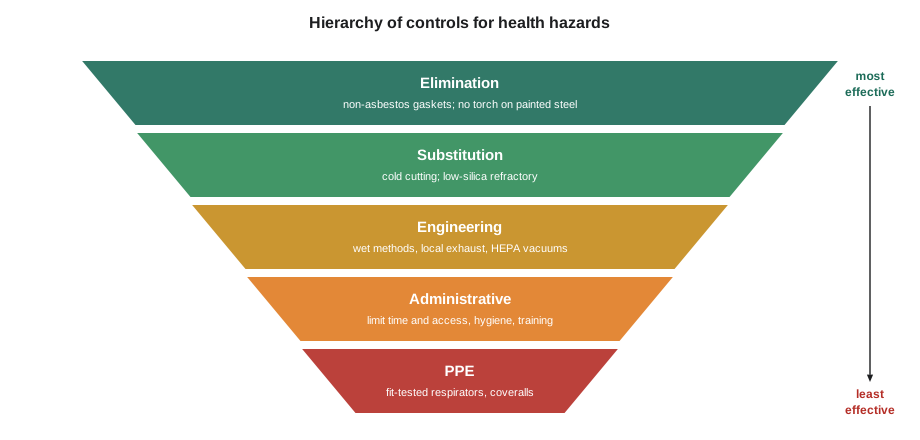
When respirators are needed, they must be the right type for the hazard and properly fitted. A filtering respirator with P100 or HEPA filters protects against dusts and fibers, but not against gases or low oxygen. A supplied-air respirator brings clean air from outside. Each worker who wears a tight-fitting respirator is fit tested for the model and size they use, at least once a year, and checks the seal each time they put it on. Facial hair under the seal defeats the fit. OSHA's respiratory protection standard, 29 CFR 1910.134, requires a written program, medical evaluation, annual fit testing and training for every worker required to wear a respirator.
Exposure is checked by sampling. An industrial hygienist puts a small pump and filter cassette on a worker's collar, in their breathing zone, for the shift, and the lab measures how much of the contaminant was collected. The result is a time-weighted average over the eight hours, compared with the exposure limit. The code below works out an eight-hour average from several shorter samples taken during a refractory demolition shift, and compares it with the limit. When a worker is exposed to several substances that affect the same organ, the fractions of each limit are added, and the sum must stay below one.
# Eight-hour time-weighted average for respirable silica from task samples (illustrative)
limit = 0.050        # OSHA PEL, respirable crystalline silica, mg/m3 (50 ug/m3)
samples = [  # task, hours, concentration in the breathing zone (mg/m3)
    ("refractory demolition, wet + exhaust", 2.0, 0.090),
    ("bagging debris",                        1.5, 0.030),
    ("anchor welding",                        3.0, 0.004),
    ("breaks, change room",                   1.5, 0.000),
]
total_h = sum(h for _, h, _ in samples)
twa = sum(h * c for _, h, c in samples) / 8.0
print(f"hours sampled: {total_h}")
print(f"8-hour TWA: {twa:.4f} mg/m3, {100 * twa / limit:.0f} % of the limit")
# a respirator with an assigned protection factor reduces what the worker breathes
for name, apf in (("half-face P100", 10), ("powered air-purifying, loose hood", 25)):
    print(f"inside a {name} (APF {apf}): {twa / apf:.4f} mg/m3, {100 * twa / apf / limit:.0f} % of the limit")
# mixed exposure: fractions of each limit that affect the lungs add together
fractions = {"silica": twa / limit, "refractory fiber": 0.30}
print(f"combined lung exposure index without respirator: {sum(fractions.values()):.2f} (must be below 1)")hours sampled: 8.0 8-hour TWA: 0.0296 mg/m3, 59 % of the limit inside a half-face P100 (APF 10): 0.0030 mg/m3, 6 % of the limit inside a powered air-purifying, loose hood (APF 25): 0.0012 mg/m3, 2 % of the limit combined lung exposure index without respirator: 0.89 (must be below 1)
The answer shows why the controls are layered. Even with wet methods and local exhaust, the shift's average is above the action level, which triggers exposure monitoring and medical surveillance, almost all of it from the two hours of demolition, and the respirator brings what the worker actually breathes far lower. The combined index for silica and fiber is a reminder that limits for separate substances are not separate allowances. And the samples guide the next improvement: the largest share of the dose comes from demolition, so that is where better exhaust or a longer-reach tool would do the most good.
Worked problem
Suspect material behind the casing
Removing a casing panel near the Unit 2 burners, Kiera finds a layer of off-white, fibrous insulation wrapped around a pipe that is not on the asbestos inventory. What should she do?
Show solution
- Stop work and do not disturb the material any further; do not try to pull it off or sample it herself.
- Keep others away from the area and tell Dale, who reports it to Rosa and the station.
- The station's hygienist takes a sample for analysis, and the area is barricaded until the result is known.
- If it contains asbestos, it is removed by an abatement contractor under the asbestos rules before Ironbridge's work continues there; if not, the crew resumes with the dust controls in the hazard assessment.
Answer: The result came back positive. The abatement took a day; the alternative would have exposed the whole crew and contaminated the burner deck.
Common mistakes
MistakeBlowing dust off with compressed air.
InsteadUse a HEPA vacuum or wet methods; compressed air puts dust into everyone's breathing zone.
MistakeDisturbing suspect insulation to see what it is.
InsteadStop, keep away and report it for sampling.
MistakeWearing a dust mask for gases or low oxygen.
InsteadParticulate filters do nothing for gases or oxygen deficiency.
MistakeWearing a tight-fitting respirator with a beard.
InsteadFacial hair breaks the seal; use a loose-fitting powered respirator or shave.
MistakeTreating limits for different substances as separate allowances.
InsteadAdd the fractions for substances that affect the same organ.
Summary and key terms
- HazCom labels and SDSs inform workers about supplied products; hazards created by the work need sampling and assessment.
- Asbestos causes asbestosis, lung cancer and mesothelioma decades later; suspect material is left alone and reported, and removal is specialist work.
- Refractory demolition releases silica and fibers; old ceramic fiber can contain cristobalite.
- OSHA's silica PEL is 50 µg/m³ with an action level of 25 µg/m³; ash, fume and process chemicals add their own hazards.
- Controls follow the hierarchy: eliminate and substitute, wet methods and exhaust, administrative limits, then fitted respirators.
- Exposure is measured as an eight-hour time-weighted average; mixed exposures to the same organ add together.
- HazCom
- OSHA's Hazard Communication Standard, the US hazard communication system.
- SDS
- Safety data sheet: the supplier's 16-section document on a product's hazards and safe use.
- Mesothelioma
- A cancer of the lining of the chest or abdomen, almost always caused by asbestos.
- Refractory
- Heat-resistant lining material such as firebrick, castable or ceramic fiber.
- Silicosis
- Incurable lung scarring caused by breathing crystalline silica dust.
- Time-weighted average
- The average concentration a worker is exposed to over a shift, usually eight hours.
- Fit test
- A test that confirms a tight-fitting respirator seals on the wearer's face.
Practice problems
Work each problem on paper first, then reveal the answer to check.
Why does old ceramic fiber insulation need more care than new?
Show answer
Long high-temperature service can convert some fiber to cristobalite, a crystalline silica.
A worker spends 4 hours at 0.04 mg/m³ and 4 hours at zero. What is the 8-hour TWA?
Show answer
(4 × 0.04) / 8 = 0.02 mg/m³.
Name two engineering controls for refractory demolition dust.
Show answer
Wet methods and local exhaust ventilation; also enclosures and HEPA vacuums.
What does a P100 filter protect against, and what does it not?
Show answer
It protects against dusts and fibers, but not gases, vapors or low oxygen.
Lesson quiz · 5 questions
Score 60% or more to complete this lesson.
Create a free account to save your progress, take quizzes and earn a certificate.