
BLR-110 · Lesson 10 of 12 · 20 min
Hot work in plants
Almost every repair a boilermaker makes involves heat. Cutting out a damaged tube, gouging a crack in a coker drum skirt, grinding a bevel, preheating a weld, welding the new tube in: all of it is hot work, and all of it can start a fire. On her first day at the Northgate Refinery turnaround, Kiera watches the hot work permit process for a cut on an exchanger nozzle. It takes forty minutes: a gas test at the nozzle, at the sewer drain below and at the flange of a line that runs past; fire blankets over the drain and the open flange; an extinguisher and a charged hose at the work site; a fire watch named on the permit. The cut itself takes six minutes. Dale tells her that the forty minutes are the job, and the six minutes are the easy part.
What hot work is
Hot work is any work that produces a flame, sparks or enough heat to ignite a flammable material. It includes oxyfuel cutting and heating, plasma cutting, arc welding, air carbon arc gouging, grinding, abrasive cutting, brazing and soldering, and in many plants the use of ordinary electrical tools, engines and vehicles in areas where flammable vapors can be present. A plant decides what counts as hot work in its own rules, and those rules apply on top of the regulations.
OSHA's welding and cutting rules in 29 CFR 1910.252 set the basic fire prevention requirements: move the work or the combustibles where possible, guard what cannot be moved, post a fire watch where needed, and keep the watch for at least half an hour after the work is finished. OSHA's process safety management standard requires a hot work permit for hot work on or near covered processes at refineries and chemical plants. Most owners also follow NFPA 51B, the fire prevention standard for welding, cutting and other hot work, which sets out the permit system, the responsibilities and the fire watch in more detail.
How fires start from hot work
A fire needs fuel, oxygen and a source of ignition. Hot work supplies the ignition, the air supplies the oxygen and the plant supplies the fuel: hydrocarbon vapor from a leaking flange or an open drain, oil-soaked insulation, coal dust or coke fines, wooden scaffold planks, fire-retardant tarps that are not, cardboard and rags left in a corner, oxygen-enriched air from a leaking hose. The fuel is often out of sight. Sparks and molten slag from cutting can travel 35 ft or more across a floor, fall much further through grating and openings, and lodge in cracks, cable trays and insulation where they smolder for an hour before flaring.
Some fuels come from the work itself. Process equipment that has been cleaned can still hold residues in crevices, behind liners and under scale, which vaporize when heated. Iron sulfide scale, formed in equipment that handled sour hydrocarbons, is pyrophoric: when it dries in air it heats up by itself and can glow and ignite deposits around it. Paint, coatings and galvanizing release fumes and can burn. A tank that held crude oil can release vapor from sludge on its floor when the shell is heated from outside.
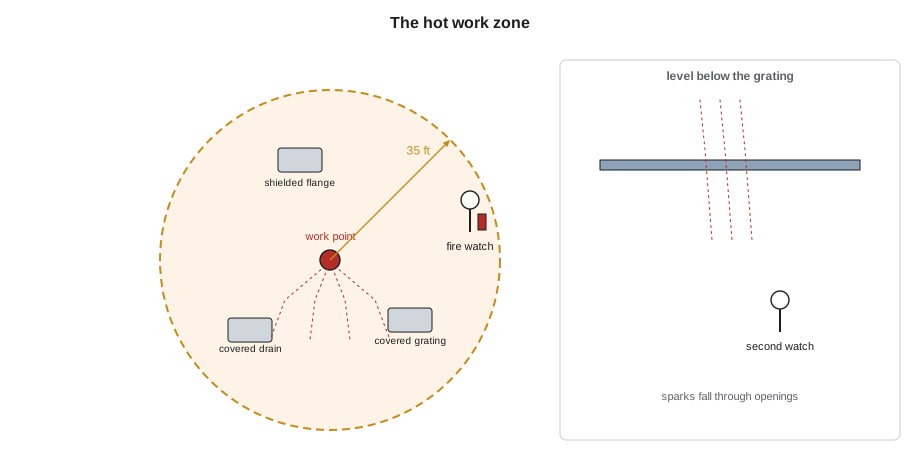
The hot work permit
A hot work permit is issued by the plant for a specific job, place and time, after the area has been prepared and checked. The permit lists the precautions, the gas test results, the fire watch and the equipment at the site, and it is signed by the issuer, the person doing the work and the fire watch. At Northgate the checklist runs to more than twenty items. The main ones are these:
- The equipment is isolated, drained, cleaned and gas-freed, and the work cannot be done another way, such as by cold cutting with a saw or a hydraulic splitter.
- The atmosphere at the work point, at drains and openings nearby, and in any space sparks could reach, reads zero on a combustible gas monitor, with continuous monitoring in process units.
- Combustibles within the hot work zone, 35 ft from the work point, are removed, or covered with fire-resistant blankets or shields where they cannot be moved.
- Floor openings, grating, drains, sewers and wall penetrations within the zone are covered or sealed so that sparks cannot fall through.
- Fire extinguishers, and in many plants a charged hose, are at the work site; the fire watch is trained and has no other duties.
- Gas cylinders are secured upright outside confined spaces; hoses and leads are in good condition and routed to avoid damage.
- Nearby crews and the control room know about the work, and work that releases vapor nearby, such as opening a flange, is not done at the same time.
The permit is valid for a stated period, usually a shift, and is suspended immediately if a gas alarm sounds, the conditions change or the fire watch has to leave. Hot work is never done under a cold work permit, and a hot work permit does not cover another job in another place, even if it is close by.
The fire watch
The fire watch is the person whose only job is to watch for fires while the hot work goes on and afterward. They stand where they can see where sparks and slag land, including the level below if sparks can fall through, keep an extinguisher ready, know how to raise the alarm and are authorized to stop the work. When the work ends, the fire watch stays on, because the most dangerous fires from hot work start as smolders that break out after the crew has gone. At Northgate, the watch continues for at least an hour after the work ends, followed by a final inspection of the area, and the permit cannot be closed until it is done.
The regulations set a minimum, and plants usually go further. OSHA's rule calls for a watch of at least half an hour after the work, and recent editions of NFPA 51B extend it to at least an hour, with further monitoring of the area afterward. Many Gulf Coast owners write the longer period into their hot work rules.
# Hot work permit check and fire watch timing (Northgate rules, illustrative)
from datetime import datetime, timedelta
checks = {
    "isolated, drained, cleaned and gas-freed": True,
    "combustible reading 0 % LEL at work point and drains": True,
    "combustibles in 35 ft zone removed or covered": True,
    "openings, grating and drains covered": False,
    "extinguisher and charged hose at site": True,
    "fire watch named, trained, no other duties": True,
    "cylinders outside, hoses and leads inspected": True,
}
missing = [k for k, v in checks.items() if not v]
print("PERMIT CAN BE ISSUED" if not missing else "NOT READY: " + "; ".join(missing))
work_end = datetime(2026, 4, 14, 15, 40)
watch_min = 60
print(f"hot work ends {work_end:%H:%M}; fire watch until {(work_end + timedelta(minutes=watch_min)):%H:%M}")
print(f"final area check, then permit closed no earlier than {(work_end + timedelta(minutes=watch_min + 15)):%H:%M}")NOT READY: openings, grating and drains covered hot work ends 15:40; fire watch until 16:40 final area check, then permit closed no earlier than 16:55
Hot work in confined spaces
Hot work inside a drum, vessel or furnace combines two sets of hazards. The fume from welding and cutting builds up in an enclosed space, the heat adds to the heat stress, and fire is harder to escape. The worst danger is the gas supply. A leaking oxygen hose or torch inside a vessel enriches the atmosphere; a leaking fuel gas hose fills it with flammable gas. Clothing that would smolder in normal air burns fiercely in enriched air, and workers have died when they struck an arc after a break in a vessel where a torch had leaked oxygen for half an hour.
The rules that follow are simple and strict. Gas cylinders stay outside the space. Torches and hoses are taken out of the space, or disconnected at the cylinders, whenever the work stops for a break, a shift change or more than a few minutes. Hoses are leak-tested before they go in. The space is ventilated, and welding fume is captured at the arc with local exhaust where possible. The atmosphere is monitored continuously during hot work, for oxygen as well as for flammables and toxic gases, and the work stops if oxygen rises above the site limit.
Worked problem
A nozzle cut at Northgate
Kiera's crew must cut off a cracked nozzle on a heat exchanger shell that has been in hydrocarbon service. The exchanger has been isolated with blinds, steamed and washed. A drain on the deck below is 10 ft away, and a pipe rack with a flanged line in service runs past 25 ft away. What does the permit need?
Show solution
- Confirm cleaning: the exchanger shell interior is gas tested through the nozzle and reads zero; the inspector checks for residues behind the nozzle reinforcement.
- Consider cold cutting: a portable band saw could cut the nozzle without sparks. The crew decides to use it for the first cut and a torch only for trimming.
- Cover the deck drain with a fire blanket and seal it; gas test at the drain and at the flanged line in the pipe rack, which is inside the hot work zone; shield the flange with a fire blanket.
- Station a fire watch with an extinguisher and a charged hose on the deck, and a second watch at the level below the grating.
- Continuous gas monitoring at the work point; the permit is suspended if any reading rises above zero.
Answer: Asking whether the job can be done without heat is part of the permit. The best fire is one that cannot start.
Hot work on equipment that held product
Welding or cutting on a tank, vessel or pipe that has held a flammable product is one of the most dangerous jobs in the trade. Vapor can remain in the space, residues can vaporize when the steel is heated, and a vessel that seems empty can explode when the torch breaks through. Before such work, the equipment is isolated, drained, cleaned and gas-freed, and then either kept gas-free by ventilation and continuous monitoring, or made inert with nitrogen or water so that no fire can start. Inerting is specialist work, because an inerted space cannot be entered without supplied-air breathing equipment. Welding onto equipment that is still in service, called hot tapping, is done only under a separate engineered procedure by qualified crews, and is not apprentice work.
Fire extinguishers
The extinguisher at a hot work site has to suit the fire it will meet. A multipurpose dry chemical extinguisher, rated for ordinary combustibles, flammable liquids and electrical equipment, is the usual choice. Before the work starts, the fire watch checks that the extinguisher is charged, the pin and seal are in place and the inspection tag is current. In use, the fire watch remembers the steps by the word PASS: pull the pin, aim at the base of the fire, squeeze the handle and sweep from side to side. An extinguisher holds only a few seconds of discharge, so the fire watch also knows where the nearest hose and alarm are and raises the alarm for any fire that is not out at once.
Fire blankets and shields are the other half of the equipment. They are made of fiberglass, silica or other fire-resistant cloth, rated for the heat and spatter they will receive, and they are laid so that sparks cannot bounce under their edges. Ordinary tarps, even those sold as fire-retardant, are not used, because hot slag burns through them.
Common mistakes
MistakeDoing a quick cut under a cold work permit.
InsteadAny flame, spark or hot surface needs a hot work permit.
MistakeGas testing only at the work point.
InsteadTest at drains, openings, nearby flanges and anywhere sparks can reach.
MistakeLeaving torches in a vessel during a break.
InsteadRemove them or disconnect them at the cylinders every time the work stops.
MistakeEnding the fire watch when the welding stops.
InsteadKeep the watch for the full period afterward; smolders break out later.
MistakeTrusting that cleaned equipment has no fuel left.
InsteadResidues and pyrophoric scale can ignite; test and inspect.
Summary and key terms
- Hot work is any work producing flame, sparks or heat that can ignite flammable material, including grinding.
- OSHA requires fire precautions and a fire watch of at least 30 minutes after work; process plants need hot work permits, and owners follow NFPA 51B.
- Sparks travel far and fall through openings; fuel may be hidden in drains, insulation, residues and pyrophoric scale.
- The permit requires isolation, cleaning, a zero gas reading, cleared combustibles, covered openings, firefighting equipment and a dedicated fire watch.
- The fire watch continues after the work ends, at Northgate for at least an hour, before a final check.
- In confined spaces, cylinders stay outside and torches come out at every break; oxygen enrichment is a deadly hazard.
- Hot work
- Work that produces a flame, sparks or heat able to ignite flammable material.
- Hot work permit
- The plant's written authorization for hot work at a specific place and time under stated precautions.
- Fire watch
- A person whose only duty is to watch for and respond to fires during and after hot work.
- Pyrophoric
- Able to ignite spontaneously in air, like dried iron sulfide scale.
- Cold cutting
- Cutting without flame or sparks, using saws, splitters or other mechanical tools.
- Oxygen enrichment
- An atmosphere with more oxygen than normal air, in which materials burn much more fiercely.
Practice problems
Work each problem on paper first, then reveal the answer to check.
Name four kinds of hot work.
Show answer
Oxyfuel cutting, plasma cutting, arc welding, air carbon arc gouging, grinding, brazing.
Why is the area below a grating deck included in the hot work zone?
Show answer
Sparks and slag fall through the grating and can ignite material below.
Hot work ends at 14:20 and the site requires a 60-minute fire watch and a 15-minute final check. When can the permit be closed?
Show answer
No earlier than 15:35.
What should be done with torches and hoses in a vessel at lunch?
Show answer
Remove them from the vessel or disconnect them at the cylinders.
Lesson quiz · 5 questions
Score 60% or more to complete this lesson.
Create a free account to save your progress, take quizzes and earn a certificate.