
BAS-440 · Lesson 5 of 12 · 20 min
Service contracts and preventive maintenance
▶ Video coming soon A video version of this lesson is on the way.
Prakash Deshmukh had spent most of his twenty-two years in service, and he said the service department was the part of a controls company that customers actually lived with. "A project lasts a few months," he said. "A service contract can last twenty years. The project is how we meet a building. Service is how we keep it." For his session he brought the service file for Ninefield Tower, where Quillon had taken over in 2022, and the visit schedule for Harcastle College, where Quillon also holds the building automation service contract.
This lesson covers the kinds of service agreements controls contractors offer, what preventive maintenance on a building automation system involves, how service is priced and scheduled, and how a service relationship is kept healthy over years.
Why building automation systems need maintenance
A control system has few moving parts compared with the equipment it controls, but it still wears and drifts. Sensors drift out of calibration; actuators and linkages loosen, as the room 108 coupling had at Tilden Hall; batteries and power supplies age; software needs security fixes and version upgrades; databases fill; and people change settings and forget them, as Callie's override report on Saturday, November 14 had shown with 14 points still held at operator priority, some since summer. A system that nobody maintains slowly stops doing what its sequences say, and the building's energy use and comfort decline long before anything alarms.
Maintenance also protects the owner's investment in the system's software. Programs, graphics, trends and alarm settings are often worth as much as the hardware, and without current backups, a failed controller or server can mean days of rebuilding, as the Morrow House firmware story had taught Quillon in 2023.
Types of service agreement
Controls contractors offer several kinds of agreement, and many owners combine them.
| Agreement | What it covers | Suits |
|---|---|---|
| Time and material | Calls charged by the hour, plus parts, when the owner asks | Small buildings with in-house staff; owners who rarely call |
| Preventive maintenance (PM) agreement | Scheduled visits with a defined task list; repairs usually charged separately or at a discount | Most commercial buildings |
| Full coverage | Scheduled visits plus repair labor and parts for covered equipment, for a fixed annual price | Owners who want a fixed budget; contractors who know the system well |
| Software maintenance agreement (SMA) | The manufacturer's software updates, security fixes and license support for the front end | Every networked front end |
| Remote monitoring or analytics service | Regular remote review of alarms, trends and fault rules, with reports and recommendations | Owners who want energy and fault performance managed |
| Guaranteed response | A promise to answer and attend within set times, at any hour | Hospitals, laboratories, data rooms, critical tenants |
Ninefield's agreement is a preventive maintenance agreement with priced response for calls, and it sits beside a software maintenance agreement for the front end. That second agreement had lapsed, which is why the front end was two versions behind and why its renewal in January 2027 is one of the plans in Callie's hardening plan from BAS-430. Declan's analytics proposal from BAS-330, a monthly service with a weekly remote review, would add a third layer if Ilona accepts it.
Prakash stressed the difference between the PM agreement and the SMA. "A PM agreement pays us to look after the system. The SMA pays the manufacturer to keep the software supported. If the SMA lapses, we can still visit every month, but we can't install the security fixes, and nobody tells the owner that until something goes wrong." Margit had made the same point in BAS-430: explaining the security consequence of a lapsed agreement is part of the contractor's job.
What preventive maintenance includes
ANSI/ASHRAE/ACCA Standard 180-2018, Standard Practice for Inspection and Maintenance of Commercial Building HVAC Systems, sets out minimum inspection and maintenance tasks and frequencies for HVAC equipment, including controls, and asks the owner to have a written maintenance program. Many specifications and service agreements refer to it. A controls PM task list is built from that kind of framework and from the system itself.
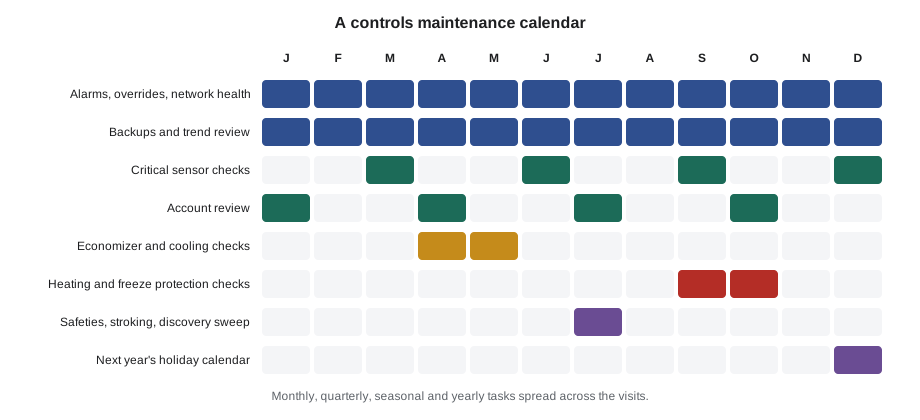
| Task | Typical frequency | Ninefield example |
|---|---|---|
| Review active alarms, overrides and disabled points | Each visit | Override report run and reviewed with Ilona's staff |
| Check controller and network health (offline devices, errors) | Each visit | Front-end device list and trunk error counts |
| Back up the front end and controllers, record firmware | Monthly, and after every change | Backups to the site folder and Quillon's offline copy |
| Review trends for key loops and equipment | Monthly | Supply air temperature, static pressure, CHW differential pressure |
| Check critical sensors against a reference | Quarterly or yearly | Outdoor air, supply air, CHW supply, building static |
| Stroke valves and dampers; check linkages | Yearly, or seasonally for economizers | Penthouse economizer actuators before summer |
| Test safeties and interlocks | Yearly | Freezestats, high static limits, fire alarm shutdown with Signalpoint |
| Check schedules and holiday calendars | Each season and at year end | Next year's holidays loaded in December |
| Apply security fixes and review accounts | As released; accounts every three months | Under the renewed SMA from January 2027 (plan) |
| Network discovery sweep for unknown devices | Yearly | Added after BAS-310 (plan) |
Callie had already done several of these tasks without calling them PM. The calibration day on Friday, November 6, when she checked 14 points for an energy manager and found 11 in tolerance, was a sensor check. The override report was an alarm and override review. The RTU-1 backups after checkout were backups. A PM agreement turns those one-off jobs into a schedule, so they happen whether or not anyone complains.
Planning and pricing a PM agreement
A PM price is built like any estimate: tasks, hours, frequency and rate. Prakash showed Callie how Ninefield's current agreement was built, at the sample rate used in Declan's estimates.
Worked problem
Ninefield PM hours
Ninefield's agreement has a 4-hour visit every month, an extra 4 hours each quarter for sensor checks and account reviews, and 16 hours once a year for safeties, stroking and the discovery sweep. How many hours a year is that? How many if a weekly 1-hour remote review is added?
Show solution
- Monthly visits: 12 × 4 = 48 h.
- Quarterly additions: 4 × 4 = 16 h.
- Yearly work: 16 h.
- Total: 48 + 16 + 16 = 80 h a year.
- With weekly remote reviews: 80 + 52 × 1 = 132 h a year.
Answer: 80 hours a year now, or 132 hours with a weekly remote review. At the sample rate of 105 dollars an hour, the current agreement's labor is 8,400 dollars a year before travel, parts and the SMA.
The price also has to cover things that are not hours on site: travel, the service coordinator's time booking visits, the cost of keeping spare parts, after-hours availability and the time spent writing reports. Many contractors price PM agreements a little below their project rates because they bring steady work, then price repairs at their normal rates. Prakash's warning was the opposite of Declan's estimating warning: a PM agreement priced too low gets done badly, because the technician is always short of time.
Response commitments are priced separately. A promise to answer within one hour and attend within four hours at any time of day or night needs an on-call roster, a phone that is always answered and technicians who can reach the site. Quillon's agreements define call priorities so that a stopped chiller on a hot afternoon is treated differently from a cold office on a mild day.
| Priority | Example | Typical response |
|---|---|---|
| Urgent | Plant down in extreme weather; a server room overheating; a safety interlock failed | Phone back within 30 minutes; on site within 4 hours, any time |
| High | A floor too hot or too cold; front end offline | Phone back within 2 hours; on site the same or next working day |
| Normal | A single room complaint; an alarm that keeps returning | Within 3 working days, or at the next visit |
| Planned | Changes, upgrades, additions | Scheduled and quoted |
Running a service visit
Prakash's visits followed the same pattern, and he wanted Callie to copy it. Before the visit, he reviewed the front end remotely, read the last visit's report and checked for open calls. On arrival, he signed in and spoke to the building's contact, Ilona or one of her staff at Ninefield, Nell or Gus at Harcastle, to ask what had been happening. He did the scheduled tasks, dealt with anything found, and before leaving he told the contact what he had found and what he recommended. The report went out the same day.
QUILLON SERVICE REPORT - NINEFIELD TOWER - MONTHLY PM (format)
Date / technician / time on site
1  Contact and concerns raised on arrival
2  Scheduled tasks completed (from the task list, with results)
3  Alarms, overrides and disabled points found; action taken
4  Backups made (file names, firmware versions)
5  Problems found and fixed
6  Problems found, not fixed: recommendation, priority, estimate
7  Changes made to programs or settings (also in the change log)
8  Next visit: date and planned tasks
Line 6 is where service turns into improvement. Most building upgrades start as a recommendation on a service report: the Ninefield retro-commissioning proposal in BAS-330 grew from items found on service visits, such as the rooftop unit fans running all night with lost schedules. A technician who writes clear recommendations, with a priority and a rough cost, gives the owner what she needs to plan, and gives the contractor its next job honestly.
Records, reporting and renewal
A service agreement is renewed, usually each year, on the strength of what the owner has seen. Quillon sends each service customer a short annual summary: calls and response times, PM tasks done, problems found and fixed, recommendations outstanding, energy or performance notes, and the plan for the next year. For Ninefield the summary also lists the security work from the hardening plan, so that Ilona can see the system becoming safer, not just being visited.
Records also protect both sides. If a sensor fails a month after a PM visit, the report showing it was checked and in tolerance is evidence that the failure was sudden. If the owner declined a recommendation, the report showing it was made is evidence that the risk was explained. Prakash keeps his reports plain and factual for that reason. "Write as if the report will be read by someone who doesn't like either of us," he said.
Renewal is also the moment to change the agreement. Buildings change: tenants arrive, equipment is replaced, systems are added. Ninefield's agreement will need new lines in 2027 for the podium rooftop units, the Thistledown floor's integrations and the hardening plan's ongoing tasks, all of which are planned work. Prakash recommended reviewing the task list every year against the building, not just copying it forward.
Maintenance and energy
Preventive maintenance is also energy work. Most of the faults Declan's fault detection rules were written to find in BAS-330, such as leaking reheat valves, stuck dampers, simultaneous heating and cooling and schedules overridden for months, are maintenance problems. The persistence of savings after a retro-commissioning project depends on someone checking that the improved sequences are still running. That is why Declan proposed that the analytics service for Ninefield be run by Quillon's service department, with fault rules reviewed weekly and the findings fixed on the next visit, rather than sold as software alone.
Spare parts and obsolescence
Service also means planning for parts that will not be available forever. Manufacturers announce the end of production and, later, the end of support for controllers, front ends and operating systems. A service contractor tracks those dates for every site in the inventory, keeps a small stock of spares for the products it supports, and tells owners early when a migration should be budgeted.
Quillon's panel shop holds spare controllers of the models installed at its main sites, loaded with nothing and labeled with their firmware, so that a failed controller can be replaced the same day and loaded from the backup. Where a product is no longer made, the plan changes: Tilden's 2009 AHU-2 controller is unsupported, and the risk has been accepted until the unit is replaced in 2027, with its backup checked and a spare located in the meantime.
Prakash's advice was to put obsolescence on the annual service summary, with years rather than surprises: which devices are past end of support, which will be within three years, and an estimate of the cost of replacing them. Owners can budget for what they are told about in advance.
Common mistakes
MistakeTreating a PM agreement and a software maintenance agreement as the same thing.
InsteadPM pays for the contractor's care; the SMA keeps the software supported and the security fixes available.
MistakeCopying last year's task list forward unchanged.
InsteadReview it each year against the building's equipment, tenants and risks.
MistakePricing PM so low that the tasks cannot be done.
InsteadPrice the real hours, travel, coordination and reporting.
MistakeLeaving recommendations in conversation only.
InsteadWrite each recommendation on the report with a priority and an estimate.
MistakeVisiting without speaking to the building's contact.
InsteadAsk what has been happening on arrival and explain findings before leaving.
Summary and key terms
- Control systems drift, wear and age, and settings left by people accumulate; maintenance keeps them doing what the sequences say.
- Agreement types include time and material, preventive maintenance, full coverage, software maintenance, remote monitoring and guaranteed response.
- Standard 180-2018 sets out inspection and maintenance tasks and frequencies, including for controls.
- A PM task list covers alarms and overrides, network health, backups, trends, sensor checks, stroking, safeties, schedules and security.
- PM prices are built from tasks, hours, frequency and rate, plus travel, coordination and reporting.
- Call priorities set response times; good visit reports carry recommendations with priorities and estimates.
- Annual summaries and a yearly task review support renewal and keep the agreement matched to the building.
- Preventive maintenance
- Scheduled inspection and maintenance done before problems appear.
- Software maintenance agreement (SMA)
- An agreement that keeps a manufacturer's software supported and updated.
- Full coverage agreement
- A service agreement that includes repair labor and parts for a fixed price.
- Call priority
- A category that sets how quickly a service call is answered and attended.
- Annual service summary
- A yearly report to the owner of the work done, problems found and plans.
Practice problems
Work each problem on paper first, then reveal the answer to check.
A building has a 3-hour monthly visit, 3 extra hours each quarter and 12 hours a year of annual work. How many hours a year?
Show answer
36 + 12 + 12 = 60 h.
At 105 dollars an hour, what is the labor in that agreement?
Show answer
60 × 105 = 6,300 dollars.
Why did Ninefield's front end fall two versions behind?
Show answer
The software maintenance agreement had lapsed, so updates and security fixes were not installed.
Which line of the service report most often leads to new work?
Show answer
Problems found and not fixed, with a recommendation, priority and estimate.
Lesson quiz · 5 questions
Score 60% or more to complete this lesson.
Create a free account to save your progress, take quizzes and earn a certificate.