
BAS-310 · Lesson 9 of 12 · 23 min
LonWorks, KNX and other protocols
▶ Video coming soon A video version of this lesson is on the way.
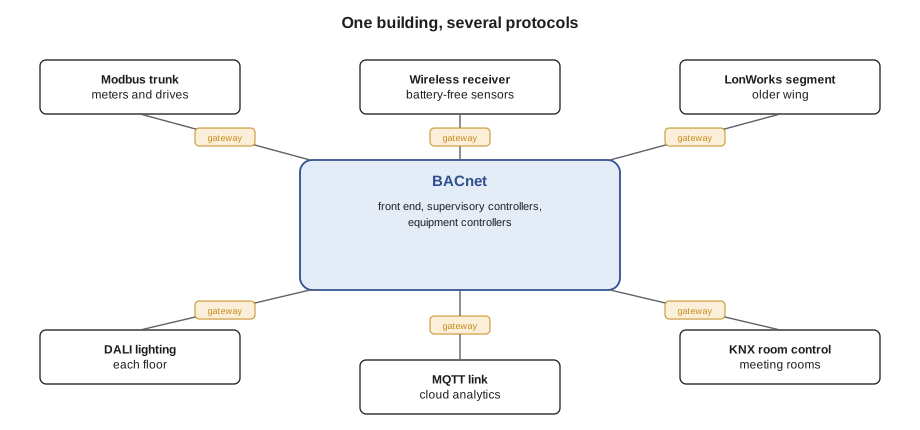
BACnet and Modbus between them cover most of what a controls technician in Canada or the US meets, but not all of it. Prakash kept one evening's worth of stories about the rest. The longest was Ellery Clinic, a two-story medical building whose 2008 control system had been built entirely on LonWorks and which Quillon had migrated to BACnet in 2022, one floor at a time, without shutting the clinic for a day. The shortest was about Ninefield's lighting, where each floor's fixtures talk a protocol called DALI that the building system never sees directly. "You won't install most of these," Prakash said. "But you will walk into buildings full of them, and you need to know what you're looking at."
LonWorks
LonWorks was developed in the 1990s by the company Echelon as a general-purpose control network for buildings, factories and transport. Each device contains a processor, originally the Neuron chip, that runs the LonTalk protocol, now standardized as ISO/IEC 14908. For a decade or so LonWorks was BACnet's main rival in commercial buildings, and many systems installed between about 1998 and 2012, particularly in schools, hospitals and government buildings, still run on it.
The most common LonWorks wiring, called FT-10 or free topology, runs at 78 kbit/s on a twisted pair that can be wired in almost any shape: daisy chain, star, loop or a mixture, with a single terminator, unlike EIA-485's strict daisy chain with two. That was one of its selling points. Devices share data through network variables, typed values such as a temperature or a switch state, which are bound to each other: an installer connects the output network variable of a sensor to the input network variable of a controller, and the value flows from then on without polling. LonMark International published standard network variable types and device profiles so that devices from different makers would bind cleanly.
The catch was that a LonWorks network's bindings and addresses lived in a database, usually built with software called LNS, kept by the integrator. A site whose database was lost could still run, but nobody could add or change a device without rebuilding it. Ellery Clinic's database had been lost when its original integrator closed in 2015, which is what led the owner to Quillon. With Echelon sold to another chip company in 2018 and fewer manufacturers offering new LonWorks building products, most such sites are now being migrated to BACnet, usually through gateways first and native controllers as equipment is replaced.
KNX
KNX is the dominant protocol for lighting, blinds and room control in Europe, and it appears in North America mainly in high-end homes, hotels and buildings designed by European firms. It is standardized as ISO/IEC 14543-3 and maintained by the KNX Association. The usual KNX wiring, TP, runs at 9,600 bit/s on a twisted pair that also carries power to the devices. Devices are configured with a single, standard tool, ETS, and communicate through group addresses, written in three parts such as 1/2/3, which act like shared mailboxes: a switch sends "on" to group 1/2/3, and every light listening to 1/2/3 turns on.
A BAS meets KNX through a gateway that maps chosen group addresses to BACnet objects. The integration question is the same as for any gateway: which group addresses the building system needs, in which direction, and who owns the KNX configuration, which must not be changed without the KNX integrator's ETS project file.
DALI
DALI, the Digital Addressable Lighting Interface, is an international standard for lighting control, IEC 62386, promoted by the DALI Alliance. A DALI line is a two-wire bus, not polarity sensitive, that carries both power for the interface and slow digital messages to the drivers in light fixtures. Each line supports up to 64 control gear addresses, typically one per fixture driver, which can be placed in up to 16 groups and recall up to 16 scenes. The newer DALI-2 revision added standard sensors and switches, called control devices, on the same line, and certification so that products from different makers work together.
Ninefield's 2019 lighting system uses DALI on each floor. Each floor's lighting controller manages its DALI lines and its own schedules and occupancy logic, and a single gateway in the penthouse presents a few values per lighting zone to the BAS over BACnet: occupancy, the zone's on or off state, an override command and the schedule. BAS-110's sixth-floor occupancy problem was solved in the lighting system's own software; the BAS only saw its effects.
Worked problem
How many DALI lines a floor needs
A Ninefield office floor has 150 LED fixtures, each with one DALI driver, and 12 DALI-2 occupancy and daylight sensors. Each DALI line supports 64 control gear addresses, and in DALI-2 control devices have their own separate set of 64 addresses on the same line. The lighting designer keeps 10 spare gear addresses per line for future fixtures. How many lines are needed?
Show solution
- Usable gear addresses per line with spares: 64 − 10 = 54.
- Lines for 150 drivers: 150 ÷ 54 = 2.8, so 3 lines.
- Sensors: 12 control devices, well under 64 per line, so they fit on those lines.
Answer: Three DALI lines for the floor, each with up to 54 fixtures and room to grow. Each line also needs a bus power supply sized for the number of devices on it, which the lighting system supplier specifies.
Meters: pulses and M-Bus
The oldest building protocol of all is a contact that closes once for each unit of energy or water. Many utility and submeters provide such a pulse output, and a controller counts the pulses on a digital input. It is simple and reliable, but it carries only a count: if pulses are missed while a controller restarts, the total is wrong, and there is no way to read the meter's own register to check.
Worked problem
Turning pulses into a quantity
A domestic water meter at Morrow House gives one pulse per gallon. The controller counted 3,280 pulses yesterday. How much water was used, in gallons and cubic feet?
Show solution
- 3,280 × 1 gal = 3,280 gal.
- 3,280 ÷ 7.48 = 438 cubic feet.
Answer: 3,280 gal, or about 438 cubic feet. If the meter's pulse value were wrongly entered as 10 gal per pulse, the trend would show ten times the real use, which is why pulse values belong on the points list and get checked against the meter register at commissioning.
M-Bus, the Meter-Bus, defined in the European standard EN 13757, is a two-wire bus designed specifically for reading heat, water, gas and electricity meters. It is common in Europe for district heating and apartment metering and occasionally appears in Canada and the US, usually on imported heat meters. Like the other protocols here, it reaches the BAS through a gateway.
Wireless and Internet-style protocols
Wireless sensors are increasingly common in retrofits, where running new cable is expensive. Some use protocols designed for buildings, such as EnOcean, whose sensors and switches harvest energy from light or the press of a button and need no batteries. Others use general wireless protocols such as Zigbee, Bluetooth Low Energy, Thread, or long-range networks such as LoRaWAN for sensors spread across a campus. They nearly always reach the BAS through a receiver or gateway that maps their readings to BACnet objects.
Two other names appear more and more in controls specifications. MQTT is a lightweight publish-and-subscribe messaging protocol from the Internet world, often used to send building data to cloud analytics platforms, which BAS-330 covers. OPC UA is an industrial data-exchange standard with a rich information model, common in factories and some large plants. Neither replaces BACnet inside the building system, but both are now common ways for the building system to share data with other systems.
| Protocol or standard | What it is | Where a BAS technician meets it |
|---|---|---|
| LonWorks (ISO/IEC 14908) | Control network with bound network variables | Older buildings, often during migration to BACnet |
| KNX (ISO/IEC 14543-3) | Bus for lighting, blinds and room control | European-designed buildings, hotels, high-end homes |
| DALI and DALI-2 (IEC 62386) | Lighting fixture and sensor bus | Networked lighting systems, behind a gateway |
| M-Bus (EN 13757) | Meter reading bus | Heat and water meters, mainly imported |
| Pulse outputs | A contact per unit of energy or water | Utility and submeters on digital inputs |
| EnOcean, Zigbee, Thread, LoRaWAN | Wireless sensor and device protocols | Retrofits and sensors where cable is costly |
| MQTT, OPC UA | Data-sharing protocols | Links from the BAS to analytics, cloud and industrial systems |
Data models: Haystack and Brick
BAS-210 introduced tagging with Project Haystack when Sophie built the RTU-1 database. Haystack and the Brick schema are not protocols: they do not move data. They describe it, with standard tags and relationships that say what a point is and what equipment it belongs to, so that software can find "every discharge air temperature on every air handler" across systems from different makers. ASHRAE Standard 223P is being developed to bring such semantic models into the standards world alongside BACnet. Lesson 10 and BAS-320 return to naming and tagging.
BACnet Secure Connect
BACnet Secure Connect, BACnet/SC, is a newer way of carrying BACnet messages, added to the standard by an addendum in 2019. Instead of broadcasting UDP packets on a local network, BACnet/SC devices connect to a hub using secure WebSocket connections protected by TLS, the same encryption used for secure websites, and each device proves its identity with a certificate. There are no broadcasts and no BBMDs; the hub relays messages, and devices may also connect directly to each other. Because it uses ordinary encrypted connections, BACnet/SC fits the way IT departments want networks to work, and it is expected to replace BACnet/IP over time, particularly where building systems share networks with other traffic. BAS-430 covers it in detail, along with the rest of building system security.
At Ellery Clinic in 2022, Quillon first put a LonWorks-to-BACnet gateway on each floor so that a new BACnet front end could read the old system, then replaced the LonWorks controllers with BACnet controllers floor by floor over four weekends, moving each zone's points from the gateway to the new controller as it went. By the last weekend the gateways had nothing left to translate and were removed. Prakash said it was the most satisfying job of his career, and the most carefully documented.
Choosing among them
A controls technician rarely chooses the protocol of a lighting system or a meter. That choice is usually made by the engineer or comes with the equipment. What the technician decides is how each island reaches the building system, and what the owner will need to maintain it. A summary helps keep the protocols straight.
| Protocol | Usual medium | Typical use in buildings | How it usually reaches BACnet |
|---|---|---|---|
| Modbus RTU or TCP | RS-485 or Ethernet | Meters, drives, boilers, generators | Driver in a controller, or a gateway |
| LonWorks | Free-topology twisted pair or IP | Older terminal units and controllers | Gateway, or replacement during upgrades |
| KNX | Twisted pair, IP or wireless | Room control, lighting and blinds, mostly in Europe | KNX to BACnet gateway |
| DALI | Two-wire control bus | Addressable lighting | Lighting controller with a BACnet interface |
| M-Bus | Two-wire bus | Heat and water meters, mostly in Europe | M-Bus master with a gateway |
| Wireless sensor protocols | Radio | Retrofits where cable is costly | Receiver or gateway |
| MQTT | IP | Sending data to cloud and analytics platforms | Gateway or a controller that publishes data |
Two questions decide most of these integrations. The first is who owns the island's configuration: a DALI system needs its addressing and groups maintained with the lighting maker's tools, and a KNX system needs its project file, so the owner needs those files and someone able to use them. The second is how much of the island the building system really needs. A lighting system may have thousands of addressable points; the BAS usually needs a few dozen, such as floor schedules, occupancy and faults. Mapping only what is needed keeps the gateway small, the polling light and the graphics useful.
Older protocols also raise the question of the future. When LonWorks devices in an older wing fail, the replacement may come from a different protocol altogether, and every such replacement is a chance to simplify the building's networks, as Quillon did when Ninefield's podium rooftop units moved from a protocol converter to BACnet controllers.
Common mistakes
MistakeAssuming every twisted pair in a building is BACnet MS/TP.
InsteadIdentify the protocol from the devices and documentation before connecting anything.
MistakeChanging KNX or LonWorks configuration without the project file or database.
InsteadGet the ETS project or LNS database, or work only through the gateway.
MistakeTrusting a pulse count without checking the pulse value.
InsteadRecord the pulse value on the points list and check it against the meter register.
MistakeTreating Haystack or Brick as a protocol.
InsteadThey are data models that describe points; a protocol is still needed to move the data.
MistakeExpecting BBMDs on a BACnet/SC network.
InsteadBACnet/SC uses secure connections through a hub instead of broadcasts.
Summary and key terms
- LonWorks uses bound network variables on free-topology FT-10 wiring; many sites are migrating to BACnet.
- KNX uses group addresses on a powered twisted pair and is configured with ETS.
- DALI carries lighting commands to up to 64 addresses per line, with groups and scenes; DALI-2 adds sensors.
- Pulse outputs count units of energy or water; M-Bus reads meters digitally.
- Wireless protocols such as EnOcean, Zigbee, Thread and LoRaWAN reach the BAS through gateways.
- MQTT and OPC UA share data with other systems; Haystack and Brick describe data but do not move it.
- BACnet/SC carries BACnet over secure WebSocket connections through a hub, without broadcasts.
- LonWorks
- A control network protocol from Echelon, standardized as ISO/IEC 14908.
- Network variable
- In LonWorks, a typed value bound from one device's output to another's input.
- KNX
- A building control bus standard, ISO/IEC 14543-3, common in Europe.
- Group address
- In KNX, a shared address that devices send to and listen on.
- DALI
- Digital Addressable Lighting Interface, IEC 62386, a bus for lighting fixtures and sensors.
- Pulse output
- A contact that closes once for each unit measured by a meter.
- M-Bus
- A two-wire bus for reading meters, defined in EN 13757.
- MQTT
- A lightweight publish-and-subscribe messaging protocol.
- BACnet/SC
- BACnet Secure Connect, which carries BACnet over TLS-secured WebSocket connections to a hub.
Practice problems
Work each problem on paper first, then reveal the answer to check.
A gas meter gives one pulse per cubic foot and counted 8,300 pulses in a week. How much gas?
Show answer
8,300 cubic feet.
A floor has 200 DALI drivers, with 8 spare addresses kept per line. How many lines?
Show answer
64 − 8 = 56 per line; 200 ÷ 56 = 3.6, so 4 lines.
What must you have before changing bindings on a LonWorks network?
Show answer
The network database, such as the LNS database.
A KNX switch sends on to 2/1/5. Which lights respond?
Show answer
Every device listening to group address 2/1/5.
Name one way BACnet/SC differs from BACnet/IP.
Show answer
It uses secure WebSocket connections to a hub with certificates, and has no broadcasts or BBMDs.
Lesson quiz · 5 questions
Score 60% or more to complete this lesson.
Create a free account to save your progress, take quizzes and earn a certificate.