
BAS-310 · Lesson 1 of 12 · 22 min
Why building systems need open protocols
▶ Video coming soon A video version of this lesson is on the way.
On Tuesday evening, September 22, after a day on the roof of Ninefield Tower's podium, Callie stayed late at Quillon's shop for the first of Prakash Deshmukh's Tuesday network nights. The podium's four rooftop units still had their 2004 unitary controllers, and those controllers spoke a language that nothing else in the building understood. A small gray box in the penthouse, a protocol converter, sat between them and the rest of the system, translating. "Everything you learned about wiring and programs assumes the controllers can talk to each other," Prakash said, pulling a stool up to the bench. "Tonight we start on how they actually do it." The bench held what Quillon called its protocol rack: a supervisory controller, two VAV controllers on a short RS-485 trunk, a router, a three-phase power meter, a small network switch and a laptop.
The problem open protocols solve
A building automation system is a network of controllers, each looking after its own equipment, that must share information. The plant controller needs to know how many zones are calling for cooling. The air handler needs the outdoor air temperature that another controller measures. The front end must read thousands of values from hundreds of devices and send them schedules, setpoints and overrides. All of that requires an agreed set of rules for how devices find each other, how they name their data, how they ask for it and how they answer. Those rules are a communication protocol.
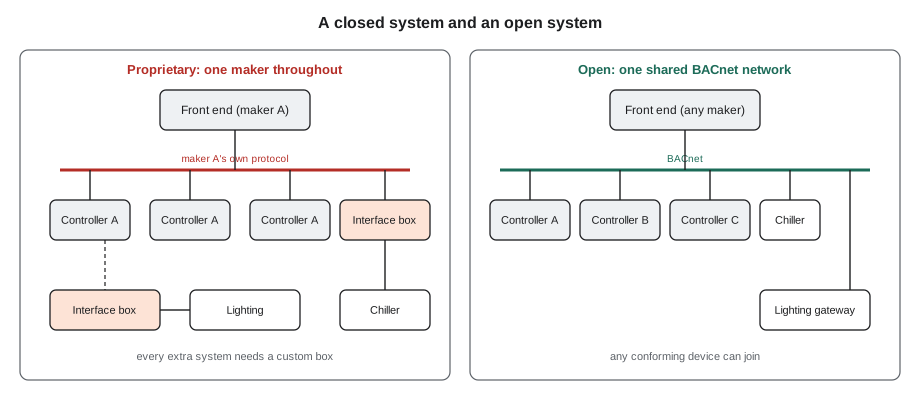
Until the 1990s, every controls manufacturer had its own protocol. A building bought from one manufacturer could only be extended, serviced or replaced by that manufacturer or its dealers, because nobody else's controllers could join the network. Owners called this being locked in. If the manufacturer raised its prices, discontinued a product line or simply had no dealer nearby, the owner had two choices: pay, or replace the whole system. Integrating equipment that arrived with its own controls, such as a chiller, a boiler or a lighting system, meant buying a custom interface from someone who knew both protocols, and those interfaces were expensive, fragile and often abandoned when the person who wrote them moved on.
Ninefield's podium was a living example. The 2004 rooftop controllers came from a manufacturer whose protocol only its own front end could read. When the building's main system was replaced in later years, someone added the protocol converter to read eighteen values from each rooftop unit and present them to the new system. It worked, slowly, for twenty years. When RTU-1's controller failed in August there was no replacement part, which is why BAS-210 spent two months replacing it with an open, programmable controller.
What an open protocol is
An open protocol is one whose rules are published so that any manufacturer can build devices that use it, without needing permission or a license from a competitor. Openness has degrees. Some protocols are published standards maintained by a standards body, open to anyone who buys the document. Some are published by a single company or an industry association that controls changes. Some are free to read but require membership or certification to use a logo. What matters to an owner is the practical result: can a different contractor, using a different manufacturer's products, add to and maintain the system?
Open does not mean automatically compatible. Two devices that both use the same protocol may support different parts of it, name their data differently or interpret optional features in different ways. Integration still takes planning, testing and documentation. The difference is that the planning is about choosing and checking features, not writing translation software from scratch.
| Protocol | Who maintains it | Typical use in buildings |
|---|---|---|
| BACnet | ASHRAE (ANSI/ASHRAE Standard 135) and ISO (ISO 16484-5) | Controllers, front ends, plant equipment, lighting gateways |
| Modbus | Modbus Organization | Meters, drives, chillers, boilers, generators |
| LonWorks | ISO/IEC 14908; LonMark International | Older controller networks, some equipment |
| KNX | KNX Association; ISO/IEC 14543-3 | Lighting, blinds and room control, mainly in Europe |
| DALI | IEC 62386; DALI Alliance | Lighting fixtures and sensors |
| M-Bus | EN 13757 | Heat, water and gas meters |
BACnet: the building industry's own protocol
BACnet, short for Building Automation and Control Networks, was written specifically for buildings. Work began in 1987, when ASHRAE formed a committee of manufacturers, engineers, owners and researchers to write a protocol that no single company owned. It was first published in 1995 as ANSI/ASHRAE Standard 135, and it became an international standard, ISO 16484-5, in 2003. The committee has kept it under continuous maintenance ever since, adding features through addenda and republishing the full standard every few years. The current edition is ANSI/ASHRAE 135-2024, and the most recent ISO edition was published in 2022.
BACnet does three jobs that a technician needs to keep separate in their head. First, it describes data as standard objects with standard properties, so a temperature input looks the same whichever company built the controller. Second, it defines services, the requests and answers devices use to read, write and report that data. Third, it can run over several kinds of network, from a twisted pair of wires to an office Ethernet network, and defines how messages are carried and routed between them. Lessons 2 to 7 take these jobs one at a time.
Because BACnet belongs to no manufacturer, almost every controls company now builds BACnet controllers, and chillers, boilers, drives, meters and lighting systems often offer BACnet interfaces. Specifications for new buildings in Canada and the US commonly require BACnet throughout. Prakash's summary was blunt: "BACnet is the reason Quillon could bid on RTU-1 at all. If Ninefield's main system spoke a proprietary language, only its maker could have touched that roof."
Conformance: PICS, BIBBs and device profiles
Because devices may implement different parts of BACnet, the standard requires manufacturers to publish a Protocol Implementation Conformance Statement, or PICS, for each product. The PICS lists which object types the device contains, which services it can request and answer, which network types it supports, whether it can handle segmented messages and which character sets it uses. Reading the PICS before a job is the cheapest integration test there is.
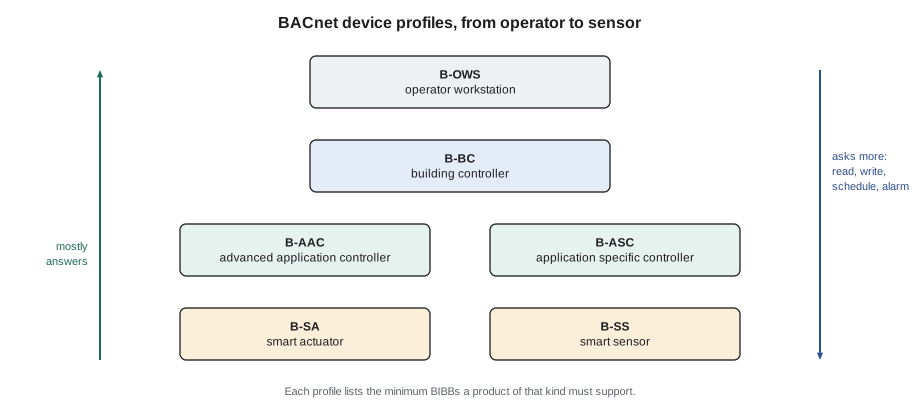
The standard also groups features into BACnet Interoperability Building Blocks, or BIBBs, each a named capability such as reading a property or receiving change-of-value reports. A BIBB name has a short code for its area, its function and a final A or B: A is the device that asks, B is the device that answers. DS-RP-A means the device can read properties from others; DS-RP-B means it can be read. A front end needs many A BIBBs; a VAV controller needs mostly B BIBBs.
Finally, the standard defines device profiles that bundle the BIBBs expected of common kinds of device. Specifications often name a profile instead of listing every feature.
| Profile | Meaning | Typical device |
|---|---|---|
| B-OWS | BACnet Operator Workstation | Front-end software used by operators |
| B-BC | BACnet Building Controller | Supervisory or plant controller with schedules, trends and alarms |
| B-AAC | BACnet Advanced Application Controller | Programmable controller for an air handler or rooftop unit |
| B-ASC | BACnet Application Specific Controller | VAV box, fan coil or unit ventilator controller |
| B-SA | BACnet Smart Actuator | Actuator with its own network connection |
| B-SS | BACnet Smart Sensor | Sensor with its own network connection |
Testing and listing
A PICS is the manufacturer's own claim. Independent testing checks it. BACnet International runs the BACnet Testing Laboratories, or BTL, program, which tests products against published test packages and lists those that pass. A BTL-listed product carries the BTL Mark and appears in a public listing that shows its profile and the protocol revision it was tested to. Specifications increasingly require BTL listing, and Quillon's rule was simple: for anything new on a job, check the listing before ordering.
Listing is not a guarantee that two products will cooperate perfectly in a particular building, but it removes the most common causes of failure. Prakash had seen an unlisted gateway that answered reads but quietly ignored writes, and a controller that claimed change-of-value support in its brochure but not in its PICS. Both problems were visible on paper before anyone climbed a ladder.
Worked problem
Why the old converter was slow
The podium protocol converter read 18 values from each of the four rooftop units over their proprietary link and could only make one request at a time. Prakash had measured about 0.5 s per value, including the converter's own processing. How long did one complete scan of all four units take, and what did that mean for the front end?
Show solution
- Values per scan: 4 units × 18 values = 72 values.
- Scan time: 72 × 0.5 s = 36 s.
Answer: Each value was up to 36 s old when the front end saw it, and a command such as a new setpoint could wait almost as long to reach the unit. That was acceptable for trends and alarms, but it made troubleshooting from the front end confusing: a technician who changed a setpoint and watched for a response often gave up before the converter got round to it.
What open protocols do not do
An open protocol makes integration possible; it does not make it automatic, and it does not decide who is responsible for what. A chiller that speaks BACnet still needs someone to decide which of its hundreds of internal values the building system should read, at what rate, and which values the building system is allowed to write. A front end that can read every controller in the building still needs graphics, alarms and trends that people can use. Those decisions are written down in an integration points list and a responsibility matrix, the subjects of lesson 10.
Open protocols also open the door to more people than the owner intended. A network that any compliant device can join is a network that any compliant laptop can join, which is why BAS-430 is devoted to cybersecurity. Lesson 9 introduces BACnet Secure Connect, the newer secure way of carrying BACnet messages.
Prakash ended the evening by plugging the laptop into the bench switch and starting a discovery tool. Within a second, the supervisory controller, the two VAV controllers, the router and, through the router, the meter's gateway had all answered with their names and numbers. "That's the whole point," he said. "Five devices, four manufacturers, one conversation. Next week we look at what's inside each of them."
Reading the protocol clause of a specification
Most technicians first meet open protocols not in a standard but in a project specification. The controls section of a specification usually has a clause on communication, and a few lines in it decide how open the finished system will really be. Reading that clause carefully before a job starts saves arguments at handover.
| What the clause says | What it means in practice |
|---|---|
| Devices shall be BTL listed | Each product must appear on the BTL listing, for the profile claimed, at the time of submittal |
| Submit a PICS for each device type | The engineer can check services and objects before anything is bought |
| Controllers shall meet the B-BC or B-AAC profile | Sets the minimum services, such as scheduling, trending and alarms, that a controller must offer |
| All points shall be readable and writable from any BACnet workstation | No values hidden in a proprietary tool; another contractor can service the system later |
| Programming tools and licenses shall be turned over to the owner | The owner is not locked into one service company for changes |
| Device instances and network numbers per the owner's plan | Addressing is coordinated with other systems on site, as in lesson 6 |
The weak spots are usually what the clause does not say. A specification that asks only for "BACnet compatible" products allows equipment that answers a handful of ReadProperty requests and nothing else. One that never mentions programming tools allows a system whose points are open but whose programs can be changed only by the original installer. Declan Kilbride's habit, when Quillon prices a job, is to list every such gap in the bid clarifications, so that the owner knows what they are buying before the contract is signed.
For an owner like Harcastle College, the result of a well-written clause is a system that any competent controls contractor can maintain. That is the real promise of an open protocol: not that every product does everything, but that the owner can choose who works on the building.
Common mistakes
MistakeAssuming two devices will work together because both say BACnet on the box.
InsteadCompare their PICS, profiles and BTL listings before the job.
MistakeSpecifying an open protocol and nothing else.
InsteadSpecify the profile, the network type, BTL listing and the points to be shared.
MistakeTreating a protocol converter as permanent.
InsteadPlan to replace proprietary links with native open devices when equipment is renewed.
MistakeConfusing the A and B sides of a BIBB.
InsteadA is the device that asks; B is the device that answers.
MistakeThinking openness only helps the owner.
InsteadIt also lets contractors bid, service and extend systems they did not install.
Summary and key terms
- A protocol is the agreed set of rules devices use to find each other, name data, request it and answer.
- Proprietary protocols lock owners to one manufacturer; open protocols let different makers' devices share a network.
- BACnet was written for buildings by an ASHRAE committee, first published in 1995 and is maintained as ANSI/ASHRAE 135 and ISO 16484-5.
- BACnet defines objects and properties, services and network types.
- A PICS states what a device supports; BIBBs name capabilities; device profiles bundle the BIBBs common devices need.
- BTL testing by BACnet International independently checks products and lists those that pass.
- Open protocols make integration possible but still need planning, documentation and security.
- Protocol
- An agreed set of rules for how devices communicate.
- Open protocol
- A protocol whose rules are published so any manufacturer can use it.
- Proprietary protocol
- A protocol owned and controlled by one manufacturer.
- Protocol converter
- A device that translates between two protocols.
- BACnet
- Building Automation and Control Networks, the ASHRAE and ISO standard protocol for buildings.
- PICS
- Protocol Implementation Conformance Statement: a list of the BACnet features a product supports.
- BIBB
- BACnet Interoperability Building Block: a named capability, with A for the asking side and B for the answering side.
- Device profile
- A standard bundle of BIBBs for a kind of device, such as B-BC or B-ASC.
- BTL
- BACnet Testing Laboratories, the independent testing and listing program run by BACnet International.
Practice problems
Work each problem on paper first, then reveal the answer to check.
A converter reads 24 values per unit from 3 units at 0.4 s per value. How long is one scan?
Show answer
3 × 24 × 0.4 = 28.8 s.
Which side of DS-WP is a front end that writes setpoints?
Show answer
DS-WP-A, because it initiates the write.
What document should you read before ordering a controller for a BACnet job?
Show answer
Its PICS, and its BTL listing if one exists.
Which profile would you expect for a programmable rooftop unit controller?
Show answer
B-AAC, an advanced application controller.
Name two things an open protocol does not decide for you.
Show answer
Which points are shared and at what rate, and who is responsible for each part of the integration.
Lesson quiz · 5 questions
Score 60% or more to complete this lesson.
Create a free account to save your progress, take quizzes and earn a certificate.