
BAR-242 · Lesson 2 of 12 · 20 min
Eligibility, education, deadlines and fees
▶ Video coming soon A video version of this lesson is on the way.
Lacey's supervising partner, Dwight Kjelstad, had been admitted in 1994. When she mentioned her application, he told her the application had been 'a few pages and a check.' Lacey laughed, because her version had taken most of a weekend. Marchetti said that was normal. 'South Dakota's rules are short compared with some states,' she said, 'but every item on the checklist matters, and the deadlines are hard. There is no late filing period. If you miss November 1, you are not sitting in February.'
This lesson covers who may apply, what education is required, the filing deadlines, the documents that must accompany an application, the fees and the practical steps that make a filing complete.
Education
South Dakota requires a J.D. from a law school approved by the American Bar Association. NCBE's summary of South Dakota's requirements lists an ABA-approved J.D. as the education requirement, and South Dakota's admission on motion route also requires graduation from an ABA-approved school. Graduates of non-ABA domestic schools, correspondence programs and law office study are not eligible to sit for the South Dakota exam on that education alone.
Graduates of foreign law schools face an additional condition. NCBE's chart for South Dakota states that a foreign law graduate may be eligible to sit for the exam only if also admitted in another United States jurisdiction, and that an LL.M. or other graduate law degree alone does not make a foreign graduate eligible. A lawyer trained in, for example, Canada or the United Kingdom who has earned only a U.S. LL.M. must first be admitted in a U.S. jurisdiction that accepts foreign-educated lawyers before South Dakota becomes an option.
Applicants who are still in law school may register with the Board before they apply for the exam. Regulation 7.1 permits first- and second-year students to register through the Bar Portal for a 100-dollar South Dakota fee plus NCBE's fee for an initial character report. Registration is not an application to take the exam, and the Board's findings on character and fitness at the registration stage are, in the regulation's words, both preliminary and non-binding. Registration still has value: it starts the character file early and surfaces problems, such as unpaid debts or an unreported citation, while there is time to address them.
Filing deadlines
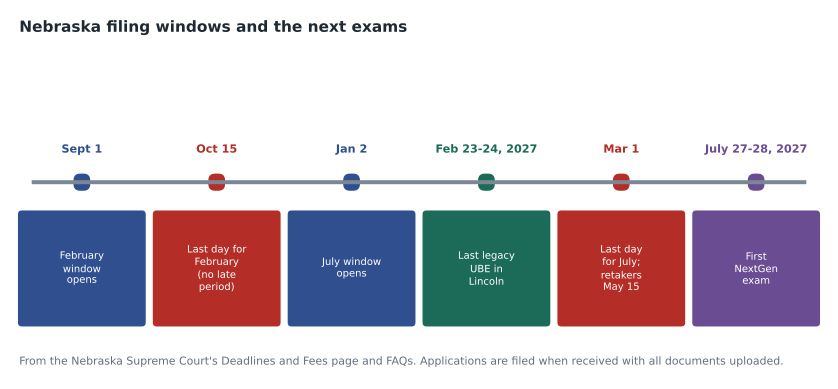
Regulation 1 sets two deadlines. Applications for the February exam must be filed electronically or postmarked on or before November 1. Applications for the July exam must be filed on or before May 1. The same deadlines apply to the request for an NCBE character report. NCBE's jurisdiction chart lists no late filing deadline for South Dakota for either exam.
Accommodation requests follow the same schedule. The Board's website says that requests for testing accommodations must be filed with the application by the filing deadline, meaning November 1 for February and May 1 for July. Requests for lactation-related accommodations must be made at least four weeks before the exam except in extraordinary circumstances, and an applicant who is denied an accommodation has five business days after receiving the denial to appeal.
What a complete application includes
Regulation 1 lists the core documents. An application must include a photograph taken within six months of the application date and fingerprint cards for both the South Dakota Division of Criminal Investigation and the FBI. The Board's website explains that fingerprints must be taken by a law enforcement agency and that fingerprint cards are requested by email, and it lists a 50-dollar fingerprint fee payable to the Division of Criminal Investigation. The application also requires the NCBE character report request, a Dean's Certificate of Study from the law school and, for laptop users, the Examplify registration form.
The Board publishes checklists for each type of application: with examination, without examination and for the Public Service Pathway. Marchetti told the group to print the checklist and treat it as a contract. 'The checklist is how the Board decides whether your application is complete,' she said. 'Do not argue with it. Satisfy it.' The Board's website also lists an Acknowledgment of Complete Applications form, which lets an applicant confirm that the Board has everything it needs.
| Item | Requirement | Source |
|---|---|---|
| Application | Filed electronically or postmarked by November 1 (February) or May 1 (July) | Regulation 1 |
| NCBE character report request | By the same deadline | Regulation 1 |
| Photograph | Taken within six months of the application date | Regulation 1 |
| Fingerprints | DCI and FBI cards taken by a law enforcement agency; 50-dollar DCI fee | Regulation 1; Board website |
| Dean's Certificate of Study | Confirms the J.D. from an ABA-approved school | Board checklist |
| Accommodation request | With the application, by the filing deadline | Board website |
Fees
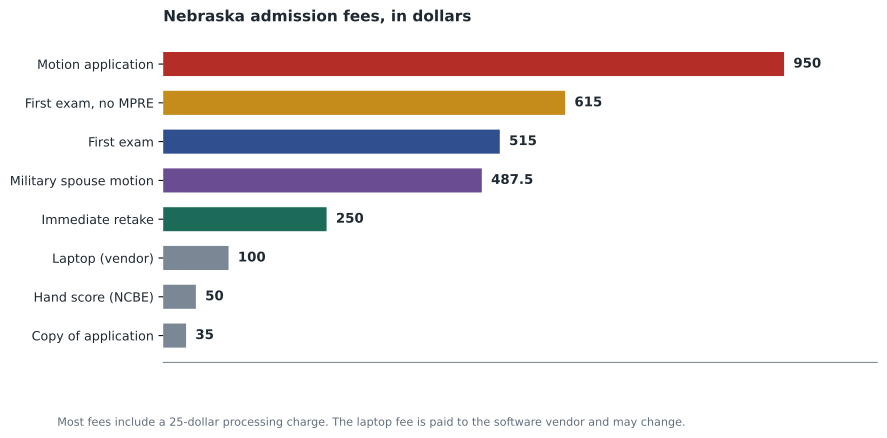
NCBE's chart lists South Dakota's bar exam application fee as 450 dollars, the same for first-time takers, attorneys and repeaters, plus a laptop fee of 100 dollars for applicants permitted to type their answers. Admission without examination costs 650 dollars plus other fees. NCBE charges its own fee for the character report, which varies by application type and timing, and the Division of Criminal Investigation charges the 50-dollar fingerprint fee. The regulations themselves say that fees are set by the applicable court rules and that NCBE sets its own character report fee, so the Board's posted fee schedule controls if any figure changes.
One detail surprises applicants from other states. Regulation 2 says fees must be paid by money order or certified check, and that payment by credit card or electronic check will be allowed when the technology is developed, with any service fee paid by the applicant. A candidate filing close to a deadline should check the Board's current payment instructions well before the due date rather than assume online payment will be available.
Laptops and the exam site
Candidates who wish to type their answers must register with ExamSoft and use the Examplify software, and they must meet ExamSoft's laptop requirements. The Board links to ExamSoft's registration login, laptop requirements and support pages. The exam is held in Pierre, so candidates from Sioux Falls, Rapid City or out of state must plan travel and lodging. Pierre is a small capital city, and hotel rooms around the February and July exams can be limited when the Legislature is in session in winter, so Lacey's colleagues told her to book early even though she lived in town.
Attempts and permission to retake
Section 16-16-11 of the Codified Laws limits repeated attempts. Under Regulation 4, an applicant who fails the written portion or the MBE three times must obtain the Supreme Court's permission before sitting again, and NCBE's chart summarizes the rule as three attempts without special permission. That limit counts attempts at each portion, so a candidate who passes the MBE but fails the written portion should treat each written attempt as precious.
Student practice
The Board's website includes a Student Practice Certification and an extension request form under section 16-18-2.3. These forms relate to the rules that allow supervised law students and recent graduates to provide certain legal services before admission. Lacey's firm had used a certified student in a magistrate court matter the year before. The details of what a certified student may do, and for how long after graduation, are set in the statute and the court's rules, and a firm that relies on them should read the current text.
Worked problem
A filing problem
Lacey's classmate Brody Rasmusson planned to sit in February 2027. On October 30, 2026 he had completed his online application but had not yet had his fingerprints taken, and his only photograph was from his law school identification card, taken in 2023. What should he do?
Show solution
- The deadline is November 1, and there is no late filing period, so the priority is to file a complete application on time.
- Regulation 1 requires a photograph taken within six months of the application date. A 2023 photograph does not qualify, so Brody needs a new one immediately.
- Fingerprints must be taken by a law enforcement agency on DCI and FBI cards. Brody should call the local sheriff's office or police department that day and ask about fingerprinting hours.
- He should also confirm with the Board how it treats a filing that is timely but missing an item, and ask whether the application will be accepted as complete if the fingerprint cards follow promptly. He should not assume the Board will hold a place for him.
Answer: Brody must get a current photograph and fingerprints at once and file by November 1; the absence of a late filing period means delay risks losing the February 2027 exam, and with it the last legacy administration.
Planning around the NextGen change
The deadline calendar has a special meaning in 2026 and 2027. February 2027 is the last time South Dakota gives the MPT, MEE, Indian Law Question and MBE. An applicant who misses November 1 cannot sit the legacy exam at all and will next sit the NextGen exam in July 2027, with a different format, a different scoring scale and a passing score South Dakota had not announced by November 2026. For a candidate who has prepared for the legacy exam for months, a missed deadline is not a short delay; it means starting a new kind of preparation.
Common mistakes
MistakeSouth Dakota has a late filing period for a higher fee.
InsteadNCBE lists no late filing deadline; applications are due by November 1 for February and May 1 for July.
MistakeA foreign LL.M. graduate may sit the South Dakota exam on the strength of the LL.M.
InsteadNCBE's chart says a foreign graduate must also be admitted in another U.S. jurisdiction, and an LL.M. alone does not qualify.
MistakeAny recent photograph will do.
InsteadRegulation 1 requires a photograph taken within six months of the application date.
MistakeAn applicant may retake the exam as often as needed.
InsteadAfter three failures of a portion, the Supreme Court's permission is required under section 16-16-11.
A filing checklist that works
Marchetti shared the checklist she gives every candidate, adapted for South Dakota. Eight weeks before the deadline: create or confirm the NCBE account and the Board portal login, request the Dean's Certificate of Study from the law school, and contact references to warn them that NCBE will be in touch. Six weeks before: arrange fingerprinting with a law enforcement agency, using the cards the Board sends, and take a new photograph that will still be within six months of the filing date. Four weeks before: complete the application questions in draft, gather court records for any citations or charges, and request any accommodation documentation from treating professionals. Two weeks before: review the whole application against the Board's checklist, prepare the payment in the form the Board requires and file. After filing: confirm receipt, watch for messages from the Board and NCBE, and answer every inquiry promptly.
Lacey followed the checklist and filed in mid-October. She kept a single folder, on paper and on her laptop, with copies of everything she submitted: the application, the fingerprint receipt, the payment record, the Dean's Certificate request and every message from the Board. When a question came from NCBE in early November about the dates of a summer job, she answered the same day from her records.
Why the details matter in a small jurisdiction
South Dakota tests a small number of candidates compared with large states, and the Board's staff is correspondingly small. Marchetti told the group that this cuts both ways. A complete, well-organized application moves smoothly, and staff can often answer a clear question quickly by phone or email. An incomplete application, by contrast, can sit while the Board waits for missing documents, and with no late filing period there is little room to fix problems after the deadline. 'Treat the Board's staff as the people who want you to succeed,' she said, 'and make their job easy.'
Budgeting for the exam
Lacey also built a budget. The 450-dollar application fee and the 100-dollar laptop fee were the largest Board charges, but the NCBE character report fee, the fingerprint fee, the earlier MPRE fee, bar review materials and any travel to Pierre added up. Classmates coming from Rapid City or out of state also budgeted for two or three nights of lodging. Several firms in the state reimburse exam costs for their law clerks, and Lacey's firm agreed to cover her fees if she passed, which she called the best motivation she had.
Accommodations
Candidates with disabilities or certain health-related conditions may request testing accommodations, such as extra time, a separate room or assistive technology. South Dakota requires accommodation requests to be filed with the application by the filing deadline, using the Board's forms and supporting documentation from qualified professionals. Marchetti told the group to start gathering documentation months in advance, because evaluators may have waiting lists, and to read the Board's policy carefully so that the request explains the functional limitation and the specific accommodation sought. A denial can be appealed, but the five-business-day appeal window leaves little time to gather new evidence.
Summary and key terms
- South Dakota requires a J.D. from an ABA-approved law school; foreign graduates must also be admitted elsewhere in the United States.
- Applications and NCBE character report requests are due November 1 for February and May 1 for July, with no late period.
- A complete application includes a photograph taken within six months, DCI and FBI fingerprint cards and the Dean's Certificate of Study.
- NCBE lists a 450-dollar exam fee, a 100-dollar laptop fee and a 650-dollar fee for admission without examination; fingerprints cost 50 dollars.
- Law students may register early for 100 dollars plus NCBE's fee; the findings are preliminary and non-binding.
- Three failures of a portion require Supreme Court permission to retake.
- 0
- ABA-approved
- 1
- filing deadline
- 2
- Dean's Certificate of Study
- 3
- character report
- 4
- law student registration
- 5
- Examplify
Practice problems
Work each problem on paper first, then reveal the answer to check.
What is the filing deadline for the February exam?
Show answer
On or before November 1.
How recent must the application photograph be?
Show answer
Taken within six months of the application date.
What does NCBE list as South Dakota's exam application fee?
Show answer
450 dollars, plus 100 dollars for laptop use.
What happens after three failures of the written portion?
Show answer
The applicant needs the Supreme Court's permission to sit again.
Lesson quiz · 5 questions
Score 60% or more to complete this lesson.
Create a free account to save your progress, take quizzes and earn a certificate.