
BAR-242 · Lesson 1 of 12 · 20 min
Becoming a lawyer in South Dakota
▶ Video coming soon A video version of this lesson is on the way.
Lacey Vesely joined Hollis Marchetti's Tuesday evening study group in September 2026 with a printed checklist and a question she could not answer. She had grown up on a farm near Tabor, in Bon Homme County, earned her J.D. in May 2026 from South Dakota's law school in Vermillion and started work that summer as a law clerk at Kjelstad & Wahl, a small general practice firm in Pierre. She planned to sit the South Dakota bar exam on February 23 and 24, 2027. Her question was simple: 'Who actually decides whether I become a lawyer here?'
Marchetti said it was the right first question. 'Every jurisdiction has the same basic parts,' she told the group, 'a court that owns the rules, a board that runs the exam and the character review, a national organization that writes most of the tests, and a bar association you join once you are in. What makes South Dakota different is how those parts fit together, and the fact that the exam itself is about to change.' This lesson maps the people and institutions involved, the routes into practice and the timeline Lacey faces.
The South Dakota Supreme Court
The practice of law in South Dakota is regulated by the South Dakota Supreme Court. The court adopts the rules for admission, decides who is admitted, regulates lawyer conduct and discipline, and has the final say on every major change to the licensing system. The statutes on admission are collected in chapter 16-16 of the South Dakota Codified Laws, and the detailed Rules and Regulations for Admission to Practice Law in South Dakota appear as an appendix to that chapter. The Rules of Professional Conduct appear as an appendix to chapter 16-18.
Two recent decisions of the court shape Lacey's path. In December 2024 the court announced that it had adopted the NextGen bar exam developed by the National Conference of Bar Examiners, with the first South Dakota administration in July 2027. In February 2025, after a public hearing on February 18, the court adopted rules for a five-year Public Service Pathway pilot program, an alternative route to licensure for a small number of students at the state's law school. Both changes are covered in later lessons, but they explain why a South Dakota candidate in 2026 and 2027 must read the rules carefully rather than rely on what an older lawyer remembers.
The Board of Bar Examiners
The South Dakota Board of Bar Examiners administers admission under the Supreme Court's rules. Its office is in Pierre, at 500 East Capitol Avenue, in the state capitol complex. The Board receives applications, reviews character and fitness, administers the exam, grades the written portion and certifies results to the court. Its staff includes a Secretary, whose initial decisions on applications can be appealed to the full Board, and a Chief of Bar Exam who handles the day-to-day administration. The Board's website, ujsbarexam.sd.gov, holds the application portal, the rules, the fee schedule, the accommodation forms and the application checklists.
Lacey noticed one feature of the website that she had not seen elsewhere: the Board posts representative passing answers from recent exams. Marchetti told her to read them early. 'They show you the length, the structure and the level of detail that passed in South Dakota,' she said. 'That is worth more than any general advice I can give you.'
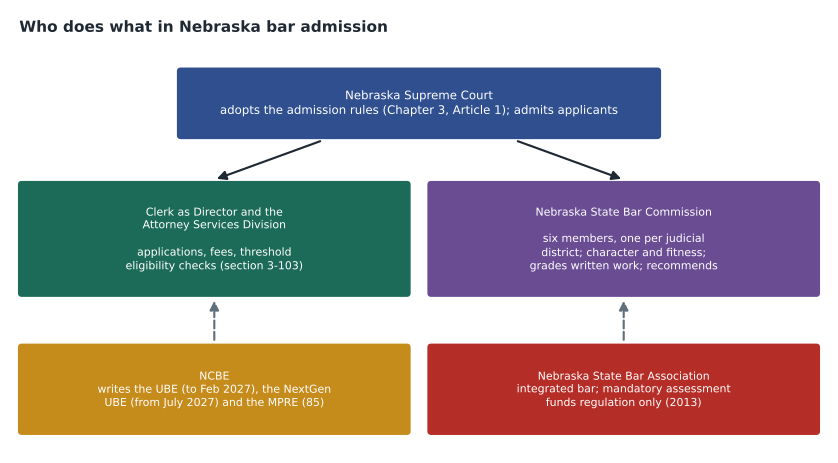
The National Conference of Bar Examiners
The National Conference of Bar Examiners, usually called NCBE, writes most of the tests a South Dakota candidate takes. Through February 2027 South Dakota gives the Multistate Bar Examination (MBE), the Multistate Essay Examination (MEE) and the Multistate Performance Test (MPT), and it requires the Multistate Professional Responsibility Examination (MPRE). NCBE also prepares character and fitness reports for South Dakota applicants. Applicants request an NCBE character report as part of their application, and they need an NCBE account and number before they apply.
South Dakota is unusual in one respect: it has given the MBE, MEE and MPT but has not been a Uniform Bar Examination jurisdiction. A UBE jurisdiction gives the same exam, graded and scored in the same way, so that a score can be transferred to other UBE jurisdictions. South Dakota grades its written portion itself, adds its own Indian Law Question and sets its own passing standards for each portion. NCBE's published information confirms that South Dakota does not accept transferred legacy UBE scores. That will change with NextGen: South Dakota is joining the jurisdictions that give the NextGen UBE, and it has already announced that it accepts transferred NextGen scores of 620 or higher.
The State Bar of South Dakota
Once admitted, a South Dakota lawyer must belong to the State Bar of South Dakota, the state's mandatory, or integrated, bar. The State Bar collects dues, runs committees and sections, publishes for its members and offers continuing legal education programs, although, as lesson 11 explains, continuing education was still voluntary in South Dakota in late 2026. The State Bar is not the admitting authority. It has no role in deciding who passes the bar exam.
The law school
South Dakota has one law school, the University of South Dakota Knudson School of Law in Vermillion. Many South Dakota lawyers graduated from it, and many of the state's judges and legislators did too. That matters in practice: the state bar is small, lawyers know each other, and a new lawyer's reputation travels quickly across the state. It also matters for the Public Service Pathway pilot, which is open only to students at that law school. Candidates from other ABA-approved schools, including the many South Dakotans who study in Minnesota, Nebraska, Iowa or elsewhere, take the exam route or, if already admitted elsewhere, may qualify for admission without examination.
| Route | Who it serves | Key requirement |
|---|---|---|
| Admission by examination | Most new graduates | Pass each portion of the South Dakota exam and the MPRE (85), plus character and fitness |
| Admission without examination | Lawyers admitted in a reciprocating jurisdiction | Active practice for 3 of the last 5 years, ABA J.D., character and fitness |
| MBE score transfer | Candidates who passed another jurisdiction's full exam | Scaled MBE of 135 or more within 24 months; then pass South Dakota's written portion |
| Transferred NextGen score | NextGen examinees from other jurisdictions | NextGen UBE score of 620 or more (accepted from July 2026) |
| Public Service Pathway (pilot) | Up to 10 students per class at the state law school | Supervised practice, character and fitness and two years of public service |
The South Dakota exam in one paragraph
Through February 2027 the South Dakota exam is given over two days in Pierre, on the last Tuesday and Wednesday of February and July. On Tuesday candidates write five MEE essays and the Indian Law Question in the morning and two MPT tasks in the afternoon. On Wednesday they take the 200-question MBE. The written work (MPT, MEE and Indian Law Question together) and the MBE are separate portions that must each be passed: the written portion requires an average of 75 percent and the MBE a scaled score of 133. Lessons 4 and 6 explain these rules in detail; the important point now is that South Dakota is not a combined-score jurisdiction. A strong MBE cannot rescue a weak written portion, and a strong written portion cannot rescue a weak MBE, except through the small bonus explained in lesson 4.
Lacey's timeline
Marchetti asked Lacey to put her dates on one page. Lacey had taken the MPRE in August 2025 and scored 97, well above South Dakota's requirement of 85. She had registered with the Board as a law student in her second year, created her NCBE account and requested her character report. She filed her bar application through the Board portal in October 2026, ahead of the November 1 deadline, with fingerprint cards and a recent photograph. Her exam would be on February 23 and 24, 2027, the last legacy South Dakota exam before NextGen arrives in July 2027.
That last fact gave Lacey a reason to take February seriously. 'If you pass both portions in February,' Marchetti said, 'the change to NextGen does not touch you. If you pass only one, South Dakota normally lets you keep it for two years. But the court has said rule changes are coming on the effect of scores earned before July 2027, so you cannot assume a February pass on one portion will carry into a NextGen administration. Plan to pass both in February.'
How South Dakota law and practice differ
The rest of the course covers what makes South Dakota distinctive. Some differences affect the exam directly: the Indian Law Question, the separate passing standards, the MBE bonus points and the review of failed written answers in Pierre. Others affect early practice: civil actions in South Dakota begin with service of the summons rather than filing, the comparative negligence statute uses a slight-gross test rather than a percentage bar, medical malpractice general damages are capped, claims against public entities require early written notice, the state's trust law has made Sioux Falls a national trust center, and the Rules of Professional Conduct require lawyers to tell clients if they do not carry malpractice insurance at specified levels. Lacey's firm handles all of these in a typical month.
Marchetti ended the first session with a warning she gives every group. 'Your exam answers are graded on the law the question tests, and the MEE and MBE test general principles. The local rules in lessons 7 to 10 are for your career and for the Indian Law Question, not for your MBE answers. Learn both, and keep them in separate boxes.'
Worked problem
Choosing a route
A lawyer admitted in Minnesota in 2020 has practiced full time at a Minneapolis firm since then and wants to move to Sioux Falls. A second person graduated from an ABA-approved law school in Iowa in May 2026 and has never been admitted anywhere. Which South Dakota route fits each?
Show solution
- The Minnesota lawyer has more than three years of active practice in the last five years. If Minnesota is a reciprocating jurisdiction under South Dakota's rules, the lawyer can apply for admission without examination.
- The lawyer must still file the Board application, pay the fee for admission without examination, submit fingerprints and a photo, request an NCBE character report and meet the MPRE requirement for that route.
- The Iowa graduate has no admission elsewhere, so admission without examination is not available. The Public Service Pathway pilot is open only to students at South Dakota's law school.
- The Iowa graduate must take the South Dakota exam or, after July 2027, the NextGen exam, unless they take NextGen elsewhere and transfer a score of 620 or more.
Answer: The Minnesota lawyer may qualify for admission without examination if reciprocity exists; the Iowa graduate must pass the South Dakota exam or transfer a qualifying NextGen score.
Common mistakes
MistakeThe State Bar of South Dakota decides who is admitted.
InsteadThe South Dakota Supreme Court admits applicants on the recommendation of the Board of Bar Examiners; the State Bar is the mandatory bar new lawyers join afterward.
MistakeSouth Dakota is a UBE jurisdiction, so a UBE score from another state transfers.
InsteadSouth Dakota does not accept transferred legacy UBE scores; it accepts transferred NextGen scores of 620 or more from July 2026.
MistakeA high MBE score can make up for a weak essay performance in South Dakota.
InsteadThe written portion and the MBE must each be passed separately; only a small bonus flows from the written portion to the MBE.
MistakeAnyone can enter the Public Service Pathway.
InsteadThe pilot is limited to up to 10 students per class at the University of South Dakota Knudson School of Law.
Reading the rules yourself
Marchetti asked every member of the group to find and read the primary rules for their own jurisdiction rather than rely on summaries, including hers. For Lacey that meant three documents. The first was the Rules and Regulations for Admission to Practice Law in South Dakota, the appendix to chapter 16-16, which sets the exam format, the passing scores, the bonus points, the review rights and the score transfer rules. The second was the Board's application checklist for admission by examination, which turns the regulations into a list of documents. The third was NCBE's South Dakota page, which summarizes fees, deadlines and the NextGen transition and links to NCBE's comparison charts.
Lacey found the exercise useful in a way she had not expected. The regulations are short, and reading them took less than an hour, but they answered several questions she had been asking classmates, such as how long a passed portion stays valid and when failed candidates can review their answers. She also noticed that some wording in the regulations, such as the description of fee payment by money order or certified check, read as though it had been written years ago. 'That is normal,' Marchetti said. 'When the rule and the Board's current instructions seem to differ, ask the Board in writing and keep the answer.'
Summary and key terms
- The South Dakota Supreme Court regulates admission and practice; the Board of Bar Examiners in Pierre administers applications, character and fitness and the exam.
- NCBE writes the MBE, MEE, MPT and MPRE and prepares character reports.
- South Dakota has not been a UBE jurisdiction and does not accept transferred legacy UBE scores.
- The current exam has a written portion (five MEE essays, the Indian Law Question and two MPTs) and the MBE, each passed separately.
- February 2027 is the last legacy exam; the first NextGen exam is in July 2027.
- The Public Service Pathway pilot, adopted in February 2025, offers a limited alternative route for students at the state law school.
- New lawyers must join the State Bar of South Dakota.
- 0
- Board of Bar Examiners
- 1
- NCBE
- 2
- Indian Law Question
- 3
- admission without examination
- 4
- Public Service Pathway
- 5
- integrated bar
Practice problems
Work each problem on paper first, then reveal the answer to check.
Which body adopts South Dakota's admission rules?
Show answer
The South Dakota Supreme Court.
Where is the South Dakota bar exam given?
Show answer
In Pierre, on the last Tuesday and Wednesday of February and July.
Does South Dakota accept a transferred legacy UBE score?
Show answer
No. It accepts transferred NextGen UBE scores of 620 or more from July 2026.
When is the first NextGen exam in South Dakota?
Show answer
July 2027.
Lesson quiz · 5 questions
Score 60% or more to complete this lesson.
Create a free account to save your progress, take quizzes and earn a certificate.