
BAR-237 · Lesson 11 of 12 · 20 min
Score transfer, admission on motion and practice after admission in Oklahoma
▶ Video coming soon A video version of this lesson is on the way.
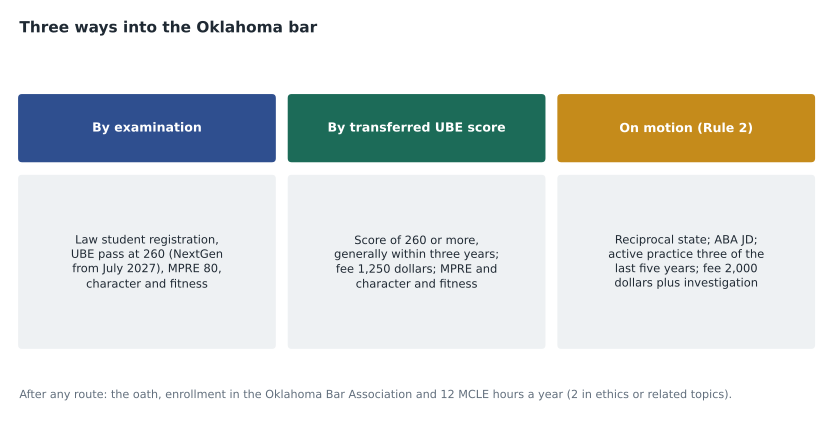
Wade Renfro has a friend from law school, Della Kincannon, who practices in Arkansas and is thinking of moving her practice to Fort Smith with an office across the river in Sallisaw. Wade asked Talia to find out how Della could become licensed in Oklahoma without sitting the bar exam again. Hollis thought it was a perfect assignment for the eleventh session, because it required Talia to understand all three routes into the Oklahoma bar and what happens after admission, whichever route a lawyer takes.
Admission by transferred UBE score
A lawyer or graduate who earned a UBE score in another jurisdiction can ask Oklahoma to accept that score instead of sitting the exam again. NCBE's chart for Oklahoma lists the requirements: a legacy UBE score of at least 260, earned within the past three years, with no separate jurisdiction-specific component, and a fee of 1,250 dollars. Oklahoma also began accepting transferred NextGen scores with the July 2026 administration, though the minimum NextGen score had not been announced as of November 2026. Oklahoma does not accept transferred MBE scores standing alone; the score must be a complete UBE score. Concurrent applications are allowed, so a candidate can apply to transfer a score while waiting for results elsewhere.
The admission rules frame this route for out-of-state attorneys who do not qualify for admission on motion. Under Rule 4, Section 1, such an attorney may be permitted either to take the Oklahoma exam or to transfer a verified UBE score from within the last three years, and must pay for an NCBE character report. Bar review providers note that a passing score between three and five years old may be considered in some cases if the applicant has practiced actively for at least two years; an applicant in that position should confirm the current rule with the Board before relying on it. Transferred-score applicants must also satisfy the MPRE requirement, a score of 80, and the character and fitness review, like every other applicant.
The score must meet Oklahoma's minimum, not the minimum of the jurisdiction where it was earned. Oklahoma's published requirement is stated as a minimum score of 260, so a 262 earned in another 260 jurisdiction plainly qualifies. An applicant whose score met 260 but did not pass in a jurisdiction with a higher minimum should confirm with the Board, before relying on it, that Oklahoma will accept it. Oklahoma's three-year limit is measured from the exam date, so an applicant planning a move should calculate it carefully.
Admission on motion under Rule 2
Lawyers with practice experience may qualify for admission without examination under Rule 2. The current text of the rule, as last amended in 2025, requires that the applicant have graduated from an ABA-approved law school; be lawfully admitted, in good standing and on active status in a reciprocal state, meaning a state that grants Oklahoma lawyers admission on motion; and have practiced law actively and continuously for at least three of the five years immediately before applying, under that state's supervision and discipline. Years of practice in more than one reciprocal state may be combined.
Qualifying practice is defined broadly. It includes private practice, in-house practice for a corporation or other organization, practice for a government agency, certain judicial and law clerk positions, and full-time teaching at an ABA-approved law school. The applicant must document the practice and the licenses with the proof the Board requires, use the Board's forms, and pay for an NCBE character report. NCBE lists the fee for admission on motion as 2,000 dollars plus the character and fitness fee.
Reciprocity limits the rule in two ways. First, if the applicant's home state imposes stricter requirements or higher fees on Oklahoma lawyers seeking admission there, those stricter requirements or higher fees apply to the applicant in Oklahoma. Second, practice in a state that is not reciprocal does not count at all and cannot be combined with practice in a reciprocal state. An applicant who practiced two years in a reciprocal state and two years in a non-reciprocal state does not have three qualifying years.
Talia noticed that one of NCBE's charts listed the motion requirement as five of the last seven years in one place and three of the last five in another. The rule's current text says three of five, so Talia relied on the rule and noted the inconsistency in her memo to Wade. Hollis approved. 'Charts are summaries,' she said. 'When a summary and a rule disagree, the rule wins, and a careful lawyer says so in writing.'
| Requirement | Transferred UBE score | Admission on motion (Rule 2) |
|---|---|---|
| Legal education | ABA-approved JD | ABA-approved JD |
| Licensure elsewhere | Not required for graduates; attorneys apply under Rule 4, Section 1 | Active, in good standing in a reciprocal state |
| Score or practice | UBE score of 260 or more, generally within three years | Active practice three of the last five years in reciprocal states |
| MPRE | Scaled score of 80 | Passing MPRE required |
| Character and fitness | Yes, with NCBE report | Yes, with NCBE report |
| Fee (NCBE chart) | 1,250 dollars | 2,000 dollars plus character and fitness fee |
Della's answer
Talia's memo for Wade worked through Della's facts. Della graduated from an ABA-approved law school, has been licensed and in active practice in Arkansas for six years, and is in good standing. If Arkansas is a reciprocal state for Oklahoma, which Talia flagged as the first thing to confirm with the Board, Della would meet the three-of-five-year requirement and could apply on motion. She would need to document her practice, pay the motion fee and the NCBE report, show a passing MPRE score, and complete the character and fitness review. If Arkansas were not reciprocal, Della could instead transfer her UBE score only if it was earned within the time limit, which a six-year-old score would not be, or sit the Oklahoma exam.
Special permits and limited practice
Rule 2 also provides for the spouse of a member of the armed forces who is stationed in Oklahoma on military orders. Such a spouse may seek a special temporary permit to practice without examination if the spouse has an ABA-approved JD, is in good standing in the jurisdictions where licensed, has passed the MPRE, completes a background investigation, takes the oath and signs the roll. No application fee is charged for the permit. The permit ends if the service member's or spouse's military status ends or if the service member is transferred out of Oklahoma.
Lawyers licensed elsewhere may also appear in a particular Oklahoma case with the court's permission, usually in association with a local lawyer, and law students may practice in limited ways under Oklahoma's legal internship rules. These forms of permission are narrow and do not substitute for admission.
The oath and the Roll of Attorneys
Whatever the route, admission ends with the oath and the signing of the Roll of Attorneys. For applicants admitted by examination, admission must be completed within one year after passing unless the Board extends the time. After admission, the new lawyer becomes a member of the Oklahoma Bar Association and pays annual dues. The Bar Association assigns a bar number and maintains the official membership records, including contact information that the lawyer must keep current.
Continuing legal education
Oklahoma's Mandatory Continuing Legal Education rules require each active member to complete 12 hours of approved CLE each calendar year. Since January 1, 2021, at least two of the 12 hours must be in legal ethics and professionalism, legal malpractice prevention, or mental health and substance use disorders. Hours above the annual minimum may be carried forward, but only into the next calendar year. The compliance period ends on December 31, and each lawyer must file an annual report by February 15 of the following year; many CLE providers report attendance directly, and the Commission sends notices to lawyers whose records show a shortfall. Newly admitted lawyers are exempt for the remainder of the calendar year in which they are first admitted.
Talia did the arithmetic for herself. If she passes in February 2027 and is admitted in the spring of 2027, she is exempt for the rest of 2027. Her first full CLE year is 2028: 12 hours, two of them in ethics or the related categories, completed by December 31, 2028 and reported by February 15, 2029. Hollis suggested she aim for a few extra hours in 2028 and carry them into 2029, because the first years of practice are when CLE on Oklahoma-specific topics is most useful.
Professional habits for the first year
Hollis closed with advice she gives every newly admitted lawyer. Set up a calendar system with redundant reminders for limitations periods, notice deadlines and appeal deadlines; in Oklahoma that means the two-year injury period, the one-year and 180-day Governmental Tort Claims Act deadlines and the 30-day petition in error deadline at a minimum. Learn the firm's trust account procedures in the first week, and never disburse client funds before the deposit has cleared. Find a mentor outside the firm, perhaps through the Bar Association's programs, who can answer questions a lawyer may not want to ask a supervising partner. Keep a list of the Oklahoma rules that differ from what the bar exam taught. And use the Bar Association's ethics resources before acting, not after.
Malpractice insurance and practice management
Oklahoma does not require lawyers in private practice to carry malpractice insurance, but most firms do, and a new lawyer should know whether she is covered under the firm's policy and what the policy requires her to report. Oklahoma lawyers must also comply with rules on advertising and solicitation, client file retention and the handling of unclaimed trust funds. The Bar Association's practice management resources are aimed at exactly the kinds of small firms where many new Oklahoma lawyers begin.
Moving away later
Some new Oklahoma lawyers will eventually want to practice in another state. The same three routes exist almost everywhere: a new exam, a transferred UBE or NextGen score within that state's time limit, or admission on motion after enough years of practice. A lawyer who passes in Oklahoma with a score of 260 to 265 should remember that some states require 266 or 270 for a transferred score. Admission on motion in most states requires several years of active practice and, often, reciprocity with Oklahoma. Keeping careful records of practice, good standing and CLE from the first year makes any later move much easier.
A note on timing for transfer applicants
Transfer and motion applications are not instant. The Board must receive the score from NCBE or verify the applicant's practice and licenses, the NCBE character report must be completed, and the Board must review the file. Applicants who are relocating for a job should start the process months before they need to be licensed and should ask the employer whether they may work under supervision in a non-lawyer role until admission. A lawyer who practices in Oklahoma before admission, even informally, risks both the unauthorized practice of law and a character and fitness problem in her own application.
Talia added a line to her memo for Wade suggesting that Della file her Oklahoma application as soon as she decides to move, collect letters confirming her good standing from Arkansas and every other jurisdiction where she is licensed, and keep a record of her practice that matches the categories in Rule 2. Wade forwarded the memo to Della the same afternoon.
Inactive status and returning
Oklahoma lawyers who stop practicing can generally move to inactive or senior status with lower dues and no CLE obligation, and later seek reinstatement to active status by meeting the Bar Association's requirements, which may include catching up on CLE. A lawyer considering a break, for example for family reasons or a job outside law, should read the rules before changing status, because the steps to return depend on how long the lawyer was inactive and what she did in the meantime.
Worked problem
Three applicants from out of state
Applicant A passed the UBE in Kansas in July 2024 with a 268 and has never practiced. Applicant B has practiced in a reciprocal state for four years after graduating from an ABA-approved school. Applicant C has practiced for four years, two in a reciprocal state and two in a non-reciprocal state.
Show solution
- Applicant A can transfer the 268 to Oklahoma as long as the application is made within three years of the July 2024 exam; the score exceeds 260.
- Applicant B meets Rule 2's three-of-five-year requirement and can apply on motion, subject to any stricter requirements her home state imposes on Oklahoma lawyers.
- Applicant C has only two years of qualifying practice; non-reciprocal practice cannot be combined. She must transfer a qualifying score or sit the exam.
Answer: A transfers, B applies on motion, and C must use a score or the exam.
Common mistakes
MistakeOklahoma accepts a transferred MBE score.
InsteadOklahoma does not accept transferred MBE scores; it requires a complete UBE score.
MistakePractice anywhere counts toward admission on motion.
InsteadOnly practice in reciprocal states counts, and it cannot be combined with non-reciprocal practice.
MistakeNew Oklahoma lawyers owe 12 CLE hours in the year of admission.
InsteadNewly admitted lawyers are exempt for the rest of the calendar year of admission.
MistakeExtra CLE hours carry forward indefinitely.
InsteadExcess hours carry forward only into the next calendar year.
Practice problems
Work each problem on paper first, then reveal the answer to check.
What is the minimum transferred legacy UBE score Oklahoma accepts?
Show answer
260, generally earned within the past three years.
How much practice does Rule 2 require?
Show answer
Active, continuous practice for at least three of the five years before applying, in reciprocal states.
How many CLE hours must an Oklahoma lawyer complete each year?
Show answer
12, including at least two in ethics and professionalism, malpractice prevention, or mental health and substance use.
When is the annual MCLE report due?
Show answer
By February 15 of the following year.
Summary and key terms
- Oklahoma accepts transferred UBE scores of 260 or more, generally within three years, and began accepting NextGen scores in July 2026.
- Rule 2 admits lawyers from reciprocal states with an ABA JD and three of the last five years of active practice; home-state requirements may apply.
- Military spouses may obtain a special temporary permit without examination.
- All routes end with the oath, the Roll of Attorneys and mandatory Bar Association membership.
- MCLE requires 12 hours a year (2 in ethics or related topics), a December 31 deadline, a February 15 report, one-year carryover and a first-year exemption.
- Reciprocal state
- A state that grants Oklahoma lawyers admission on motion, whose lawyers may use Oklahoma Rule 2.
- Transferred UBE score
- A UBE score earned in one jurisdiction and used for admission in another.
- Special temporary permit
- Permission for a military spouse stationed in Oklahoma to practice without examination.
- MCLE
- Mandatory continuing legal education, administered by the Oklahoma Bar Association's MCLE Commission.
Lesson quiz · 5 questions
Score 60% or more to complete this lesson.
Create a free account to save your progress, take quizzes and earn a certificate.