
BAR-237 · Lesson 10 of 12 · 19 min
Indian country jurisdiction and the Oklahoma Rules of Professional Conduct
▶ Video coming soon A video version of this lesson is on the way.
Talia saw Indian country jurisdiction from two sides. As a citizen of the Cherokee Nation, she had grown up with the Nation's courts, its government and its services as part of ordinary life. As a law clerk in Tulsa, she now saw clients whose cases turned on whether an event happened inside a reservation and whether the people involved were Indian. 'No other state's bar course would need this lesson,' Hollis said when Talia proposed it. 'In Oklahoma, a new lawyer who does not understand it can give a client the wrong answer about which court even has power over the case.' They paired it with the Oklahoma Rules of Professional Conduct, because both topics come down to the same habit: checking the rule before acting.
McGirt v. Oklahoma
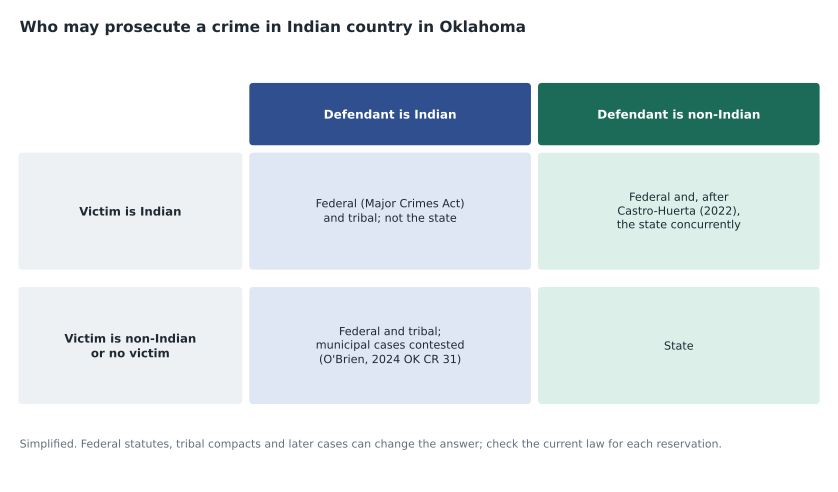
In McGirt v. Oklahoma, decided by the Supreme Court of the United States in July 2020, the Court held that the reservation Congress established for the Muscogee (Creek) Nation in the nineteenth century had never been disestablished by Congress and therefore remained Indian country for purposes of the federal Major Crimes Act. Because the crime in that case was committed by an Indian within the reservation, the State of Oklahoma lacked jurisdiction to prosecute it; jurisdiction belonged to the federal government (and, for many offenses, the tribe). The decision rested on a simple principle: only Congress can disestablish a reservation, and it must do so clearly.
The reasoning of McGirt applied to other nations with similar treaty and statutory histories. The Oklahoma Court of Criminal Appeals soon recognized that the reservations of the Cherokee, Chickasaw, Choctaw and Seminole Nations, as well as several others, also had not been disestablished. Hogner v. State, 2021 OK CR 4, for example, applied McGirt to the Cherokee Nation reservation. Together the reservations recognized after McGirt cover much of eastern Oklahoma, including most of Tulsa.
Limits and later decisions
Several later decisions defined McGirt's reach. In State ex rel. Matloff v. Wallace, decided in August 2021, the Court of Criminal Appeals held that McGirt does not apply retroactively to state convictions that were already final when it was decided, so it did not reopen thousands of old cases on collateral review. In Oklahoma v. Castro-Huerta, decided in 2022, the Supreme Court of the United States held that the federal government and the state have concurrent jurisdiction to prosecute crimes committed by non-Indians against Indians in Indian country, rejecting the view that such jurisdiction was exclusively federal.
The most contested questions since then involve municipal prosecutions of Indians. In City of Tulsa v. O'Brien, 2024 OK CR 31, the Court of Criminal Appeals held that the City of Tulsa could prosecute an Indian for a municipal offense within the Muscogee (Creek) reservation, relying in part on the Curtis Act of 1898. A federal district court reached the opposite view in a case involving the City of Henryetta in May 2024. In Stitt v. City of Tulsa, the Court of Criminal Appeals in 2025 again upheld a Tulsa traffic conviction of a Cherokee Nation citizen, and the Supreme Court of the United States denied review on October 6, 2025. These questions remained in active litigation in 2026, including federal suits filed by the Cherokee Nation in November 2025 and by the Muscogee (Creek) Nation in 2026 over state enforcement on their reservations; in June 2026 the federal court denied the state's motions to dismiss both suits.
Civil and tax questions
McGirt was a criminal case, but it raised civil questions too. The Supreme Court of Oklahoma, not the Court of Criminal Appeals, decides most of them. In Stroble v. Oklahoma Tax Commission, decided in 2025, the Supreme Court of Oklahoma held that McGirt did not exempt a tribal citizen living and working within a reservation from Oklahoma income tax; the Supreme Court of the United States denied review in April 2026. Questions about hunting and fishing regulation, family law, taxation of businesses and regulatory authority continue to arise. In December 2025 the Oklahoma Attorney General issued an opinion concluding that federal law preempts state enforcement of state hunting and fishing licensing against tribal members on certain reservations, and that position became part of a dispute with the Governor that reached the Supreme Court of Oklahoma in 2026.
Tribal courts in Oklahoma exercise substantial jurisdiction over civil matters involving their citizens and their lands, including family, probate and contract matters, and many tribes have their own codes, bar admission processes and court rules. Oklahoma has statutes and court rules on the recognition of tribal court judgments, and many Oklahoma lawyers are admitted to practice in one or more tribal courts as well as the state courts.
The practical checklist
Hollis asked Talia to reduce the subject to a checklist for a new lawyer in a general practice. Talia offered four questions. Where did the event occur, and is that location within a reservation or other Indian country? Is any party, especially the defendant in a criminal matter, an enrolled member of a federally recognized tribe or otherwise Indian under federal law? What is the type of matter: criminal, civil, tax, family or regulatory? And what is the most recent controlling decision on that type of matter from the right court: the Supreme Court of the United States, the Court of Criminal Appeals, the Supreme Court of Oklahoma or the federal courts? 'If you ask those four questions every time,' Hollis said, 'you will not give a client an answer that ignores half the map.'
| Question | Why it matters |
|---|---|
| Where did it happen? | Reservations recognized after McGirt cover much of eastern Oklahoma, including most of Tulsa |
| Is a party Indian? | Federal criminal statutes and many civil rules turn on Indian status |
| What kind of matter is it? | Criminal, civil, tax and regulatory questions have different answers and different deciding courts |
| What is the latest controlling decision? | The law has changed repeatedly since 2020 and remained in litigation in 2026 |
The Oklahoma Rules of Professional Conduct
Turning to professional conduct, Oklahoma's rules are the Oklahoma Rules of Professional Conduct, adopted by the Supreme Court of Oklahoma and based closely on the ABA Model Rules. The current version took effect in 2008 and has been amended since. For most purposes, a lawyer who knows the Model Rules from law school and the MPRE knows the structure and much of the content of Oklahoma's rules. The differences are mostly in the details of administration, and the most important for a new lawyer are the trust account rules.
Trust accounts
Oklahoma Rule 1.15 governs safekeeping of property. A lawyer must keep client and third-party funds separate from the lawyer's own funds, in a trust account, and must keep complete records of those funds and preserve them for five years after the representation ends. Funds that are nominal in amount or held for a short time must be placed in an interest-bearing IOLTA account at an approved institution; the interest goes to the Oklahoma Bar Foundation for charitable law-related purposes. A lawyer must consider whether particular funds could earn a positive net return for the client and, if so, hold them in a separate interest-bearing account with interest payable to the client.
Oklahoma also has a strong overdraft reporting system. To be an approved institution for lawyer trust accounts, a bank must sign a Trust Account Overdraft Reporting Agreement and report to the Bar any instrument presented against insufficient funds in a trust account, whether or not the bank honors it. Every lawyer admitted in Oklahoma is deemed to have consented to that reporting. And a lawyer must report to the Oklahoma Bar Association the name of the bank, the account name and the account number of each trust account within 30 days of opening, closing or changing it. Hollis noted that overdraft reports are one of the most common ways trust account problems come to light in every state, and that most of them begin with sloppy bookkeeping rather than theft.
Lawyer discipline
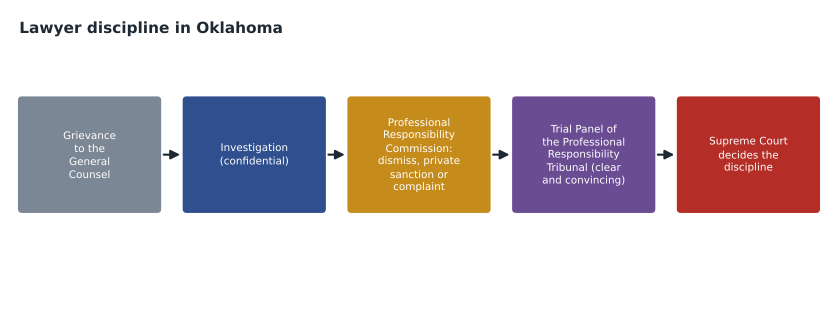
Discipline of Oklahoma lawyers is governed by the Rules Governing Disciplinary Proceedings, adopted by the Supreme Court of Oklahoma, which has original and exclusive jurisdiction over discipline. Grievances go to the General Counsel of the Oklahoma Bar Association, who investigates them. Investigations are confidential. The Professional Responsibility Commission, made up of five lawyers and two non-lawyers, reviews the results and may dismiss a grievance, issue a private reprimand or letter of admonishment, or direct that a formal complaint be filed. For lesser misconduct, the General Counsel may refer a lawyer to a diversion program instead, but not in cases involving misappropriation, dishonesty, serious crimes or prejudice to clients.
Formal complaints are tried before a three-member Trial Panel of the Professional Responsibility Tribunal, two lawyers and one non-lawyer drawn from a larger panel of masters. The charges must be proven by clear and convincing evidence, and hearings are public. The Trial Panel reports its findings and recommendation to the Supreme Court, which decides the discipline: disbarment, suspension for a definite term or until further order, public censure or private reprimand, sometimes with conditions. A lawyer convicted of a crime showing unfitness to practice is subject to summary discipline, including immediate interim suspension. A disbarred lawyer may not petition for reinstatement for five years, and the lawyer bears a clear and convincing burden to show fitness.
Ethics resources
The Oklahoma Bar Association offers ethics guidance to its members, including formal ethics opinions and an ethics counsel who can discuss a lawyer's own prospective conduct. Advice from ethics counsel is not binding on the disciplinary system, but a lawyer who seeks guidance before acting and follows it is in a far better position than one who guesses. Talia had already used the Bar's published opinions twice at Wade's request, once on whether the firm could accept a referral fee and once on how long to keep closed files.
Where the two halves meet
Hollis pointed out that the two halves of the lesson share a lesson of their own. In both areas, the law changes and the details matter. A lawyer who assumes that a criminal charge in Tulsa belongs in state court, or that a trust account can be reconciled whenever there is time, will eventually be wrong in a way that harms a client. The cure in both cases is the same: check the current rule, document what you did, and ask for help when the answer is not clear. 'That is the professional responsibility lesson,' she said. 'The rules are the floor. The habit of checking is the profession.'
Worked problem
A traffic ticket and a trust account
A Cherokee Nation citizen receives a City of Tulsa speeding ticket within the Muscogee (Creek) reservation and asks Wade whether the city can prosecute her. The same week, Wade's bank notifies the Bar of an overdraft on the firm's trust account caused by a deposit that had not yet cleared.
Show solution
- On the ticket, the Court of Criminal Appeals upheld Tulsa's authority to prosecute Indians for municipal offenses in O'Brien (2024 OK CR 31) and Stitt (2025), and the Supreme Court of the United States denied review in Stitt in October 2025; a federal court in the Henryetta case took a different view, and related federal suits remained pending in 2026.
- Wade should advise that, in state and municipal courts, current Court of Criminal Appeals precedent supports the city, while explaining that the question remains contested in federal litigation.
- On the overdraft, Rule 1.15 deems Oklahoma lawyers to have consented to overdraft reporting; the Bar will ask for an explanation.
- Wade should promptly reconstruct the transaction, show that client funds were not misused, correct the practice that caused it (disbursing before deposits clear), and keep the records.
Answer: Both matters call for checking the current controlling authority and documenting the facts.
Common mistakes
MistakeMcGirt applies only to the Muscogee (Creek) Nation.
InsteadIts reasoning has been applied to the Cherokee, Chickasaw, Choctaw, Seminole and other reservations.
MistakeMcGirt reopened every final state conviction.
InsteadMatloff (2021) held it does not apply retroactively to convictions final before McGirt.
MistakeAfter McGirt, the state cannot prosecute anyone in Indian country.
InsteadCastro-Huerta (2022) recognized concurrent state jurisdiction over non-Indians who commit crimes against Indians, and the state always had jurisdiction over crimes between non-Indians.
MistakeAn Oklahoma lawyer may keep trust account records for three years.
InsteadOklahoma Rule 1.15 requires five years after the representation ends.
Practice problems
Work each problem on paper first, then reveal the answer to check.
What did McGirt v. Oklahoma hold?
Show answer
The Muscogee (Creek) reservation was never disestablished, so it remains Indian country under the Major Crimes Act.
Which case recognized concurrent state jurisdiction over non-Indians for crimes against Indians in Indian country?
Show answer
Oklahoma v. Castro-Huerta (2022).
How long must Oklahoma lawyers keep trust account records?
Show answer
Five years after the representation ends.
Who decides discipline of Oklahoma lawyers?
Show answer
The Supreme Court of Oklahoma, after proceedings before the Professional Responsibility Commission and Tribunal.
Summary and key terms
- McGirt (2020) held the Muscogee (Creek) reservation was never disestablished; its reasoning applies to several other reservations covering much of eastern Oklahoma.
- Matloff limited retroactivity; Castro-Huerta recognized concurrent state jurisdiction over non-Indians; municipal jurisdiction over Indians remains contested.
- Civil and tax questions are decided mostly by the Supreme Court of Oklahoma; Stroble (2025) upheld state income tax on a tribal citizen.
- The Oklahoma Rules of Professional Conduct follow the Model Rules; Rule 1.15 requires five-year records, IOLTA, overdraft reporting and account reporting.
- Discipline runs from the General Counsel through the Professional Responsibility Commission and Tribunal to the Supreme Court.
- Indian country
- A federal legal term that includes reservations, dependent Indian communities and Indian allotments.
- Disestablishment
- Congress's clear act ending a reservation's status; only Congress can do it.
- Major Crimes Act
- The federal statute giving federal courts jurisdiction over listed serious crimes by Indians in Indian country.
- IOLTA
- Interest on Lawyers' Trust Accounts; in Oklahoma, interest goes to the Oklahoma Bar Foundation.
- Professional Responsibility Tribunal
- The panel of masters from which Trial Panels hear formal disciplinary complaints.
Lesson quiz · 5 questions
Score 60% or more to complete this lesson.
Create a free account to save your progress, take quizzes and earn a certificate.