
BAR-216 · Lesson 11 of 12 · 16 min
Score transfer, admission on motion and practice after admission in Iowa
▶ Video coming soon A video version of this lesson is on the way.
Two people in Marchetti's wider circle are coming to Iowa by routes other than the February exam. One is a lawyer who has practiced in Illinois for nine years and is moving to Davenport to join a firm in the Quad Cities. The other is a recent graduate who sat the July 2026 NextGen exam in Missouri, scored 624 and has just accepted a job in Des Moines. Amos asks Marchetti how each of them gets an Iowa license. 'Different doors to the same room,' she says. 'And once you are in the room, the rules are the same for all of you.'
This lesson covers the routes to an Iowa license other than sitting the Iowa exam, chiefly admission by transferred score and admission on motion, and the duties every Iowa lawyer has after admission: the oath, the annual report and fee, continuing legal education, trust account compliance and the other obligations that keep a license active.
Admission by transferred score
Rule 31.4 of the Iowa Court Rules allows an applicant to be admitted on the strength of a Uniform Bar Examination score earned in another jurisdiction. The rule accepts both legacy and NextGen scores, with minimums that depend on the type and date of the exam. For a legacy UBE score from an exam given on or before July 1, 2026, the minimum is 266. For a legacy score from an exam given after July 1, 2026, the minimum is 260. For a NextGen score, the minimum is 610.
The rule also limits how old the score may be. An applicant without prior legal practice must transfer a score from an exam given within the two years immediately preceding the date the transfer application is filed. An attorney applicant may transfer a qualifying score up to five years after the exam was taken, but only with proof of regular practice in at least two of the last three years. The time limit is measured from the exam to the application, so an applicant close to the two-year line should file promptly.
Other requirements mirror those for admission by examination. The applicant must have a J.D. or LL.B. from a law school approved by the ABA at the time of graduation, shown by the dean's affidavit; must have earned a scaled score of at least 80 on the MPRE; must not have been denied admission or permission to sit for a bar exam by any jurisdiction on character and fitness grounds; and must satisfy the board's character and fitness review. The applicant must cause NCBE to transfer the score to Iowa no later than three months after the application is filed. The application carries a nonrefundable administrative fee of 900 dollars, plus any vendor fee and, if the board requires one, the cost of an NCBE character report.
Once the board grants a transfer application, the applicant must satisfy all requirements for admission within one year of the written notice granting the application or of any conditions imposed, though the board may extend that period for good cause. In practice that means completing the character and fitness process and taking the oath within the year.
| Score type | Exam date | Minimum score | How old the score may be |
|---|---|---|---|
| Legacy UBE | On or before July 1, 2026 | 266 | Two years; five years for attorneys with regular practice in two of the last three years |
| Legacy UBE | After July 1, 2026 | 260 | Two years; five years for qualifying attorneys |
| NextGen | Any NextGen administration | 610 | Two years; five years for qualifying attorneys |
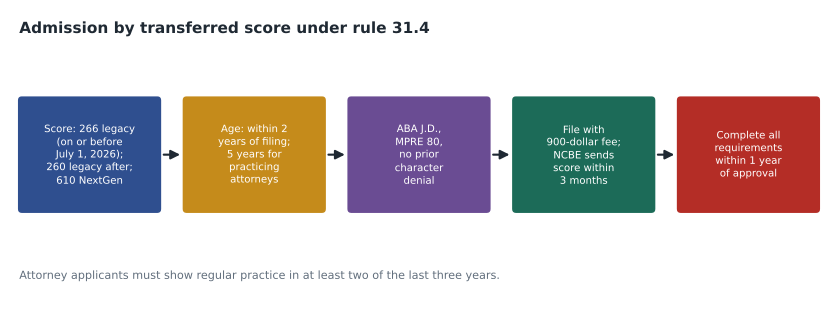
Applying the transfer rule
The recent graduate in Marchetti's circle fits the rule neatly. She sat the NextGen exam in Missouri in July 2026 and scored 624, above Iowa's 610 minimum. She has no prior practice, so she must file within two years of the exam, by July 2028. She has an ABA-approved J.D. and an MPRE score of 92. She files her application in October 2026, asks NCBE to send her score and expects to be sworn in by the spring once character and fitness is complete. She does not need to take any Iowa-specific course or test, because Iowa has no jurisdiction component for transferred scores.
The rule also works in the other direction. A score earned on Iowa's February 2027 exam can be transferred to other UBE jurisdictions, subject to each jurisdiction's own minimum and time limit. Amos, if he passes, will have a portable legacy score that he could use in another jurisdiction during the period that jurisdiction allows.
Admission on motion
Rule 31.12 allows experienced lawyers admitted in another United States jurisdiction to be admitted without an exam. The central requirement is practice: the applicant must have been primarily engaged in the active practice of law for at least five of the seven years immediately before applying. The applicant must also be in good standing everywhere admitted, must meet the rule's education and MPRE requirements and must satisfy the board on character and fitness. The fee is 900 dollars plus the character and fitness fee.
The Illinois lawyer moving to Davenport has nine years of practice and a clean record, so admission on motion is likely his best route. He gathers certificates of good standing, documentation of his practice over the last seven years and his MPRE score, and files with the Office of Professional Regulation. Because the board investigates every applicant, he should expect the same kind of character and fitness review that bar exam applicants receive, including an NCBE report if the board requests one.
Applicants should read the current text of rule 31.12 carefully before filing. It defines what counts as the practice of law for this purpose, treats some kinds of practice differently and excludes applicants in certain situations, such as some who have failed the Iowa bar exam. Those details change from time to time, and the board's staff can answer questions about a particular history.
Other ways to practice in Iowa
Some lawyers need permission to practice in Iowa without full admission. In-house lawyers employed by an Iowa business who are admitted elsewhere may register as house counsel, which allows them to advise their employer but not to appear in court or represent others. Lawyers admitted elsewhere may appear in a particular Iowa case by permission of the court under the pro hac vice rules, usually with local counsel. Iowa's rules also provide for military spouse licensing and for supervised practice by law students and recent graduates. Each route has its own requirements in chapter 31 of the Iowa Court Rules.
Taking the oath
After the board recommends an applicant and the court approves admission, the applicant takes the oath of admission and signs the roll of attorneys. Iowa holds admission ceremonies at the Iowa Supreme Court in Des Moines, and applicants may also be sworn in before a judge elsewhere in some circumstances. The oath includes a promise to support the constitutions of the United States and of Iowa and to discharge the duties of an attorney faithfully. Amos hopes to be sworn in during the spring of 2027 if he passes in February.
Duties after admission
Admission is the beginning of a set of continuing obligations administered by the Office of Professional Regulation. Every Iowa lawyer must file an annual report and pay an annual fee by the deadline the office sets. The report collects information about the lawyer's practice status, trust accounts and CLE compliance, among other things, and the fee supports the Client Security Commission and the disciplinary system. A lawyer who fails to comply may be suspended by court order.
Continuing legal education is administered by the Commission on Continuing Legal Education under chapter 41 of the Iowa Court Rules. Iowa requires fifteen hours of accredited CLE each calendar year, including at least one hour of legal ethics and one hour of either attorney wellness or diversity and inclusion. Hours must come from accredited activities, and the rules limit how many hours may be earned through certain formats and allow some carryover. Lawyers who are not practicing may seek inactive status or an exemption from CLE under the rules.
| Duty | Source | What it requires |
|---|---|---|
| Annual report and fee | Office of Professional Regulation; Iowa Court Rules chapter 39 | File each year and pay the fee by the deadline |
| Continuing legal education | Iowa Court Rules chapter 41 | 15 hours each calendar year, including at least one hour of ethics and one hour of wellness or diversity and inclusion |
| Trust accounts | Rule 32:1.15 and chapter 45 | Keep client funds in trust; maintain records; submit to audits |
| Professional conduct | Iowa Rules of Professional Conduct, chapter 32 | Follow the rules; cooperate with the Attorney Disciplinary Board |
| Bar association | Iowa State Bar Association | Voluntary; not required for a license |
Support for new lawyers
Iowa offers several kinds of help to lawyers starting out. The Iowa State Bar Association, though voluntary, has a young lawyers division, practice-area sections and mentoring programs, and many new lawyers join for those reasons. The Iowa Lawyers Assistance Program offers confidential help with stress, substance use and mental health concerns. Iowa's law schools and the bar association offer bridge-the-gap programs on practical topics such as opening a trust account, handling a first probate matter and managing a calendar. Pettit makes every new lawyer at her firm attend one in the first year.
Worked problem
Can she transfer?
A lawyer sat the legacy UBE in Nebraska in February 2023 and scored 270. She has practiced in Omaha since her admission. In December 2026 she wants to join a firm in Council Bluffs. Can she transfer her score to Iowa, or should she apply on motion?
Show solution
- Her legacy score of 270 meets the 266 minimum that applies to exams on or before July 1, 2026.
- More than two years have passed since February 2023, so the two-year limit for applicants without prior practice does not help her.
- As an attorney, she may transfer up to five years after the exam if she has regularly practiced in at least two of the last three years, which she has.
- She would need to file before February 2028, with her ABA J.D., an MPRE of 80 or more and a clean character record.
- She has fewer than five years of practice, so admission on motion under rule 31.12 is not yet available.
Answer: She can transfer her score as an attorney applicant under rule 31.4, filing before the five-year limit.
Common mistakes
MistakeIowa accepts transferred scores of any age.
InsteadScores must generally come from an exam within two years of filing, or five years for attorneys with regular practice in two of the last three years.
MistakeIowa requires 266 for every transferred legacy score.
Instead266 applies to exams on or before July 1, 2026; 260 applies to legacy exams after that date; NextGen scores need 610.
MistakeAdmission on motion requires reciprocity with the other state.
InsteadIowa's rule focuses on five of the last seven years of active practice, good standing and character and fitness.
MistakeIowa lawyers must join the state bar association.
InsteadIowa State Bar Association membership is voluntary; the court and the Office of Professional Regulation regulate lawyers.
Choosing between transfer and motion
Some applicants qualify for both routes and must choose. A lawyer with a recent qualifying score and five years of practice might transfer the score or apply on motion. The requirements overlap but are not identical, and the right choice depends on the applicant's record, the time remaining on the score and the documents most readily available. Marchetti suggests that applicants in that position call the Office of Professional Regulation before filing, describe their situation and ask which application the board expects. A short call can prevent a wasted fee.
Practicing across state lines
Iowa sits between six states, and many Iowa lawyers practice in more than one. Lawyers in Council Bluffs often hold Nebraska licenses, lawyers in the Quad Cities often hold Illinois licenses and lawyers in Sioux City may hold licenses in Nebraska and South Dakota. A portable UBE or NextGen score makes it easier to qualify in a second UBE jurisdiction early in a career, while admission on motion becomes available later. Amos plans to stay in Cedar Rapids, but Marchetti tells him to keep his score report safe in case he needs it for a transfer within the time other jurisdictions allow.
Keeping a license in good standing
A license must be maintained. Lawyers who move away from practice, take a job outside the law or retire may change their status under the court's rules, and the reporting and CLE requirements differ by status. A lawyer who wants to return to active practice after a period of inactive status must follow the reinstatement steps, which may include making up CLE hours. Marchetti tells the group to read the rules on status changes before making a career change, not after, because the consequences of missing a step can include suspension.
Malpractice insurance
Iowa does not require lawyers in private practice to carry malpractice insurance, but the annual report asks whether a lawyer is covered, and many clients and firms expect it. New lawyers joining an established firm are usually covered by the firm's policy. A new lawyer opening a solo practice should obtain coverage before taking the first client, both to protect clients and to protect the lawyer's own finances.
Summary and key terms
- Rule 31.4 accepts transferred scores: 266 legacy on or before July 1, 2026; 260 legacy after; 610 NextGen.
- Scores must be from within two years of filing, or five years for attorneys with regular practice in two of the last three years.
- Transfer applicants need an ABA J.D., MPRE 80, a clean character record and the 900-dollar fee, and must finish within a year of approval.
- Rule 31.12 allows admission on motion after five of the last seven years of active practice.
- Every Iowa lawyer files an annual report, pays a fee and earns fifteen CLE hours each calendar year.
- Transferred score
- A UBE score earned in one jurisdiction and used for admission in another.
- Attorney applicant
- Under rule 31.4, a transfer applicant with regular practice in two of the last three years, who may use a score up to five years old.
- Admission on motion
- Admission without an exam for lawyers with substantial practice elsewhere.
- House counsel
- A lawyer admitted elsewhere who registers to advise an Iowa employer only.
- Pro hac vice
- Permission to appear in a single case in a jurisdiction where the lawyer is not admitted.
Lesson quiz · 5 questions
Score 60% or more to complete this lesson.
Create a free account to save your progress, take quizzes and earn a certificate.