
BAR-216 · Lesson 10 of 12 · 16 min
Iowa family law, probate and farm property
▶ Video coming soon A video version of this lesson is on the way.
On a Saturday in mid-November, Amos spends the morning with Lorna Pettit at a farmhouse outside Mount Vernon. The client, a widow in her seventies, owns 240 acres with her late husband's brother, rents them to a neighbor on a handshake lease and wants to make sure her grandchildren inherit the land. In two hours the conversation touches a will, a joint tenancy, a farm lease, a family dispute and an old divorce decree. On the drive back Pettit says, 'That is a normal Saturday in small-town Iowa practice. Family law, probate and land, all in one kitchen.'
This lesson gives an overview of three areas of Iowa law that general practitioners meet constantly: dissolution of marriage and related family matters under chapter 598 of the Iowa Code, wills and estates under the Iowa Probate Code in chapter 633, and the property rules that matter most in a farm state, including farm tenancies, homesteads and foreclosure. The legacy UBE does not test these Iowa rules, and family law and trusts and estates no longer appear on the MEE, though they may appear on the MPT with the law supplied. Family law joins the NextGen foundational concepts in July 2028. The value of this lesson is for the first year of practice.
Dissolution of marriage
Iowa calls divorce dissolution of marriage, and it is governed by chapter 598 of the Iowa Code. Iowa is a no-fault state: the only ground is that there has been a breakdown of the marriage relationship to the extent that the legitimate objects of matrimony have been destroyed and there remains no reasonable likelihood that the marriage can be preserved. Fault is generally not relevant to the decision to grant a dissolution, and Iowa courts give it little weight in dividing property or awarding support.
Procedurally, a petition is filed in the district court. If the respondent is not an Iowa resident and was not personally served in Iowa, the petitioner must generally have been an Iowa resident for one year. The court cannot enter a decree until ninety days after the respondent has been served, unless it waives the waiting period for good cause. Parties with children usually must attend a course on the effects of dissolution on children, and many districts require mediation of contested custody issues before trial.
Property division and spousal support
Iowa divides marital property equitably, not by community property rules. In practice, Iowa courts begin with the principle that an equal or nearly equal division is often equitable, and then adjust using the factors listed in section 598.21, such as the length of the marriage, each party's contributions, the age and health of the parties and their earning capacities. Property inherited by or given to one spouse, other than gifts between the spouses, is generally not divided unless refusing to divide it would be unjust to the other spouse or the children. Farmland that came to one spouse by inheritance is a frequent source of dispute in Iowa dissolutions for exactly that reason.
Iowa courts recognize several types of spousal support, sometimes called alimony: traditional support, usually for a long marriage in which one spouse cannot become self-supporting at a comparable standard of living; rehabilitative support, to allow a spouse to gain education or training; reimbursement support, to compensate a spouse who supported the other through education or training that increased the other's earning capacity; and transitional support, a shorter award to help a spouse adjust. The court considers the factors in section 598.21A.
Children: custody, care and support
Iowa law distinguishes legal custody, which concerns decision-making about a child's upbringing, from physical care, which concerns where the child lives. Courts favor joint legal custody unless there are clear and convincing reasons against it. On physical care, if either parent requests joint physical care, the court must consider it, and if it denies the request it must make specific findings explaining why joint physical care is not in the child's best interest. The child's best interests govern every decision, and the court considers factors listed in section 598.41.
Child support is calculated under the Iowa Child Support Guidelines, which the Iowa Supreme Court adopts and periodically revises in chapter 9 of the Iowa Court Rules. The guidelines use an income shares approach based on both parents' net incomes, with schedules for the number of children and adjustments for health insurance, child care and extraordinary visitation. Deviations from the guideline amount require written findings.
Marriage formation and related matters
Iowa recognizes common law marriage. A couple who intend to be married, who continuously cohabit and who publicly declare that they are husband and wife or spouses may be validly married without a license, and the dissolution of such a marriage requires a decree like any other. The party asserting a common law marriage bears the burden of proving it. Iowa lawyers see the issue most often in probate, when a surviving partner claims a spouse's share of an estate.
Wills and the Iowa Probate Code
Wills, estates, guardianships and conservatorships are governed by the Iowa Probate Code, chapter 633 of the Iowa Code. A valid will must be in writing, signed by the testator or by another person in the testator's presence and at the testator's direction, and witnessed by two competent persons who sign in the testator's presence and in each other's presence. Iowa allows a will to be made self-proved by the testator's and witnesses' affidavits, which simplifies probate. Iowa does not recognize holographic wills that are not witnessed, though a will executed elsewhere that was valid where made is generally recognized.
When a person dies without a will, Iowa's intestacy rules determine who inherits. In general, a surviving spouse takes the entire estate if all of the decedent's surviving children are also children of the surviving spouse. If the decedent has children who are not the surviving spouse's, the spouse takes a share and the children take the rest. Without a spouse, the estate passes to the decedent's descendants, then to parents and their descendants, under the order set out in the code.
A surviving spouse who is unhappy with the will may elect against it and take an elective share, which includes one-third of certain real and personal property of the decedent, along with other rights such as the homestead in some circumstances. The election must be made within the time the code allows. Iowa also offers a simplified procedure for small estates, which allows heirs to collect assets by affidavit when the value is below a statutory limit that the legislature has raised over the years, and a summary administration for some modest estates.
| Topic | Iowa rule | Where to find it |
|---|---|---|
| Will formalities | Writing, signature, two witnesses signing in the presence of the testator and each other | Iowa Code chapter 633 |
| Self-proved will | Allowed by affidavit | Iowa Code chapter 633 |
| Intestacy with spouse | Spouse takes all if all children are also the spouse's | Iowa Code chapter 633 |
| Elective share | Includes one-third of certain property | Iowa Code chapter 633 |
| Inheritance tax | Repealed for deaths on or after January 1, 2025 | Iowa Code chapter 450, phased out by 2021 legislation |
| Estate tax | None at the state level | Federal estate tax may apply |
The end of the Iowa inheritance tax
For more than a century Iowa taxed inheritances received by some beneficiaries, though surviving spouses, children and other lineal descendants had long been exempt. Legislation enacted in 2021 phased the tax out, reducing it in steps and repealing it for deaths occurring on or after January 1, 2025. Iowa has no separate state estate tax. Older Iowa estates still being administered may involve inheritance tax returns, but for new estates the question is gone, which simplifies the advice Iowa lawyers give to families.
Farm tenancies
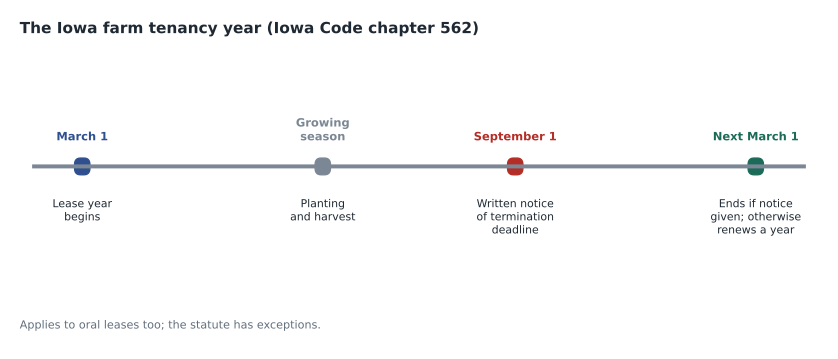
Much of Iowa's farmland is rented, and Iowa law gives farm tenants an important protection. Under chapter 562 of the Iowa Code, a farm tenancy continues from year to year on the same terms unless either party gives written notice of termination by September 1, in which case the tenancy ends on March 1 of the following year. This rule applies even to oral, handshake leases like the one Pettit's client has with her neighbor. A landowner who wants to change tenants or terms for the next crop year must serve notice on time and in the manner the statute requires, or the lease rolls over for another year.
The September 1 deadline shapes Iowa farm practice. Lawyers advising landowners keep a calendar of notices due each August, and lawyers advising buyers of farmland confirm whether a tenant's lease has been properly terminated before closing. The statute contains exceptions, for example for certain written leases and small tracts, which are worth reading before relying on the rule.
Homesteads and foreclosure
Iowa protects a homestead from most creditors under chapter 561 of the Iowa Code. The homestead exemption is unlimited in value but limited in area: generally up to one-half acre in a city or up to forty acres outside one. Both spouses must join in a conveyance or mortgage of the homestead. Mortgage foreclosure in Iowa is usually judicial, followed by a sheriff's sale, and the debtor may have a period of redemption after the sale under chapter 628, which can be shortened or waived in some circumstances. Iowa also provides a nonjudicial voluntary foreclosure procedure under chapter 654 and an alternative nonjudicial procedure under chapter 655A, each with its own conditions.
Worked problem
Advising the widow
Pettit's client and her late husband's brother own the 240 acres as joint tenants with right of survivorship. She wants her grandchildren to inherit her interest, and she wants to change the farm tenant next year. What should Pettit advise?
Show solution
- As a joint tenant, her interest passes to the surviving joint tenant at death, not by will, so a will alone will not reach the grandchildren.
- She may sever the joint tenancy by conveying her interest, creating a tenancy in common that she can leave by will or place in a trust.
- Because Iowa has repealed its inheritance tax for deaths after 2024, the grandchildren would owe no Iowa inheritance tax; federal estate tax depends on the size of the estate.
- To change tenants, she must serve written notice of termination on the current tenant by September 1, ending the tenancy on the following March 1.
Answer: Sever the joint tenancy, plan the transfer by will or trust, and serve farm lease notice by September 1.
Common mistakes
MistakeIowa is a community property state.
InsteadIowa divides property equitably under chapter 598, often near equally, and generally excludes inherited and gifted property.
MistakeA handshake farm lease can be ended at any time.
InsteadUnder chapter 562 it renews yearly unless written notice is given by September 1, ending the tenancy on March 1.
MistakeIowa families must still plan for Iowa inheritance tax.
InsteadThe tax was repealed for deaths on or after January 1, 2025.
MistakeIowa does not recognize common law marriage.
InsteadIowa does recognize it, if intent, continuous cohabitation and public declaration are proved.
Farm succession and estate planning
Iowa estate planning often centers on farmland. A family that wants to keep land in the family must plan for how ownership passes, who will farm it and how children who do not farm will be treated fairly. Common tools include wills, revocable trusts, limited liability companies that hold the land, buy-sell agreements among family members and long-term leases to the farming child. With the Iowa inheritance tax repealed, the main tax questions for most families are federal income tax issues, such as the basis adjustment at death, and, for larger estates, federal estate tax.
Pettit warns new lawyers against a common mistake: relying on joint tenancy as a substitute for an estate plan. Joint tenancy can be useful between spouses, but between siblings or other relatives it often leads to results the owners did not intend, because the last survivor takes the whole property and can leave it to anyone. When a client owns land in joint tenancy with someone other than a spouse, the lawyer should ask what the client actually wants and whether severing the joint tenancy or using a trust would serve those wishes better.
Probate administration in practice
When an Iowa estate is opened, the court appoints an executor named in the will or, without a will, an administrator. The personal representative gives notice to heirs, beneficiaries and creditors, collects and inventories the assets, pays valid claims, expenses and taxes and distributes the remainder. Creditors must file claims within the time set by the probate code after notice is published. The personal representative files a final report, and the court closes the estate. Iowa probate practice is largely paper-based within the electronic filing system, with standard forms that experienced practitioners use routinely.
Guardianships and conservatorships
The probate code also governs guardianships, which concern decisions about an adult's or a minor's personal care, and conservatorships, which concern management of property. Iowa revised its adult guardianship and conservatorship laws significantly in 2019, emphasizing the least restrictive form of intervention, requiring consideration of alternatives such as powers of attorney and expanding the rights of the person subject to the proceeding. New Iowa lawyers often see these cases through court appointments or in family practice, and should read the current statute carefully, because the 2019 changes altered many familiar forms and procedures.
Agricultural law beyond leases
Iowa's agricultural laws reach beyond tenancies. Partition fences between neighboring landowners are governed by chapter 359A, which sets out how the cost of building and maintaining a boundary fence is shared and how disputes are resolved by the township trustees acting as fence viewers. Drainage districts, which manage the tile and ditch systems that drain much of Iowa's farmland, are governed by chapter 468. Iowa also has laws on agricultural liens, livestock and the ownership of farmland by corporations and nonresident aliens. Pettit's firm handles all of these at one time or another, and she tells Amos that a small-town Iowa lawyer cannot avoid them.
Summary and key terms
- Iowa dissolution under chapter 598 is no-fault, with a ninety-day waiting period after service.
- Property is divided equitably, often near equally; inherited and gifted property is generally excluded.
- Joint legal custody is favored; denying requested joint physical care requires specific findings.
- Iowa wills need two witnesses; the elective share includes one-third of certain property; the inheritance tax is repealed for deaths from 2025.
- Farm tenancies renew yearly unless written notice is given by September 1, ending the tenancy on March 1.
- Dissolution of marriage
- Iowa's term for divorce, governed by chapter 598 of the Iowa Code.
- Physical care
- The arrangement for where a child lives, distinct from legal custody.
- Elective share
- The portion of an estate a surviving spouse may take instead of the provisions of the will.
- Farm tenancy
- A lease of agricultural land, which in Iowa renews yearly unless terminated by notice by September 1.
- Homestead exemption
- Iowa's protection of a debtor's home from most creditors, limited by area rather than value.
Lesson quiz · 5 questions
Score 60% or more to complete this lesson.
Create a free account to save your progress, take quizzes and earn a certificate.