
ARCH-231 · Lesson 9 of 12 · 20 min
Tension structures
Szymańska begins the ninth class with the same experiment that opened Structures I: a bag of sand hung from the middle of a cord, held by Wren and Joon-ho, who try in vain to pull it straight. This time she asks a different question. 'How thick would this cord need to be if it were a steel column carrying the same bag?' The students reason it out: very little thickness for strength, but a column of that slenderness would buckle at once. 'A cable cannot buckle,' Szymańska says. 'It uses every gram of its steel at full strength, and that is why the lightest roofs in the world hang. The price is that cables move, flutter and pull very hard on whatever holds them.'
Cables
A cable is a flexible tension member, usually made of high-strength steel wires twisted into strands and strands into ropes. Steel wire for cables has a tensile strength several times that of ordinary structural steel, around 220 to 280 ksi, and because a cable carries only tension it can use that strength fully. A cable has no stiffness in bending, so it takes whatever shape its loads demand: a straight line between two point loads, a catenary under its own weight, a parabola under a load uniform along the horizontal. That shape is the funicular, and Lesson 12 of Structures I showed how it can be found by hanging a model.
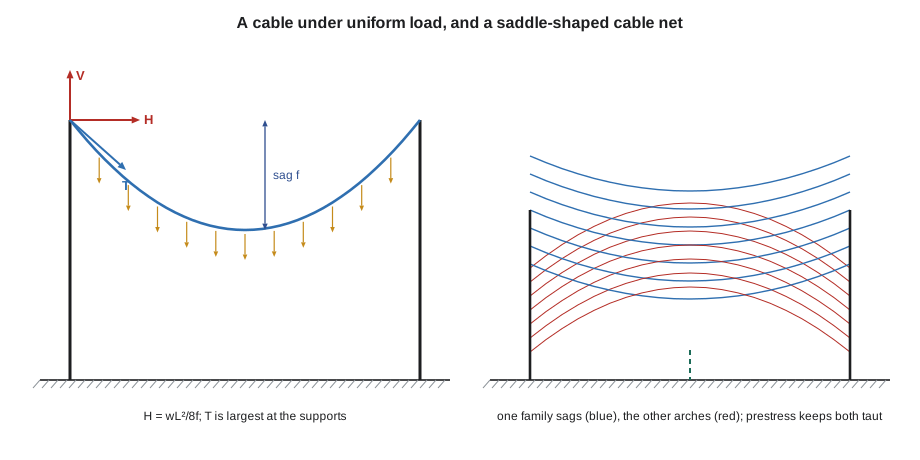
For a cable with a uniform load w per unit of horizontal length, spanning L with a sag f, the horizontal component of the tension is H = wL²/8f, the same expression as for an arch's thrust, and it is constant along the cable. The tension is largest at the supports, where the cable is steepest: the vertical component there is wL/2, and the total tension is the hypotenuse of the two components. The sag is the designer's main control. A cable with a deep sag pulls gently; a flat cable pulls very hard, and a perfectly straight one would need infinite tension.
# Cable roof over the outdoor stage at Kestrel Point (kips, ft)
import math
span, w = 130, 0.82                     # span and factored load per cable (kip/ft)
fu, phi = 228, 0.45                   # breaking strength of strand and resistance factor (ksi)
for ratio in (8, 10, 15, 20):
    sag = span / ratio
    H = w * span ** 2 / (8 * sag)
    T = math.hypot(H, w * span / 2)
    area = T / (phi * fu)
    dia = math.sqrt(4 * area / math.pi)
    length = span * (1 + 8 / 3 * (sag / span) ** 2)
    print(f"sag span/{ratio:<2} = {sag:5.1f} ft: H {H:6.0f}, T {T:6.0f} kips, strand {dia:5.2f} in, length {length:.1f} ft")
# a fabric membrane: tension needed to carry a pressure grows with the radius of curvature
p = 0.03                                   # factored snow or wind pressure (ksf)
for Rc in (15, 30, 60, 150):
print(f"membrane curvature radius {Rc:>4} ft: tension p x R = {p * Rc:6.2f} kip/ft")sag span/8 = 16.2 ft: H 107, T 119 kips, strand 1.22 in, length 135.4 ft sag span/10 = 13.0 ft: H 133, T 144 kips, strand 1.33 in, length 133.5 ft sag span/15 = 8.7 ft: H 200, T 207 kips, strand 1.60 in, length 131.5 ft sag span/20 = 6.5 ft: H 266, T 272 kips, strand 1.84 in, length 130.9 ft membrane curvature radius 15 ft: tension p x R = 0.45 kip/ft membrane curvature radius 30 ft: tension p x R = 0.90 kip/ft membrane curvature radius 60 ft: tension p x R = 1.80 kip/ft membrane curvature radius 150 ft: tension p x R = 4.50 kip/ft
For the outdoor stage at Kestrel Point, a roof of cables spanning 130 ft at about 13 ft spacing, each carrying 0.82 kip/ft of factored load, the script shows the trade-off. A sag of a tenth of the span gives a horizontal pull of about 133 kips and needs a strand of about 1.33 in. Halve the sag and the pull doubles. The cable length changes very little, only about 4 ft over the range, but the anchor forces change enormously. Wren's sketch for the rink in Lesson 7 used a sag of a fifteenth, and she now sees why its anchors were so large.
The problem of flexibility
A single cable is unstable in a way a beam is not. Change the pattern of load and it changes shape: a point load pulls it into a V, wind suction lifts it into an upward curve, and gusts can set it fluttering. A roof hung on single parallel cables needs something to keep its shape under changing loads. There are three common answers. The first is weight: a heavy roof deck, such as precast concrete panels laid on the cables and then grouted, so that the dead load dominates and holds the shape, as in Eero Saarinen's terminal at Dulles Airport near Washington, completed in 1962. The second is a second set of cables curving the other way, pulling down against the first, as in a cable truss or a cable net. The third is prestress: tensioning the cables so heavily that loads never make them go slack.
Cable nets do all three things with geometry. A net of two families of cables, one sagging and one arching, crossing each other at regular intervals and tensioned against each other, forms an anticlastic surface like a saddle. Downward loads are resisted mainly by the sagging cables, upward loads by the arching ones, and the prestress keeps both families taut. The edges of a cable net are carried by heavy edge cables or by stiff ring beams and arches, and the whole system pulls inward on its supports. The Ingalls Rink at Yale, completed by Eero Saarinen in 1958, hangs its roof of cables from a central concrete arch like the spine of a whale, an early cable roof for a hockey arena. Frei Otto's roofs for the Munich Olympics of 1972, which the students met in Structures I, are the most famous cable nets of all.
Fabric membranes
A fabric membrane extends the cable net to a continuous surface. Architectural fabrics are woven from glass or polyester fibers and coated with PTFE, the slippery polymer of non-stick pans, or with PVC. PTFE-coated glass fiber lasts thirty years or more and lets about a tenth of daylight through, glowing at night when lit from inside; PVC-coated polyester is cheaper, more flexible and shorter-lived. ETFE, a clear fluoropolymer foil, is used in inflated cushions that act both as roof and as insulated glazing. Fabric membranes span between masts, arches and edge cables, and they must be prestressed and doubly curved to stay taut and to shed water and snow without ponding.
A membrane carries a pressure normal to its surface through tension in the fabric, and the tension it needs is proportional to the pressure and to the radius of curvature: for a surface curved in one direction, T = p × R. A tightly curved membrane carries loads with low tension; a flat one needs very high tension or it bulges and ponds. The script's last lines show this for a factored snow or wind pressure of 30 psf: a curvature radius of 15 ft needs a tension of 0.45 kip/ft, within the range of a good PTFE fabric, while a radius of 150 ft, nearly flat, needs ten times as much and would tear the fabric. This is why membranes look the way they do: steep, saddle-shaped and full of curvature.
Membrane structures are designed by form-finding software that finds the equilibrium shape for a given prestress and boundary, then analyzed for snow, wind and ponding under large deflections. The fabric is cut into strips, called cutting patterns, that are welded or sewn into the doubly curved surface, and the membrane is stretched into place with turnbuckles and edge cables. The Denver International Airport terminal, completed in 1995, roofs its great hall with PTFE-coated glass fiber membranes on masts, evoking the snowy Rocky Mountains to the west. In northern climates, snow is the critical load for membranes, and the design must prevent drifts from collecting in the valleys of the surface.
Air-supported and inflated structures
Air can also hold up a membrane. An air-supported roof is a membrane sealed around its edges and held up by a small excess of air pressure inside the building, maintained by fans. The pressure needed is surprisingly small, about the pressure of the snow or wind it must resist, and people barely feel it, but the doors must be revolving doors or airlocks, and the fans must run continuously. The Metrodome in Minneapolis, opened in 1982, had an air-supported roof that deflated several times under snow, most dramatically in December 2010; the stadium was replaced in 2016. Air-supported domes remain common for seasonal sports bubbles over tennis courts and soccer fields. Inflated structures, by contrast, are made of tubes or cushions filled with air under higher pressure, like the ETFE cushions on many recent stadiums and atriums; the building itself is not pressurized.
Anchors, masts and details
Everything that a tension structure gains in lightness it gives back at its supports. Cables and membranes pull on their anchors with very large forces, often inclined, and those forces must be carried into the ground by heavy foundations, ground anchors drilled into soil or rock, or compression rings and arches that close the forces within the structure. Masts are compression members, usually pinned at both ends so that they carry pure axial load, and stayed by back cables to anchors. The connections at the ends of cables, sockets, clevises and turnbuckles, are fittings made in a factory; they must be accessible for inspection and retensioning, because cables relax and stretch over time.
Tension structures demand careful thinking about safety. A cable that breaks releases its stored energy violently, and a membrane that tears can fail progressively. Designers therefore provide redundancy, more than one cable to each anchor and nets that can redistribute load, and design anchors and fittings to be stronger than the cables themselves. The structure must also be stable during erection, when the prestress is not yet applied. Szymańska describes a small fabric canopy she designed over a school entrance in her first years of practice; its cables were perfect, but the masts' foundations, which the contractor had placed a little shallower than drawn, began to lean in the first spring thaw. 'Tension structures forgive nothing at their anchors.'
Worked problem
Anchors for the stage roof
Each cable of the stage roof spans 130 ft with a sag of 13 ft and a factored load of 0.82 kip/ft. At the back of the stage the cable runs over a mast 33 ft tall and continues down at 45 degrees to a ground anchor. Find the force in the back stay and the vertical load on the mast, assuming the back stay carries the same horizontal pull as the span.
Show solution
- Horizontal pull from the span: H = 0.82 × 130² ÷ (8 × 13) = 133 kips.
- Vertical component at the mast from the span: 0.82 × 130 ÷ 2 = 53 kips.
- Back stay at 45 degrees with the same horizontal component: tension 133 ÷ 0.707 = 188 kips, with a vertical component of 133 kips.
- Vertical load on the mast: 53 + 133 = 186 kips, in compression.
- The ground anchor must resist 188 kips at 45 degrees: about 133 kips of uplift and the same horizontally, with a margin.
Answer: The back stay pulls about 190 kips; the mast carries about 186 kips of compression.
Exercise 9: tension structures
- Build a small cable net from string over a wire frame with two high and two low corners, and tension it until it holds a coin without sagging.
- Calculate the horizontal pull of a cable roof over a space in your studio project for sags of a tenth and a twentieth of the span.
- Sketch a fabric canopy for an entrance, showing its masts, edge cables and anchors, and mark where snow could collect.
- Find a tension structure in your region and identify how it is stabilized: by weight, opposed cables or prestress.
Self-check
- Can I explain why a cable cannot be straight under load?
- Do I know why cable roofs need weight, opposed cables or prestress?
- Do I understand why membranes must be doubly curved?
Common mistakes
MistakeDrawing a flat cable or membrane.
InsteadGive cables generous sag and membranes strong double curvature, or the forces become enormous.
MistakeForgetting the anchors.
InsteadShow the anchors, masts and back stays from the first sketch; they often dominate the design.
MistakeRelying on a single family of cables to resist uplift.
InsteadUse opposed cables, weight or prestress to stabilize the roof.
MistakeDesigning a membrane with flat valleys in a snowy climate.
InsteadShape the surface so snow and water shed; check drifting and ponding.
MistakeTreating cables as permanent and maintenance-free.
InsteadProvide access to fittings for inspection and retensioning.
Summary and key terms
- Cables carry only tension and take the funicular shape of their loads; their horizontal pull is H = wL²/8f.
- Reducing the sag sharply increases the pull on anchors; generous sag is efficient.
- Single cables are unstable under changing loads; weight, opposed cables in nets and trusses, and prestress stabilize them.
- Fabric membranes carry pressure through tension proportional to the radius of curvature, so they must be prestressed and doubly curved.
- Air-supported roofs use small internal pressure; all tension structures depend on robust, accessible anchors and fittings.
- Cable
- A flexible tension member of steel wires, strands or rope.
- Sag
- The vertical distance from a cable's supports to its lowest point.
- Cable net
- A surface of two families of cables tensioned against each other.
- Prestress
- Tension introduced into cables or membranes before loads are applied.
- PTFE
- A durable fluoropolymer coating used on glass-fiber architectural fabric.
- Air-supported structure
- A membrane held up by slightly raised air pressure inside the building.
Practice problems
Work each problem on paper first, then reveal the answer to check.
A cable spans 100 ft with a sag of 10 ft and a load of 0.7 kip/ft. What is its horizontal pull?
Show answer
0.7 × 10,000 ÷ 80 = 87.5 kips.
If the sag is halved, what happens to the pull?
Show answer
It doubles.
A membrane curved with a radius of 25 ft carries a pressure of 25 psf. What tension does it need?
Show answer
25 × 25 = 625 lb/ft.
Why does a cable net use two families of cables curving in opposite directions?
Show answer
So that one family resists downward loads and the other upward loads, with prestress keeping both taut.
What keeps an air-supported roof up?
Show answer
A small excess of air pressure inside the building, maintained by fans, with airlock doors.
Lesson quiz · 5 questions
Score 60% or more to complete this lesson.
Create a free account to save your progress, take quizzes and earn a certificate.