
AI-440 · Lesson 9 of 12 · 25 min
Sector regulation: finance, health, transport and employment
Much of the most detailed AI regulation comes not from AI laws but from sector regulators, who have supervised models, devices and safety-critical systems for decades and are adapting their frameworks to AI. A bank's credit model, a hospital's diagnostic software, an automated vehicle and an employer's hiring tool are each governed by sector rules that specify validation, documentation, approval, monitoring and reporting in detail. For practitioners in these sectors, sector rules are often the binding constraint. This lesson surveys financial services (model risk management, fair lending and insurance), health (AI as a medical device), transportation (automated vehicles and aviation), employment, and other regulated professions, and shows how a core practice, ongoing model monitoring, works in a regulated setting.
Financial services: model risk management
Financial regulators have long required banks to manage the risk that models, used for credit decisions, pricing, capital, trading and fraud detection, are wrong or misused. The core principles are effective challenge (independent, competent review), sound development and validation, governance with clear roles, inventories and documentation, and ongoing monitoring.
In the United States, the Federal Reserve's SR 11-7 and the OCC's parallel Bulletin 2011-12, Supervisory Guidance on Model Risk Management (2011), remain the foundation, applied by examiners to AI and machine learning models: banks must maintain model inventories, validate models independently (evaluating conceptual soundness, ongoing monitoring and outcomes analysis), document thoroughly, and govern model use with policies and board oversight. Third-party models are subject to the same expectations. Fair lending laws (ECOA and the Fair Housing Act) require testing for discrimination and specific adverse action reasons, and the Fair Credit Reporting Act governs data used in credit, employment and insurance decisions. Insurance is regulated by states: the National Association of Insurance Commissioners adopted a model bulletin on insurers' use of AI in 2023, adopted by many states, requiring written AI programs, governance and testing for unfair discrimination, and Colorado has specific rules limiting unfairly discriminatory use of external data and algorithms in insurance.
For AI models, validation practices extend to: assessing data quality and representativeness, testing for bias, evaluating explainability and the reliability of explanations used in adverse action notices, stress-testing robustness, and setting monitoring thresholds. Generative AI used in banking, for customer service, document processing or coding, falls under the same governance, with added attention to hallucination, data leakage and third-party dependencies.
Ongoing monitoring
Models degrade as the populations and conditions they were built for change. Regulators expect ongoing monitoring of inputs, outputs and outcomes against thresholds that trigger review. A widely used measure of input drift is the population stability index (PSI), which compares the distribution of a variable (often the model score) in recent data with its distribution at development:
where e_i and a_i are the shares of the development and recent populations in bin i. Common rules of thumb treat a PSI below 0.10 as stable, 0.10 to 0.25 as a moderate shift needing investigation, and above 0.25 as a significant shift.
import numpy as np
# Monitoring a credit model in production with the population stability index (PSI)
rng = np.random.default_rng(9)
dev = rng.normal(650, 60, 20_000)          # credit score distribution at development
recent = {"quarter 1": rng.normal(648, 61, 5_000), "quarter 2": rng.normal(640, 65, 5_000),
          "quarter 3": rng.normal(622, 72, 5_000)}
edges = np.percentile(dev, np.linspace(0, 100, 11))
edges[0], edges[-1] = -np.inf, np.inf
def psi(expected, actual):
    e = np.histogram(expected, edges)[0] / len(expected)
    a = np.histogram(actual, edges)[0] / len(actual)
    a = np.clip(a, 1e-6, None)
    return np.sum((a - e) * np.log(a / e))
for q, x in recent.items():
    v = psi(dev, x)
    action = "stable" if v < 0.10 else "investigate" if v < 0.25 else "significant shift: review or redevelop"
print(f"{q}: PSI {v:.3f} {action}")quarter 1: PSI 0.002 stable quarter 2: PSI 0.030 stable quarter 3: PSI 0.181 investigate
The first two quarters are stable, but by the third quarter, as applicants' scores shift lower and spread wider (perhaps because of an economic downturn or a new marketing channel), the PSI reaches about 0.18, triggering investigation: are the model's predictions still accurate for this population, are approval rates and losses changing, and are some groups affected differently? Monitoring results, the investigation and decisions are documented and reported through model governance, and significant shifts can lead to recalibration, redevelopment or restrictions on use. The same principles apply to AI systems in any sector (AI-420).
Health: AI as a medical device
Software intended to diagnose, treat, mitigate or prevent disease, such as an AI that detects tumors in images or predicts sepsis, can be a medical device requiring regulatory authorization.
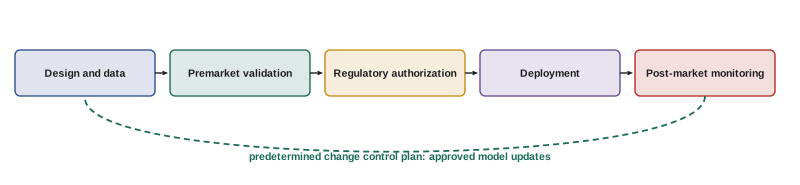
In the United States, the Food and Drug Administration (FDA) regulates AI-enabled device software functions; by 2025 it had authorized over a thousand AI-enabled devices, most in radiology. Devices are classified as Class I, II or III, and most AI devices reach market through 510(k) clearance or De Novo classification. The FDA finalized guidance on predetermined change control plans in December 2024, allowing manufacturers to describe planned model modifications and their validation in advance. Some clinical decision support software that allows clinicians to independently review the basis for recommendations is excluded from device regulation under the 21st Century Cures Act. HIPAA governs health information privacy for covered entities.
Clinical use raises additional governance questions: validation on the local patient population, integration into clinical workflows, clinician training, monitoring for performance drift and bias, and informing patients. Hospitals increasingly establish AI governance committees to review tools before adoption.
Transportation
Automated vehicles, drones and aviation systems are safety-critical and heavily regulated.
In the United States, the National Highway Traffic Safety Administration (NHTSA) sets vehicle safety standards, requires crash reporting for vehicles with automated driving systems and advanced driver assistance under a standing general order, and has investigated and prompted recalls of driver assistance systems; states regulate testing and deployment of autonomous vehicles, with California and others issuing permits for driverless services. The Federal Aviation Administration regulates drones and aviation systems, including AI in avionics.
Across transport, regulators emphasize safety cases (AI-430), operational design domains defining the conditions under which an automated system may operate, data recording for incident investigation, and incident reporting.
Employment
Employment is one of the most active areas of AI regulation, because hiring, promotion, scheduling, monitoring and termination decisions directly affect livelihoods. Beyond human rights and anti-discrimination law (Lesson 5) and privacy law (Lesson 4), specific rules include disclosure of AI use in hiring (Ontario job postings; New York City and Illinois), bias audits (New York City), limits on electronic monitoring of employees (Ontario requires employers with 25 or more employees to have a written electronic monitoring policy; several US states require notice of monitoring), and labor law: unions in both countries have negotiated provisions on the introduction of AI and algorithmic management, and labor boards may treat AI-driven changes as subjects of bargaining. The EU AI Act treats AI in employment as high-risk and prohibits workplace emotion recognition (Lesson 3).
Other regulated professions and sectors
Many other regulators have issued AI guidance or rules: law societies (on competence, confidentiality and supervision when lawyers use AI), medical regulatory colleges (on AI scribes and clinical decision support), engineering regulators (on professional responsibility for AI-assisted work), securities regulators (on AI in advice, trading and disclosures), education authorities (on student data and academic integrity), and telecommunications and broadcasting regulators. Public sector bodies have their own directives (Lesson 2). Practitioners should identify the regulators of their sector and their clients' sectors, because sector rules often impose the most specific obligations.
Worked problem
Deploying a machine learning credit model
A US bank plans to replace its traditional scorecard for unsecured personal loans with a gradient-boosted model. What does model risk governance require?
Show solution
- Inventory and risk rating: register the model, rated high risk because of its financial and customer impact.
- Development standards: document data sources, representativeness, feature selection (excluding prohibited bases and examining proxies), and performance.
- Independent validation: conceptual soundness, outcomes analysis on holdout data, stability, bias testing across groups, robustness, and the reliability of explanations for adverse action reasons.
- Approval and controls: approval by the model risk committee, implementation testing, access controls, and documented limits on use.
- Monitoring: PSI and characteristic stability, approval rates, default rates and fairness metrics by group, with thresholds and escalation.
- Fair lending: disparate impact testing and less discriminatory alternative search, and specific reasons for adverse actions under ECOA.
Answer: Replacing a scorecard with machine learning is feasible under model risk management, but requires stronger validation of bias, stability and explanations, documented governance, and continuous monitoring. Early engagement with the validation team and regulators avoids delays.
Common themes across sectors
Despite their differences, sector regimes share a recognizable pattern that practitioners can carry from one sector to another. Each requires a clear statement of intended use and its limits; evidence that the system performs adequately for that use, on the relevant population, before deployment; controls on changes, so that updates do not silently alter behavior; ongoing monitoring with thresholds that trigger action; human oversight appropriate to the stakes; records sufficient to investigate failures; and reporting of serious incidents to the regulator. Recognizing these common elements makes it easier to design one internal process that satisfies several regulators.
Sector regimes also share an expectation that responsibility cannot be outsourced. A bank remains accountable for a vendor's model, a hospital for a licensed device it deploys, an employer for a hiring tool it buys. Regulators expect organizations to understand the AI they use well enough to manage its risks, to obtain the information they need from vendors, and to stop using systems they cannot adequately oversee.
Engaging with sector regulators
Many regulators offer channels for discussing innovative uses before deployment: innovation offices, regulatory sandboxes that allow testing under supervision, pre-submission meetings for medical devices, and consultations on draft guidance. Using these channels early can clarify expectations, reduce the risk of costly redesign, and build a constructive relationship. Organizations should prepare for such engagement with a clear description of the system, its intended use, the evidence of performance and safety, and the controls proposed, and should be candid about uncertainties.
Documentation regulators expect
Across sectors, regulators tend to ask for a similar package of documents when they examine an AI system: a description of the system and its intended use; the data used to build and validate it, with an assessment of its quality and representativeness; validation and testing results, including performance across relevant subgroups; the human oversight design and operating procedures; monitoring reports and actions taken; change history; incident records; and vendor documentation for third-party components. Maintaining this package as a living record, rather than assembling it under pressure when an examination is announced, is one of the most effective investments an organization in a regulated sector can make.
Common mistakes
MistakeAssuming vendor models are outside model risk management.
InsteadApply inventory, validation and monitoring to third-party models too.
MistakeValidating a model once at launch.
InsteadMonitor inputs, outputs and outcomes continuously with thresholds.
MistakeTreating diagnostic AI as ordinary software.
InsteadDetermine whether it is a regulated medical device.
MistakeUpdating an authorized device model without a plan.
InsteadUse a predetermined change control plan for anticipated changes.
MistakeOverlooking sector regulators when an AI law is absent.
InsteadIdentify sector rules, which are often the most specific.
Summary and key terms
- Sector regulators impose some of the most detailed AI requirements.
- SR 11-7 and OCC 2011-12 govern model risk; fair lending and state insurance rules add requirements.
- Ongoing monitoring with measures such as PSI detects drift and triggers review.
- The FDA regulates AI-enabled devices and allows predetermined change control plans.
- Transport regulators require safety cases, operational design domains, data recording and incident reporting.
- Employment AI faces disclosure, audit, monitoring and labor law requirements.
- Professional regulators set expectations for AI use by their members.
- Model risk management
- The governance of risks from model errors and misuse.
- Effective challenge
- Independent, competent critical review of models.
- Model validation
- Independent assessment of a model's soundness and performance.
- Population stability index
- A measure of change between two distributions.
- Software as a medical device
- Software intended for medical purposes without being part of hardware.
- Predetermined change control plan
- An authorized plan for anticipated model modifications.
- Operational design domain
- Conditions under which an automated system may operate.
- Standing general order
- A US requirement to report crashes involving automated driving systems.
- Electronic monitoring policy
- A required policy describing employee monitoring.
- Adverse action reason
- A specific reason given for denying credit.
Practice problems
Work each problem on paper first, then reveal the answer to check.
Name three principles of model risk management.
Show answer
Effective challenge, sound development and validation, governance, inventory and documentation, monitoring.
What is SR 11-7?
Show answer
The 2011 Federal Reserve supervisory guidance on model risk management.
What PSI range suggests investigation?
Show answer
0.10 to 0.25.
From the output, which quarter needs investigation?
Show answer
Quarter 3, with PSI about 0.18.
What should an investigation of drift examine?
Show answer
Accuracy, approval and loss rates, and effects on different groups.
When is AI software a medical device?
Show answer
When intended to diagnose, treat, mitigate or prevent disease.
What does a predetermined change control plan allow?
Show answer
Anticipated model updates without a new authorization for each.
What is an operational design domain?
Show answer
The conditions under which an automated system may operate.
Name two employment-specific AI rules.
Show answer
AI disclosure in job postings, bias audits, electronic monitoring policies, labor bargaining.
Why identify sector regulators even where AI laws exist?
Show answer
Sector rules are often the most specific and binding.
Lesson quiz · 5 questions
Score 60% or more to complete this lesson.
Create a free account to save your progress, take quizzes and earn a certificate.