
AI-440 · Lesson 1 of 12 · 25 min
The AI governance landscape
Artificial intelligence is governed by a growing and shifting web of laws, regulations, standards, contracts and organizational policies. Some rules are written specifically for AI, such as the European Union's AI Act; most are general laws, on privacy, discrimination, consumer protection, intellectual property, product liability and sector regulation, that apply to AI as they apply to any other technology. Practitioners who build, buy or deploy AI systems need to understand this landscape well enough to recognize when legal questions arise, to work effectively with lawyers and compliance teams, and to design systems and processes that meet their obligations. This course provides that understanding.
This first lesson maps the landscape: why AI raises distinctive governance questions, the kinds of instruments that govern it, the main regulatory approaches, the actors and roles defined in AI rules, and the first practical step for any organization, an inventory of its AI systems. Lessons 2 and 3 cover national frameworks and the EU AI Act; Lessons 4 to 8 cover privacy, discrimination, intellectual property, liability and consumer protection; Lesson 9 covers sector regulation; Lessons 10 and 11 cover standards, audits and organizational governance; and Lesson 12 covers frontier AI, international governance and a capstone compliance project.
Why AI raises governance questions
Many features of AI systems strain existing legal frameworks:
- Scale and speed: a single model can make millions of decisions affecting people, so small error rates or biases become large harms.
- Opacity: complex models are hard to explain, which makes it difficult for affected people to understand or contest decisions, and for regulators to verify compliance.
- Data dependence: models are trained on large datasets that may contain personal information, copyrighted works or historical biases.
- Probabilistic and adaptive behavior: outputs vary, may be wrong in unpredictable ways (hallucinations), and may change as models are updated.
- Distributed responsibility: a foundation model developer, a fine-tuner, an application developer, a deployer and an end user may each contribute to an outcome, making it unclear who is responsible.
- Dual use: the same capabilities can serve beneficial and harmful purposes, from drug discovery to cyberattacks.
- Rapid change: capabilities advance faster than legislation can be written, so rules risk being either outdated or premature.
Governance responds by assigning responsibilities, requiring transparency and testing, protecting rights, and creating mechanisms for oversight and redress, while trying not to stifle beneficial innovation. Where that balance should lie is contested, and different jurisdictions have struck it differently.
Instruments of AI governance
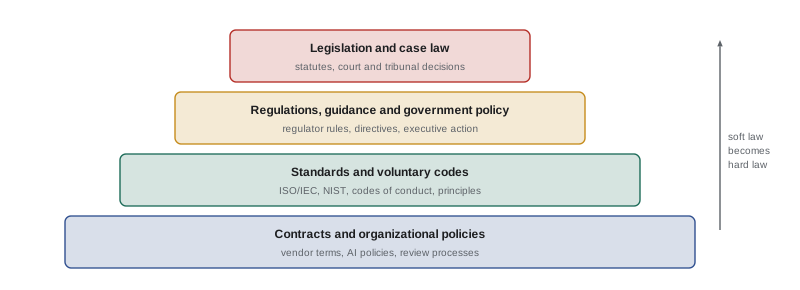
AI is governed through several kinds of instruments, which interact:
- Legislation: statutes passed by legislatures, such as privacy acts, human rights codes, consumer protection laws and AI-specific laws.
- Regulations and guidance: detailed rules and interpretive guidance issued by regulators under statutory authority, such as financial regulators' model risk guidelines.
- Case law: court and tribunal decisions interpreting how existing law applies to AI, for example on copyright in training data or liability for chatbot statements.
- Executive and government policy: directives governing government's own use of AI, procurement rules, and national strategies.
- Standards: technical and management standards from bodies such as ISO and IEC, national standards bodies and NIST, which define good practice and can be referenced by law (Lesson 10).
- Soft law and voluntary commitments: codes of conduct, principles and industry commitments, such as the OECD AI Principles or voluntary codes for generative AI.
- Contracts: terms between developers, vendors, customers and users that allocate responsibilities, data rights and liabilities (Lesson 11).
- Organizational policies: internal rules, review processes and accountability structures.
Soft law often precedes hard law: voluntary principles shape expectations, standards make them concrete, and legislation may later make them mandatory. Organizations that adopt good practice early are better placed when rules arrive.
Regulatory approaches
Jurisdictions take different approaches to regulating AI:
- Horizontal, risk-based regulation: a single law covering AI across sectors, with obligations proportionate to risk, from banned practices through high-risk systems with heavy requirements to minimal-risk systems with few. The EU AI Act is the leading example (Lesson 3).
- Sectoral regulation: existing regulators (financial, health, transport, employment) apply and adapt their rules to AI within their domains, without a single AI law. This is the predominant approach in the United States at the federal level and, in practice, in Canada.
- Principles-based approaches: regulators are given principles (fairness, transparency, accountability, safety, contestability) to apply within their remits, as in the United Kingdom's approach.
- Targeted laws: rules for specific applications or harms, such as automated employment decision tools, deepfakes in elections, chatbots that impersonate humans, or frontier model transparency.
- Light-touch and pro-innovation strategies: emphasizing investment, infrastructure and voluntary measures, with regulation reserved for demonstrated harms.
Most real systems mix these approaches. A multinational organization therefore faces a patchwork: EU horizontal rules, sectoral and state rules in the United States, privacy-centered rules in Canada, and different rules again in Asia and elsewhere. Lesson 12 discusses how organizations build compliance programs that work across jurisdictions.
Actors and roles
AI rules assign obligations by role in the AI value chain. Terms vary, but common roles are:
- Developer or provider: the organization that develops an AI system or model and places it on the market or puts it into service under its own name.
- Deployer or user: the organization that uses an AI system in its operations, for example an employer using a hiring tool.
- Distributor, importer or reseller: parties that make systems available without developing them.
- General-purpose or foundation model provider: the developer of a model that can be adapted to many tasks, with obligations focused on documentation, copyright policies and, for the most capable models, systemic risk.
- Affected persons: individuals subject to or affected by AI decisions, who may have rights to notice, explanation, correction, human review or redress.
- Regulators and enforcement bodies: privacy commissioners, human rights bodies, consumer protection agencies, sector regulators and, in some jurisdictions, dedicated AI offices.
The same organization can hold several roles: a bank may develop some models (provider), buy others (deployer), and fine-tune a third-party foundation model, which under some rules can make it a provider of the modified system. Determining roles is therefore the first step in determining obligations.
Common principles
Despite differences in approach, AI governance frameworks share recurring principles, reflected in the OECD AI Principles (adopted 2019 and updated 2024), the G7 Hiroshima Process, national frameworks and industry codes:
- Human rights, fairness and non-discrimination.
- Transparency and explainability: people should know when they are interacting with AI and, for significant decisions, understand the main factors.
- Robustness, safety and security throughout the life cycle.
- Privacy and data governance.
- Accountability: identifiable people and organizations are responsible for AI systems and their outcomes.
- Human oversight and contestability: meaningful human involvement and the ability to challenge decisions.
These principles become concrete through specific obligations: impact assessments, documentation, testing, notices, human review and incident reporting, which this course examines in turn.
Starting with an inventory
An organization cannot govern AI systems it does not know about. The first practical step in any AI governance program is an inventory: a register of all AI systems the organization develops, buys or uses, including AI features embedded in purchased software and generative AI tools used by staff. For each system, the inventory records the purpose, owner, role (developer or deployer), data used, people affected, degree of automation, vendor, and applicable laws. A risk tier then determines the level of review and controls.
# An AI system inventory with a simple risk-tiering rule
systems = [  # name, decision affects people, domain, autonomy (0 = advice only, 2 = fully automated), uses personal data
    ("Code completion for developers", False, "internal tools", 0, False),
    ("Resume screening", True, "employment", 1, True),
    ("Customer service chatbot", True, "consumer service", 1, True),
    ("Credit limit adjustment", True, "credit", 2, True),
    ("Demand forecasting", False, "operations", 1, False),
    ("Fraud alert triage", True, "financial crime", 1, True),
]
high_impact_domains = {"employment", "credit", "housing", "health", "education", "public benefits"}
def tier(people, domain, autonomy, personal):
    score = 2 * people + 3 * (domain in high_impact_domains) + autonomy + personal
    return ("high" if score >= 6 else "medium" if score >= 3 else "low"), score
for name, people, domain, autonomy, personal in systems:
    t, sc = tier(people, domain, autonomy, personal)
print(f"{name:32s} score {sc} tier {t}")Code completion for developers score 0 tier low Resume screening score 7 tier high Customer service chatbot score 4 tier medium Credit limit adjustment score 8 tier high Demand forecasting score 1 tier low Fraud alert triage score 4 tier medium
The resume screening tool and credit limit model fall into the high tier because they affect people in domains where decisions have significant consequences and where specific laws apply (employment and credit); the chatbot and fraud triage are medium; developer tools and demand forecasting are low. Real tiering schemes use more factors and judgment, but the principle is the same: focus scrutiny where potential harm is greatest. Inventories are rarely complete on the first attempt; procurement records, software asset lists, expense reports for AI subscriptions and surveys of business units all help find systems.
Working with legal and compliance teams
Engineers and data scientists are not expected to be lawyers, but they play essential roles in compliance. They know what data a system uses, how it was tested, how it can fail, and what controls are technically feasible; lawyers know what the law requires and how regulators and courts interpret it. Effective collaboration involves:
- Involving legal and privacy teams early, at design rather than launch.
- Documenting systems in ways that answer legal questions: data sources and rights, intended use, testing results, limitations, and human oversight.
- Translating legal requirements into technical requirements, such as logging, explanation features, bias testing and access controls.
- Escalating uncertainties promptly rather than assuming they are someone else's problem.
Throughout this course, the goal is literacy: knowing the questions to ask and the requirements to design for, and knowing when to seek legal advice.
Worked problem
Identifying governance questions for a new project
A hospital network plans to use a vendor's AI model to prioritize radiology scans, flagging those likely to show urgent findings for earlier reading. What governance questions arise?
Show solution
- Roles: the vendor is the developer; the hospital is the deployer; radiologists are human overseers; patients are affected persons.
- Sector regulation: is the software a regulated medical device requiring authorization? (Lesson 9)
- Privacy: what patient data is used for operation and for vendor improvement, under what legal authority, and where is it stored? (Lesson 4)
- Fairness and safety: has performance been validated on the hospital's patient population and equipment, across groups? (Lesson 5)
- Liability and contracts: who is responsible if an urgent case is missed, and what warranties, indemnities and audit rights does the contract provide? (Lessons 7 and 11)
- Governance: who approves deployment, how is performance monitored, and how are incidents reported?
Answer: Even a seemingly simple deployment raises questions of device regulation, privacy, validation and fairness, liability and contracts, and internal governance. Mapping these at the start allows them to be addressed in procurement and design rather than discovered after deployment.
Common mistakes
MistakeAssuming AI is unregulated where no AI-specific law exists.
InsteadApply privacy, discrimination, consumer, IP, liability and sector laws.
MistakeTreating governance as a launch-time legal review.
InsteadInvolve legal and compliance teams from design onward.
MistakeIgnoring AI embedded in purchased software and staff tools.
InsteadInventory all AI systems, including vendor features and generative tools.
MistakeAssuming roles are fixed.
InsteadDetermine whether the organization is developer, deployer or both for each system.
MistakeRelying on this course as legal advice.
InsteadUse it to ask the right questions and consult qualified counsel.
Summary and key terms
- AI raises governance questions through scale, opacity, data dependence, probabilistic behavior, distributed responsibility, dual use and rapid change.
- Instruments include legislation, regulations, case law, government policy, standards, soft law, contracts and internal policies.
- Approaches range from horizontal risk-based laws to sectoral, principles-based and targeted rules.
- Obligations attach to roles: developer, deployer, distributor, general-purpose model provider.
- Common principles include fairness, transparency, robustness, privacy, accountability and human oversight.
- An AI inventory with risk tiers is the first practical governance step.
- Engineers and lawyers must collaborate early to translate legal requirements into design.
- AI governance
- The rules, processes and structures that direct and control AI use.
- Hard law
- Legally binding rules such as statutes and regulations.
- Soft law
- Non-binding principles, codes and guidance.
- Risk-based regulation
- Obligations proportionate to the risk of a use.
- Sectoral regulation
- Regulation by existing domain regulators.
- Provider (developer)
- The organization that develops and markets an AI system.
- Deployer
- The organization that uses an AI system in its operations.
- Affected person
- Someone subject to or affected by an AI decision.
- AI inventory
- A register of an organization's AI systems.
- Risk tier
- A category determining the level of review and controls.
Practice problems
Work each problem on paper first, then reveal the answer to check.
Name four features of AI that strain existing legal frameworks.
Show answer
Scale, opacity, data dependence, probabilistic behavior, distributed responsibility, dual use, rapid change.
What is the difference between hard law and soft law?
Show answer
Hard law is legally binding; soft law consists of non-binding principles and codes.
Which jurisdiction is the leading example of horizontal risk-based AI regulation?
Show answer
The European Union, with the AI Act.
What is a deployer?
Show answer
An organization that uses an AI system in its operations.
How can a deployer become a provider?
Show answer
By substantially modifying or fine-tuning a system and offering it under its own name, under some rules.
Name four common AI governance principles.
Show answer
Fairness, transparency, robustness, privacy, accountability, human oversight.
From the output, which systems are high tier?
Show answer
Resume screening and credit limit adjustment.
Why does domain matter in risk tiering?
Show answer
Decisions in employment, credit and similar areas have significant consequences and specific laws.
Name three sources for finding AI systems for an inventory.
Show answer
Procurement records, software asset lists, expense reports, business unit surveys.
Why involve legal teams at design rather than launch?
Show answer
Requirements can then shape data, testing and features, avoiding costly rework.
Lesson quiz · 5 questions
Score 60% or more to complete this lesson.
Create a free account to save your progress, take quizzes and earn a certificate.