
AERO-410 · Lesson 11 of 12 · 25 min
Performance and cost analysis
With the configuration laid out, the drag polar refined, the powertrain sized and the mass statement assembled, the team can now ask what the Petrel will actually do and what it will cost to fly. Performance analysis turns the design into the numbers the operators care about: how far it flies with how much payload, how long a typical leg takes and how much fuel it burns. Cost analysis turns those into money: the price of buying the aircraft and the cost of each hour and each seat-kilometer it flies. Both feed the trade study in Lesson 12, where the Petrel is compared with a conventional alternative.
The range equation for a propeller aircraft
For a propeller aircraft with a fuel-burning engine, the cruise range follows from the Breguet range equation. It assumes that the lift-to-drag ratio, propeller efficiency and specific fuel consumption stay roughly constant during the cruise, and that the aircraft gets lighter as fuel burns:
Here \(c\) is the brake specific fuel consumption in kilograms of fuel per joule of shaft work, \(W_i\) and \(W_f\) the masses at the start and end of cruise. For the Petrel the efficiency in the equation must be the whole chain from turboshaft shaft to thrust: the propeller's 0.82 times the electrical chain's 0.89, about 0.73. The program uses a turboshaft specific fuel consumption of 0.30 kg per kilowatt-hour, a typical value for a modern small turboshaft running near its rated power, which the engine maker's data will replace. Reserves follow the mission of Lesson 1: a 100 km diversion and a 45-minute hold, with take-off, climb, descent and landing handled by fixed fractions.
# Petrel 19 payload-range with the refined drag polar, block fuel for a typical leg, and direct operating cost.
import math
g, bsfc, eta = 9.81, 0.30 / 3.6e6, 0.733
LD_c, LD_h, V_h = 13.0, 15.0, 77.8          # refined in Lesson 6
MTOW, OEWc, cap_fuel, max_pl = 8450, 5007 + 400 + 180, 1400, 1805
k = bsfc * g / eta
pts = []
for fuel in (1054, 1200, cap_fuel):
    pl = min(max_pl, MTOW - OEWc - fuel)
    W0 = OEWc + pl + fuel
    w = W0 * 0.992 * 0.996 * 0.986
    reserve = W0 * (1 - math.exp(-100e3 * k / LD_c) * 0.99 * math.exp(-2700 * k * V_h / LD_h) * 0.995) * 0.98
    burn = fuel / 1.06 - W0 * (1 - 0.992 * 0.996 * 0.986 * 0.995 * 0.996) - reserve
    R = LD_c / k * math.log(w / (w - burn)) / 1e3
    pts.append((pl, R)); print(f"fuel {fuel:4d} kg, payload {pl:4.0f} kg ({pl / 95:4.1f} passengers): range {R:4.0f} km")
# typical leg: 220 km hub to village, full cabin
leg = 220e3; W0 = MTOW
cruise_burn = W0 * 0.98 * (1 - math.exp(-leg * k / LD_c))
trip = cruise_burn + W0 * (1 - 0.997 * 0.996 * 0.986 * 0.995 * 0.998)   # taxi on battery power
block_h = 0.25 + leg / (400 / 3.6) / 3600
print(f"220 km leg: trip fuel {trip:.0f} kg, block time {block_h * 60:.0f} min")
# direct operating cost per block hour (illustrative unit costs)
fuel_price = 1.45                               # per kg, delivered to the hub
crew_h, maint_h, insure = 520.0, 610.0, 95.0    # per block hour
price = 14.5e6                                   # aircraft price, illustrative
depr = price * 0.9 / 15 / 2000                   # 15 years, 2000 block hours a year, 10 percent residual
charge_kwh, kwh = 0.28, 60                       # battery recharge at the hub per block
cost_h = (trip * fuel_price + kwh * charge_kwh) / block_h + crew_h + maint_h + insure + depr
seat_km = 19 * 220 / block_h
print(f"cost per block hour {cost_h:.0f}; per seat-km {cost_h / seat_km:.3f} (in the site currency, illustrative)")fuel 1054 kg, payload 1805 kg (19.0 passengers): range 557 km fuel 1200 kg, payload 1663 kg (17.5 passengers): range 763 km fuel 1400 kg, payload 1463 kg (15.4 passengers): range 1051 km 220 km leg: trip fuel 389 kg, block time 48 min cost per block hour 2386; per seat-km 0.457 (in the site currency, illustrative)
The payload-range diagram
The payload-range diagram shows how far the aircraft can fly with each payload. Its first corner is the range with the maximum payload, here 19 passengers at 95 kg each, 1805 kg, and the fuel that fits under the maximum take-off mass: 1054 kg. Beyond that, extra fuel can only be carried by leaving passengers behind, trading payload for range along a sloping line at constant take-off mass, until the tanks are full at 1400 kg. Past that corner, range can grow only by reducing payload further without adding fuel, a steeper line not usually shown in operators' planning.
With the refined polar of Lesson 6, a cruise lift-to-drag ratio of 13.0 instead of the 11.5 assumed in sizing, the full-passenger range with reserves rises to 557 km, against the 500 km design requirement. At 17.5 passengers the range is 763 km, and with full tanks and about 15 passengers it reaches 1051 km, enough to reposition the aircraft between hubs or reach a southern maintenance base in one hop with a reduced load.
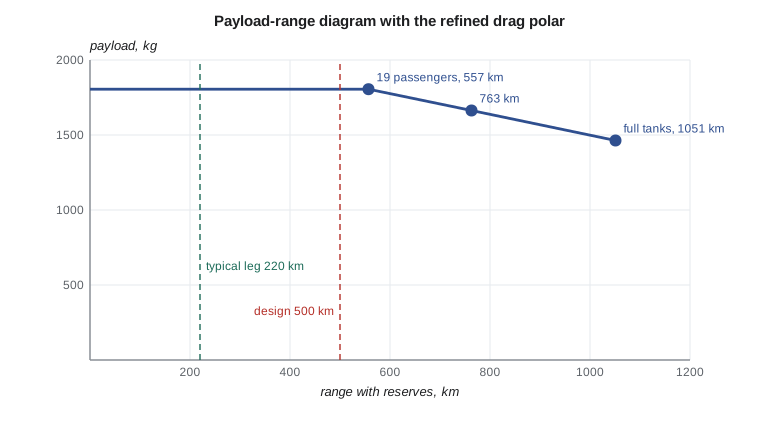
Élise reminds the team that the 557 km rests on an estimate that has not yet been confirmed by test, and that the Lesson 1 requirement was 500 km. The difference, about 11 percent, is the team's margin against drag growth, mass growth and engine performance shortfalls. It will not be offered to the operators until the wind tunnel and engine data confirm it. If the margin survives, it can be used either to promise more range or to accept some mass growth without losing the 500 km requirement.
Field performance and climb
The take-off and landing performance, estimated with the constraint methods of Lesson 3, is rechecked with the actual design. With the refined mass, the double-slotted flaps and the 1380 kW of installed motor power, the take-off distance to 50 ft on the hot-day gravel case comes out near 1000 m, inside the 1100 m requirement, and the landing distance at the maximum landing mass about 780 m on a dry paved runway, rising with the gravel factor to about 900 m. The one-motor-out climb, the active constraint in Lesson 3, is checked with the engine-out drag of a feathered propeller and the rudder deflection from Lesson 7, and still meets the company's gradient target with a small margin. These checks are repeated whenever the mass or the drag changes, and the performance engineer keeps a record of each version.
Climb and descent performance also shape the block time. On short legs the aircraft spends a large share of its time climbing and descending, and the Petrel's 3000 m cruise altitude is chosen partly because legs of 200 to 300 km do not justify climbing higher. A higher cruise would improve the true airspeed for the same indicated speed and reduce fuel per kilometer in cruise, but the extra time and fuel spent climbing would cancel the gain on a 220 km leg.
A typical leg
The design range is a limit case, but most flying is shorter. Sam's operator data show a typical leg of about 220 km from Bethel to a village on the Kuskokwim River. On that leg the Petrel burns 389 kg of fuel with a full cabin, and the block time, from pushback to arrival at the gate, is about 48 minutes, including 15 minutes for taxi, take-off, approach and landing. Taxiing on battery power saves fuel on the ground, where turbines are very inefficient, and quiets the ramp for ground crews. The fuel burn translates into about 1230 kg of carbon dioxide per leg, using about 3.16 kg of carbon dioxide per kilogram of jet fuel burned, or about 0.29 kg per seat-kilometer with a full cabin.
Direct operating cost
Operators judge an aircraft largely by its direct operating cost, the cost of flying it, usually expressed per block hour and per seat-kilometer. The main items are fuel, crew, maintenance, insurance, and the ownership cost of the aircraft spread over its life. The Petrel also has an electricity cost for recharging its battery at the hub. Kenji builds the estimate with illustrative unit costs in US dollars, which the business team will replace with quoted values; the point at this stage is the structure of the cost and its sensitivity, not the exact figure.
| Item | Basis | Per block hour |
|---|---|---|
| Fuel | 389 kg at 1.45 per kg, 0.80 h block | 705 |
| Electricity | 60 kWh at 0.28 per kWh | 21 |
| Crew | two pilots | 520 |
| Maintenance | airframe, motors, turboshafts, battery reserve | 610 |
| Insurance | hull and liability | 95 |
| Ownership | price 14.5 million, 15 years, 2000 h a year, 10 percent residual | 435 |
| Total | 2386 |
The total, about 2386 per block hour, gives about 0.457 per seat-kilometer with a full cabin. Maintenance is the largest single item, and the most uncertain, because the battery's replacement cost is spread over its expected life in cycles, and that life in a cold climate is not yet known. Fuel is the second largest, and here the hybrid has its advantage: Lesson 12 shows that a conventional twin turboprop of the same size would burn about 470 kg on the same leg, 17 percent more. At the illustrative fuel price that difference is worth about 145 per block hour, about 6 percent of the total.
Acquisition cost and life-cycle cost
The aircraft's price is estimated at this stage from statistical cost models, such as the DAPCA method described by Raymer, which relate development and production costs to empty mass, speed, the number of aircraft produced and the cost of engines and avionics, with factors for materials such as composites. Such models are calibrated on older aircraft and do not know about hybrid powertrains, so the team adds the battery, motors and power electronics as purchased items at supplier estimates. The illustrative price of 14.5 million is a planning value for the business case, not a quotation.
Life-cycle cost adds everything over the aircraft's life: development, production, operations, maintenance and disposal. For the operator, the important view is the total cost of ownership over 15 to 20 years. For the manufacturer, the important view includes development costs spread over the number of aircraft sold, which is why small production runs make every aircraft expensive. A 19-seat commuter typically sells in hundreds, not thousands, and Dr. Nakamura's business case assumes a modest production run, which makes development cost control, and the reuse of the Tern's certified systems and test data, important to the price.
Sensitivities
Cost results matter less as single numbers than as answers to questions such as: what happens if fuel prices double, if the battery lasts half as long as expected, or if the aircraft flies 1500 hours a year rather than 2000? Kenji's spreadsheet runs each case. Doubling the fuel price adds about 30 percent to the cost per block hour and widens the hybrid's advantage. Halving the battery life adds a large maintenance reserve and nearly cancels that advantage. Lower utilization raises the ownership cost per hour, which hurts any new aircraft with a high price. These results go straight into the trade study.
Worked problem
Range factor
With \(\eta = 0.733\), \(c = 0.30\) kg/kWh and \(L/D = 13.0\), find the range factor \(\eta (L/D)/(c g)\) in kilometers.
Show solution
- \(c = 0.30/3.6\times 10^6 = 8.33\times 10^{-8}\) kg/J; \(c g = 8.18\times 10^{-7}\) per meter.
- \(0.733 \times 13.0 / 8.18\times 10^{-7} = 1.165\times 10^7\) m.
Answer: About 11 650 km, multiplied by the logarithm of the mass ratio.
Worked problem
Carbon dioxide per seat-kilometer
The 220 km leg burns 389 kg of fuel with 19 passengers. Using 3.16 kg of carbon dioxide per kilogram of fuel, find the emissions per seat-kilometer.
Show solution
- \(389 \times 3.16 = 1229\) kg of carbon dioxide.
- \(1229 / (19 \times 220) = 0.294\) kg per seat-kilometer.
Answer: About 0.29 kg per seat-kilometer.
Worked problem
Ownership cost per block hour
A price of 14.5 million, 10 percent residual value, 15 years and 2000 block hours a year. Find the ownership cost per block hour.
Show solution
- Depreciated amount \(= 0.9 \times 14.5\times 10^6 = 13.05\times 10^6\).
- \(13.05\times 10^6 / (15 \times 2000) = 435\) per block hour.
Answer: About 435 per block hour.
Common mistakes
MistakeUsing the propeller efficiency alone in a hybrid's range equation.
InsteadMultiply by the electrical chain efficiency.
MistakeOffering range margin to customers before it is confirmed.
InsteadHold the margin until test data support it.
MistakeJudging cost by the design range.
InsteadUse the typical leg, where most flying happens.
MistakeTreating illustrative unit costs as quotes.
InsteadReplace them with quoted values and run sensitivities.
Summary and key terms
- With the refined drag polar the Petrel carries 19 passengers 557 km with reserves and reaches 1051 km with full tanks.
- A typical 220 km leg burns 389 kg of fuel in a 48-minute block, about 0.29 kg of carbon dioxide per seat-kilometer.
- Field performance and climb meet the requirements with margin.
- An illustrative direct operating cost of about 2386 per block hour, or 0.457 per seat-kilometer, is dominated by maintenance, fuel, crew and ownership.
- Sensitivities show fuel price and battery life as the main risks to the hybrid's advantage.
- Breguet range equation
- The range of an aircraft in cruise from efficiency, lift-to-drag ratio, fuel consumption and mass ratio.
- Payload-range diagram
- A chart of payload against range at the maximum take-off mass and fuel capacity.
- Block time
- The time from pushback to arrival at the gate.
- Direct operating cost
- The cost of flying an aircraft per block hour or seat-kilometer.
- Life-cycle cost
- All costs over an aircraft's life, from development to disposal.
- Utilization
- The number of block hours an aircraft flies per year.
Practice problems
Work each problem on paper first, then reveal the answer to check.
What range does the Petrel have with 19 passengers?
Show answer
About 557 km with reserves.
How much fuel does the typical leg burn?
Show answer
About 389 kg.
What efficiency is used in the range equation?
Show answer
About 0.73, the propeller times the electrical chain.
What is the largest item in the operating cost?
Show answer
Maintenance.
How much more fuel would a conventional twin burn on the typical leg?
Show answer
About 17 percent more, 470 kg.
Which sensitivity nearly cancels the hybrid's advantage?
Show answer
Halving the battery life.
Lesson quiz · 5 questions
Score 60% or more to complete this lesson.
Create a free account to save your progress, take quizzes and earn a certificate.