
AERO-410 · Lesson 1 of 12 · 27 min
Requirements and mission definition
Every aircraft design begins long before anyone draws a wing. It begins with a question about a market or a mission: who will fly this aircraft, from where to where, carrying what, and why would they buy it instead of something already flying? This course follows Prairiewind Aerospace in Wichita through the conceptual and preliminary design of a new aircraft from that first question to a design review. Each lesson takes one step of the classic design process described by Raymer, Roskam and Torenbeek and applies it to a real-looking project, reusing the aerodynamics, structures, stability, propulsion, systems and materials work from the earlier courses in this program.
The project is the Petrel 19, a 19-passenger hybrid-electric commuter for short, rough strips. Élise Fournier, the chief engineer who led the Tern program, is the design lead. Arjun Mehta, now an engineer in training, is the design engineer who runs the numbers. Marcus Webb leads structures, Tomasz Wierzbicki aerodynamics, Hélène Lavoie flight controls, Dr. Teresa Nakamura propulsion and Dr. Kenji Watanabe, fresh from the Swift 900 jet study, chairs the design reviews. Sam Littlechild, the test pilot, represents the people who will fly it.
Where requirements come from
Requirements come from three directions. Customers and operators state what they need: payload, range, speed, airfields, comfort and cost. Regulators state what every aircraft of the type must meet: for the Petrel that is 14 CFR Part 23 at certification level 4, which covers normal category airplanes with 10 to 19 passenger seats and a maximum take-off weight of 19,000 lb (8618 kg). The company adds its own goals: a product that fits its factory, its suppliers, its engineering skills and its finances, and that beats the competitors that will exist when the aircraft enters service, not the ones flying today.
For the Petrel, Élise's market team interviewed operators serving western Alaska, where communities are linked to a regional hub such as Bethel by short flights on gravel strips. Many routes are supported by the federal Essential Air Service program, so ticket prices are only part of the economics. The operators told a consistent story. Their current fleet of 19-seat turboprops is old, fuel delivered to remote communities is expensive and sometimes scarce, noise matters near small towns, and the strips are short and rough. They want a modern 19-seat aircraft that burns noticeably less fuel, can taxi and climb out quietly, and can still operate in winter from the strip at a village on the Kuskokwim River, which is 1220 m (4000 ft) of gravel.
The team translates these wishes into numbers, because only numbers can be designed to and tested against. A requirement must be measurable, verifiable, traceable to its source and, as far as possible, free of a specific solution. Saying that the Petrel needs a battery is a solution; saying that it must taxi and make its first climb with the turboshafts at idle or off for noise reasons is a requirement that a battery may or may not best satisfy.
| Requirement | Value | Source |
|---|---|---|
| Passengers | 19 at 95 kg each including bags (company planning value), 2 crew | operators; certification limit of 19 seats |
| Design range | 500 km with full passengers, plus reserves for a 100 km diversion and a 45 minute hold | route analysis (Lesson 2 trade) |
| Cruise speed | 400 km/h true airspeed at 3000 m | block-time target against current turboprops |
| Field length | take-off over 35 ft and landing from 50 ft within 1100 m on gravel, hot day | strips of about 1200 m |
| Maximum take-off mass | at most 8618 kg (19,000 lb) | certification category |
| Fuel use | at least 15 percent less fuel per trip than the turboprops it replaces | operators and company goal |
| Noise | battery-only taxi; quiet first climb | communities near strips |
| Cold weather | operations down to −40 °C, known icing | northern climate |
A requirements table like this is a living document. Every row has an owner, a rationale and a way to verify it, by analysis, test, inspection or demonstration. Rows that conflict are flagged early: in Lesson 2 the 600 km range the operators first asked for turns out to push the aircraft past the certification weight limit, and the range becomes 500 km after a documented trade.
The mission profile
Most of conceptual design revolves around a design mission, a flight profile the aircraft must be able to fly with its design payload. The Petrel's mission starts with engine start and taxi, then take-off and climb to a cruise altitude of 3000 m, a 500 km cruise, descent and landing. Reserves follow: the aircraft must be able to climb away from a landing that cannot be made, fly 100 km to an alternate and hold for 45 minutes before landing there. Real operating rules for commuter flights, under the commuter rules of 14 CFR Part 135, set the minimum reserves an operator must carry, and the company chooses reserve assumptions at least as demanding so that customers are not caught short.
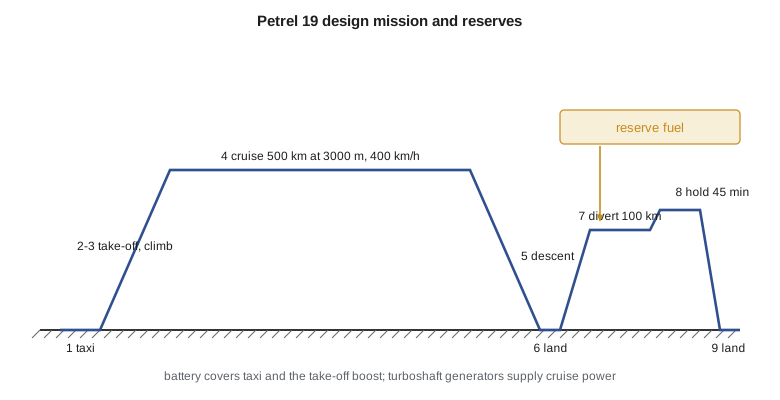
The mission profile is divided into segments, and each segment is assigned a mass fraction: the ratio of aircraft mass at the end of the segment to the mass at its start. Short segments such as taxi, take-off and landing use fractions from historical data, typically 0.99 or more. Cruise and hold fractions come from the Breguet equations studied in the performance course. For a propeller aircraft the cruise fraction is
where \(R\) is the cruise range, \(c_p\) the fuel consumed per unit of shaft work, \(\eta\) the overall efficiency from shaft to thrust and \(L/D\) the lift-to-drag ratio. The hold fraction uses endurance instead of range, so the flight time multiplied by the flight speed takes the place of \(R\).
A hybrid-electric powertrain in the mission
The Petrel follows the series hybrid architecture proven on the Tern: turboshaft engines drive generators, the electricity powers electric motors that turn the propellers, and a battery adds power for taxi and take-off. In a series hybrid the fuel's energy passes through a chain of conversions, generator, power electronics, motor and cables, each with its own loss. Dr. Nakamura's group estimates the chain at about 0.96 for the generator, 0.94 for the inverter and motor and 0.99 for cabling, so 0.893 overall. Multiplied by a propeller efficiency of 0.82, the overall efficiency in the Breguet equation is 0.733, lower than a direct-drive turboprop's propeller efficiency alone. The hybrid has to win back that penalty elsewhere: by sizing the turboshafts for cruise instead of take-off, by running them at their best point, by taxiing on the battery and by letting the airframe designer place the propellers where they work best.
The turboshaft fuel consumption is taken as 0.30 kg per kWh of shaft work, a typical value for a modern small turboshaft at its cruise power. Cruise lift-to-drag ratio is taken as 11.5 and hold lift-to-drag ratio as 14.0, cautious first guesses that Lesson 6 will refine. The hold is flown at about 280 km/h, near the speed for maximum endurance.
# Petrel 19 design mission: fuel fractions for a series hybrid-electric commuter (Raymer-style segment method).
import math
g = 9.81
bsfc = 0.30 / 3.6e6        # turboshaft generator fuel use, kg per joule of shaft work (0.30 kg/kWh)
eta_chain = 0.96 * 0.94 * 0.99   # generator x inverter-motor x cables
eta_prop = 0.82
eta = eta_chain * eta_prop
LD_cruise, LD_hold = 11.5, 14.0
V_hold = 280 / 3.6         # m/s
def cruise_fraction(R_m):
    return math.exp(-R_m * bsfc * g / (eta * LD_cruise))
def hold_fraction(t_s):
    return math.exp(-t_s * bsfc * g * V_hold / (eta * LD_hold))
segments = [("engine start, taxi", 0.992), ("take-off", 0.996), ("climb to 3000 m", 0.986),
            ("cruise 600 km", cruise_fraction(600e3)), ("descent", 0.995), ("landing, taxi", 0.996),
            ("divert 100 km", cruise_fraction(100e3) * 0.99), ("hold 45 min", hold_fraction(45 * 60)),
            ("final landing", 0.995)]
w = 1.0
print(f"chain efficiency {eta_chain:.3f}, overall propulsive efficiency {eta:.3f}")
for name, f in segments:
    w *= f
    print(f"{name:20s} fraction {f:.4f}  cumulative {w:.4f}")
used = 1 - w
fuel_frac = used * 1.06          # 6 percent for trapped and unusable fuel and margin
print(f"fuel used fraction {used:.4f}; with 6% margin Wf/W0 = {fuel_frac:.4f}")
for W0 in (8000, 8618):
print(f"at W0 {W0} kg fuel load {fuel_frac * W0:.0f} kg")chain efficiency 0.893, overall propulsive efficiency 0.733 engine start, taxi fraction 0.9920 cumulative 0.9920 take-off fraction 0.9960 cumulative 0.9880 climb to 3000 m fraction 0.9860 cumulative 0.9742 cruise 600 km fraction 0.9434 cumulative 0.9191 descent fraction 0.9950 cumulative 0.9145 landing, taxi fraction 0.9960 cumulative 0.9108 divert 100 km fraction 0.9804 cumulative 0.8930 hold 45 min fraction 0.9834 cumulative 0.8782 final landing fraction 0.9950 cumulative 0.8738 fuel used fraction 0.1262; with 6% margin Wf/W0 = 0.1338 at W0 8000 kg fuel load 1070 kg at W0 8618 kg fuel load 1153 kg
The program multiplies the segment fractions to find the mass at the end of the mission. With the first-pass cruise distance of 600 km, the aircraft uses about 12.6 percent of its take-off mass in fuel; adding 6 percent for unusable fuel and margin gives a fuel fraction of about 0.134. At the certification limit of 8618 kg that would be about 1150 kg of fuel. The cruise segment dominates, but the reserves, diversion and hold together cost almost as much as the first 300 km of cruise, which is why reserve policy is part of the requirements discussion and not an afterthought.
Arjun notices how sensitive the result is to the efficiency chain. Every percent of loss in the power electronics shows up directly in the fuel fraction, so Dr. Nakamura's group records the chain efficiency as a design parameter with a target and a tolerance. Requirements engineering in a modern aircraft is as much about these internal budgets, efficiency, mass, power, cost, as about the customer-facing numbers.
Design drivers and the design space
Not all requirements matter equally to the shape of the aircraft. A few design drivers dominate. For the Petrel these are the 1100 m gravel field length, which sets wing area, lift devices and installed power; the certification mass limit, which caps everything else; the range and fuel-saving goals, which push toward a slender wing and low drag; and the cold-weather and icing requirements, which affect the systems and the choice of airfoils. Cruise speed is a weaker driver: 400 km/h is modest, and the team can trade a few kilometers per hour for lower power or lower cost.
The design space is the set of all combinations of design variables, wing area, span, power, battery size and so on, that the team could choose. Constraints such as field length and climb remove parts of that space; objectives such as low mass or low cost rank what remains. Lessons 2 and 3 map the space with two classic tools: the sizing loop, which finds the take-off mass that closes the mission, and the constraint diagram, which finds the wing loading and power loading that meet every performance constraint.
Certification and operating rules as requirements
The certification basis is the set of airworthiness standards the aircraft must show compliance with. For a new 19-seat aircraft the basis is 14 CFR Part 23 at certification level 4, which covers normal category airplanes with 10 to 19 passenger seats and a maximum take-off weight of 19,000 lb (8618 kg). These modern standards are written as performance-based objectives, with detailed acceptable means of compliance in industry consensus standards, which makes it easier to certify novel technologies such as electric propulsion. Even so, a hybrid-electric powertrain will bring additional requirements, often called special conditions, covering battery safety, high-voltage systems and electric motors. Élise asks Prairiewind Aerospace's Designated Engineering Representative to start talks with the FAA at the requirements stage, because certification surprises late in a program are expensive.
Operating rules matter too. A commuter aircraft is flown by an operator under rules for commercial passenger flights, the commuter rules of 14 CFR Part 135. These rules set crew requirements, fuel reserves, performance margins on take-off and landing and equipment such as flight data recorders. The design must make it possible for an operator to comply economically. For example, factored landing distances in commercial operations are longer than the certified unfactored distance, so a design that just meets 1100 m in certification may not let an operator use an 1100 m strip with a full load.
Verification and the requirements baseline
Every requirement needs a verification method decided now, not after the aircraft is built. Field length will be verified by analysis during design and by flight test on paved and gravel runways; the mass limit by weighing; fuel use by flight test and fuel flow measurement; noise by measurement to the applicable standard; cold-weather operation by a winter test campaign. A requirements verification matrix lists each requirement against its method and the test or report that closes it.
Once the team agrees the requirements, they are placed under configuration control as the requirements baseline. Changes are still possible, but each one goes through a change request that records the reason, the impact on cost, weight and schedule and who approved it. Kenji, who chairs the reviews, insists on this discipline: the most common cause of cost overruns in aircraft programs is requirements that drift without anyone tallying the consequences.
Worked problem
Cruise mass fraction
With overall efficiency 0.733, fuel consumption 0.30 kg/kWh (\(8.33 \times 10^{-8}\) kg/J), \(L/D = 11.5\) and a range of 500 km, find the cruise mass fraction.
Show solution
- Exponent: \(R c_p g / (\eta L/D) = 500\,000 \times 8.33\times10^{-8} \times 9.81 / (0.733 \times 11.5) = 0.4086/8.43 = 0.0485\).
- Fraction: \(e^{-0.0485} = 0.953\).
Answer: About 0.953, so the aircraft burns about 4.7 percent of its mass in cruise.
Worked problem
Reserve fuel
The divert and hold fractions are 0.982 and 0.985. Roughly what share of take-off mass do they consume?
Show solution
- Combined fraction: \(0.982 \times 0.985 = 0.967\).
- Share: \(1 - 0.967 = 0.033\), applied to the mass at the start of the divert, slightly less than take-off mass.
Answer: About 3 percent of take-off mass, roughly 250 kg on the Petrel.
Worked problem
Writing a measurable requirement
An operator says the aircraft must handle short gravel strips. Rewrite this as a measurable requirement.
Show solution
- Name the condition: gravel, hot day, maximum take-off mass.
- Name the quantity: distance to 35 ft on take-off and from 50 ft on landing.
- Name the limit: within 1100 m.
Answer: At maximum take-off mass on a hot day, take-off distance to 35 ft and landing distance from 50 ft on gravel shall each not exceed 1100 m.
Common mistakes
MistakeStarting with a configuration before the requirements are clear.
InsteadDefine the mission, payload, field and certification basis first; the configuration follows.
MistakeWriting a solution into a requirement.
InsteadState what is needed, such as quiet taxi, and let trade studies pick the solution.
MistakeIgnoring reserve fuel in early sizing.
InsteadReserves can cost as much fuel as a large part of the cruise.
MistakeUsing certified distances as if operators could use them directly.
InsteadOperating rules factor field lengths, so check the operator's usable payload too.
Summary and key terms
- Aircraft design begins with requirements from customers, regulators and the company.
- Good requirements are measurable, verifiable and free of specific solutions.
- A design mission divided into segments, each with a mass fraction, gives the fuel fraction needed for sizing.
- The Petrel's series hybrid powertrain has an overall shaft-to-thrust efficiency of about 0.733.
- Design drivers for the Petrel are field length, the certification mass limit, range and fuel use, and cold-weather operation.
- Requirement
- A measurable statement of what the design must achieve, with a source and a verification method.
- Design mission
- The flight profile and payload used to size the aircraft.
- Mass fraction
- The ratio of aircraft mass at the end of a mission segment to that at its start.
- Certification basis
- The set of airworthiness standards an aircraft must show compliance with.
- Design driver
- A requirement that strongly shapes the configuration or size of the aircraft.
- Requirements baseline
- The agreed set of requirements under configuration control.
Practice problems
Work each problem on paper first, then reveal the answer to check.
What overall efficiency does the program use for the Petrel's powertrain?
Show answer
About 0.733, the chain efficiency 0.893 times propeller efficiency 0.82.
What fuel fraction does the program give for the 600 km first pass?
Show answer
About 0.134 including the 6 percent margin.
Name two sources of requirements besides the customer.
Show answer
Regulators and the company itself.
Why is cruise speed a weaker driver than field length for the Petrel?
Show answer
400 km/h is modest; the short gravel strips shape wing, lift devices and power more strongly.
What document lists how each requirement will be verified?
Show answer
The requirements verification matrix.
Why does the team record the power-electronics efficiency as a design parameter?
Show answer
Every percent of loss shows up directly in fuel burn.
Lesson quiz · 5 questions
Score 60% or more to complete this lesson.
Create a free account to save your progress, take quizzes and earn a certificate.