
WLD-310 · Lesson 6 of 12 · 16 min
Filler metals and adding filler
In stick and wire welding, the filler and the arc come together: the electrode melts as the arc burns, and the welder cannot add one without the other. In GTAW, they are separate. The welder can melt the joint without any filler, can add a little or a lot, and decides exactly where and when each drop goes. That freedom is what makes GTAW so precise, and it is also what makes it hard to learn. This lesson covers the filler metals Hartwell uses, how they are classified and chosen, how to keep them clean, and the technique of adding filler by hand.
Autogenous welds and when filler is needed
A weld made without filler is called autogenous: the arc simply melts the edges of the joint together. Autogenous GTAW is used on thin edge and flange joints, on tight-fitting butt joints in thin tube, as in orbital welding of sanitary tubing, and for fusing the root of some joints. It has limits. With no filler, the weld cannot be larger than the metal melted from the edges, so any gap leaves a concave, thin weld. The weld metal has exactly the composition of the base metal, which on some alloys cracks or has poor corrosion resistance, and on others, such as many aluminum alloys, is prone to hot cracking without the right filler. Most of Hartwell's GTAW welds use filler.
Filler rod and how it is classified
Manual GTAW filler comes as straight bare rods, usually 914 mm (36 in) long, in diameters from 1.0 to 3.2 mm (0.040 to 1/8 in). Each rod is stamped or tagged near one end with its classification so that it can be identified even when it has been taken out of the box. The same classifications are used for the solid wire of GMAW, so the letters ER, for electrode or rod, appear on both.
| Base metal | Common filler | Notes |
|---|---|---|
| Carbon steel | ER70S-2, ER70S-6 | ER70S-2 has extra deoxidizers for slightly dirty or rusty steel and is the usual GTAW rod; ER70S-6 is common in wire |
| 304, 304L stainless | ER308L | L means low carbon, at most 0.03 %, for resistance to intergranular corrosion |
| 316, 316L stainless | ER316L | Contains molybdenum, like the base metal, for chloride resistance |
| Stainless to carbon steel | ER309L | Higher alloy to make up for dilution by the carbon steel |
| Aluminum 6061, 3003, 1100 | ER4043 | Silicon filler; flows well, resists cracking, turns dark after anodizing |
| Aluminum 5052, 5083, 6061 for strength | ER5356 | Magnesium filler; stronger, better colour match, more porosity-prone if dirty |
In Canada, the classifications for steel filler appear in CSA W48 with metric strength designations: the GTAW and GMAW solid wire matching ER70S-2 is designated ER49S-2, where 49 is the minimum tensile strength in tens of megapascals. Stainless and aluminum filler are designated the same way in both countries. Devon's procedure sheets show both, because Hartwell buys rod from American and Canadian suppliers.
Choosing filler
The welding procedure names the filler, and the welder uses exactly what it names. Elena Marchetti chooses filler for each procedure on three grounds. The first is strength: the weld metal must match or exceed the strength the design requires. The second is chemistry: on stainless, the filler must give the right corrosion resistance and a small amount of ferrite in the weld, which lesson 8 explains; on aluminum, it must resist cracking in the alloy being welded. The third is service: a part that will be anodized, polished, used in hot water or exposed to chlorides may need a different filler from the same base metal in a dry frame.
The aluminum choice between 4043 and 5356 is a good example. ER4043, with about 5 % silicon, flows smoothly, wets well and resists hot cracking in the 6000-series alloys. ER5356, with about 5 % magnesium, gives a stronger, more ductile weld that matches the colour of the base metal after anodizing and suits the 5000-series alloys, but it is less fluid and more sensitive to dirt. Wes Brandvold's water tank is made of 5052, a magnesium alloy, and the welding table Elena uses gives 5356 as the first choice for it, because silicon filler on a high-magnesium alloy can form a brittle compound in the weld.
Keeping filler clean
GTAW filler rod goes straight into the pool with no flux to clean it, so anything on the rod goes into the weld. Rod is kept in its box or a sealed tube, off the floor, away from grinding and away from oily hands. Aluminum rod is the most sensitive, because its surface oxide absorbs moisture, and the moisture becomes hydrogen porosity in the weld; aluminum rod that has been stored open in a damp shop for weeks is wiped with solvent or discarded. Stainless rod is wiped with solvent before use if it has been handled. Devon wears clean gloves for stainless and aluminum and keeps a rag damp with solvent in his kit for wiping each rod.
The end of the rod also matters. When the welder stops, the hot end of the rod oxidizes if it leaves the gas shield. Before restarting, the oxidized tip, a few millimetres long and discoloured, is snipped off with side cutters. Feeding an oxidized tip into the pool adds oxide to the weld, which on stainless shows as dark specks and on aluminum as porosity and lack of fusion.
Adding filler: the dab
The basic manual GTAW technique is called dabbing. The welder establishes the pool, holds the torch steady at a constant arc length and angle, and dips the end of the filler rod into the leading edge of the pool, then withdraws it slightly, still inside the gas shield. While the rod is out of the pool, the torch advances a short distance and the pool moves forward. Then the rod dips again. Each dip adds a small amount of metal, and the rhythm of dip and advance forms the ripples of the finished bead. The rod is never pushed into the arc itself, where it would melt into drops that fall into the pool or spatter, and it never touches the tungsten.
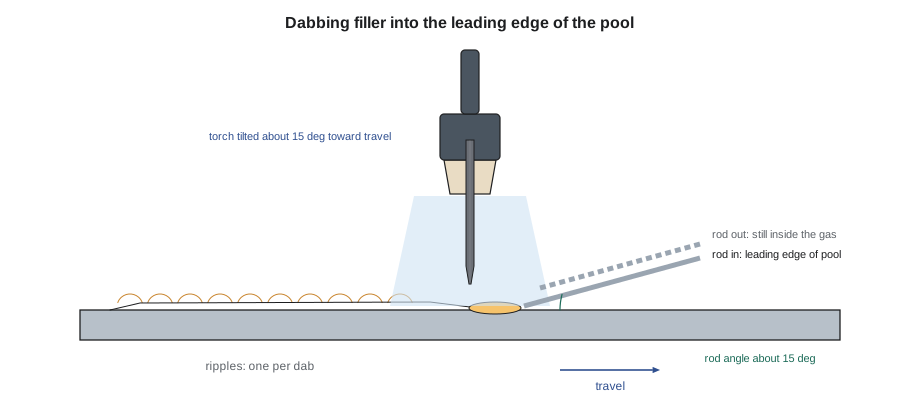
The rod angle is low, about 15 to 20 degrees from the work, so that it enters the pool from the front without crossing the arc. The torch and rod are roughly in line with the joint, with about 90 to 110 degrees between them as seen from the side. In a groove or fillet, the rod enters at the leading edge and toward the side that needs more metal. On a wide pass, the welder may weave the torch and dab at each side.
Other ways of adding filler are used for special jobs. In lay-wire, the rod is laid in the joint or along it and the arc is run over it, melting it in as the torch advances; this is used on some roots and for long, even beads. In walking the cup, used mostly on pipe, the cup rests on the joint and is rocked from side to side while the rod is fed. Feeding the rod continuously, sliding it through the fingers into the pool without dabbing, is used on longer passes and gives an even bead once mastered.
Feeding the rod with the fingers
Holding a 914 mm (36 in) rod by its far end would put the welder's hand nowhere near the work and make the tip wander, so the rod is held about a third of the way along and fed forward through the fingers as it melts. The common grip holds the rod between the thumb and the first two fingers, with the rod resting on the ring finger, and slides it forward by pushing with the thumb and pulling the fingers back, a small creeping motion that does not move the hand. Learning this feed without looking at the hand, while watching the pool, takes Devon most of a week. Marta has him practise feeding a rod into a coffee can while watching a spot on the wall.
How much filler a joint needs
Filler consumption is easy to estimate from the size of the weld. The volume of weld metal per unit length is the cross-section of the weld, and the mass is that volume times the density of the metal. A rod of a given diameter and length holds a known mass, and the welder uses most, but not all, of each rod: the last 50 to 75 mm (2 to 3 in) is too short to hold safely and is thrown away.
# Filler rod needed for a GTAW weld: weld metal volume, mass and number of rods
import math
leg = 4          # fillet leg, mm
length = 3600       # total weld length, mm
rod_d, rod_len, stub = 1.6, 914, 60   # rod diameter, rod length, unused stub (mm)
density = 0.008      # g per cubic mm (stainless steel)
area = leg ** 2 / 2 * 1.15            # fillet plus about 15 % reinforcement
weld_vol = area * length
rod_vol = math.pi / 4 * rod_d ** 2 * (rod_len - stub)
mass = weld_vol * density
print(f"weld metal {weld_vol:,.0f} cubic mm ({mass:.0f} g)")
print(f"usable volume per rod {rod_vol:,.0f} cubic mm -> {math.ceil(weld_vol / rod_vol)} rods")weld metal 33,120 cubic mm (265 g) usable volume per rod 1,717 cubic mm -> 20 rods
The calculation is for the fillet welds that hold the tubing supports on the first Coldwater skid: about 3.6 m (142 in) of 4 mm (5/32 in) fillets in all. Devon takes a few more rods than the number calculated, because practice welds and restarts use extra, but he no longer brings a full box to the skid.
Rod diameter and the size of the pool
The filler rod diameter is chosen to suit the pool. A rod that is too small for the pool melts away as soon as it touches, so the welder must feed fast and the bead grows slowly. A rod that is too large chills the pool when it enters, may not melt fully, and can be pushed through the pool to stick on the far side. A good rule is a rod about the same diameter as the tungsten, or about the thickness of thin material: 1.6 mm (1/16 in) rod for thin sheet and roots, 2.4 mm (3/32 in) for most fill and cap passes on light plate and small pipe, and 3.2 mm (1/8 in) for heavier aluminum. Devon carries two diameters to most jobs and changes between them as the joint fills.
Filler on different metals
Each metal has its own feel. On carbon steel, the rod melts readily and the pool accepts it without fuss. On stainless, the pool is sluggish and the rod must be fed into the very front of the pool or it sits on top and does not fuse; the welder watches for the rod to flow out and blend before the next dab. On aluminum, the pool is fluid and fast, the rod melts the moment it touches, and the welder feeds more often and in larger amounts. Rob Haldane tells Devon that the hardest thing about aluminum is that it gives no warning: the rod tip does not glow before it melts, so a rod held too close to the arc simply drips into the pool, and the oxide on the drop goes in with it.
Gloves change the feel too. A thick stick-welding glove makes it almost impossible to feed rod smoothly, which is why GTAW welders wear thin, close-fitting gloves on the filler hand. On high-current aluminum, where the heat at the hand is strong, some welders wear a thin glove on the rod hand and a heavier one on the torch hand, or slip a heat shield over the glove.
Matching filler to the procedure
Every Hartwell procedure for GTAW names the filler classification and the diameters allowed, and the welder's job is to use exactly those. On procedure and code work, an inspector may check the stamp on the rod being used against the procedure. Devon has once already been stopped by Lucia when a stub of ER308L from a previous job was found in his 316L rod tube; the mix-up would have put the wrong alloy in a weld on a line designed for chloride service. Since then, he empties his rod tubes completely between jobs and labels each one.
Common mistakes
MistakePushing the rod into the arc.
InsteadDip the rod into the leading edge of the pool, below the arc.
MistakeRestarting with the oxidized rod tip.
InsteadSnip off the discoloured tip before restarting.
MistakePulling the rod out of the gas shield between dabs.
InsteadWithdraw the rod only slightly, keeping its hot end in the gas.
MistakeUsing 4043 on a high-magnesium aluminum alloy because it flows better.
InsteadUse the filler the procedure names; 5356 suits the 5000 series.
MistakeLeaving aluminum rod open in a damp shop.
InsteadStore rod sealed; wipe or discard rod that has been exposed.
Summary and key terms
- GTAW filler is added separately; autogenous welds use none.
- Filler rod is classified with ER designations and must be identified on the rod.
- The procedure names the filler, chosen for strength, chemistry and service.
- Rod must be kept clean and dry, and its oxidized tip snipped off before restarting.
- Dabbing adds filler at the leading edge of the pool at a low rod angle.
- Filler consumption can be estimated from the weld cross-section and length.
- Autogenous weld
- A weld made by fusing the base metal without filler.
- Dabbing
- Adding filler by dipping the rod into the leading edge of the pool at a steady rhythm.
- ER308L
- A low-carbon stainless filler for 304 and 304L stainless steel.
- Lay-wire
- A technique in which filler is laid in the joint and the arc is run over it.
Practice problems
Work each problem on paper first, then reveal the answer to check.
A 3 mm fillet, with 15 % reinforcement, runs 2 m. What is the weld metal volume?
Show answer
3 x 3 / 2 x 1.15 x 2000 = 10,350 cubic mm.
Which filler would Hartwell use for 316L tube?
Show answer
ER316L.
Why is 309L used to join stainless to carbon steel?
Show answer
Its higher alloy makes up for dilution by the carbon steel so the weld stays stainless.
Lesson quiz · 5 questions
Score 60% or more to complete this lesson.
Create a free account to save your progress, take quizzes and earn a certificate.