
WLD-310 · Lesson 2 of 12 · 17 min
GTAW power sources, polarity and AC balance
Devon's booth has an inverter GTAW machine about the size of a carry-on suitcase, with a front panel full of settings that his stick machine never had: polarity, AC balance, AC frequency, pre-flow, post-flow, up-slope, down-slope, start current, crater current, pulse. Marta says the panel is less complicated than it looks. Most of the settings control one of three things: which way the current flows, how the arc starts and ends, and, on AC, how the current is split between cleaning and penetration. This lesson works through them in that order, with the power source first.
Constant current power sources
GTAW uses a constant current power source, like stick welding. The machine holds the current close to its set value even as the arc length, and so the arc voltage, changes with the welder's hand. That matters because the welder's hand is never perfectly steady. If the machine were constant voltage, like a wire machine, a small change in arc length would swing the current by a large amount and the pool would grow and shrink with every movement. With constant current, a change in arc length changes the voltage and the width of the arc, but the heat stays nearly the same.
Older GTAW machines are large transformer-rectifier units with heavy copper windings, which give AC from the transformer and DC through a rectifier. Hartwell still has one in the back of the shop, and Glen Teskey uses it for heavy aluminum because it runs all day without complaint. Modern machines are inverters, which convert the incoming power to high frequency, transform it, and then build the output current electronically. The inverter can shape the current in ways a transformer cannot: square AC waves, adjustable balance and frequency, fast pulsing, precise slopes. It is also much lighter and uses less power from the line.
A GTAW machine has a duty cycle like any other. A machine rated at 250 A at 40 % can run at that current for 4 minutes in every 10 before it must cool. At lower current the allowable time rises; at 200 A the same machine may run continuously. Most GTAW work on thin stainless runs well under 150 A, so duty cycle rarely limits the booth machines; on heavy aluminum with AC at 250 A it can, and that is one reason the old transformer machine still has a job.
DCEN: the normal polarity for GTAW
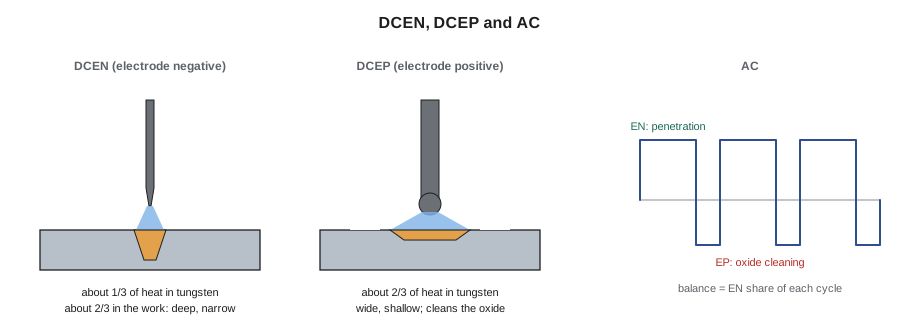
With direct current, the current flows one way all the time, and the polarity decides where the heat goes. In GTAW, the electrons flow from the negative electrode to the positive one, and most of the heat, roughly two thirds, is released where they arrive. With the tungsten negative, direct current electrode negative or DCEN, the electrons flow from the tungsten to the work, so most of the heat goes into the work and only about a third stays in the tungsten. The arc is narrow and stable, penetration is good, and a small tungsten can carry a lot of current without melting. DCEN is the polarity for carbon steel, stainless steel, nickel alloys, copper and titanium.
With the tungsten positive, direct current electrode positive or DCEP, the balance reverses. About two thirds of the heat goes into the tungsten, which must be much larger to carry the same current, and the arc is wide and shallow. DCEP has one useful property: as the current flows from the work to the tungsten, the positive ions striking the work break up the oxide layer on its surface. On aluminum and magnesium, whose oxides melt far above the metal, this cleaning action is what allows the weld to fuse. But DCEP alone puts so much heat into the tungsten that it is almost never used for welding. Instead, AC combines the two.
AC and the oxide problem
Aluminum is always covered with a thin, tough layer of aluminum oxide, which forms again within seconds of being removed. The oxide melts at about 2,050 °C (3,700 °F), while aluminum melts at about 660 °C (1,220 °F). If the oxide is not broken up, the aluminum under it melts and the oxide floats on the pool like a skin, so the filler and the base metal never mix. Alternating current solves this by switching polarity many times a second. During the electrode-negative half of each cycle, the arc heats and penetrates the work; during the electrode-positive half, the arc cleans the oxide off the surface ahead of the pool and around it. The cleaned band is visible after welding as a frosty white strip on each side of the bead, called the etched zone.
Conventional AC from a transformer is a sine wave at the line frequency, 60 Hz in North America, with equal time on each half. At each zero crossing the current drops to nothing and the arc goes out for an instant, which is why transformer machines keep the high-frequency on continuously on AC: it relights the arc every half cycle. Inverters switch the current in a square wave, passing through zero almost instantly, so the arc stays lit with little or no continuous high-frequency, and they allow the welder to set how long each half lasts.
AC balance
AC balance is the share of each cycle spent on electrode negative. A balance of 50 % means equal time on each half, like a sine wave. Turning the balance up, to 65 or 75 % electrode negative, gives more penetration, a narrower bead, a cooler tungsten that holds its point, and less cleaning. Turning it down, toward 50 or 60 %, gives more cleaning, a wider etched zone, and a hotter tungsten that tends to ball. Some machines label the setting the other way, as the percentage of electrode positive, so the first thing to check on an unfamiliar machine is which way the dial runs.
Marta's rule for clean aluminum is to start at about 70 % electrode negative and lower it only if the pool shows specks of oxide or a dirty, peppery surface. Heavily oxidized or dirty aluminum, such as the old tank on Wes Brandvold's farm, needs more cleaning, but she would rather clean the metal properly with a stainless brush and solvent than turn the balance down and burn up the tungsten.
# AC balance and frequency: how long each half cycle lasts and how the heat divides (illustrative split)
freq = 120          # AC frequency, Hz
for en_pct in (50, 60, 70, 75):
    period_ms = 1000 / freq
    t_en = period_ms * en_pct / 100
    t_ep = period_ms - t_en
    # rough heat split: about 2/3 of the arc heat goes to whichever side receives the electrons
    work = en_pct / 100 * 2 / 3 + (1 - en_pct / 100) * 1 / 3
print(f"balance {en_pct}% EN: EN {t_en:.2f} ms, EP {t_ep:.2f} ms per cycle, about {work * 100:.0f}% of the heat into the work")balance 50% EN: EN 4.17 ms, EP 4.17 ms per cycle, about 50% of the heat into the work balance 60% EN: EN 5.00 ms, EP 3.33 ms per cycle, about 53% of the heat into the work balance 70% EN: EN 5.83 ms, EP 2.50 ms per cycle, about 57% of the heat into the work balance 75% EN: EN 6.25 ms, EP 2.08 ms per cycle, about 58% of the heat into the work
The calculation is a rough model, but it shows the trend. Moving from 50 to 75 % electrode negative shifts several percent more of the heat into the work and out of the tungsten, which is why a high balance lets the welder use a smaller, pointed tungsten on AC. It also shows how short each half cycle is at 120 Hz: a few milliseconds.
AC frequency
Inverters also let the welder set the AC frequency, from about 20 to 250 Hz or more. A higher frequency squeezes the arc into a narrower cone, gives a narrower bead and a more focused pool, and makes the arc stiffer and easier to direct into a corner or a fillet. A lower frequency gives a wider, softer arc and a wider bead, useful for build-up and on wide joints. Hartwell's starting setting for aluminum fillets and thin butt welds is about 120 Hz; for wide cap passes on thicker plate, about 80 Hz. The frequency does not change the heat much; it changes its shape.
Starting and ending the weld
The other settings on the panel control the sequence of a weld from the moment the welder presses the pedal or the torch switch:
| Setting | What it does | Typical starting value |
|---|---|---|
| Pre-flow | Gas flows before the arc starts, purging air from the cup and hose | 0.2 to 0.5 s |
| Start current | Current used to strike the arc, before the slope begins | 20 to 40 A |
| Up-slope | Time to ramp from start current to welding current | 0 to 1 s |
| Welding current | Maximum current, reached at full pedal | Set for the job |
| Down-slope | Time to ramp down when the welder releases the switch | 1 to 3 s |
| Crater current | Low current held at the end to fill the crater | 10 to 30 % of welding current |
| Post-flow | Gas flows after the arc stops, protecting the cooling tungsten and crater | About 1 s per 10 A, at least 5 s |
With a foot pedal, the welder does the slopes with the foot, and the machine's up-slope and down-slope are usually set to zero. With a torch switch, as when welding on the skid where a pedal cannot be used, the slopes and crater current do the work that the foot would. The post-flow is the setting beginners most often get wrong. If the gas stops while the tungsten is still red hot, the tip oxidizes and turns blue or black and the crater cools in air. Devon's first week, he lifts the torch away as soon as the arc stops, out of habit from stick welding; Marta makes him hold the torch over the crater until the gas stops, every time, until it becomes habit.
Remote controls and torch switches
The foot pedal is the most common remote control in a booth: the welder presses it to start, varies the current with it, and lifts off to end. In the field, or in a position where the welder cannot stand on a pedal, a thumb wheel or slider on the torch handle does the same job, and a simple on-off torch switch uses the machine's slope settings. Some machines also have a two-step and four-step trigger mode: in two-step, the arc runs while the switch is held; in four-step, a press and release starts the weld and holds the current, and a second press starts the down-slope and crater. Four-step saves the welder's hand on long welds.
Setting up the machine for the first job
Before Devon's first beads, Marta has him set up the machine for 3 mm (1/8 in) 304 stainless plate and write down each setting: DCEN; lift or high-frequency start; pre-flow 0.3 s; start current 20 A; up-slope 0 s with the pedal; welding current 120 A maximum; down-slope 0 s; crater 20 A; post-flow 8 s; pulse off. For aluminum, the next week, the list changes: AC; high-frequency start; balance 70 % electrode negative; frequency 120 Hz; welding current 150 A maximum; post-flow 10 s. The list goes into his notebook beside a sketch of the panel, so that he can set any machine in the shop the same way.
Reading the machine's display
Most inverters show the set current while idle and the actual current and voltage while welding, and many hold the last readings for a few seconds after the arc stops. Marta has Devon read the display after every practice bead and write the numbers in his notebook beside the bead's appearance. After a week, the notebook shows him something the panel does not say directly: for the same pedal feel, his arc voltage ran about a volt higher on the days his beads were wide and flat, because he was holding a longer arc when he was tired. The voltage is the honest measure of arc length, and on procedure work it is the number the inspector writes down.
The display also shows when the machine is not doing what the welder thinks. If the actual current never reaches the set maximum at full pedal, the pedal's range setting or its cable may be at fault. If the voltage on AC jumps around while the bead looks normal, the high-frequency or the work connection may be poor. Devon learns to clamp the work lead close to the weld and on clean metal, because a loose ground on AC makes the arc wander and can mark the part with small arc strikes far from the joint.
Common mistakes
MistakeUsing DCEP to weld steel with GTAW.
InsteadUse DCEN for steel; DCEP puts two thirds of the heat in the tungsten.
MistakeTurning the AC balance down to deal with dirty aluminum.
InsteadClean the aluminum first; low balance overheats and balls the tungsten.
MistakeAssuming every machine's balance dial reads the same way.
InsteadCheck whether the dial shows electrode negative or electrode positive.
MistakeLifting the torch as soon as the arc stops.
InsteadHold the torch over the crater until the post-flow ends.
MistakeLeaving machine slopes on while using a foot pedal.
InsteadSet slopes to zero and control them with the pedal.
Summary and key terms
- GTAW uses a constant current power source so the heat stays steady as arc length varies.
- DCEN puts most of the heat in the work and is used for steel, stainless and most metals.
- AC alternates penetration (electrode negative) and oxide cleaning (electrode positive) for aluminum.
- AC balance sets the share of electrode negative; higher means more penetration and a cooler tungsten.
- AC frequency shapes the arc; higher is narrower and stiffer.
- Pre-flow, slopes, crater current and post-flow control the start and end of each weld.
- DCEN
- Direct current electrode negative; electrons flow from the tungsten to the work.
- AC balance
- The percentage of each AC cycle spent on electrode negative.
- Etched zone
- The cleaned, frosty band beside an AC aluminum weld left by the electrode-positive half cycle.
- Post-flow
- Shielding gas that keeps flowing after the arc stops to protect the tungsten and crater.
Practice problems
Work each problem on paper first, then reveal the answer to check.
A machine is set to 120 Hz and 70 % EN. How long is the electrode-positive part of each cycle?
Show answer
The cycle is 8.33 ms; 30 % of that is 2.5 ms.
What post-flow would Hartwell's rule give for a 150 A weld?
Show answer
About 15 s (1 s per 10 A).
Why does a transformer machine need continuous high-frequency on AC?
Show answer
The sine wave passes slowly through zero and the arc goes out each half cycle; high-frequency relights it.
Lesson quiz · 5 questions
Score 60% or more to complete this lesson.
Create a free account to save your progress, take quizzes and earn a certificate.