
TRD-106 · Lesson 8 of 12 · 20 min
Resolving conflict on site
Construction sites are full of the ingredients for conflict: tight schedules, shared space, noise, heat and cold, long days, money at stake and people from many companies and backgrounds. Some disagreement is normal and even useful, because it brings problems into the open. But conflict that is handled badly wastes time, damages relationships, leads to rework and, at its worst, turns into harassment or violence. This lesson gives practical ways to keep disagreements about the work, settle them quickly and know when to bring in someone else.
Where conflict comes from
Most conflicts on site start with one of a few causes. Recognizing the cause helps you choose the right fix.
- Space and sequence: two crews want the same area, lift or ceiling route at the same time.
- Unclear or changing instructions: different people were told different things, or the plan changed and not everyone heard.
- Quality and standards: one person thinks the work is acceptable and another does not.
- Workload and fairness: someone feels they are doing more than their share, or always get the worst jobs.
- Damage: one trade damages another's work, or someone's tools go missing.
- Personal friction: different styles, a bad day, an offhand comment taken the wrong way.
Most of these are problems with the work, not with the people. That is good news, because problems with the work can usually be solved with facts, drawings and planning. The skill is to keep the conversation on the problem and stop it from becoming personal.
Keep it about the work
When Maya started on Kingsway Tower, she watched Luis handle a disagreement with a drywall lead hand who had framed a wall across a riser chase. The lead hand was angry because his crew had been told to finish the floor by Friday. Luis did not argue about whose fault it was. He brought the drawing, pointed to the chase, and said: The chase is on the drawing here, and my risers have to go through it. Can we figure out how to open it up without costing you the day? Within ten minutes, they agreed the drywall crew would move two studs that afternoon and Northbridge would install the risers first thing the next morning.
What Luis did well: he stayed calm, used facts (the drawing), described the problem rather than blaming the person, acknowledged the other side's pressure, and asked for a solution that worked for both. Those five habits settle most site disagreements.
| Instead of | Try | Why |
|---|---|---|
| You guys always block our chases. | This wall is across the riser chase shown on the drawing. | States a fact instead of a generalization |
| That's not my problem. | I see you need to finish by Friday. Let's find a way that works for both of us. | Acknowledges their pressure |
| You did it wrong. | This doesn't match the drawing here. Can we check it together? | Invites a check instead of blaming |
| Whatever, I'll just do it myself. | Let's ask our foremen to sort it out. | Escalates properly instead of acting alone |
| You never listen. | I'm worried this will fail the test. Can I show you what I mean? | Uses an I-statement about the concern |
An I-statement describes your concern from your side, without accusing: I'm worried that, I need, I'm not sure that. It is much harder to argue with than a you-statement, which sounds like an attack and makes the other person defend themselves.
A simple method for settling a disagreement
Conflict resolution trainers use many models, but on a job site, a short sequence works well:
- Pause. If you are angry, take a breath, or walk away for a few minutes. Decisions made in anger are usually bad ones.
- Listen first. Let the other person explain their side fully, without interrupting. Ask questions to understand what they need, not to win points.
- Say your side briefly, using facts and I-statements.
- Find the shared goal. On a site, it is almost always the same: get the work done safely, on time and right the first time.
- Look for options. Who can go first? Can the work be split? Is there another route, another time, another area?
- Agree and confirm. Say back what you agreed, who does what and when. Closed-loop communication applies here too.
- Follow through, and tell your foreman what was agreed so it can go into the record.
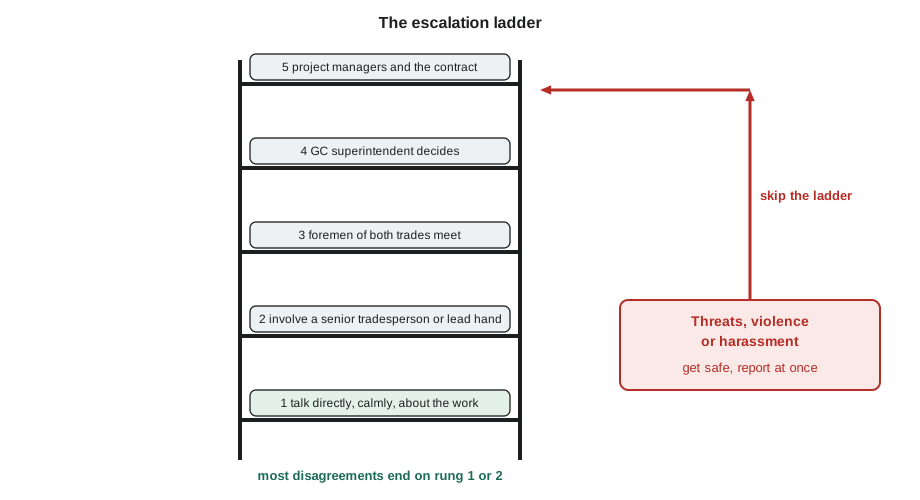
When to escalate
Many disagreements can be settled between the people involved. Some cannot, and an apprentice in particular should not try to settle disputes that involve the contract, other companies' work or decisions above their level. Escalate to your journeyperson or foreman when: the disagreement is about who pays or who is responsible; the fix involves changing another trade's work; you cannot agree after a calm conversation; the other person is a supervisor from another company; or the disagreement is getting heated.
Escalating is not running to the teacher. It moves the problem to the person with the authority and information to solve it. Dave would much rather hear I couldn't sort this out with the drywallers, can you talk to their foreman? than discover later that Maya had argued for half an hour, or worse, that she had moved their studs herself.
When you escalate, bring facts: where the problem is, what you were trying to do, what the other person said, what you have already tried, and any photos or drawings. A short, factual summary lets your foreman act quickly.
Conflict within your own crew
Not all conflict is between trades. Apprentices sometimes clash with a journeyperson or another apprentice: about how a task should be done, about being given only the dirty jobs, about tone, or about workload. Most of these can be settled with a direct, private, respectful conversation at a calm moment.
On her fourth month, Maya felt that she was always given the cleanup and material handling while the other first-year apprentice, Raj, was given more installation work. Rather than complaining to the crew or going straight to Dave, she asked Luis at the end of the day if she could talk for a minute. She said: I've been doing mostly cleanup and staging the last couple of weeks. I'd like to get more time on installation so I can get my skills signed. Is there something I need to work on first? Luis had not noticed the pattern. He explained that Raj had more experience with the threader, and agreed to rotate the tasks so Maya got time on installation every day.
That conversation worked because Maya picked a private moment, described the pattern without accusing anyone, said what she wanted, and asked if there was something she could do. If it had not worked, her next step would have been to raise it with Dave, in the same calm, factual way.
Dealing with someone who is angry
Sometimes the other person is not calm. A foreman from another trade is shouting, a journeyperson is swearing at a mistake, a customer is upset. De-escalation means lowering the temperature so the problem can be solved. A few techniques help:
- Keep your own voice calm and lower than theirs. Shouting back raises the temperature.
- Keep a safe distance and an open posture. Do not point, crowd or block their exit.
- Acknowledge the feeling without agreeing to the blame: I can see this is a real problem for your schedule.
- Focus on what can be done next, not on who was wrong.
- If they will not calm down, end the conversation politely: I want to sort this out. Let me get my foreman and we'll come back. Then leave and do that.
You do not have to stand and take abuse. Anger about the work is one thing; threats, insults about who you are, or physical intimidation are another. Walk away and report it.
When conflict becomes violence or harassment
Under Ontario's Occupational Health and Safety Act, employers must have a workplace violence policy and program and a workplace harassment policy and program, assess the risk of violence, and investigate incidents and complaints. Workplace violence includes threats and attempts as well as actual physical force. A worker can refuse work where they have reason to believe workplace violence is likely to endanger them. If anyone threatens you, pushes you, throws something at you or damages your property in anger, leave the situation if you can and report it immediately to your foreman and the constructor. In an emergency, call 911.
Threats and violence skip the escalation ladder. You do not try to talk it out first. You get to safety, report it and let the employer and the general contractor deal with it. The same applies to harassment, which Lesson 9 covers in detail.
Conflict and stress
Conflict is more likely when people are tired, hungry, hot, cold, behind schedule or worried about things outside work. A journeyperson who snaps at an apprentice at 4:30 on a Friday after a failed test may be reacting to the day, not to the apprentice. That does not make rudeness acceptable, but it helps to recognize the signs and pick your moment: a question about fair task rotation is better raised on a calm Monday morning than in the middle of a crisis.
Look after the basics that keep your own temper in check: eat, drink water, take your breaks, get enough sleep and step away for a minute when you feel your anger rising. If you notice a coworker who is unusually short-tempered, withdrawn or struggling over several days, a quiet word (You seem off lately, everything okay?) can matter more than you think. Construction has high rates of stress, substance use and suicide compared with many industries, and many employers and unions now offer confidential support programs. Pointing someone toward that help is part of looking after the crew.
Finally, after a conflict has been settled, let it go. Bringing up old arguments, telling the story around the lunch room or holding a grudge against another trade keeps the conflict alive and makes the next disagreement harder. A short follow-up (Thanks for moving those studs yesterday, that saved us a day) repairs the relationship and makes the next conversation easier.
The cost of unresolved conflict
Unresolved conflict costs real time and money. When two crews are not speaking, information stops flowing, clashes are not caught early and work is torn out. A foreman once estimated that a single unresolved argument over a ceiling route on another project cost two days of rework for two crews. The program below estimates the cost of rework from a coordination failure, using example crew sizes, hours and rates. Even with modest numbers, the cost of a missed conversation dwarfs the cost of having it.
# cost of rework from a missed five-minute conversation (example rates, CAD)
crews = [("plumbing", 2, 9.0, 92.0), ("electrical", 2, 6.5, 95.0), ("drywall", 3, 4.0, 85.0)]
# trade, people, hours each to tear out and redo, loaded hourly cost
materials = 1350.0          # fittings, tray parts, board and fasteners replaced
conversation = 2 * (5 / 60) * 92.0     # two people talking for five minutes
labour = sum(p * h * r for _, p, h, r in crews)
for t, p, h, r in crews:
    print(f"{t:10}: {p} x {h:4.1f} h x ${r:.0f} = ${p * h * r:8,.0f}")
total = labour + materials
print(f"labour ${labour:,.0f} + materials ${materials:,.0f} = ${total:,.0f}")
print(f"cost of the conversation that would have prevented it: ${conversation:,.2f}")plumbing : 2 x 9.0 h x $92 = $ 1,656 electrical: 2 x 6.5 h x $95 = $ 1,235 drywall : 3 x 4.0 h x $85 = $ 1,020 labour $3,911 + materials $1,350 = $5,261 cost of the conversation that would have prevented it: $15.33
Common mistakes
MistakeArguing about whose fault it is.
InsteadFocus on the problem and the next step, using facts and drawings.
MistakeUsing you-statements and generalizations.
InsteadUse I-statements and describe the specific problem.
MistakeTrying to settle a contract or responsibility dispute yourself.
InsteadEscalate to your foreman with the facts.
MistakeShouting back at someone who is angry.
InsteadKeep your voice calm, acknowledge the feeling, and end the conversation if it does not cool down.
MistakeComplaining to the crew about a journeyperson instead of talking to them.
InsteadHave a private, calm conversation first; then go to your foreman if needed.
MistakeTrying to talk your way through a threat.
InsteadGet to safety and report it immediately.
Summary and key terms
- Most site conflicts are about space, instructions, quality, fairness, damage or personal friction, and most are problems with the work.
- Keep it about the work: stay calm, use facts, describe the problem, acknowledge the other side and look for a shared solution.
- A simple method: pause, listen, state your side, find the shared goal, look for options, agree and confirm, follow through.
- Escalate disputes about responsibility, other trades' work or decisions above your level, bringing facts.
- De-escalate anger with a calm voice, safe distance and a focus on next steps; walk away from abuse.
- Threats, violence and harassment skip the escalation ladder: get safe and report immediately.
- Conflict
- A disagreement between people or groups about goals, methods or resources.
- I-statement
- A statement of your own concern or need that does not accuse the other person.
- Escalation
- Moving a problem to someone with more authority or information to solve it.
- De-escalation
- Calming a tense situation so the problem can be solved.
- Shared goal
- An outcome both sides want, such as finishing the work safely and on time.
- Workplace violence
- Physical force, or attempts or threats of physical force, against a worker at work.
Practice problems
Work each problem on paper first, then reveal the answer to check.
Name four common causes of conflict on site.
Show answer
Any four of: space and sequence, unclear instructions, quality, workload and fairness, damage, personal friction.
Rewrite You did it wrong as a better statement.
Show answer
For example: This doesn't match the drawing here. Can we check it together?
List the steps of the simple method for settling a disagreement.
Show answer
Pause, listen, state your side, find the shared goal, look for options, agree and confirm, follow through.
When should an apprentice escalate a disagreement?
Show answer
When it is about responsibility or payment, involves changing another trade's work, cannot be agreed calmly, involves another company's supervisor, or is getting heated.
What should you do if someone threatens you on site?
Show answer
Get to safety, report it immediately to your foreman and the general contractor, and call 911 in an emergency.
Why is an I-statement better than a you-statement?
Show answer
It describes your concern without accusing, so the other person does not have to defend themselves.
Lesson quiz · 5 questions
Score 60% or more to complete this lesson.
Create a free account to save your progress, take quizzes and earn a certificate.