
TRD-106 · Lesson 4 of 12 · 21 min
Radios, phones, hand signals and clear speech
A construction site is a hard place to talk. It is noisy, people are spread over many floors, hearing protection muffles voices, and a lot of the crew may be working in a second or third language. Yet some messages must get through perfectly the first time: stop, the load is coming down, the circuit is live, the valve is open. This lesson covers how to talk clearly face to face, how to use a two-way radio, when and how to use a phone on site, and how simple hand signals carry messages where voices cannot.
Clear speech on a noisy site
The basics of clear speech are the same anywhere, but a site makes each one more important. Get the person's attention before you start: say their name, wait for them to look at you, and if they are using a loud tool, wait for them to stop. Face them so they can see your mouth and your hands. Speak a little slower and a little louder than normal, but do not shout, which distorts words. Use short sentences with one instruction each. Name things exactly: not that thing over there, but the 50 mm elbow on the second shelf of the gang box.
Numbers are where spoken messages most often go wrong. Fifteen and fifty sound alike, especially through hearing protection. So do thirteen and thirty, and sixteen and sixty. Experienced tradespeople say numbers digit by digit when it matters: one-five or five-zero, and give the unit every time. In a mixed metric and imperial world, a measurement without a unit is a trap. Luis's rule for Maya is that every measurement she says aloud has a unit, and every important number is repeated back.
Avoid slang and nicknames that a newcomer, or someone working in a second language, may not know. Every trade has its own words, and part of an apprenticeship is learning them, but when the message is about safety, use the plain word. Say turn off the power and lock it out rather than kill it and tag it if you are not sure the other person knows what you mean.
Closed-loop communication
Closed-loop communication is a simple method used wherever mistakes are costly: in aviation, hospitals, the military and on job sites. The sender gives a clear message. The receiver repeats it back in their own words. The sender confirms the repeat-back is correct, or corrects it. Only then does the receiver act. Lesson 2 used the same idea for tasks; here it is applied to every important message.
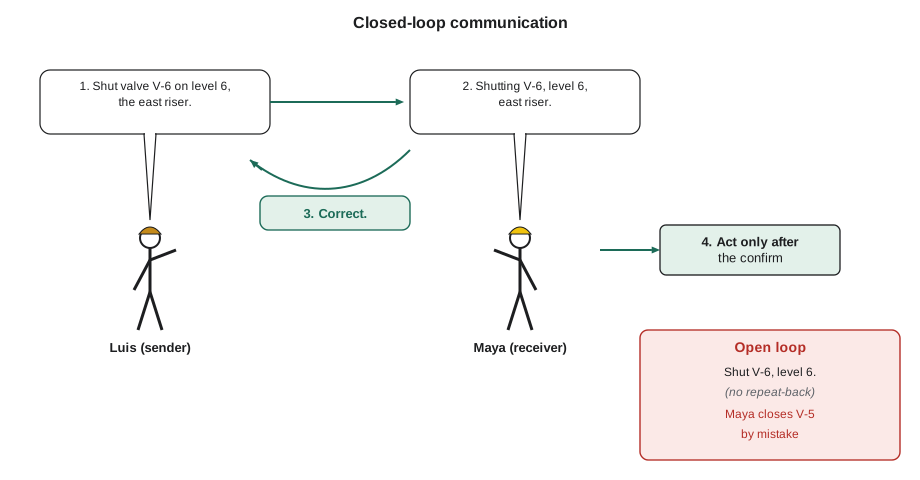
The repeat-back catches mistakes before anyone acts on them. In the example in the figure, Maya repeated V-6, but if she had said V-5 by mistake, Luis would have caught it before she touched the wrong valve. Closed-loop communication takes a few extra seconds, so crews use it for messages that matter: valve and breaker operations, lockout steps, crane and hoist signals, measurements, and anything involving another trade's systems.
Worked problem
Repeat-back catches an error
Luis calls Maya on the radio from level 7: Cut me a piece of 22 millimetre copper, six-four-five millimetres long. Maya repeats: Copy, 22 millimetre copper, five-four-six millimetres. What should happen next?
Show solution
- Luis hears that the length is wrong: 546 instead of 645.
- He corrects her: Negative. Six-four-five. Six, four, five millimetres.
- Maya repeats again: Six-four-five millimetres, 22 copper.
- Luis confirms: Correct. Only then does she cut. The two-second check saved a length of copper and a trip up and down the stairs.
Answer: Say important numbers digit by digit and always repeat them back.
Two-way radios
Radios are the main way crews talk across a large site. Many crews carry handheld two-way radios, and the general contractor, crane operators and riggers usually have their own channels. A radio is different from a phone: only one person can talk at a time on a channel, everyone on the channel hears everything, and messages are often clipped or broken. Good radio habits make the channel useful for everyone.
- Listen before you talk, so you do not cut across someone else's message.
- Press the talk button, wait a moment, then speak; the first word is often cut off if you start too soon.
- Hold the radio a few centimetres from your mouth and speak across it rather than straight into it.
- Start with who you are calling, then who you are: Luis, Maya. Wait for an answer before giving the message.
- Keep messages short. Give one message, then release the button so the other person can reply.
- Use clear standard words: copy or roger (message received), say again (please repeat), negative (no), affirmative (yes), stand by (wait), over (I have finished talking and am waiting for a reply), out (conversation finished).
- Repeat back anything important.
- Do not use the radio for chatter, jokes or personal calls. Keep the channel clear for work and emergencies.
- Know which channel you should be on, and never use the crane or emergency channel unless you are part of that communication.
| Word | Meaning | Example |
|---|---|---|
| Copy / roger | I received and understood your message | Copy, bringing the threader to level 5. |
| Say again | Please repeat your last message | Say again the length? |
| Affirmative / negative | Yes / no | Negative, the valve is still open. |
| Stand by | Wait, I will get back to you | Stand by, checking the drawing. |
| Over | I've finished talking and am waiting for your reply | Is the hoist free? Over. |
| Out | Conversation finished; no reply needed | Thanks, out. |
| All stop | Everyone on the channel stop what you are doing | All stop, all stop, person in the swing zone. |
Spelling letters and codes over a radio is a common source of errors, because b, d, e, g, p, t, v and z all sound alike. Most trades use the international phonetic alphabet (Alfa, Bravo, Charlie and so on) when spelling out equipment tags, grid lines and valve numbers. The program below converts a tag into phonetic words so you can practise saying the tags you use most.
# spell equipment tags and grid lines with the phonetic alphabet
PHON = dict(zip("ABCDEFGHIJKLMNOPQRSTUVWXYZ",
    "Alfa Bravo Charlie Delta Echo Foxtrot Golf Hotel India Juliett Kilo Lima Mike November "
    "Oscar Papa Quebec Romeo Sierra Tango Uniform Victor Whiskey X-ray Yankee Zulu".split()))
DIGITS = "zero one two three four five six seven eight nine".split()
def say(tag):
    words = []
    for ch in tag.upper():
        if ch in PHON: words.append(PHON[ch])
        elif ch.isdigit(): words.append(DIGITS[int(ch)])
        elif ch in "-/": words.append("dash")
    return " ".join(words)
for tag in ["V-6", "PRV-12B", "C-4", "DCW-7", "MAU-1"]:
print(f"{tag:8} -> {say(tag)}")V-6 -> Victor dash six PRV-12B -> Papa Romeo Victor dash one two Bravo C-4 -> Charlie dash four DCW-7 -> Delta Charlie Whiskey dash seven MAU-1 -> Mike Alfa Uniform dash one
When the radio is not working well, do not guess. If a message is broken or unclear, ask for it again. If you lose contact during a task that depends on the radio, such as guiding a load or coordinating a valve shutdown, stop the task until contact is restored. TRD-105 set the same rule for crane lifts: lost contact means stop.
Phones on site
Mobile phones are useful on site: crews text photos of problems, look up drawings, call suppliers and coordinate with the office. They are also a major distraction. Walking while looking at a screen, answering a call at the edge of a slab, or texting while operating equipment has led to many injuries. Most sites have phone rules, and apprentices should learn them at orientation.
- Do not use a phone while operating any equipment, climbing, working at height or walking through active work areas. Step into a safe spot first.
- Keep personal calls and messages for breaks.
- Use the phone for work deliberately: photos of a problem to send to your foreman, a quick call to confirm a detail, reading the current drawing.
- Do not post photos or videos of the site, other workers or the customer's property on social media without permission. Many contracts forbid it, and it can expose private information.
- Know how to call for help: the site emergency number or procedure, the address of the site, and where to send the ambulance.
Texts and group chats are informal communication, but they leave a record. A text from Dave saying move the riser 300 mm east is better than a spoken instruction because it can be checked later. Still, if the change affects cost, schedule or the design, it needs to go through the proper channels as well, as Lesson 6 explains.
Hand signals
Where noise or distance makes speech impossible, hand signals carry the message. TRD-105 covered the standard crane signals in detail. Many crews also use a few simple signals for everyday work. On Kingsway Tower, Luis and Maya agreed on a short set during her first week:
- Stop: arm straight out, palm facing the other person. Everyone on site recognizes this one.
- Emergency stop or danger: both arms waved back and forth overhead.
- Come here: palm up, fingers curled toward you.
- Wait or hold: one finger raised.
- Okay or understood: thumbs up.
- Turn it on / turn it off: rotating finger / flat hand slicing across the throat. Use these only with someone you have agreed them with, because they can be misread.
- Show me: pointing to your eyes, then to the item.
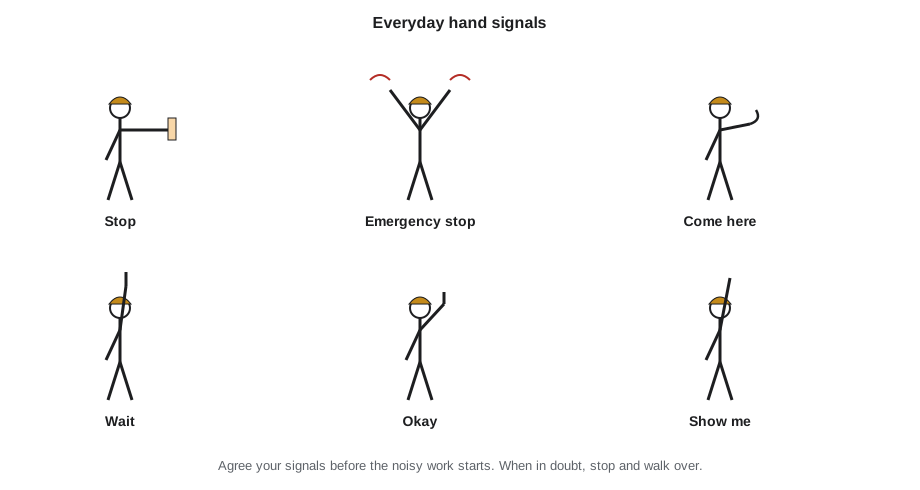
Hand signals only work if both people agree on them before the noisy work starts. A signal that means turn it off to one person might mean cut it here to another. For any signal that controls equipment or energy, use the site's standard signals, and if there is any doubt, stop and walk over to talk.
Working across languages
Many construction crews include workers whose first language is not English, and in some regions not French or Spanish either. That is a strength: it brings experience from many places. It also means messages have to be built to get through. Use simple words, short sentences and the present tense. Show rather than tell: point to the drawing, mark on the floor, demonstrate the step. Use pictures, symbols and colour codes. Check understanding by asking the person to show you or tell you back in their own words, rather than asking Do you understand? which almost always gets a yes.
Never assume that a nod means agreement. In many cultures, nodding means I am listening or I respect you, not I understand and will do it. Repeat-back and demonstration are much better checks.
Employers have a duty to make sure safety information is understood. Where workers are not fluent in the language the site uses, that may mean translated material, interpreters at orientation or a buddy who speaks the worker's language. If you are a worker who does not fully understand an instruction, saying so is a safety act, not a weakness.
Hearing protection and communication
Hearing protection is essential on a loud site, but it makes conversation harder, and some workers take it off to talk. That defeats the purpose. Better options are to move to a quieter spot for longer conversations, use hand signals and written notes, and where it is common, use hearing protection with built-in radios or level-dependent electronics that pass speech while blocking loud noise. Never remove hearing protection in a high-noise area just to make a call or have a chat.
Common mistakes
MistakeSaying a number once and assuming it was heard.
InsteadSay important numbers digit by digit with the unit, and get them repeated back.
MistakeStarting to talk before the radio transmits.
InsteadPress, pause, then speak; keep messages short and release the button.
MistakeChatting on the work channel.
InsteadKeep the channel clear for work and emergencies.
MistakeAsking Do you understand? and accepting a nod.
InsteadAsk the person to tell you back or show you.
MistakeUsing a phone while walking through active work areas.
InsteadStep into a safe spot before using your phone.
MistakeTaking off hearing protection to talk in a loud area.
InsteadMove somewhere quieter, use signals or notes, or use communication-capable protection.
Summary and key terms
- Get attention, face the person, use short sentences, name things exactly and give every measurement a unit.
- Closed-loop communication means send, repeat back, confirm, then act.
- On radios: listen first, press and pause, identify who you are calling, keep it short, use standard words and keep the channel clear.
- Use the phonetic alphabet to spell tags and grid lines over the radio.
- Use phones deliberately and only in safe spots; keep personal use for breaks.
- Agree hand signals before noisy work starts, and check understanding by repeat-back or demonstration, not by a nod.
- Closed-loop communication
- A method where the receiver repeats the message back and the sender confirms it before anyone acts.
- Repeat-back
- Saying a message back to the sender in your own words to check it was understood.
- Copy
- Radio word meaning I received and understood your message.
- Say again
- Radio phrase asking for a message to be repeated.
- Phonetic alphabet
- A set of code words for letters (Alfa, Bravo, Charlie and so on) used to spell clearly over radio.
- All stop
- A radio call for everyone on the channel to stop work immediately.
- Level-dependent hearing protection
- Hearing protection with electronics that pass normal speech and block loud noise.
Practice problems
Work each problem on paper first, then reveal the answer to check.
Why do experienced tradespeople say numbers digit by digit?
Show answer
Many numbers sound alike, such as fifteen and fifty; digits reduce the chance of error.
What are the four steps of closed-loop communication?
Show answer
Send, repeat back, confirm or correct, then act.
What does say again mean on a radio?
Show answer
Please repeat your last message.
Spell the valve tag DCW-7 using the phonetic alphabet.
Show answer
Delta Charlie Whiskey dash seven.
What should you do if you lose radio contact during a task that depends on it?
Show answer
Stop the task until contact is restored.
Why is Do you understand? a weak check?
Show answer
People often say yes or nod even when they do not understand; repeat-back or demonstration is better.
Lesson quiz · 5 questions
Score 60% or more to complete this lesson.
Create a free account to save your progress, take quizzes and earn a certificate.