
TRD-106 · Lesson 3 of 12 · 22 min
Pre-job planning and toolbox talks
Every good day on site starts with a few minutes of planning. Before a crew picks up a tool, someone should have thought about what is being built, in what order, with what material and equipment, around which other trades, and with which hazards. The two main tools for this are the pre-job plan, which the foreman or lead hand prepares before the work starts, and the toolbox talk, a short meeting where the plan and its hazards are shared with the crew. This lesson shows how both work on Kingsway Tower and what an apprentice should do to get the most out of them.
Why plan before starting
A trade crew that walks onto a floor without a plan loses time in small pieces: waiting for material that was never ordered, discovering the scissor lift is booked by another trade, finding the area is not ready, or realizing halfway through that the work should have started at the other end. Each delay is small, but together they can eat a quarter of a day. Planning also prevents injuries. Most serious incidents on construction sites happen when something about the job is different from what the crew expected: a missing guardrail, an energized circuit, a crane load overhead, a slab that was not cured. A few minutes spent looking at the task before starting is the cheapest safety measure there is.
Planning happens at several levels. The general contractor's schedule sets out what happens on each floor in which weeks. Dave turns that into a weekly plan for the Northbridge crew at the Tuesday coordination meeting. Each morning, he or Luis breaks it down into tasks for each pair. And right before each task, the people doing it look at the specific place, tools and hazards. Apprentices are mostly involved at the last two levels, but understanding the bigger picture helps them see why the plan is what it is.
What goes into a pre-job plan
A pre-job plan for a task answers a set of simple questions. On Kingsway Tower, Dave uses a one-page form for anything more than a routine task. For routine tasks, the same questions are talked through at the gang box.
- What is the task, and what does finished look like? For example: install the domestic water risers for suites 601 to 612 from level 6 to level 7, capped and labelled for test.
- Where exactly is the work? Which floor, area, grid lines and rooms, and is the area ready (floor clean, openings guarded, layout marked)?
- What drawings, specifications or instructions apply, and are they the current revision?
- What material is needed, and is it on site, staged and checked?
- What tools and equipment are needed, including lifts, ladders, scaffolds, hoists and power, and are they booked and inspected?
- Who is doing it, and are they trained for every part of it?
- Which other trades are working in the same area or will be affected, and has the work been coordinated with them?
- What are the hazards, and what controls are in place?
- What permits are needed, such as hot work, confined space, lockout or work at height?
- What could change the plan, and what do we do if it does?
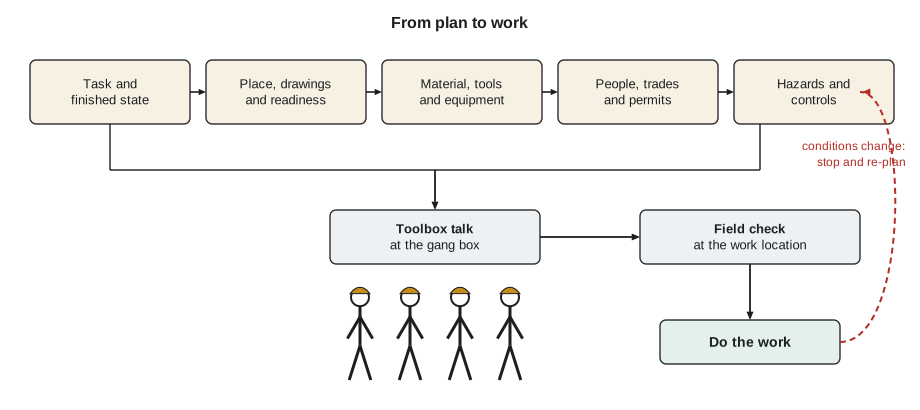
The plan does not have to be long. For a pair of apprentices staging pipe on a floor, it might be three sentences. For the rooftop make-up air unit lift in TRD-105, it was a multi-page lift plan with drawings and an engineer's stamp. What matters is that the questions are asked and answered before the work starts, by people who know the job.
The toolbox talk
A toolbox talk, also called a tailgate meeting, safety huddle or crew talk, is a short meeting at the start of a shift or task, usually five to fifteen minutes, where the crew goes over the work, the hazards and the controls. Many employers require a talk every day or every week and keep a signed record of who attended and what was covered. General contractors often require trade contractors to hold them and submit the records.
In Ontario, the Occupational Health and Safety Act requires employers and supervisors to tell workers about hazards and to give them the information, instruction and supervision they need to work safely. Toolbox talks and the written hazard assessments that go with them are one of the main ways employers meet that duty, and they leave a record an inspector can review.
There are two kinds of toolbox talk, and good crews use both. The first is a topic talk: a short lesson on one subject, such as ladder safety, heat stress, silica dust or a recent incident on another site. Many companies have a library of prepared topics. The second is a task talk: a discussion of today's work, today's hazards and today's controls. Topic talks build general knowledge; task talks keep today's crew safe. A talk that is only a topic read from a sheet, with no mention of what the crew is actually doing that day, misses most of its value.
What a good task talk covers
Dave's morning talks on Kingsway Tower follow a simple pattern that takes about ten minutes:
- The plan: what each pair is doing today, where, and what finished looks like.
- What has changed since yesterday: new trades on the floor, areas closed, crane lifts planned, deliveries, weather, inspections.
- The hazards for today's tasks and the controls for each one, talked through rather than read out.
- Equipment and permits: what is booked, what needs inspecting, what permits are open.
- Questions and concerns from the crew, asked for directly, not as an afterthought.
- Sign-in: everyone signs the attendance sheet, including anyone who arrives late.
The question step is the one most often skipped, and it is the most important for apprentices. When Dave asks Any questions or concerns? and waits, he is not being polite. He is giving the people closest to the work a chance to point out what he missed. On a Thursday in October, Maya mentioned that the floor opening she had seen the day before on level 7 still had a loose cover. That one sentence led to the cover being fixed before the crew started work beside it.
Worked problem
A task talk for the riser installation
On Monday of week 6, Dave plans the domestic water risers on levels 6 and 7. Luis and Maya will work from a 2.4 m step ladder and a rolling scaffold; the copper pipe will be brought up in the material hoist; Brightline is pulling wire in the same corridor; Stonebridge plans a crane lift of formwork on the north side at 10:00. What should the talk cover?
Show solution
- The plan: risers for suites 601 to 612, level 6 to level 7, capped and labelled for test by end of day.
- Changes: Brightline in the corridor; crane lift at 10:00 on the north side, so nobody near the north edge or the landing area from 9:45.
- Hazards and controls: ladder use (three points of contact, no top two steps), rolling scaffold (wheels locked, guardrails on, nobody riding it), floor openings at the riser chases (covers secured and marked), cutting and soldering (hot work permit, fire extinguisher, fire watch), manual handling of pipe lengths (two people for long lengths).
- Equipment and permits: scaffold inspected and tagged, hot work permit from Stonebridge for level 6, hoist booked for 7:30.
- Questions: Maya asks where the fire extinguisher for the hot work will come from; Dave assigns it to her to bring from the gang box.
- Sign-in: all four crew members sign, and the sheet goes into the Northbridge site binder.
Answer: A good talk ties every hazard to today's real task, location and timing.
How to take part
Apprentices sometimes see toolbox talks as something that happens to them. A talk is far more useful when everyone takes part. Here is what Maya does:
- Arrives on time, with her gear on, and stands where she can hear.
- Puts her phone away and listens.
- Thinks about her own task as the hazards are described: Does this apply to what I'm doing? Is anything missing?
- Asks at least one question when she is unsure about any part of the plan or the controls.
- Speaks up about anything she has seen that the crew should know: a damaged guardrail, a slippery floor, an area that is not ready.
- Signs the sheet only for the talk she actually attended. Signing for a talk you missed creates a false record and takes away the protection the talk was meant to give you.
If you arrive after the talk has started or finished, ask your foreman or journeyperson to brief you before you start work, and sign in then. Starting work without knowing about a crane lift overhead or a closed area is one of the ways people are hurt.
The field check at the work location
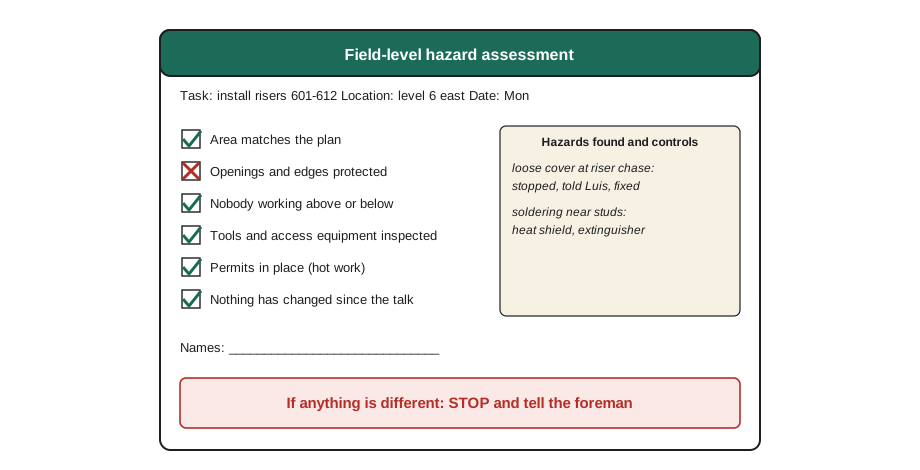
The toolbox talk happens at the gang box. The work happens somewhere else, and conditions there may not match the plan. Before starting any task, the people doing it should take a minute at the actual location to check it: a field-level hazard assessment, last-minute risk check or take-five, depending on the company. TRD-101 introduced this check. In communication terms, it is the moment where the plan meets reality, and where any difference must be reported back up the chain.
The field check asks: Is the area as expected? Are the openings guarded? Is anyone working above or below? Are the tools and equipment in good condition? Have I got everything I need? Has anything changed since the talk? If the answer to any of these is not what was planned, the crew stops and tells the foreman before going on. Luis's rule for Maya is: if it is different from what we talked about, we talk again.
Keeping the record
Toolbox talk records serve several purposes. They show the crew was told about the hazards, which protects both the workers and the employer. They give the general contractor evidence that trade contractors are running their safety program. They help investigators after an incident understand what the crew knew. And over time, they show which topics have been covered and which have not.
A good record includes the date, location, task, the hazards discussed and the controls agreed, any concerns raised and what was done about them, and the signatures of everyone who attended. Records that are just a topic title and a list of names are weak; they do not show that anything specific to the day was discussed.
Dave checks every week that each person on his crew has signed in for each day they worked. The program below does that comparison for one week, using a crew list and the sign-in sheets, and lists anyone who worked a day without signing in.
# who worked a day without signing in to that day's toolbox talk?
worked = {   # from the time sheets
    "Mon": ["Luis", "Maya", "Raj", "Priya"], "Tue": ["Luis", "Maya", "Raj", "Priya"],
    "Wed": ["Luis", "Maya", "Raj"], "Thu": ["Luis", "Maya", "Raj", "Priya"], "Fri": ["Luis", "Maya", "Priya"],
}
signed = {   # from the toolbox talk sign-in sheets
    "Mon": ["Luis", "Maya", "Raj", "Priya"], "Tue": ["Luis", "Maya", "Priya"],
    "Wed": ["Luis", "Maya", "Raj"], "Thu": ["Luis", "Raj", "Priya"], "Fri": ["Luis", "Maya", "Priya"],
}
missing = [(day, p) for day in worked for p in worked[day] if p not in signed.get(day, [])]
for day, p in missing:
    print(f"{day}: {p} worked but did not sign in")
print(f"{len(missing)} gaps to follow up this week")Tue: Raj worked but did not sign in Thu: Maya worked but did not sign in 2 gaps to follow up this week
When a gap shows up, Dave does not just get a signature after the fact. He asks the person whether they were briefed, and if they were not, he briefs them on what was covered.
Common mistakes
MistakeReading a generic topic sheet and calling it a toolbox talk.
InsteadTie every talk to the crew's actual tasks, location and hazards for the day.
MistakeSkipping the questions step because everyone is in a hurry.
InsteadAsk for questions and concerns directly and wait for answers.
MistakeSigning the sheet for a talk you did not attend.
InsteadGet briefed by your foreman, then sign for the briefing you received.
MistakeStarting work without checking the actual location.
InsteadDo a field check at the work location and report anything that differs from the plan.
MistakeKeeping quiet about a hazard because it is another trade's problem.
InsteadMention it at the talk or report it right away; it may affect your crew too.
Summary and key terms
- A pre-job plan answers what, where, with what, who, around whom, with which hazards and permits, and what could change.
- A toolbox talk shares the plan, the changes, the hazards and controls, the equipment and permits, and invites questions.
- Task talks about today's work matter more than generic topic talks.
- Apprentices take part by listening, thinking about their own task, asking and reporting.
- A field check at the work location confirms the plan matches reality; if anything is different, stop and talk again.
- Records should show the specific hazards and controls discussed and who attended.
- Pre-job plan
- A short plan made before work starts covering the task, location, resources, people, coordination, hazards and permits.
- Toolbox talk
- A short crew meeting at the start of a shift or task about the work, hazards and controls; also called a tailgate meeting or safety huddle.
- Topic talk
- A toolbox talk that teaches one general safety subject.
- Task talk
- A toolbox talk about the crew's actual work and hazards for the day.
- Field check
- A quick hazard check at the work location just before starting; also called a field-level hazard assessment or take-five.
- Hot work permit
- A written authorization for cutting, welding, soldering or other work that can start a fire.
- Sign-in sheet
- The record of who attended a toolbox talk.
Practice problems
Work each problem on paper first, then reveal the answer to check.
Name five questions a pre-job plan should answer.
Show answer
Any five of: what and finished state, where and readiness, drawings, material, tools and equipment, who and training, other trades, hazards and controls, permits, what could change.
What is the difference between a topic talk and a task talk?
Show answer
A topic talk teaches a general subject; a task talk covers today's actual work, location and hazards.
Why is the questions step so important?
Show answer
It lets the people closest to the work point out hazards or problems the planner missed.
You arrive after the toolbox talk. What should you do?
Show answer
Get briefed by your foreman or journeyperson before starting, then sign for the briefing.
What should happen if the work location is different from what the talk described?
Show answer
Stop and tell the foreman, then re-plan before going on.
What makes a toolbox talk record weak?
Show answer
Only a topic title and names, with no specific hazards, controls or concerns from the day.
Lesson quiz · 5 questions
Score 60% or more to complete this lesson.
Create a free account to save your progress, take quizzes and earn a certificate.