
SMW-230 · Lesson 2 of 12 · 21 min
Welding safety: fumes, light, fire and electricity
Aggie MacLeod would not let Kai strike an arc until he could explain the hazards of the bay and how each was controlled. Welding and cutting combine four hazards that most shop work does not: a cloud of metal fume and gas, light intense enough to burn eyes and skin, sparks and hot metal that start fires, and electrical circuits that can kill. Each has known controls, and on a well-run job none of them hurts anybody. This lesson covers them in the order Aggie taught them, with the rules that apply in each country.
Fumes and gases
Welding fume is a cloud of very fine particles, mostly metal oxides, formed when metal vaporizes in the arc and condenses in the air above it. The particles are small enough to reach deep into the lungs. What is in the fume depends on the base metal, the filler, any coating and the process. Welding also produces gases: ozone, formed when ultraviolet light from the arc acts on oxygen in the air, especially with GTAW and with aluminum; nitrogen oxides; and carbon monoxide, from carbon dioxide shielding gas and from burning coatings. The shielding gases themselves, argon, carbon dioxide and helium, are not toxic but displace oxygen, so in a tank, a pit or a small closed room they can suffocate a welder.
Three fumes matter most in sheet metal work.
- Zinc oxide from galvanized steel. Welding or cutting through the zinc coating produces a dense white fume. Breathing it causes metal fume fever, a flu-like illness with chills, fever and aches that starts a few hours after exposure and usually passes in a day or two. It is a sign of overexposure, not a normal part of the job. The fix is to remove the coating back from the weld area before welding, wherever the procedure allows, and to capture the fume at its source.
- Hexavalent chromium from stainless steel. Stainless contains chromium, and welding it, especially with processes that produce a lot of fume, turns some of the chromium into the hexavalent form. Hexavalent chromium is a known cause of lung cancer and can damage the nose, skin and kidneys. GTAW produces much less of it than GMAW or stick welding, which is one more reason stainless sheet is welded with GTAW, but every stainless weld needs good extraction.
- Manganese and other metals in steel and filler. Manganese in welding fume has been linked to damage to the nervous system with long exposure. Coatings, paint, oil and cleaning residues on the metal add their own fumes, some of them very toxic, which is why parts are cleaned before welding.
In Nova Scotia, the occupational health regulations adopt the threshold limit values published by the ACGIH as the exposure limits that employers must meet, and the limit for hexavalent chromium compounds is a small fraction of a microgram per cubic metre of air over a work shift. Employers must assess the exposure, control it, and provide information and training. The same approach applies in most provinces, though the exact limits differ. Keelson's safety program, written by Halima Noor with an occupational hygienist, sets out where fume extraction must be used and when air monitoring is done.
Controlling fume
Fume is controlled in the same order as any workplace hazard: get rid of it if possible, then control it at the source, then with ventilation, then with procedures, and only then with respirators. In practice that means several steps on every job.
- Choose the process and materials that make less fume. GTAW makes far less fume than GMAW or stick. Lower current and shorter arcs make less fume than high settings. Removing zinc, paint and oil before welding removes their fume.
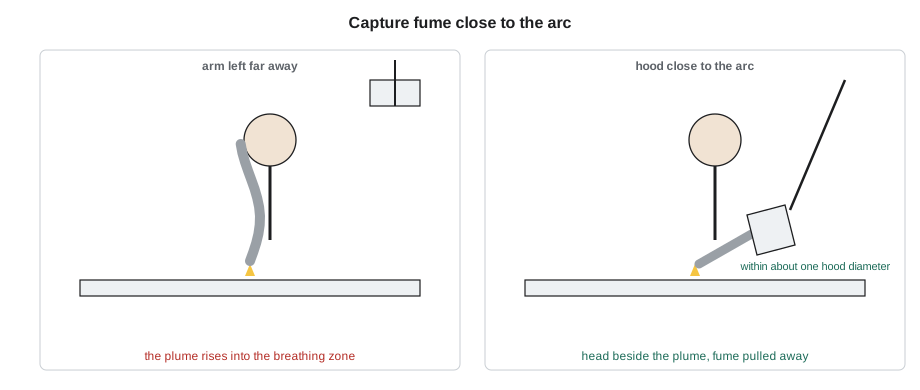
- Capture fume at the source. Local exhaust ventilation, a fume arm or a fume extraction gun nozzle, pulls the fume away within a short distance of the arc before it reaches the welder's breathing zone. A fume arm works only when its hood is close to the work, usually within about one hood diameter, and is moved as the weld moves. Positioned a metre or three feet away it does almost nothing.
- Keep your head out of the plume. The fume rises from the arc; a welder who leans over the work breathes the worst of it. Position the work and your body so the plume rises away from your face.
- Ventilate the space. General ventilation dilutes whatever the local exhaust misses, but it is not a substitute for capture at the source.
- Use respirators when the controls are not enough. A powered air-purifying respirator built into the welding helmet is common for stainless work. Respirators need fit testing, training and maintenance under the employer's program.
Air monitoring tells whether the controls are working. A hygienist clips a small pump and filter cassette near the welder's collar, inside the helmet where possible, for a full shift, then sends the filter to a laboratory. The result is an eight-hour time-weighted average, which is compared with the exposure limit. Kai's first stainless job came after Keelson had monitored Aggie doing the same kind of work, so the shop knew its controls kept her well below the limit.
The time-weighted average is the exposure at each level multiplied by the time spent at it, added up and divided by the eight-hour shift. Kai worked through a day from the monitoring report, using an illustrative set of numbers, in the script below.
# Eight-hour time-weighted average of hexavalent chromium (illustrative monitoring data)
periods = [('GTAW grease duct seams, fume arm on', 3.0, 0.8),
           ('grinding and fitting, no welding', 2.5, 0.1),
           ('GTAW in a tight corner, fume arm far away', 1.0, 6.0),
           ('break and paperwork', 1.5, 0.0)]   # (task, hours, micrograms per cubic metre)
total = sum(h * c for _, h, c in periods)
twa = total / 8.0
for task, h, c in periods:
    print(f"{task:<42} {h:>4} h  {c:>4} ug/m3")
print(f"8-hour TWA = {total:.2f} / 8 = {twa:.2f} ug/m3")
print("compare with the provincial limit set by the employer's program; the corner job is the one to fix")
for task, h, c in periods:
    if c > 2:
print(f"largest share: {task} ({h * c / total:.0%} of the dose)")GTAW grease duct seams, fume arm on 3.0 h 0.8 ug/m3 grinding and fitting, no welding 2.5 h 0.1 ug/m3 GTAW in a tight corner, fume arm far away 1.0 h 6.0 ug/m3 break and paperwork 1.5 h 0.0 ug/m3 8-hour TWA = 8.65 / 8 = 1.08 ug/m3 compare with the provincial limit set by the employer's program; the corner job is the one to fix largest share: GTAW in a tight corner, fume arm far away (69% of the dose)
One hour in the tight corner with the fume arm left behind gave most of the day's dose. The fix was simple: move the arm, or use the extraction torch Keelson kept for awkward joints. Monitoring results nearly always point at one or two tasks like that.
Arc light and radiation
An arc gives off visible light far too bright to look at, ultraviolet radiation that burns skin and the surface of the eye, and infrared radiation that heats them. A few seconds of unprotected exposure causes arc eye, a painful inflammation of the cornea that feels like sand in the eyes and usually starts hours later. Longer exposure burns skin like severe sunburn. GTAW, with its bright, clean arc and no smoke to filter it, gives off a lot of ultraviolet light; aluminum work reflects it.
- A welding helmet with the right filter shade protects the face and eyes. Auto-darkening helmets switch from a light shade to the welding shade in a fraction of a second when the arc starts. The shade is chosen by process and current: lower currents for thin GTAW need a lighter shade than heavy GMAW. The helmet supplier's chart, and the safety standard, give the ranges. Safety glasses are worn under the helmet.
- Cover the skin. Flame-resistant long sleeves and gloves stop ultraviolet burns as well as sparks; GTAW gloves are thin enough for feel but still cover the wrists.
- Protect other people. Curtains or screens around each booth stop arc light reaching others in the shop. Anyone working nearby must not look at an arc without a filter.
Fire and hot work
Sparks and spatter from welding, and especially from plasma and oxy-fuel cutting and grinding, travel several metres and stay hot enough to start fires in dust, cardboard, insulation, oily rags and the debris in ceiling spaces. Most welding fires start out of sight: behind a wall, in a ceiling, below a floor opening or inside a duct. Hot work in a shop booth built for it is controlled by the booth itself. Hot work anywhere else, on site, or in the shop outside the booths, needs a hot work permit.
Keelson's hot work program follows the provincial fire and safety rules, CSA W117.2 and the client's own permit system where there is one. Before work starts, the area within 11 metres is cleared of combustibles or the combustibles are covered with fire-resistant blankets, openings in walls and floors are covered, the sprinklers stay in service, and an extinguisher is at hand. A trained fire watch stays during the work and for at least an hour after it ends, checking above, below and behind the work. The permit is signed by the person in charge of the area and posted at the work.
Welding on duct that has carried grease or flammable vapour is especially dangerous. Old kitchen exhaust duct can hold a layer of grease that ignites from the outside heat of a weld and burns through the whole duct. Duct and containers that have held flammable liquids can explode. Such work needs the duct cleaned, tested or isolated, and a specific procedure, and it is never done by an apprentice alone.
Electrical safety
Arc welding machines produce low voltages but high currents, and the open-circuit voltage between the electrode and the work before the arc starts can be high enough to shock a welder who is wet or sweating, kneeling on wet ground or working inside a metal duct or tank. Primary power to the machine is at full supply voltage. The rules are straightforward.
- Inspect cables, the gun or torch and the ground clamp before use. Replace damaged insulation; never use a cable with bare spots.
- Attach the work clamp to the work, close to the weld. A clamp on the table or a nearby frame sends current through other paths, including bearings, pipes and other people's equipment.
- Keep dry. Wear dry gloves, stand on a dry insulating mat in damp places, and never change electrodes or tungsten with wet gloves.
- Take extra care in tight, metal-enclosed spaces. Inside a large duct, a plenum or a tank, use a machine with reduced open-circuit voltage where the procedure calls for it, keep the machine outside, and follow confined space rules for air testing and attendants.
- Lock out the primary power before working on the machine itself, using the shop's lockout procedure from SMW-110.
Cylinders and gases
Shielding gas cylinders are under high pressure. A cylinder knocked over with its valve broken off becomes a rocket. Cylinders are chained or strapped upright, capped when not in use, moved on a cart, and kept away from heat and arcs. Regulators are matched to the gas, opened slowly, and checked for leaks. Oxygen and fuel gas cylinders for cutting are stored apart, and oxygen fittings are never oiled. In small spaces, gas leaks or a long purge can push the oxygen level down; the confined space procedure includes testing the air before and during the work.
Personal protective equipment
| Hazard | Main protection | Notes |
|---|---|---|
| Fume and gas | Local extraction; respirator if needed | Remove coatings; keep head out of the plume |
| Arc light and ultraviolet | Helmet with correct shade, safety glasses | Booth curtains protect others |
| Sparks and spatter | Flame-resistant clothing, leather gloves, boots | No synthetic clothing; no open pockets or cuffs |
| Hot metal | Gloves, pliers, marking hot parts | Quench or label hot work pieces |
| Noise | Hearing protection | Plasma cutting and grinding are loud |
| Grinding | Face shield over safety glasses | Guards on, correct disc for the material |
Clothing matters more than it seems. Synthetic fabrics melt into skin when a spark lands on them. Cuffs on trousers and open shirt pockets catch spatter. A cotton or wool shirt treated for flame resistance, a leather apron or jacket for heavy work, high-top boots and gauntlet gloves are the welder's uniform.
Worked problem
Choosing controls for a stainless job
Kai is to weld 20 metres of seams on stainless grease duct over two days in the shop. What controls should be in place before he starts?
Show solution
- Process: GTAW, which makes much less fume than GMAW on stainless.
- Source capture: fume arm within about one hood diameter, moved with the weld; extraction torch for the corners.
- Position: work set up so the plume rises away from his face.
- Respiratory protection as the shop's program requires for stainless, typically a powered air helmet.
- Booth curtains closed, correct shade, flame-resistant clothing and GTAW gloves.
Answer: With those in place, Keelson's earlier monitoring shows exposure well below the limit. Without the fume arm close to the work, the same job could exceed it.
Common mistakes
MistakeTreating metal fume fever as normal after galvanized work.
InsteadIt is a sign of overexposure: remove the zinc where allowed and capture the fume.
MistakeLeaving the fume arm parked far from the weld.
InsteadKeep the hood within about one hood diameter and move it with the arc.
MistakeWelding on a site without a hot work permit and fire watch.
InsteadGet the permit, clear or cover combustibles, and keep a fire watch during and after the work.
MistakeClamping the ground lead to the welding table when the work is elsewhere.
InsteadClamp to the work, close to the weld.
MistakeWearing synthetic clothing in the welding bay.
InsteadWear flame-resistant natural fibre clothing with no open pockets or cuffs.
Summary and key terms
- Welding fume contains fine metal oxide particles; zinc, hexavalent chromium and manganese are the main concerns in sheet metal work.
- Control fume by process choice, removing coatings, capture at the source, keeping out of the plume, ventilation and then respirators.
- Air monitoring gives an eight-hour time-weighted average to compare with the exposure limit.
- Arc light burns eyes and skin; use the right helmet shade, cover skin and screen other workers.
- Hot work outside a booth needs a permit, a cleared area, covered openings and a fire watch during and after.
- Inspect cables, clamp to the work, keep dry and secure gas cylinders upright.
- Welding fume
- Fine particles, mostly metal oxides, formed when metal vaporizes in the arc and condenses.
- Metal fume fever
- A flu-like illness after breathing zinc or other metal oxide fume.
- Hexavalent chromium
- A toxic, cancer-causing form of chromium formed when stainless steel is welded.
- Local exhaust ventilation
- Extraction that captures fume close to where it is made.
- Time-weighted average
- An exposure averaged over a work shift, weighted by the time at each level.
- Hot work permit
- A written authorization listing the precautions for welding or cutting outside a designated area.
Practice problems
Work each problem on paper first, then reveal the answer to check.
A welder spends 4 hours at 1.0 unit, 2 hours at 3.0 and 2 hours at zero. What is the eight-hour average?
Show answer
(4 × 1 + 2 × 3) ÷ 8 = 1.25.
Why does GTAW produce more ozone than GMAW in many cases?
Show answer
Its bright arc gives off strong ultraviolet light, which forms ozone from oxygen in the air.
How long must a fire watch stay after hot work ends under Keelson's program?
Show answer
At least an hour, checking above, below and behind the work.
Why is welding on old kitchen exhaust duct dangerous?
Show answer
Grease inside can ignite from the heat and burn through the duct.
Lesson quiz · 5 questions
Score 60% or more to complete this lesson.
Create a free account to save your progress, take quizzes and earn a certificate.