
SLS-251 · Lesson 4 of 12 · 19 min
Window displays
▶ Video coming soon A video version of this lesson is on the way.
Juniper & Pine's flagship faces a large parking lot on the edge of a power centre, with a grocery store, a pharmacy and a coffee shop sharing the same lot. On either side of the main entrance are two display windows, each about the size of a small bedroom wall. For years they held a sofa and a lamp, changed whenever someone had time. When Noura took over visual merchandising, she began treating them as the store's biggest sign. "Most of the people who will ever see our windows are walking to the grocery store," she told Aiden on October 20. "We get about three seconds of their attention. The window has to say one thing, clearly, in that time."
A window display is a display built to be seen from outside the store. It has three jobs: to stop people who are passing, to tell them what kind of store this is, and to give them a reason to come in now. Unlike displays inside, it is seen from farther away, often in passing, and through glass with reflections. This lesson covers the types of windows, how to plan a window around a single idea, how scale and distance change what works, how often to change windows, and how to measure whether a window is doing its job.
Types of windows
| Type | Description | Strengths | Challenges |
|---|---|---|---|
| Closed-back | A window with a back wall that separates it from the store, like a small stage | Complete control of the scene, lighting and background | Hides the store interior; needs access for changes |
| Open-back | No back wall; shoppers outside see the display and the store behind it | Shows the store itself; lets light in | The store behind must look good too; harder to control the view |
| Island or shadow box | A small enclosed window, often at eye level, for a few items | Draws close attention to small or valuable products | Holds little; works only for close viewing |
| Corner | A window visible from two directions at a corner of the building | Seen by more passers-by | Must work from two viewpoints |
Juniper & Pine's two windows are closed-back, each about 3.6 metres wide, 2.4 metres high and 1.5 metres deep, with a door at the back for access and a separate lighting track. They face south, which means strong sun in the middle of the day and reflections from parked cars.
One idea per window
The most common mistake in windows is trying to show too much. A window crowded with a sofa, three lamps, a rug, a mirror, cushions and a price list says nothing in three seconds. Strong windows are built around a single idea that can be understood at a glance: a theme, a season, a promotion or one hero product. Everything in the window supports that idea, and anything that does not is removed.
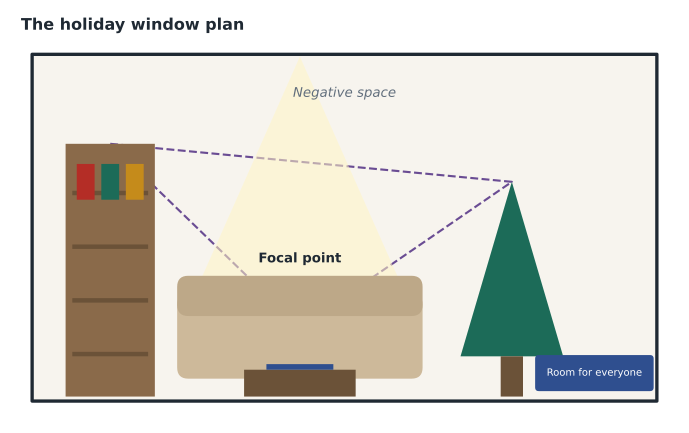
Noura plans each window with a one-line brief before choosing a single product. The fall window that was in place in October had the brief "Gather around the table": a dining table set for six with autumn colours, warm lighting overhead and one simple sign. The holiday window, installed on November 9, had the brief "Make room for everyone": a sectional sofa, a coffee table with a board game halfway through, a small tree and stockings with names hung on a bookcase. Both briefs describe a feeling and a situation rather than a list of products, which is what makes them easy to read from a distance.
| Part | Question it answers | Holiday 2026 window |
|---|---|---|
| Brief | What one idea should a passer-by take away? | "Make room for everyone" |
| Hero | What single product or group carries the idea? | The modular sectional in a warm oatmeal fabric |
| Supporting items | What helps tell the story without distracting? | Coffee table, board game, throw, small tree, stockings, one lamp |
| Message | What, if anything, is written? | One sign: "Room for everyone. Holiday delivery booking now." |
| Call to action | Why come in now? | Holiday delivery dates filling up |
| Lighting | Where does the eye go first? | Warm accent light on the sectional and the game |
| Change date | When does it come down? | January 3, 2027, for the new-year sale window |
Composition: leading the eye
The principles of display composition, covered in detail in lesson 5, apply to windows with extra force. A window needs a clear focal point, the place the eye goes first. It is usually the hero product, lit more brightly than anything else and placed slightly off centre, at or just below adult eye height for people standing outside. Supporting items lead the eye from the focal point through the rest of the scene. A rough triangle, with the tallest element at one side and lower elements stepping down, is the most common shape, because it gives the eye a path to follow.
Windows also need negative space: empty areas around the products that let the eye rest and separate one element from another. Beginners fill every corner. Experienced dressers leave as much as a third of the window empty, especially in the upper part, so that the hero stands out.
Scale and distance
Windows are seen from much farther away than displays inside. A shopper walking from the parking lot may see the window from across the lot, then again from a few steps away, and only rarely up close. Details that work inside the store, such as small labels, delicate ornaments and fine patterns, disappear at a distance. Windows need large, simple shapes, strong contrast between the products and the background, and few colours.
Noura uses a two-distance test. She looks at a new window from the far side of the main parking aisle, about 30 metres away, and asks whether she can tell what the store sells and what the idea is. Then she stands about 3 metres from the glass and asks whether there is enough detail to reward a closer look. A good window passes both.
Reflections are a practical problem with south-facing glass. Bright sky and cars reflected in the window can hide what is behind it. The usual fixes are to light the inside of the window brightly enough to compete with daylight, to use darker or solid backgrounds that reduce see-through glare, and in some cases to fit anti-reflective film. The window lighting at Juniper & Pine runs on a timer that turns it to full power in the late morning and keeps it on until the store closes and for two hours after, because evening shoppers at the grocery store pass the windows in the dark.
Changing windows
A window that never changes stops being seen. Regular shoppers learn to look past it within a few weeks. Many retailers change their windows every four to six weeks, and more often around major selling seasons. The schedule at Juniper & Pine follows the selling calendar: a new-year sale window in January, spring refresh in March, patio and outdoor living in May, back-to-school and dorm in August, fall in September, holiday in November. Each change is planned two months ahead, so that the products, props and signs are ready, and it is installed when the store is closed.
Changes also protect the merchandise. Products in a south-facing window fade in the sun, and upholstery in particular can change colour within weeks. Window products are rotated, and the sectional in the holiday window will be sold as a floor model with a disclosed discount, not as new, when it comes out.
Measuring a window
Windows are hard to measure directly, because most of the people they influence are not counted anywhere. Retailers use a few practical measures. The stop rate is the share of passers-by who stop or noticeably slow down to look. Door counts before and after a window change show whether more people came in, although many other things also affect traffic. Sales of the products shown in the window are another signal, especially if the products are not promoted anywhere else.
Worked problem
Did the holiday window stop more people?
On the Tuesday before the change, Aiden counted passers-by in front of the windows for two hours, from 4 to 6 p.m.: 610 people walked past and 31 stopped or slowed to look. On the Tuesday after the holiday window went in, at the same time, 640 walked past and 58 stopped or slowed. What was the stop rate each time, and how many more people stopped per 100 passers-by?
Show solution
- Stop rate before:
- \[31 \div 610 \approx 0.051\]
- Stop rate after:
- \[58 \div 640 \approx 0.091\]
- Difference per 100 passers-by:
- \[9.1 - 5.1 = 4.0\]
Answer: The stop rate rose from about 5 in 100 to about 9 in 100 passers-by, about 4 more people stopping per 100. That is an encouraging sign, but two counts are a small sample, and the holiday season itself makes people more likely to look. Noura planned two more counts in late November before drawing conclusions.
The example shows an important habit: compare like with like. A Tuesday-evening count should be compared with another Tuesday-evening count, not with a Saturday afternoon. Weather, school holidays and promotions at other stores in the power centre all change how many people walk past and how many stop.
Windows beyond the glass
A window is now seen by far more people online than in the parking lot. Tessa Yellowbird, who runs Juniper & Pine's e-commerce and marketing, photographs every new window the morning after it goes in and uses the pictures on the store's website, its social media accounts and the next email to customers. She has learned to ask Noura for small changes that make the window photograph well: a background without a bright window frame showing, lights that do not create hot spots in the camera, and a scene that still makes sense when cropped to a square. In return, Noura uses the comments and saves on Tessa's posts as one more signal of which windows people liked.
Window themes also tie the store together. The holiday brief, "Make room for everyone", was repeated on the feature table inside the main entrance, in the email Tessa sent in mid-November and on the home page of the website. A shopper who saw the window, then the email, then the same sectional styled the same way inside the store met one clear idea three times. SLS-254 returns to joining up the store and its online channels; for a merchandiser, the practical point is to share the brief and the photographs with marketing before the window goes in, not after.
Safety and practicalities
Window installations involve ladders, heavy furniture, electrical connections and hot lights in a small space. Noura installs windows with at least two people, uses a step ladder rather than standing on furniture, and keeps lights and fabric decorations apart. Props such as artificial trees and fabric backdrops must meet the same flame-resistance rules as decorations inside the store. Anything in a window that could fall against the glass, such as a tall mirror or bookcase, is anchored. Finally, the window must not create a false impression: if a product shown in the window is not available at the price or in the form shown, it should not be there, a point lesson 6 covers under signage.
Common mistakes
MistakeShow as many products as possible in the window.
InsteadBuild each window around one idea and remove anything that does not support it.
MistakeSmall signs and detailed props make a window interesting.
InsteadWindows are seen from far away. Use large, simple shapes and few words.
MistakeA good window can stay up for months.
InsteadShoppers stop seeing a window within weeks. Change it every four to six weeks, following the selling calendar.
MistakeA higher stop rate on one day proves the new window works.
InsteadCompare like with like over several counts, and remember other causes such as the season.
MistakeWindow products can go back on sale as new.
InsteadSun and handling can fade or mark them. Inspect them and sell them as floor models where appropriate.
Summary and key terms
- A window display stops passers-by, tells them what the store is, and gives them a reason to come in now.
- Closed-back, open-back, island and corner windows each have strengths and challenges.
- Strong windows are built around one idea, with a hero product, a clear focal point, a path for the eye and plenty of negative space.
- Windows are seen from far away and through reflections, so they need large shapes, strong contrast, few words and strong lighting.
- Change windows every four to six weeks and follow the selling calendar.
- Measure windows with stop rates, door counts and sales of featured products, comparing like with like.
- Window display
- A display built to be seen from outside the store.
- Closed-back window
- A window with a back wall that separates the display from the store.
- Brief
- A one-line statement of the single idea a display should communicate.
- Focal point
- The place in a display where the eye goes first.
- Negative space
- Empty space around products that lets the eye rest and separates elements.
- Stop rate
- The share of passers-by who stop or slow down to look at a window.
Practice problems
Work each problem on paper first, then reveal the answer to check.
Write a one-line brief for a spring window in a home store.
Show answer
For example: "Open the windows: light, fresh rooms for spring", with one bright, airy living room setting as the hero.
In one hour, 300 people walk past a window and 18 stop. What is the stop rate?
Show answer
18 divided by 300 is 0.06, or 6 in 100.
Why do windows need simpler shapes than displays inside the store?
Show answer
They are usually seen from much farther away and in passing, so small details disappear.
Name two ways to reduce reflections in a south-facing window.
Show answer
Light the inside of the window brightly, use darker or solid backgrounds, or fit anti-reflective film.
Lesson quiz · 5 questions
Score 60% or more to complete this lesson.
Create a free account to save your progress, take quizzes and earn a certificate.