
SLS-230 · Lesson 4 of 12 · 25 min
Onboarding and ramp time
▶ Video coming soon A video version of this lesson is on the way.
Maya Chen started at Ridgeline on Monday, August 31, 2026. By Friday, November 13, ten and a half weeks later, she had won four new customers, Northfield Family Clinic, Keystone Grain Equipment, Halverson Law and Lakeview Veterinary Hospital, and was credited with 48,172 dollars of first-year revenue against a ramp quota of 75,000 dollars for her first quarter. That was 64.2 in 100 of her ramp quota, with two and a half weeks of the quarter still to go and a best-case deal at Halverson Law still open.
Darnell thought Maya's start was good, but he was also honest that it owed a lot to Maya herself: she had sold appliances at Juniper & Pine for three years and already knew how to listen and follow up. The new account executive starting on January 4, 2027, would come from a different industry, and Darnell wanted a better plan for that person than the one Ridgeline had used for Maya, which had been mostly a stack of product manuals and a week of shadowing. Bev Halvorsen, meanwhile, had to prepare two seasonal sellers to sell confidently within a week. This lesson is about getting new sellers productive quickly and keeping them.
What onboarding is for
Onboarding is everything a company does to help a new employee become effective and stay: the welcome, the training, the introductions, the tools, the early coaching and the first goals. In sales, onboarding has a measurable purpose: to shorten ramp time, the period between a seller's start date and the point at which they produce results like an established seller. Every week of ramp time is a week of pay and support without full results, so a shorter ramp is worth real money. Good onboarding also reduces early departures, which are common in sales and expensive, as lesson 3 showed.
Published estimates of ramp time vary widely. Vendor and consultancy surveys of business-to-business sales teams often report averages of three to nine months, with longer ramps for complex products and long sales cycles. These surveys use different definitions and samples, so they are best treated as a rough range rather than a benchmark. A company's own history is a better guide. Grace Liu looked at Ridgeline's last six field hires and found that the median seller reached a full quarter of quota-level results in their third full quarter, about seven to nine months after starting.
Ramp quotas and ramp schedules
A new seller cannot fairly carry a full quota from day one, but having no target at all removes the focus that a quota provides. Most companies use a ramp quota: a reduced quota that rises over the first months until it reaches the full level. Ridgeline's schedule for field account executives sets the first quarter at 50 in 100 of full quota, the second at 75 in 100 and full quota from the third. Maya's first-quarter ramp quota was 50 in 100 of 150,000, or 75,000 dollars.
Worked problem
Measuring Maya's ramp against her quota
Maya's ramp quota for September to November 2026 is 75,000 dollars of first-year revenue. By November 13 she had credits of 5,808 (Northfield), 21,616 (Keystone), 15,804 (Halverson) and 4,944 (Lakeview). What share of her ramp quota has she reached, and what does she still need?
Show solution
- \[5{,}808 + 21{,}616 + 15{,}804 + 4{,}944 = 48{,}172 \text{ dollars}\]
- \[\frac{48{,}172}{75{,}000} = 0.6423 \approx 64.2 \text{ in } 100\]
- \[75{,}000 - 48{,}172 = 26{,}828 \text{ dollars still needed}\]
Answer: Maya has reached about 64.2 in 100 of her ramp quota and needs about 26,800 dollars more by November 30. Her open best-case deal, a second printer for Halverson Law worth 2,268 dollars in first-year revenue, would not close the gap on its own, so Darnell expected her to finish the quarter at around 65 to 70 in 100 of ramp quota, a solid result for a first quarter.
Ramp quotas carry a design question that matters for pay. If a new seller's commission is based on attainment of a reduced quota, they may earn close to an established seller's commission rate on far less revenue. Ridgeline handled this by paying new sellers a guaranteed amount, a non-recoverable draw, for their first quarter in addition to base salary, and then switching to the standard plan. Lesson 8 explains draws in detail.
A 30-60-90 day plan
Darnell rebuilt Ridgeline's onboarding around a 30-60-90 day plan: a written plan with goals for the first 30, 60 and 90 days, agreed with the new seller in the first week and reviewed at each milestone. The early goals are about learning and activity, which the seller controls; the later ones move toward results.
| Period | Main goals | How Darnell checks |
|---|---|---|
| Before day one | Laptop, CRM login and phone ready; territory and account list prepared; first-week schedule sent | New seller confirms everything works on day one |
| Days 1 to 30 | Learn the products, CRM and sales process; shadow four experienced sellers; meet the inside rep in their pod; learn the top 30 accounts in the territory | Product certification quiz; mock discovery call with Darnell |
| Days 31 to 60 | Run discovery calls with Darnell or a peer present; build a pipeline of qualified opportunities; complete a territory plan | Ten qualified first meetings; territory plan reviewed |
| Days 61 to 90 | Run calls alone with debriefs; send first proposals; forecast own pipeline | Three proposals sent; pipeline coverage of at least two times the next quarter's ramp quota |
The plan also named people. Each new seller would have a buddy, an experienced peer who is not their manager, to answer everyday questions; Lisa Tran agreed to be the buddy for January's hire. The inside rep in the new seller's pod would book the first meetings. Grace would run a CRM session in week one, and Farida would explain how account management worked so the new seller understood which customers belonged to whom.
Darnell kept one rule from his own first job: in the first week, the new seller should talk to at least two real customers, even if only to listen. Reading about customers is no substitute for hearing what they actually care about, and early contact with customers is motivating in a way that product manuals are not.
Onboarding on the sales floor
Retail onboarding is shorter but follows the same logic. Bev's plan for the two seasonal sellers covered four days in the week of November 16, before the busiest weekends.
- Day 1: welcome, store tour, safety orientation, the up system and the point-of-sale system, with a practice transaction for every common payment type.
- Day 2: product training in mattresses and upholstery, the two departments seasonal sellers would cover first; shadowing Carl Jensen for an afternoon.
- Day 3: role-plays of greetings, needs questions and add-ons, then selling on the floor with a buddy nearby.
- Day 4: policies customers ask about most: delivery windows, the 90-night comfort exchange, financing basics and protection plans, followed by a short quiz.
Bev also covered the legal basics every new employee needs: breaks, hours, how pay was calculated, the store's harassment policy and how to report a concern, and the safety training required under Saskatchewan's occupational health and safety rules, including WHMIS training for the cleaning products in the stockroom.
Seasonal sellers were paid hourly rather than on commission, because their stay was short and Bev wanted them to help any customer, including ones who might buy later from a permanent seller. They earned a small bonus for each protection plan or delivery booking they recorded, so that their extra effort was recognized without changing the up system.
Worked problem
Is four days of training worth it?
Each seasonal seller is paid 17 dollars an hour, and training takes four 8-hour days. Bev estimates that a trained seasonal seller makes 1,200 dollars more in gross margin per Saturday than an untrained one, through better add-ons and fewer mistakes, and each will work ten Saturdays. Ignoring the cost of Carl's and Bev's time, does the training pay for itself?
Show solution
- \[\text{Training pay} = 4 \times 8 \times 17 = 544 \text{ dollars per seller}\]
- \[\text{Extra margin} = 1{,}200 \times 10 = 12{,}000 \text{ dollars per seller}\]
- \[12{,}000 - 544 = 11{,}456 \text{ dollars}\]
Answer: Even if Bev's estimate of extra margin is double the truth, the training pays for itself many times over. The figure for extra margin is a judgment, not a measurement, but the case does not depend on its exact value.
Measuring onboarding
Onboarding is easy to praise and hard to measure, so Darnell chose three numbers to track for every new field seller: time to first deal, the number of days from the start date to the first signed contract; ramp attainment by quarter, against the ramp quota; and whether the seller was still with Ridgeline after a year. Maya's time to first deal was about five weeks, from August 31 to the Northfield signing in early October. Grace added the three measures to the sales dashboard so that each new hire could be compared with past ones.
Worked problem
The cost of a slow ramp
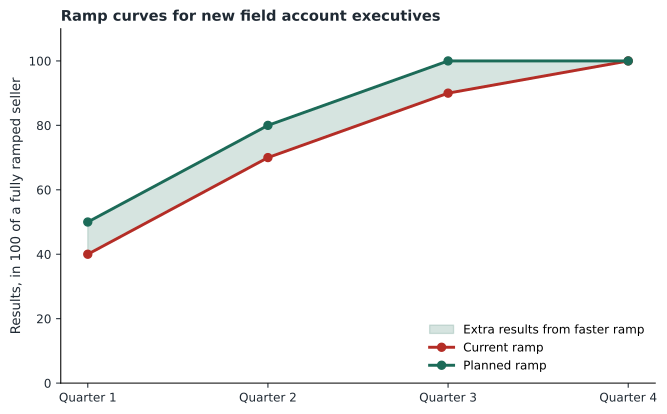
A fully ramped account executive at Ridgeline produces about 150,000 dollars of first-year revenue a quarter. Under the current onboarding, a new seller produces about 40 in 100 of that in quarter one, 70 in 100 in quarter two and 90 in 100 in quarter three. Darnell believes the new plan can lift those to 50, 80 and 100 in 100. With a gross margin of 35 in 100, how much extra margin would one new seller produce in the first three quarters?
Show solution
- \[\text{Current} = 150{,}000 \times (0.40 + 0.70 + 0.90) = 150{,}000 \times 2.00 = 300{,}000\]
- \[\text{New plan} = 150{,}000 \times (0.50 + 0.80 + 1.00) = 150{,}000 \times 2.30 = 345{,}000\]
- \[\text{Extra margin} = (345{,}000 - 300{,}000) \times 0.35 = 15{,}750 \text{ dollars}\]
Answer: A faster ramp would be worth about 15,750 dollars of extra margin per new seller in the first nine months. The improvement assumed is Darnell's estimate; tracking the three onboarding measures will show whether the new plan delivers it.
Keeping new sellers
Many new sellers who leave in their first year do so because the job was not what they expected, because they felt unsupported, or because they could not see how to succeed. Onboarding answers all three if it is honest. Darnell's revised interview process included a frank description of a typical week, including the prospecting and the rejection. His 30-60-90 day plan gave new sellers clear early goals they could meet. And his weekly one-to-one meetings in the first quarter, covered in lesson 5, gave them a regular place to raise problems before those problems turned into a decision to quit.
Common onboarding gaps
When Darnell compared the notes of the last four people Ridgeline had hired, the same gaps came up. New sellers were given product training in the first week but did not see a real customer meeting until the third or fourth week. Nobody told them which accounts in their territory were most likely to buy soon. And their first deals often stalled at the paperwork stage because they had never been shown how Ridgeline's credit approval and order entry worked. None of these gaps was expensive to fix. Each simply needed somebody to own it.
Grace suggested a simple test for any onboarding plan: for each week, can the new seller say what they should be able to do by Friday, and who will check? If the answer is vague, the week is probably filled with activity rather than learning. A plan that names an outcome and a checker each week also makes it easier for the manager to spot a seller who is falling behind early, while there is still time to help.
Worked problem
The cost of losing a new seller
Ridgeline estimates that recruiting and onboarding an account executive costs about 18,000 dollars in advertising, interview time, training time and lost manager hours, and that a new seller who leaves in the first year has produced about 60,000 dollars of first-year revenue less than a fully productive replacement would have in the same months. If one of every four new hires leaves in the first year, what is the expected cost per hire?
Show solution
- \[18{,}000 + 60{,}000 = 78{,}000 \text{ dollars per early leaver}\]
- \[\frac{1}{4} \times 78{,}000 = 19{,}500 \text{ dollars per hire}\]
Answer: Each hire carries an expected cost of about 19,500 dollars from early departures alone, which is why spending a few extra manager hours in the first 90 days usually pays for itself.
Common mistakes
MistakeHanding a new seller product manuals and a full quota.
InsteadUse a ramp quota and a written 30-60-90 day plan with learning, activity and results goals.
MistakeKeeping new sellers away from customers until they know everything.
InsteadArrange early, low-stakes customer contact, starting in the first week.
MistakeLeaving the new seller to work out who to ask for help.
InsteadAssign a buddy, introduce the key internal partners and schedule them into the first weeks.
MistakeJudging onboarding by how it feels.
InsteadTrack time to first deal, ramp attainment and first-year retention for every hire.
MistakeRushing seasonal sellers onto the floor without training.
InsteadGive even short-term sellers focused training on the products, systems and policies they will meet.
Summary and key terms
- Onboarding helps new employees become effective and stay; in sales its measurable purpose is to shorten ramp time, the period before a new seller produces results like an established one.
- Published ramp-time averages vary widely and a company's own history is a better guide.
- Ramp quotas set reduced targets that rise over the first quarters, and new sellers may receive a draw while they ramp.
- A 30-60-90 day plan sets learning, activity and results goals for each period, with named people such as a buddy.
- Retail onboarding is shorter but covers products, systems, policies, legal basics and practice.
- Leaders should track time to first deal, ramp attainment and first-year retention, and estimate the value of a faster ramp.
- Honest expectations, early wins and regular support help keep new sellers.
- Onboarding
- What a company does to help a new employee become effective and stay.
- Ramp time
- The time from a seller's start date until they produce results like an established seller.
- Ramp quota
- A reduced quota for a new seller that rises to the full level over several periods.
- 30-60-90 day plan
- A written plan setting a new employee's goals for their first 30, 60 and 90 days.
- Buddy
- An experienced peer, not the manager, who helps a new employee with everyday questions.
- Time to first deal
- The number of days from a seller's start date to their first signed contract.
Practice problems
Work each problem on paper first, then reveal the answer to check.
A full quota is 160,000 dollars a quarter and the ramp schedule is 50 in 100 for the first quarter. A new seller closes 56,000 dollars. What share of ramp quota is that?
Show answer
Ramp quota is 80,000 dollars; 56,000 ÷ 80,000 = 0.70, or 70 in 100.
A training week costs 640 dollars in wages and is expected to add 900 dollars of margin a week for eight weeks. What is the net benefit?
Show answer
900 × 8 = 7,200 dollars; 7,200 − 640 = 6,560 dollars.
Why did Darnell want new sellers to talk to customers in their first week?
Show answer
Hearing what customers care about teaches more than manuals and is motivating, and it starts building the seller's confidence early.
Lesson quiz · 5 questions
Score 60% or more to complete this lesson.
Create a free account to save your progress, take quizzes and earn a certificate.