
SLS-220 · Lesson 11 of 12 · 21 min
Multi-site and national accounts
▶ Video coming soon A video version of this lesson is on the way.
In early November, Ridgeline's installation lead brought Farida a problem. If Prairie Valley School Division signed as planned later in the month, Ridgeline would need to install 44 devices across 14 schools and the division office, remove the old equipment, connect everything to the division's network, train staff in each building and switch every school to automatic toner ordering. Each school had its own principal, its own secretary, its own timetable and its own opinions. "It is one contract," the installation lead said. "It is fifteen customers."
A multi-site account is a customer that buys for, or receives products and services at, many locations. When the locations span several regions, provinces or states, the account is often called a national account or, across countries, a global account. Multi-site accounts are among the most valuable a supplier can have, and among the hardest to serve well, because the supplier has to be consistent across every site while respecting that each site is different. This lesson covers how multi-site customers buy, how to organize contracts and service across sites, how to measure cost to serve by site, and how to plan a multi-site rollout.
How multi-site customers buy
Organizations with many sites buy in different ways, and the account plan has to say which way each customer uses. Some buy centrally: one department chooses suppliers and negotiates contracts for every site. Some buy locally: each site chooses for itself, perhaps within a budget. Many use a mix: a central contract sets the supplier, prices and terms, and sites order within it.
| Model | Who decides | What the supplier must do | Ridgeline example |
|---|---|---|---|
| Centralized | A central office for all sites | Win and keep the central relationship; serve sites consistently | Prairie Valley's division office runs the managed print contract |
| Decentralized | Each site for itself | Sell and serve site by site | A franchise group whose clinics each choose their own furniture |
| Hybrid | Central contract; sites order and approve locally | Serve both the centre and each site; report both ways | City of Regina: central standing offer for furniture, ordered by each building |
The model matters because it decides who the supplier must satisfy. In a centralized account, a site that is unhappy may still be stuck with the supplier, but its complaints will reach the central office and shape the next renewal. In a hybrid account, every site that orders is, in effect, a small customer that can choose to order more or less. In a decentralized account, the supplier may be strong at one site and unknown at the next, which makes the white-space map in lesson 6 essential.
One agreement, many sites
Multi-site customers usually want the same terms everywhere: one price list, one set of service levels, one invoice format and one point of contact for problems. Suppliers usually want the same thing, because consistency is cheaper to run. The common structure is a master agreement that sets the terms for all sites, with schedules or order forms for each site or each purchase.
Consistency has limits. Sites differ in size, use, opening hours and access. A secondary school prints far more than a small rural elementary school; a civic building open to the public has different security needs from a works yard. Good multi-site agreements set common rules and allow defined variations, such as a service level that applies everywhere but a different device mix at each site.
Taxes and regulations can also differ by location. A customer with sites in more than one province or state may be charged different sales taxes on the same products, and invoices must apply the rules for each location. Ridgeline's regional insurance brokerage had offices on both sides of a provincial border, and Ridgeline's billing team kept a site table showing which tax rules applied to each office. Farida's rule for account managers was simple: never quote a tax-included price for another jurisdiction from memory; ask billing.
A single point of contact, and a contact at every site
Multi-site customers often complain that they cannot get a clear answer from a supplier, because every site talks to someone different. Suppliers often complain that they cannot get a decision, because every site wants something different. Both problems are reduced by a clear contact structure on both sides.
| Ridgeline role | Prairie Valley counterpart | Responsibility |
|---|---|---|
| Account manager (Farida) | Business manager (Patricia Klassen) | Contract, reporting, escalations, business reviews |
| Executive sponsor (Rob) | Superintendent of business administration | Senior relationship and major issues |
| Installation lead | IT manager (Ken Fehr) and each school's site contact | Rollout schedule, network setup, site readiness |
| Service manager | Each school's site contact | Service calls, response times, site reports |
| Account executive (Maya) | Principal Sarah Nakamura and the technology committee | Feedback from schools, the first-school pilot |
Each school would name a site contact, usually the school secretary or an administrative assistant, who would report problems, receive deliveries and pass on training. Site contacts are often the people a multi-site supplier knows least and needs most. Farida asked the installation lead to meet every site contact in person during the rollout, and to record their names, hours and preferences in the CRM.
Cost to serve by site
In lesson 1, the insurance brokerage contributed far less than the City after the cost to serve, mainly because its twelve offices were spread across a wide area. Multi-site accounts make the cost to serve visible site by site, and the account plan should look at it that way.
Worked problem
Finding the expensive sites
The brokerage's cost to serve in fiscal 2026 was 52,000 dollars. Ridgeline's service data show that 4 offices in the main city accounted for 14,000 dollars and the 8 outlying offices for 38,000 dollars, mostly in technicians' travel time. What is the average cost to serve per office in each group? If remote diagnostics and a toner stock at each outlying office cut their travel-related visits by half, saving 40 in 100 of their cost to serve, what would the total cost to serve become?
Show solution
- City offices: 14,000 ÷ 4 = 3,500 dollars each.
- Outlying offices: 38,000 ÷ 8 = 4,750 dollars each.
- Saving at outlying offices: 38,000 × 0.40 = 15,200 dollars.
- New outlying cost: 38,000 − 15,200 = 22,800 dollars.
- New total: 14,000 + 22,800 = 36,800 dollars.
Answer: The outlying offices cost about 4,750 dollars each to serve, compared with 3,500 in the city. Remote diagnostics and local toner stock would cut the total cost to serve from 52,000 to about 36,800 dollars, raising the account's contribution from 19,400 dollars to about 34,600 dollars without changing the customer's price.
The answer also shows why a change in service model is usually a better first step than a price increase when a multi-site account is unprofitable. The customer pays the same and may get faster fixes, because a remote diagnosis often solves a problem before a technician could have arrived.
Planning a multi-site rollout
Installing products across many sites is a project in its own right. A rollout plan sets the order of sites, the dates, the people, the dependencies and the checks at each site. Good rollout plans start with a pilot site, learn from it and then move faster. They respect the customer's calendar, which for a school division or district means avoiding the busiest weeks of the school year and doing disruptive work when students are not in the building.
Worked problem
How long will the Prairie Valley rollout take?
Ridgeline's installation crew can install, network and test 6 devices a day at a school, and needs half a day at each site for training and removing old equipment, regardless of the number of devices. Prairie Valley has 44 devices across 15 sites. If only full days are scheduled, and each site's devices and training are done in whole days, how many crew-days will the rollout need if the sites have 6, 5, 4, 4, 3, 3, 3, 3, 3, 2, 2, 2, 2, 1 and 1 devices?
Show solution
- Check the total: 6 + 5 + 4 + 4 + 3 + 3 + 3 + 3 + 3 + 2 + 2 + 2 + 2 + 1 + 1 = 44 devices.
- At 6 devices a day, every site's installation fits in one day or less, but each site also needs half a day for training and removal.
- A site with 6 devices needs 1 day of installation plus half a day, so 1.5 days, which rounds up to 2 days.
- Sites with 1 to 3 devices need half a day or less of installation plus half a day: 1 day each. There are 11 such sites (the five 3s, four 2s and two 1s).
- Sites with 4 or 5 devices need more than half a day of installation plus half a day: more than 1 day, so 2 days each. There are 3 such sites.
- Total: (1 site × 2) + (3 sites × 2) + (11 sites × 1) = 2 + 6 + 11 = 19 crew-days.
Answer: The rollout needs about 19 crew-days. With one crew, that is about four school weeks; with two crews on the larger sites, about three. Starting with Sarah Nakamura's school as the pilot and pausing for a day to apply what is learned would add a day but reduce the risk of repeating mistakes at fourteen more sites.
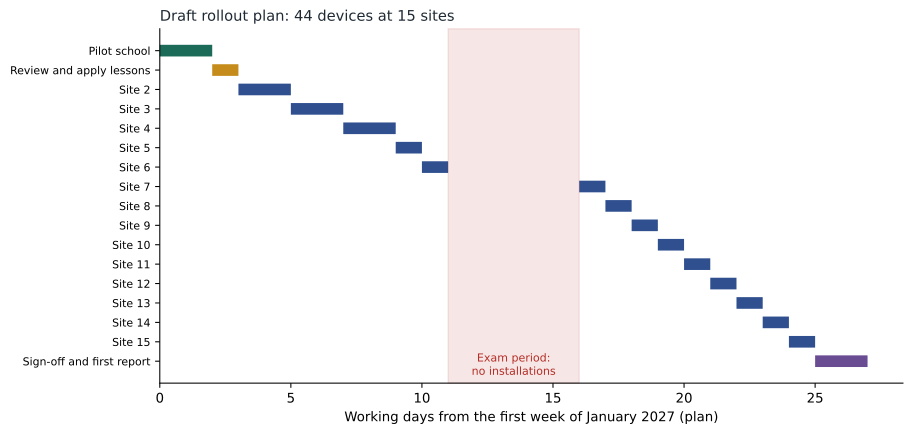
Farida's draft rollout plan, to be agreed with Patricia Klassen and Ken Fehr after signing, began in the first week of January 2027 with the pilot school, paused for a review, then installed the remaining sites over the following weeks, avoiding the school's exam period and any day the division marked as a professional development day. It was a plan, not a promise, until the division agreed it.
Reporting for the centre and for each site
Central buyers want reports that show the whole account: total spending, service across all sites, savings against the business case. Site managers want reports about their own site. A multi-site supplier should be able to produce both from the same data, and the account plan should say who receives what.
For Prairie Valley, Ridgeline's draft monthly report gave Patricia Klassen one page for the whole division and a short table by school: devices, pages printed, service calls, response times and toner deliveries. It also flagged any school whose print volume was rising fast, which might mean a device was in the wrong place, or falling fast, which might mean staff were printing elsewhere. Those flags would be the first evidence of whether the managed print program was working site by site.
National accounts and coverage outside the territory
Some multi-site customers have sites beyond the supplier's own service area. A regional dealer like Ridgeline faces this whenever a key account opens an office in another province or state, or is acquired by a larger organization. There are a few ways to handle it: serve the distant sites from the nearest branch at a higher cost to serve, use a partner dealer in the other region under a service agreement, or agree with the customer that the distant sites are outside the contract. Each choice should be made deliberately and written into the agreement, because the customer will expect the same service at every site unless told otherwise.
Ridgeline's brokerage account showed the risk. In 2025 the brokerage had opened an office about three hours' drive from Ridgeline's nearest technician. Nobody had changed the agreement. Service calls from that office cost Ridgeline nearly three times the average, and response times there regularly missed the target, which appeared in the brokerage's service reports and irritated its operations manager. Farida's plan for fiscal 2027 proposed a service agreement with a partner dealer near that office, with Ridgeline remaining responsible to the customer.
Keeping a multi-site account consistent
Farida finished the session with a list of habits for multi-site accounts. They were, she said, the difference between an account that feels like one relationship and one that feels like fifteen.
- Keep one master record of sites, devices, contacts and service levels, and update it whenever anything changes.
- Use the same report format for every site, so that comparisons are fair.
- Treat site contacts as part of the relationship map, not as an afterthought.
- Escalate a problem at one site to the central contact if it reflects something that could happen at others.
- Review cost to serve and service by site at least twice a year, and change the service model where needed.
Common mistakes
MistakeTreating a multi-site contract as one customer.
InsteadServe the central buyer and every site, and know which decides what.
MistakeOffering identical service everywhere regardless of site differences.
InsteadSet common rules with defined variations by site.
MistakeQuoting a tax-included price for another jurisdiction from memory.
InsteadCheck each location's tax rules with billing.
MistakeAccepting a high cost to serve at distant sites as unavoidable.
InsteadLook for a different service model, such as remote diagnostics or a partner dealer, before changing price.
MistakeRolling out to every site at once.
InsteadStart with a pilot site, learn and then move faster, respecting the customer's calendar.
Summary and key terms
- A multi-site account buys for or receives products at many locations; a national or global account spans regions or countries.
- Customers buy centrally, locally or through a hybrid of central contracts and local ordering, and the model decides whom the supplier must satisfy.
- Master agreements set common terms for all sites, with defined variations; taxes and regulations may differ by location.
- A clear contact structure on both sides, including a site contact at each location, reduces confusion.
- Cost to serve should be measured by site, and changes to the service model often fix an unprofitable account better than price increases.
- Rollouts should start with a pilot site and respect the customer's calendar.
- Reports should serve both the central buyer and each site.
- Sites outside the supplier's territory need a deliberate decision, written into the agreement.
- Multi-site account
- A customer that buys for, or receives products and services at, many locations.
- National account
- A multi-site account whose locations span several regions, provinces or states.
- Master agreement
- A contract setting common terms for all of a customer's sites or purchases, with schedules for each.
- Site contact
- The person at a customer location who reports problems, receives deliveries and passes on information.
- Rollout plan
- A plan for installing products across sites, with order, dates, people, dependencies and checks.
- Pilot site
- The first site in a rollout, used to test and improve the approach before the rest.
Practice problems
Work each problem on paper first, then reveal the answer to check.
An account's cost to serve is 30,000 dollars: 3 nearby sites cost 9,000 and 6 distant sites cost 21,000. What is the average per distant site?
Show answer
21,000 ÷ 6 = 3,500 dollars, against 3,000 for each nearby site.
A crew installs 5 devices a day and needs half a day per site for training. A site has 7 devices. How many whole days should be scheduled?
Show answer
7 ÷ 5 = 1.4 days of installation plus 0.5 days = 1.9, so 2 days.
A key account opens an office far outside your service area. What options should you consider?
Show answer
Serve it from the nearest branch at higher cost, use a partner dealer under a service agreement, or agree with the customer that it is outside the contract; write the choice into the agreement.
Lesson quiz · 5 questions
Score 60% or more to complete this lesson.
Create a free account to save your progress, take quizzes and earn a certificate.