
ROB-400 · Lesson 3 of 12 · 33 min
Contact mechanics and friction
Every grasp is held together by contact forces. To reason about whether a grasp will hold, how much squeeze is needed, or why an object slips and twists, we need simple but useful models of what happens where a fingertip touches an object. This lesson develops those models: contact types, Coulomb friction and the friction cone, its linearized approximation, soft-finger contacts that resist twisting, and what happens when contacts slip. The tools here feed directly into the grasp analysis of lesson 4 and the force sizing of lesson 7.
Contact forces and wrenches
When a fingertip presses on an object, it exerts a distributed pressure over a small contact patch. For analysis we usually replace that distribution with a single force acting at a contact point, plus in some models a moment. The force can be split into a normal component \( f_n \), perpendicular to the surface and pointing into the object, and a tangential component \( f_t \) in the surface plane, which is friction.
Contact forces can only push, never pull, unless there is adhesion or suction. This unilateral constraint \( f_n \ge 0 \) is what makes grasping different from bolting two parts together. A finger can always lose contact by moving away, and the grasp must be designed so that every contact keeps a positive normal force under all expected loads.
A force applied at a point also creates a moment about the object's reference point. Combining force and moment gives a wrench, a six-dimensional vector in 3-D (three force components and three moment components) or a three-dimensional vector in the plane (two force components and one moment). If the contact force \( \mathbf{f} \) acts at position \( \mathbf{p} \) relative to the object's reference point, the moment is \( \mathbf{p} \times \mathbf{f} \), and the wrench is
Grasp analysis asks whether the set of wrenches the contacts can apply is enough to balance any external wrench, such as gravity or an acceleration load. Lesson 4 builds that analysis on the contact models below.
Contact models
Three contact models cover most grasp analysis.
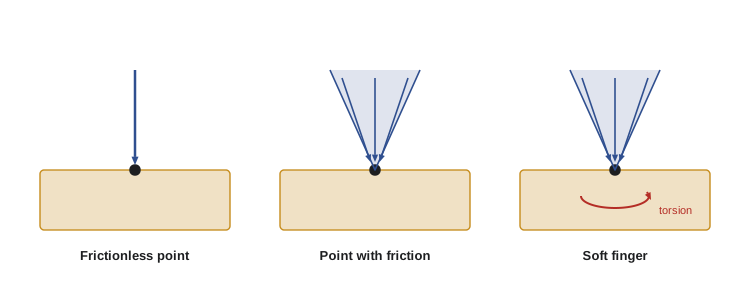
A frictionless point contact can only apply a force along the surface normal. It is a useful worst case and describes contacts on very slippery surfaces. One wrench direction is available, scaled by \( f_n \ge 0 \).
A point contact with friction (also called a hard-finger contact) can apply a normal force plus a tangential friction force, as long as the friction force stays within the limit set by Coulomb's law. In 3-D this gives three force components; in the plane, two.
A soft-finger contact adds a limited moment about the surface normal, because a deformable fingertip has a finite contact patch that can resist twisting. This torsional friction is what lets two rubber fingertips hold a pen against rotation about the line joining the fingers. A hard point contact cannot do that.
| Contact model | Forces and moments transmitted (3-D) | Number of wrench components | Example |
|---|---|---|---|
| Frictionless point | Normal force only | 1 | Steel ball on oiled glass |
| Point with friction (hard finger) | Normal force plus friction force within the cone | 3 | Hard plastic fingertip on cardboard |
| Soft finger | Normal force, friction force and limited moment about the normal | 4 | Silicone fingertip pad on a box |
Coulomb friction and the friction cone
Coulomb's model of dry friction says that while two surfaces stick, the tangential force can take any value up to a limit proportional to the normal force:
Here \( \mu \) is the coefficient of static friction. If the tangential force needed to hold the object would exceed \( \mu f_n \), the surfaces slip, and the friction force then acts opposite to the relative sliding velocity with magnitude \( \mu_k f_n \), where \( \mu_k \), the kinetic coefficient, is usually somewhat smaller than \( \mu \).
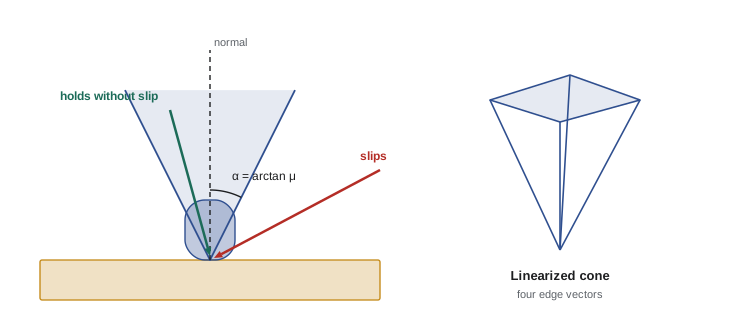
Geometrically, the set of contact forces that do not cause slip forms a cone around the surface normal. Its half-angle is
Any force inside or on the cone is achievable without slip; any force outside it is not. A larger friction coefficient gives a wider cone and a more forgiving grasp. Typical values vary widely: rubber or polyurethane pads on cardboard or painted metal might have \( \mu \) around 0.5 to 1.0 when clean and dry, steel on steel around 0.15 to 0.3 when lightly oiled, and smooth plastic on plastic around 0.2 to 0.4. Real values depend strongly on contamination, humidity, wear and pressure, so grasp design uses conservative values and safety factors.
Worked problem
Will the finger slip?
A fingertip presses on a box with a normal force of 20 N. The task requires a tangential force of 9 N at that contact. The friction coefficient is estimated as 0.5. Does it slip? What if contamination reduces \( \mu \) to 0.35?
Show solution
- Maximum friction with \( \mu = 0.5 \): \( 0.5 \times 20 = 10 \) N. Since 9 N is less than 10 N, the contact sticks.
- Equivalent check with angles: the force direction makes \( \arctan(9/20) \approx 24.2^\circ \) with the normal; the cone half-angle is \( \arctan 0.5 \approx 26.6^\circ \). Inside, so no slip.
- With \( \mu = 0.35 \): maximum friction \( 0.35 \times 20 = 7 \) N, less than 9 N, so the contact slips. The cone half-angle drops to \( 19.3^\circ \).
- To hold with \( \mu = 0.35 \), the normal force must be at least \( 9 / 0.35 \approx 25.7 \) N.
Answer: It holds at \( \mu = 0.5 \) with only 10 % margin and slips at \( \mu = 0.35 \). The fix is more normal force, higher-friction pads or a grasp that needs less tangential force.
Linearizing the cone
The friction cone is a curved surface, which makes many grasp computations nonlinear. A common simplification replaces the cone with a pyramid of \( m \) edges. Any force inside the pyramid is a non-negative combination of its edge vectors. With four edges the pyramid can either inscribe the cone (conservative, slightly smaller) or circumscribe it (optimistic). Eight or more edges give a close approximation. In the plane the cone is just two edge vectors, so the planar case needs no approximation at all.
Writing contact forces as non-negative combinations of edge vectors turns many grasp questions into linear programs or convex hull tests, which are fast and reliable. In 3-D with four edges per contact, each contact contributes four wrench vectors; a three-finger grasp contributes twelve. Lesson 4 uses exactly this representation.
# Inscribed linearized friction cone: edge vectors and the worst-case loss of friction
import numpy as np
mu = 0.5
for m in (4, 6, 8, 16):
    ang = 2 * np.pi * np.arange(m) / m
    edges = np.stack([mu * np.cos(ang), mu * np.sin(ang), np.ones(m)], axis=1)  # normal along z
    # inscribed pyramid: the weakest direction lies midway between edges
    mu_eff = mu * np.cos(np.pi / m)
print(f"m={m:2d}: edges={edges.shape[0]}, worst-case effective mu = {mu_eff:.3f} ({100*mu_eff/mu:.1f} % of mu)")m= 4: edges=4, worst-case effective mu = 0.354 (70.7 % of mu) m= 6: edges=6, worst-case effective mu = 0.433 (86.6 % of mu) m= 8: edges=8, worst-case effective mu = 0.462 (92.4 % of mu) m=16: edges=16, worst-case effective mu = 0.490 (98.1 % of mu)
The output shows the price of linearization. With only four edges, the weakest direction of an inscribed pyramid allows about 71 % of the true friction; with eight edges, about 92 %. Conservative grasp analysis accepts that loss, because underestimating friction is safer than overestimating it.
Soft-finger contact and torsional friction
A deformable fingertip pressed against a surface forms a contact patch of radius \( a \). Friction distributed over the patch can resist a moment \( m_z \) about the normal. A common model, for a uniform pressure distribution, gives a maximum torsional moment
Other pressure distributions change the constant: Hertzian contact gives about \( \tfrac{3\pi}{16} \mu a f_n \approx 0.59 \mu a f_n \). A simple engineering approach treats the soft-finger contact as an elliptical limit surface combining tangential force and torsion: when the contact is also carrying a large tangential force, less torsional capacity remains, and vice versa.
Worked problem
Holding a pen against rotation
Two silicone fingertips pinch a 12 g pen horizontally at its centre with 4 N each. The contact patch radius is 3 mm and \( \mu = 0.8 \). Someone presses the pen tip, 70 mm from the grasp point, with a 0.5 N force perpendicular to both the pen and the line joining the fingers. Do the fingers resist rotation about the line joining them? Assume uniform pressure.
Show solution
- Moment about the finger axis: \( 0.5 \times 0.070 = 0.035 \) N·m.
- Torsional capacity per finger: \( \tfrac{2}{3} \times 0.8 \times 0.003 \times 4 = 0.0064 \) N·m.
- Two fingers together resist at most \( 0.0128 \) N·m, less than 0.035 N·m.
- The pen rotates in the grasp. To resist, the grip force would need to rise to about \( 4 \times 0.035 / 0.0128 \approx 10.9 \) N per finger, or the contacts must be farther apart or larger.
Answer: The pen pivots. Torsional friction is small because the patch is small; grasps that rely on it are weak against off-axis loads, which is why holding long objects near one end is hard.
Slip, sliding and stick-slip
When a contact slips, the friction force drops to the kinetic value and points against the sliding direction. In grasping, slip is usually a failure, but controlled slip is useful: a robot can let a held object slide down between the fingers to reposition it, or pivot an object about a fingertip. Lesson 9 calls these in-hand manipulation primitives.
Stick-slip occurs when static friction is noticeably larger than kinetic friction and the system has compliance. The contact sticks, elastic energy builds up, the contact suddenly slips, the force drops, and the cycle repeats as a jerky motion. It can cause chatter in insertion tasks and noise in sliding mechanisms. Lubrication, materials with similar static and kinetic coefficients, stiffer structures and velocity control help.
Slip can be detected before an object falls. Tactile sensors see the contact patch shear and the edges start to slide, vibration sensors pick up high-frequency signals, and wrist force-torque sensors see the tangential-to-normal ratio approaching \( \mu \). Grip force controllers respond by increasing normal force as soon as incipient slip appears, which lets the robot hold fragile objects with minimal squeeze.
Contact stiffness, area and pressure
Real contacts deform. Hertz contact theory relates normal force to contact patch size and penetration for curved elastic bodies; for a sphere on a flat, the contact radius grows with the cube root of force. Two practical consequences follow. First, soft pads spread force over a larger area, lowering peak pressure, which protects fragile objects. Second, contact stiffness affects control: a stiff contact between a rigid tool and a rigid part turns tiny position errors into large forces, which is why impedance control or passive compliance is essential for insertion.
Pressure limits are often the binding constraint in food and pharmaceutical handling. Strawberries, eggs, bread and blister packs bruise or crush above certain pressures. Designers spread force over a larger contact area with conformal pads, add more contacts, or switch to suction or soft grippers.
Worked problem
Peak pressure on a fragile item
A gripper squeezes a ripe peach with 6 N per finger. With hard fingers the contact area is about 20 mm²; with a soft foam pad it is about 300 mm². If bruising begins near 0.1 MPa average pressure, which fingers are acceptable?
Show solution
- Hard fingers: \( 6 / 20 = 0.30 \) N/mm² = 0.30 MPa, three times the bruising threshold.
- Foam pad: \( 6 / 300 = 0.020 \) MPa, a fifth of the threshold.
- Check that 6 N per finger with the pad friction coefficient still holds the peach under transport accelerations (lesson 7).
Answer: Only the soft pads are acceptable. Spreading force over area, not reducing force below what is needed to hold, protects fragile items.
Uncertainty in friction
Because friction is uncertain, robust grasp design treats \( \mu \) as a range. A designer might measure friction on samples of the actual product with the actual pad material, using a simple tilt test (the angle at which an object starts to slide on an inclined pad gives \( \mu = \tan\theta \)) or a pull test with a force gauge. They then design to the lower end of the measured range and add a safety factor. Contaminants in the real environment, such as dust, oil, condensation or release agents on moulded parts, should be included in the tests.
Worked problem
A tilt test
A product sample begins to slide on a polyurethane pad when the pad is tilted to 28 degrees. Five repeats give 28, 31, 26, 30 and 27 degrees. What friction coefficient should the designer use?
Show solution
- Convert each angle with \( \mu = \tan\theta \): 0.53, 0.60, 0.49, 0.58, 0.51.
- Mean about 0.54; minimum 0.49.
- Design value: take the minimum or slightly below, for example 0.45, then apply the safety factor in the force calculation.
Answer: Use about 0.45 rather than the mean. Repeat the test with dusty or damp samples if those conditions occur in production.
Common mistakes
MistakeAssuming contacts can pull on an object
InsteadContact forces are unilateral; design every contact to keep a positive normal force.
MistakeUsing a handbook friction coefficient
InsteadMeasure \( \mu \) on the real product and pad, under real contamination, and design to the low end.
MistakeRelying on torsional friction to resist large moments
InsteadTorsional capacity scales with patch radius and is small; space contacts apart instead.
MistakeTreating the four-edge pyramid as exact
InsteadIt can underestimate friction by about 29 % in its weakest direction; use more edges or account for it.
MistakeReducing grip force to protect fragile items
InsteadSpread force over larger contact areas so the object is held without excessive pressure.
Summary and key terms
- Contact forces are unilateral and combine with moments into wrenches that act on the object.
- Common contact models are frictionless point, point with friction and soft finger.
- Coulomb friction allows tangential force up to \( \mu f_n \); the no-slip forces form a cone of half-angle \( \arctan\mu \).
- Linearizing the cone as a pyramid makes grasp problems linear at a small, known cost in conservatism.
- Soft fingers resist a limited moment about the normal that grows with patch size, friction and normal force.
- Slip can be detected and controlled; stick-slip arises with compliance and static friction above kinetic.
- Friction and pressure limits must be measured on real materials and designed with conservative values.
- Unilateral contact
- A contact that can push but not pull, so the normal force is non-negative.
- Wrench
- A combined force and moment vector acting on a body.
- Point contact with friction
- A contact model transmitting normal and tangential force within the friction cone.
- Soft-finger contact
- A contact model that also transmits a limited moment about the normal.
- Coefficient of static friction
- The ratio \( \mu \) of maximum tangential force to normal force before slip.
- Friction cone
- The set of contact forces that cause no slip, with half-angle \( \arctan\mu \).
- Linearized friction cone
- A pyramid approximation of the friction cone using a finite set of edge vectors.
- Torsional friction
- Friction resisting rotation about the contact normal over a finite patch.
- Stick-slip
- Jerky motion caused by alternating sticking and slipping in a compliant system.
- Tilt test
- A friction measurement in which \( \mu = \tan\theta \) at the angle where sliding starts.
Practice problems
Work each problem on paper first, then reveal the answer to check.
A contact has \( f_n = 15 \) N and \( \mu = 0.4 \). What is the maximum friction force?
Show answer
6 N.
What is the friction cone half-angle for \( \mu = 1 \)?
Show answer
45 degrees.
A required tangential force is 12 N with \( \mu = 0.6 \). Minimum normal force?
Show answer
20 N.
How many wrench components does a soft-finger contact transmit in 3-D?
Show answer
Four.
Why can a frictionless point contact not hold an object alone?
Show answer
It applies force only along one normal direction.
A sample slides at 35 degrees on a pad. What is \( \mu \)?
Show answer
\( \tan 35^\circ \approx 0.70 \).
With an inscribed 8-edge pyramid, what fraction of \( \mu \) is guaranteed in every direction?
Show answer
About 92 % (cos 22.5 degrees).
Compute the uniform-pressure torsional capacity for \( \mu = 0.5 \), \( a = 4 \) mm, \( f_n = 10 \) N.
Show answer
\( \tfrac{2}{3} \times 0.5 \times 0.004 \times 10 \approx 0.0133 \) N·m.
Name one way to reduce stick-slip.
Show answer
Lubrication, stiffer structure, materials with similar static and kinetic friction, or velocity control.
How do soft pads protect fragile items?
Show answer
They spread the force over a larger area, lowering peak pressure.
Lesson quiz · 5 questions
Score 60% or more to complete this lesson.
Create a free account to save your progress, take quizzes and earn a certificate.