
RAC-320 · Lesson 9 of 12 · 18 min
Packaged and rooftop units for light commercial buildings
The dental clinic's rooftop unit had been one of Northfield's regular stops since Theo's first year: the dirty condenser in RAC-110, the heat strip with an open element in RAC-130, the pitted contactor, the economizer actuator that had slipped on its shaft in RAC-230. It was seventeen years old, it ran on R-410A, and its compressor had started tripping on its internal overload on hot afternoons. The clinic's owner, Dr. Amara Singh, decided to replace it before it failed in the middle of a busy week. She asked for a packaged heat pump, to cut the electric strip heating that made up most of the clinic's winter bill. Dana gave the job to Raj, with Theo as his second.
This lesson covers packaged and rooftop units in light commercial buildings: their arrangement and parts, economizers and ventilation, how to check their capacity in the field, and what is involved in replacing one. The refrigeration and controls are the same as in residential equipment; what changes is the roof, the ventilation duty, the commercial codes and the fact that the customer's business depends on the unit.
What a rooftop unit is
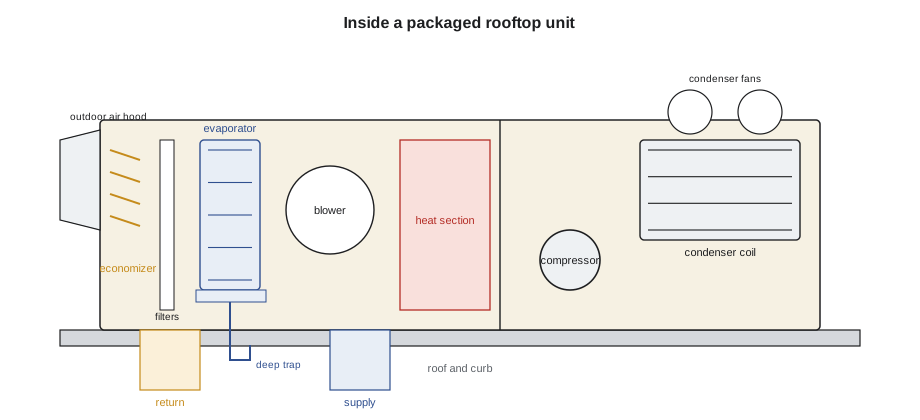
A rooftop unit, or RTU, is a packaged unit built to sit on a roof curb, a raised steel frame flashed into the roof, with its supply and return openings in the base connecting to ducts that drop through the roof into the building below. Everything is in one cabinet: the compressor or compressors, the condenser coil and fans, the evaporator coil, the supply blower, the filters, the heating section, the economizer and the controls. Light commercial RTUs serve shops, offices, clinics, restaurants and schools, typically in sizes from 3 to 25 tons; larger buildings use several.
- The heating section is a gas-fired heat exchanger and burner in most RTUs, electric resistance strips in some, or the heat pump itself with backup strips in a packaged heat pump.
- The supply blower is direct-drive with a multi-speed or variable-speed motor in smaller units, belt-driven in many larger and older ones; belt drives need tension, alignment and sheave checks, as RAC-210 described.
- The economizer is a set of outdoor-air, return-air and sometimes relief dampers with an actuator and a controller, which brings in outdoor air for ventilation and, when the outdoor air is cool and dry enough, for free cooling, as RAC-230 explained.
- Units above a certain size have two or more compressors or a variable-speed compressor, so that capacity can be staged.
The evaporator section of most RTUs is on the suction side of the blower, so the condensate pan is under strong negative pressure. Its drain trap must be deep enough to hold back that suction, usually deeper than a residential trap, and outdoors it must be protected from freezing in winter. A dry or shallow trap on an RTU lets air rush up the drain, so water backs up in the pan and blows off into the supply duct.
Ventilation and the economizer
A commercial building must bring in outdoor air for its occupants, and the RTU is usually how it does that. The amount is set by the ventilation standard the building code adopts, in Ontario through the building code's reference to ASHRAE 62.1 for most occupancies, with CSA Z317.2 applying to health care facilities that fall within its scope, and it depends on the floor area, the type of space and the number of people. The design minimum outdoor air is set at commissioning, as a damper position or an airflow, and must be kept whenever the space is occupied.
Outdoor air is also a load. In summer it is hot and humid; in winter it is cold. The mixture of return air and outdoor air entering the coil, the mixed air, depends on the outdoor air fraction. The first part of the script below shows how much the mixed air changes with the outdoor air fraction and the weather, for the clinic's unit with return air at the clinic's usual temperature. The second part uses a measurement Raj made on the old unit to estimate its sensible cooling capacity from airflow and temperature drop.
# Clinic rooftop unit: mixed air temperature with the economizer, and sensible capacity across the coil
AIRFLOW = 566                 # L/s supply air
for oa in (0.15, 0.30):           # outdoor air fraction: minimum ventilation, then a higher economizer setting
    for t_out in [30.0, 10.0, -10.0]:
        t_mix = oa * t_out + (1 - oa) * 24.0
        print(f"OA {oa:.0%}, outdoor {t_out:5.1f} °C: mixed air {t_mix:5.1f} °C")
T_MIX, T_SUPPLY = 25.0, 13.5                # measured on a cooling call
sens = 1.21 * AIRFLOW * (T_MIX - T_SUPPLY)
print(f"sensible cooling: {sens:,.0f} W (= {sens / 1000:.2f} kW) from a {T_MIX - T_SUPPLY:.1f} °C drop at {AIRFLOW} L/s")OA 15%, outdoor 30.0 °C: mixed air 24.9 °C OA 15%, outdoor 10.0 °C: mixed air 21.9 °C OA 15%, outdoor -10.0 °C: mixed air 18.9 °C OA 30%, outdoor 30.0 °C: mixed air 25.8 °C OA 30%, outdoor 10.0 °C: mixed air 19.8 °C OA 30%, outdoor -10.0 °C: mixed air 13.8 °C sensible cooling: 7,876 W (= 7.88 kW) from a 11.5 °C drop at 566 L/s
With 15 % outdoor air, the mixed air stays close to the return temperature in any weather. At 30 %, on a cold winter day it falls well below room temperature, which is useful as free cooling in a building with internal heat but costly if the building needs heat. That is why the economizer's minimum position must be set correctly and its controls must close it to minimum when the outdoor air is not useful, and why a stuck-open damper, like the one in RAC-230, shows up as a jump in heating cost and complaints about cold air.
The old unit's sensible capacity came out at about 7.9 kW, from an 11.5 K drop at 566 L/s. Its nominal total capacity was 10.5 kW, and with latent capacity for the humid day it was close to what the extended table predicted for the conditions, so the compressor itself was still pumping. The overload trips came from high head pressure on hot afternoons: the condenser coil was partly blocked by corroded, flattened fins, and the condenser fan motor was running hot. A repair was possible, but on a seventeen-year-old unit Dr. Singh's decision to replace it made sense.
Efficiency of commercial units
As lesson 1 said, three-phase units below 19 kW (65,000 Btu/h) are rated in SEER2 and HSPF2, while larger RTUs are rated in EER and IEER, the integrated rating that weights performance at 100, 75, 50 and 25 % load. Commercial energy codes, the National Energy Code of Canada for Buildings and Ontario's SB-10, which RAC-230 mentioned, also require features beyond the unit's rating: economizers on units above a certain size in most climates, fan speed control, controls that close outdoor air dampers when the building is unoccupied and, increasingly, fault detection on economizers. When an RTU is replaced, the new unit must usually meet the code in force at the time of replacement, not the one the building was built to.
Replacing a rooftop unit
Replacing an RTU is a small construction project. Raj's plan for the clinic covered:
- Selection: the clinic's load had not changed much, so the new unit was the same nominal size, a 3-ton packaged heat pump on R-454B with a small electric heater kit and an economizer with fault detection. Its weight, footprint and curb dimensions were compared with the old unit's.
- Curb: new units seldom fit old curbs. An adapter curb, built to match the old curb's footprint at the bottom and the new unit's at the top, avoids cutting the roof, but it raises the unit and must be checked for the roof's load capacity and wind uplift. Where the old curb is in poor condition, a new curb and roofing work are needed, coordinated with the building's roofer so the roof warranty is kept.
- Roof structure: a heavier unit, or a heavier unit on a taller adapter curb, may need a structural engineer's review of the roof framing.
- Lifting: the old unit is lifted off and the new one set by crane, scheduled for a quiet time with the street or parking area closed below, a lift plan and a qualified rigger and signaller. Lifting points and spreader bars follow the manufacturer's rigging instructions.
- Refrigerant: the old unit's charge is recovered before it is lifted, as RAC-120 required, and recorded.
- Electrical: a three-phase heat pump and its heater kit may need a different circuit than the old unit; the nameplate MCA and MOCP decide, as lesson 8 explained, and the disconnect and service receptacle must meet the electrical code.
- Controls: the thermostat or building automation connection, the economizer settings, the minimum outdoor air position and the heat pump's lockouts and backup staging.
Raj scheduled the lift for a Saturday morning, when the clinic was closed. The crane company provided the lift plan; Northfield provided the rigging points from the manual and a signaller on the roof. The old unit's refrigerant was recovered on Friday evening, and the electrical contractor disconnected it. By Saturday afternoon the new unit was on its adapter curb, wired and running; Monday's patients never knew.
Working on roofs
Rooftop work adds hazards that residential work does not have. Falls from roof edges, through skylights and through unguarded roof openings are among the most serious hazards in the trade. Ontario's construction and industrial regulations require fall protection where a worker could fall a set height, and working-at-heights training for workers who use fall protection on construction projects. In practice that means guardrails, warning lines, travel restraint or fall arrest systems near edges, covers or screens on skylights and roof hatches, and safe ladders or access. Other hazards include heat and sun in summer, ice and wind in winter, the crane and suspended loads during a replacement, and the unit's own electrical and refrigeration hazards, with lockout as RAC-130 described.
Raj walked the roof before any work started. He found one skylight without a screen near the path to the unit and had a temporary cover installed before the lift, and he marked a warning line two metres back from the parapet on the street side, where the crane would swing.
Packaged heat pumps in cold weather
Packaged heat pumps on roofs face harsher conditions than residential split heat pumps: wind across the roof, snow drifting against the unit and long duct runs on the roof curb that lose heat. Most packaged heat pumps are not cold-climate units, so their balance points are higher, and the backup heat does more of the work in deep cold. For the clinic, that was acceptable: the building had large internal gains from equipment and people during the day, the backup strips covered the coldest mornings, and the heat pump still cut the clinic's heating energy by more than half compared with strips alone. The defrost water from a rooftop unit must drain to the roof's drainage without forming an ice patch in a walkway, so Raj checked the roof slope and the unit's drain location against the roof drains.
Commissioning the new rooftop unit
Commissioning the clinic's new unit followed lesson 10's sequence, with commercial items added. Raj and Theo measured the supply airflow with a traverse of the main duct and set the blower to the design value; set the economizer's minimum position to deliver the clinic's design outdoor airflow, checked with a measurement at the outdoor air intake; stroked the dampers through their full range and confirmed the fault detection reported no faults; tested the heat pump in both modes, the backup heat stages and a forced defrost; and checked the deep condensate trap, which they primed with water before the first cooling run. The building automation contractor connected the unit to the clinic's schedule, so the outdoor air dampers closed when the clinic was empty. Every value went on the start-up sheet for the next maintenance visit.
Common mistakes
MistakeLeaving an RTU's condensate trap shallow or dry.
InsteadFit the deep trap the manufacturer specifies and protect it from freezing.
MistakeSetting a new unit on an old curb without checking the fit and the roof.
InsteadUse an adapter curb or new curb, with the roof's capacity checked.
MistakeSetting the economizer's minimum position by eye.
InsteadSet it to the design minimum outdoor air at commissioning and record it.
MistakeWorking near roof edges and skylights without protection.
InsteadUse guardrails, warning lines, restraint or arrest, and cover skylights.
MistakeRecovering the refrigerant after the unit is lifted off.
InsteadRecover and record it before disconnecting and lifting.
Summary and key terms
- A rooftop unit contains the whole system in one cabinet on a roof curb, with ducts through the roof.
- RTU condensate traps must be deep enough for the blower's suction and protected from freezing.
- The economizer supplies ventilation and free cooling; its minimum position must meet the ventilation standard.
- Sensible capacity can be estimated from airflow and temperature drop across the coil.
- Replacement involves curbs, roof structure, crane lifts, refrigerant recovery, electrical and controls.
- Roof work requires fall protection, skylight protection and planning for lifts and weather.
- Rooftop unit
- A packaged heating and cooling unit mounted on a roof curb.
- Roof curb
- A raised frame flashed into the roof that supports a rooftop unit and frames its duct openings.
- Adapter curb
- A curb that fits an old curb at the bottom and a new unit at the top.
- Mixed air
- The blend of return air and outdoor air entering the coil.
- Minimum outdoor air
- The outdoor airflow required for ventilation whenever a space is occupied.
- IEER
- Integrated energy efficiency ratio, which weights a commercial unit's efficiency at several part loads.
- Lift plan
- A written plan for a crane lift covering the load, the crane, rigging, signals and the area below.
Practice problems
Work each problem on paper first, then reveal the answer to check.
Return air is at 24 °C (75 °F) and outdoor air at −10 °C (14 °F). What is the mixed air temperature with 20 % outdoor air?
Show answer
0.2 × −10 + 0.8 × 24 = 17.2 °C.
Estimate the sensible cooling from 400 L/s with an 11 K drop (850 cfm with a 20 °F drop).
Show answer
1.21 × 400 × 11 = about 5,300 W.
Why must an RTU's condensate trap be deeper than a residential coil's?
Show answer
The blower's stronger suction on the drain pan would pull air up a shallow trap.
Name three items in a rooftop unit replacement plan besides the unit itself.
Show answer
Any three of: curb or adapter curb, roof structure, crane and lift plan, refrigerant recovery, electrical, controls, roof safety.
Lesson quiz · 5 questions
Score 60% or more to complete this lesson.
Create a free account to save your progress, take quizzes and earn a certificate.