
RAC-320 · Lesson 2 of 12 · 19 min
Heat pump fundamentals: reversing valves, COP and balance points
The Lindqvists had lived with their R-454B heat pump for a year. Northfield had installed it the previous autumn, next to their existing high-efficiency gas furnace, and RAC-220 described its charging and refrigerant detection system. Now Erik Lindqvist called with a question rather than a problem. "In December the furnace came on every cold morning, and some days it ran all day," he said. "I thought the point of a heat pump was that I wouldn't use gas. Is something wrong with it?" Dana sent Theo with the installation file and a laptop. "Nothing is wrong," she said. "But you need to be able to explain why, with numbers, in his kitchen."
This lesson explains how a heat pump reverses the refrigeration cycle, what COP means and why it falls in cold weather, and how the house's heat loss and the heat pump's capacity meet at the thermal balance point. Lesson 6 adds the economic balance point that governs a dual-fuel system like the Lindqvists'.
Moving heat uphill
Every refrigeration system moves heat from a cold place to a warm place. A walk-in cooler takes heat out of the box and rejects it outdoors. A heat pump in heating mode does the same thing in the other direction: it takes heat out of the outdoor air, even when that air is well below freezing, and rejects it into the house. Outdoor air at −10 °C (14 °F) still contains plenty of heat; it is only cold compared with the house. As long as the outdoor coil's evaporating temperature is below the outdoor air temperature, heat flows from the air into the refrigerant.
The heat delivered to the house is the heat picked up outdoors plus the electrical energy the compressor puts into the refrigerant. That is why a heat pump delivers more heat than the electricity it uses. An electric furnace or baseboard heater turns one unit of electricity into one unit of heat. A heat pump may deliver three or four units of heat for each unit of electricity in mild weather, and still two or more in cold weather.
The reversing valve
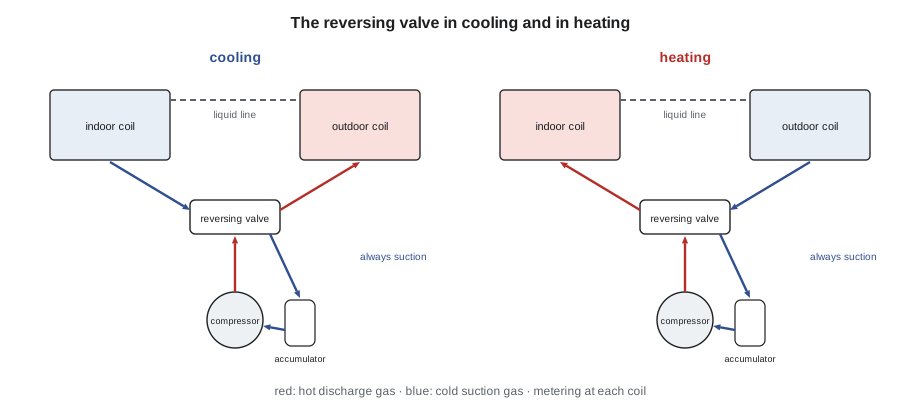
The four-way reversing valve is what turns an air conditioner into a heat pump. It sits in the compressor's discharge and suction lines, close to the compressor, and connects four lines: the compressor discharge, the compressor suction (through the accumulator), the outdoor coil and the indoor coil's vapour line. Inside is a slide that connects the discharge either to the outdoor coil or to the indoor coil, while connecting the other coil to the suction.
- In cooling mode, discharge gas goes to the outdoor coil, which works as the condenser. The indoor coil is the evaporator, and its vapour line returns through the valve to the suction.
- In heating mode, discharge gas goes to the indoor coil, which becomes the condenser and heats the house air. The outdoor coil is the evaporator, and its outlet returns through the valve to the suction.
- The line from the reversing valve to the compressor's suction is always suction, whatever the mode, and the compressor's discharge line is always discharge. The large line to the indoor coil, often still called the suction line, is a hot-gas line in heating mode.
The slide is moved by refrigerant pressure, not by the solenoid directly. A small pilot valve, operated by the solenoid coil, directs high-pressure gas to one end of the slide and vents the other end to suction, so the slide shifts. That is why a reversing valve only changes over when there is a pressure difference across it, with the compressor running.
Manufacturers differ in which mode the valve is energized in. Most residential heat pumps in North America energize the valve in cooling, through the thermostat's O terminal, and fail to heating if the coil or its wiring fails. Some brands energize it in heating, through a B terminal, and fail to cooling. RAC-230 explained how to set the thermostat to match. A heat pump that heats when cooling is called for, or the reverse, is often simply set to the wrong convention.
Metering in both directions
Because refrigerant flows through the liquid line in opposite directions in the two modes, a heat pump needs a metering device at each coil, or one device that works in both directions. Older and simpler heat pumps used a piston or a thermostatic expansion valve at each coil, each with a check valve or a bypass that lets liquid flow freely in the reverse direction. A heat pump piston often moves in its body: in one direction it seats and meters through its orifice, in the other it lifts and lets refrigerant pass around it. Bidirectional TXVs are also used. Most inverter heat pumps use an electronic expansion valve in the outdoor unit that meters in both modes, as RAC-220 explained, often with a second valve or a fixed restriction indoors.
Heat pumps also have components air conditioners usually lack. A suction accumulator protects the compressor from liquid floodback, especially at the start of heating and after a defrost, when liquid can collect in the outdoor coil. Many heat pumps have a liquid-line filter-drier that works in both directions, a crankcase heater, a defrost control with outdoor coil and air sensors, and sometimes a high-pressure switch and a discharge temperature sensor.
COP: heat out for energy in
The coefficient of performance, COP, is the heat delivered divided by the electrical energy used, in the same units. A COP of 3 means three units of heat for each unit of electricity. It is not a fixed property of a heat pump; it depends on how hard the compressor is working, which depends on the temperatures at both ends of the cycle.
The theoretical upper limit is the Carnot COP, set only by the absolute temperatures of the hot and cold sides, in kelvin:
With a condensing temperature of about 40 °C (104 °F), or 313 K, and an evaporating temperature of −10 °C (14 °F), or 263 K, the limit is \(313 / 50 = 6.3\). Real heat pumps reach perhaps 40 to 50 % of the Carnot COP, because of compressor losses, the temperature differences needed to move heat through the coils, fan power and defrost. The important lesson is the shape: as the outdoor temperature falls, the evaporating temperature falls, the lift between the two sides grows, and COP falls. The same happens if the indoor coil has to condense at a higher temperature, for example because of low indoor airflow or a request for very hot supply air.
Capacity falls too. A colder evaporator means lower suction pressure, and lower-pressure vapour is less dense, so each stroke or revolution of the compressor moves less refrigerant. A single-speed heat pump that delivers 10.3 kW (35,000 Btu/h) at 8.3 °C (47 °F) may deliver only about 60 % of that at −8.3 °C (17 °F), and less again below that. At the same time, the house needs more heat as it gets colder. The two lines cross.
The thermal balance point
The house's heat loss is roughly proportional to the difference between the indoor temperature and the outdoor temperature. Because lights, appliances, people and the sun supply some heat, the house needs no heating at all above a certain outdoor temperature, often around 15 to 18 °C (59 to 64 °F) for an older house and lower for a well-insulated one. Below that, the load rises in a straight line to the design heat loss at the outdoor design temperature, which lesson 7 explains.
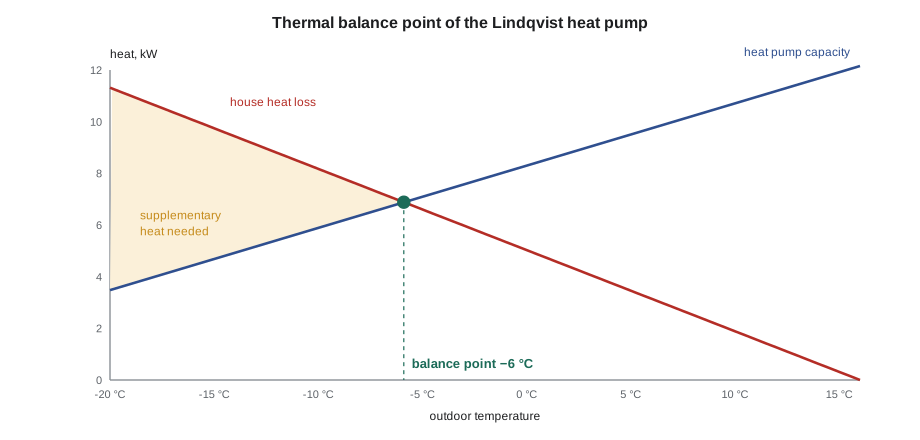
The thermal balance point is the outdoor temperature at which the heat pump's capacity exactly equals the house's heat loss. Above it, the heat pump has more capacity than the house needs and cycles or slows down. Below it, the heat pump alone cannot keep up, and something else must supply the difference: electric resistance heat, a furnace or a boiler. The balance point depends on both the house and the equipment, so the same heat pump has a different balance point in a leaky house than in a tight one.
Theo used the two rated heating points from the AHRI data and the heat loss from Northfield's load calculation for the Lindqvist house. The script draws a straight line through the rated capacities and COPs, a straight load line from zero at the no-heat temperature to the design load, and finds where they cross.
# Thermal balance point of the Lindqvist heat pump: where the house load meets the heat pump's capacity
T1, CAP1, COP1 = 8.3, 10.3, 3.9        # rated high-temperature heating point (°C, kW)
T2, CAP2, COP2 = -8.3, 6.3, 2.5        # rated low-temperature heating point
DESIGN_T, DESIGN_LOAD = -19, 11.0        # outdoor design temperature and design heat loss
ZERO_T = 16                         # outdoor temperature at which internal gains cover the losses
UA = DESIGN_LOAD / (ZERO_T - DESIGN_T)      # load per degree
def load(t): return max(0.0, UA * (ZERO_T - t))
def lin(t, a, b): return a + (b - a) * (t - T1) / (T2 - T1)    # straight line through the two rated points
def cap(t): return lin(t, CAP1, CAP2)
def cop(t): return lin(t, COP1, COP2)
# solve UA*(ZERO_T - t) = cap(t) for t
slope = (CAP1 - CAP2) / (T1 - T2)
t_bal = (UA * ZERO_T - CAP2 + slope * T2) / (UA + slope)
print(f"load per degree {UA:.3f} kW per °C; thermal balance point {t_bal:.1f} °C")
for t in [10, 0, -6, -10, -19]:
    short = load(t) - cap(t)
    note = f"short {short:.1f}" if short > 0 else "heat pump covers the load"
print(f"{t:5.0f} °C: load {load(t):7.1f}, capacity {cap(t):7.1f} kW, COP {cop(t):.2f} {note}")load per degree 0.314 kW per °C; thermal balance point -5.9 °C
10 °C: load 1.9, capacity 10.7 kW, COP 4.04 heat pump covers the load
0 °C: load 5.0, capacity 8.3 kW, COP 3.20 heat pump covers the load
-6 °C: load 6.9, capacity 6.9 kW, COP 2.69 short 0.1
-10 °C: load 8.2, capacity 5.9 kW, COP 2.36 short 2.3
-19 °C: load 11.0, capacity 3.7 kW, COP 1.60 short 7.3The Lindqvists' single-speed heat pump carries the whole house down to about −6 °C. At −10 °C it is short by more than 2 kW, and on a −19 °C design morning it supplies only a third of the load. Theo sketched the two lines on the back of the work order, the same graph as the figure below, and showed Mr. Lindqvist the cross. In December the house had spent many hours below that temperature, and on those days the system had correctly switched to the furnace. The heat pump had still carried every mild day of the autumn and would carry most of the spring.
Why heat pump air feels cool
A gas furnace typically heats the air passing through it by 30 to 40 K (55 to 70 °F), so the air at the registers is hot to the hand. A heat pump in heating mode delivers more air at a lower temperature, typically 30 to 40 °C (85 to 105 °F) at the register, depending on the outdoor temperature and the airflow. That air is still well above the room temperature and is heating the house, but against skin, which is at about 33 °C (91 °F), it can feel cool. The feeling is strongest near registers that blow onto people and on the coldest days, when the heat pump's supply temperature is lowest.
Customers who switch from a furnace sometimes call this a fault. The answer is to explain it, to check that the airflow is set for heat pump operation and not excessively high, and to check that the thermostat is not calling for supplementary heat unnecessarily. Variable-speed systems help, because they can slow the blower in mild weather and deliver warmer air. Raising the indoor coil's condensing temperature to give hotter air costs COP, so manufacturers balance comfort and efficiency in their airflow settings.
Reading a heat pump in each mode
Because the coils swap roles, gauge readings and line temperatures mean different things in each mode. In heating, the large vapour line to the indoor coil is hot, the high-side gauge on the outdoor unit's vapour service valve reads condensing pressure, and the suction reading comes from a dedicated suction port between the reversing valve and the compressor, if the unit has one. Many residential heat pumps have only two service valves at the outdoor unit, and in heating the vapour valve shows high-side pressure. Technicians who connect gauges in heating mode must know which port reads what and must be ready for hot gas in the large line, as RAC-110 warned about high pressures. Manufacturers' charging procedures are usually written for cooling mode; in winter, many say to weigh in the charge or use their heating charging chart, as RAC-220 described.
Line temperatures are a quick check of which mode a heat pump is really in. With the system heating, the large line at the indoor coil should be hot and the small liquid line warm; in cooling, the large line is cold and sweating and the small line warm. A heat pump whose large line is cold while the thermostat calls for heat is in cooling mode, or in defrost, and lesson 12 explains how to tell which.
Common mistakes
MistakeSaying a heat pump has failed because the backup heat runs in very cold weather.
InsteadExplain the balance point; check that the backup comes on only below it.
MistakeExpecting the reversing valve to shift with the compressor off.
InsteadTest changeover with the compressor running; the slide needs a pressure difference.
MistakeReading the large line as suction in heating mode.
InsteadIn heating, the large line to the indoor coil carries hot discharge gas.
MistakeAssuming capacity and COP are the same at all outdoor temperatures.
InsteadUse the rated points and extended data; both fall in cold weather.
MistakeSetting the thermostat's changeover convention without checking the brand.
InsteadConfirm whether the valve is energized in cooling or in heating.
Summary and key terms
- A heat pump moves heat from outdoor air into the house and delivers more heat than the electricity it uses.
- The reversing valve's pilot-operated slide directs discharge gas to the outdoor coil in cooling and the indoor coil in heating.
- Heat pumps need metering in both directions, an accumulator and a defrost control.
- COP and capacity both fall as the outdoor temperature falls.
- The thermal balance point is where heat pump capacity equals the house's heat loss; below it, supplementary heat is needed.
- Heat pump supply air is cooler than furnace air but still heats the house.
- Reversing valve
- A four-way valve that swaps the roles of the indoor and outdoor coils.
- Pilot valve
- The small solenoid valve that uses refrigerant pressure to move the reversing valve's slide.
- COP
- Coefficient of performance: heat delivered divided by electrical energy used.
- Thermal balance point
- The outdoor temperature at which heat pump capacity equals the building's heat loss.
- Accumulator
- A vessel in the suction line that traps liquid refrigerant before it reaches the compressor.
- O terminal
- The thermostat terminal that energizes the reversing valve in cooling.
- B terminal
- The thermostat terminal that energizes the reversing valve in heating.
Practice problems
Work each problem on paper first, then reveal the answer to check.
Calculate the Carnot heating COP for a condensing temperature of 45 °C (113 °F) and an evaporating temperature of −15 °C (5 °F).
Show answer
318 ÷ (318 − 258) = 5.3.
A heat pump's reversing valve coil has burned out on a system that energizes the valve in cooling. In which mode will it run?
Show answer
Heating, its fail-safe mode.
Why does a tighter, better-insulated house have a lower balance point with the same heat pump?
Show answer
Its heat loss line is lower and flatter, so it crosses the capacity line at a colder temperature.
Name two components a heat pump has that a basic air conditioner usually lacks.
Show answer
Any two of: reversing valve, accumulator, defrost control, bidirectional metering or check valves.
Lesson quiz · 5 questions
Score 60% or more to complete this lesson.
Create a free account to save your progress, take quizzes and earn a certificate.