
RAC-320 · Lesson 1 of 12 · 19 min
Air conditioning and heat pump systems: types and efficiency ratings
Theo Martel started his third year at Northfield Mechanical on the residential side. For two years he had worked mostly in walk-ins, kitchens and the brewery, and on the Harvest Lane start-up. Now Dana Okafor wanted him on the comfort side of the business for a season: central air conditioners, heat pumps, ductless systems and the small rooftop units on clinics and shops. "Half our calls from May to September are air conditioning," she told him, "and now that most of our new installs are heat pumps, half our calls from November to March are too. The refrigeration is the same as everything you have learned. What changes is the customer, the house and the way the equipment is rated."
This course covers residential and light commercial air conditioning and heat pumps. It builds on the cycle, components, charging and controls from levels 1 and 2 and does not repeat them: RAC-210 covered compressors and coils, RAC-220 metering devices, evacuation and charging, and RAC-230 thermostats, defrost controls and communicating controls. Psychrometrics, load calculation in detail, airflow and duct design are the subject of RAC-330, so they appear here only as far as equipment selection and start-up need them.
What counts as comfort cooling equipment
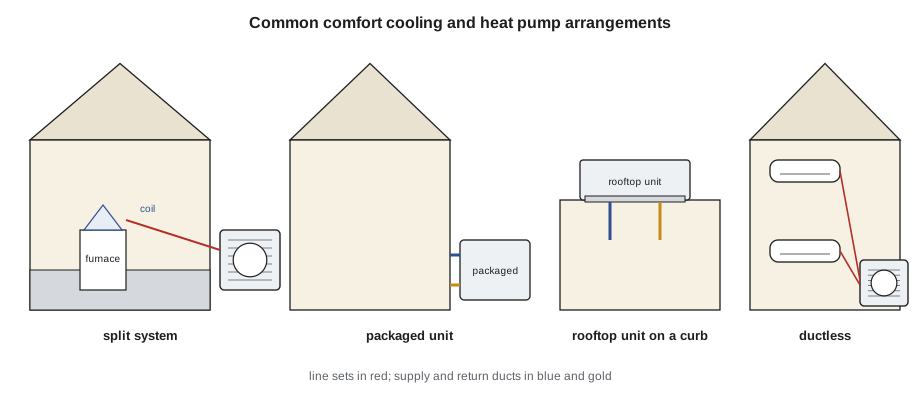
Comfort cooling and heat pump equipment comes in a few common arrangements. The refrigeration cycle inside each is the same; what differs is where the parts are, how the air reaches the rooms and who installs what.
- Split systems: an outdoor unit with the compressor, outdoor coil and fan, connected by a refrigerant line set to an indoor coil. The indoor coil sits on a furnace or inside an air handler, and the furnace or air handler blower moves the air through the house's ducts. This is the most common arrangement in houses in both countries.
- Packaged units: the compressor, both coils and the blower in one cabinet, outdoors on a pad or on a roof, connected to the building by supply and return ducts. Rooftop units, often called RTUs, are packaged units on a curb on a flat roof; they are the usual equipment for small commercial buildings such as the dental clinic Northfield services.
- Ductless mini-splits: an outdoor unit connected by line sets to one or more indoor heads on walls, ceilings or floors, each with its own fan and controls. They need no ducts, and almost all are inverter-driven heat pumps.
- Ducted mini-splits and slim-duct units: the same inverter outdoor units connected to small concealed air handlers that serve a few rooms through short ducts.
- Window, through-the-wall and packaged terminal units: self-contained units for single rooms, common in apartments, hotels and additions. They are serviced like small self-contained refrigeration equipment.
Any of these can be an air conditioner or a heat pump. An air conditioner only cools; the house needs a separate heat source such as a gas furnace, a boiler or electric baseboards. A heat pump has a reversing valve and can run its cycle in either direction, so it heats in winter and cools in summer. Lesson 2 explains how. In both countries, the share of new installations that are heat pumps has grown quickly over the last few years, driven by efficiency, incentives, building and climate policies and the fact that a heat pump costs little more than an air conditioner of the same size.
Nominal capacity: tons and kilowatts
Residential equipment is sold by nominal cooling capacity. In both countries the industry still uses the ton: one ton is 12,000 Btu/h (3.52 kW), the heat needed to melt a ton of ice in a day, as RAC-110 explained. Residential split systems come in half-ton steps from about 1.5 to 5 tons. Ductless units are usually labelled in thousands of Btu/h: a 9,000, 12,000, 18,000 or 24,000 unit, often shortened to 9k, 12k and so on. Canadian literature also gives kilowatts, so a 3-ton unit is about 10.5 kW. Light commercial rooftop units run from about 3 to 25 tons; above that, units are usually called large commercial equipment.
Nominal capacity is only a name. The real capacity of any unit depends on the outdoor temperature, the indoor temperature and humidity, the airflow and the matched indoor coil. A 3-ton outdoor unit with a mismatched or small indoor coil, low airflow or a long line set may deliver much less than 10.5 kW (36,000 Btu/h). Manufacturers publish extended performance tables that give capacity and power input at other conditions; technicians use those tables, not the nominal size, when they check performance in lesson 11.
How efficiency is rated: SEER2, EER2 and HSPF2
Residential central air conditioners and heat pumps below 19 kW (65,000 Btu/h) of cooling capacity are rated under a test procedure set by the United States Department of Energy, and Canada's federal energy efficiency regulations use the same metrics for the same products. Since 2023 the ratings carry a 2 after their names, because the test was changed to use more realistic external static pressure, the resistance the blower works against in typical ducts. Older ratings without the 2 cannot be compared directly with the new ones.
- SEER2, the seasonal energy efficiency ratio, is cooling output in Btu over a typical season divided by electrical energy input in watt-hours. It combines tests at several outdoor temperatures and at part load, so it rewards units that run efficiently at the low loads that dominate most of the season.
- EER2, the energy efficiency ratio, is the same ratio at one hot condition, an outdoor temperature of 35 °C (95 °F). It shows how the unit performs on the hottest afternoons, when the electrical grid is most loaded.
- HSPF2, the heating seasonal performance factor, is heating output in Btu over a season divided by electrical input in watt-hours, including defrost and any resistance heat the test assumes. It applies only to heat pumps. It is calculated for a climate region: the United States uses a moderate region for its ratings, while Canada calculates HSPF2 for a colder region, so the same unit has a lower HSPF2 on a Canadian rating than on an American one.
- COP, the coefficient of performance, is heat delivered divided by electrical energy used, both in the same units. It is not a seasonal rating, but manufacturers quote it at test temperatures such as 8.3 °C and −8.3 °C (47 °F and 17 °F), and for cold-climate units at −15 °C (5 °F). Because SEER2, EER2 and HSPF2 divide Btu by watt-hours, dividing them by 3.412 converts them to an average COP.
As a rough guide, SEER2 values are about 4 to 5 % lower than the old SEER values of the same ducted equipment, and HSPF2 values are about 15 % lower than old HSPF values; the exact conversion depends on the product. A customer who remembers that the last unit was "16 SEER" is not comparing like with like if the new quote says 15.2 SEER2.
Minimum efficiency rules
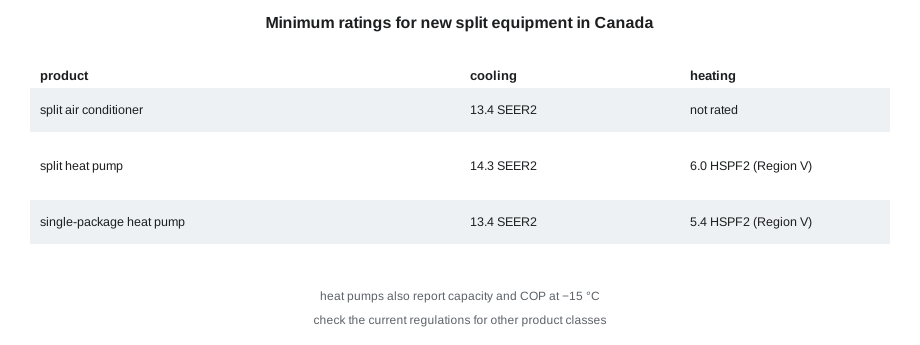
In Canada, Natural Resources Canada sets minimum efficiency standards under the federal Energy Efficiency Regulations, and the provinces may set their own for products sold within them. The federal rules for central air conditioners and heat pumps were amended to use the SEER2 and HSPF2 metrics, aligned with the United States: split-system air conditioners at 13.4 SEER2, and split-system heat pumps at 14.3 SEER2 with an HSPF2, calculated for Canada's colder climate region, of 6.0. Heat pumps must also report their capacity and COP at −15 °C, which helps buyers compare cold-weather performance. Check the current regulations when a customer asks for the exact figure for an unusual product class, such as a single-package unit or a space-constrained system.
Minimum standards set the floor. Many utilities, incentive programs and building codes ask for more, and ENERGY STAR sets higher levels for products that qualify for its label. When Theo saw Northfield's price book, it offered three tiers of most products: a single-stage unit at or just above the minimum, a two-stage unit and a variable-speed inverter unit. Lesson 5 explains why the inverter units rate so much higher.
What the ratings mean for a customer's bill
The Bauer house was the first sales call Dana took Theo on. Mrs. Bauer's air conditioner, a 2.5-ton R-410A unit installed in 2009, was the one with the piston that had been overcharged by years of top-ups, as RAC-220 described. It worked again, but it was old, its outdoor coil was corroded and its fan motor bearings were noisy. She wanted to know what a new unit would save. Dana asked Theo to estimate it. The script below does the arithmetic Theo used: annual cooling energy is the capacity times the equivalent full-load hours, divided by SEER2. The full-load hours are the number of hours the unit would have to run at full capacity to deliver the season's cooling; they depend heavily on the climate and the house.
# Annual cooling energy and cost for the Bauer house's replacement options (illustrative inputs)
CAPACITY = 30000            # Btu/h, nominal 2.5 ton; SEER2 is defined in Btu per watt-hour, so it is used here on both sites
HOURS = 450                # equivalent full-load cooling hours per year (illustrative for Kitchener)
PRICE = 0.15               # dollars per kWh, all-in
options = [("existing 2009 unit, as it runs now", 8.0),
           ("new unit at the federal minimum", 13.4),
           ("new variable-speed unit", 17.0)]
base = None
for name, seer2 in options:
    kwh = CAPACITY * HOURS / seer2 / 1000          # Btu = W·h × SEER2, so W·h = Btu / SEER2
    cost = kwh * PRICE
    base = base or cost
print(f"{name:36s} SEER2 {seer2:4.1f}: {kwh:5.0f} kWh/yr, {cost:5.0f} dollars/yr, saves {base - cost:4.0f} dollars/yr")existing 2009 unit, as it runs now SEER2 8.0: 1688 kWh/yr, 253 dollars/yr, saves 0 dollars/yr new unit at the federal minimum SEER2 13.4: 1007 kWh/yr, 151 dollars/yr, saves 102 dollars/yr new variable-speed unit SEER2 17.0: 794 kWh/yr, 119 dollars/yr, saves 134 dollars/yr
Kitchener's cooling season is short. Even a much better unit saves Mrs. Bauer only about 100 to 130 dollars a year, and the efficiency upgrade alone would take many years to pay back. The real reasons to replace were the unit's age, the corroded coil and the fact that a heat pump would also cut her gas bill for much of the heating season, as lesson 6 shows. Theo noticed that the assumed 8.0 SEER2 for the old unit mattered most: its original rating would have been higher, but a seventeen-year-old unit with a dirty, corroded coil and a history of wrong charge performs well below its rating.
Customers are often surprised that efficiency ratings do not describe their own system. The rating is earned in a laboratory with a matched indoor coil, correct airflow and an exact charge. In the field, low airflow, leaky ducts, wrong charge and dirty coils can easily cut real efficiency by a quarter or more. A good installation, covered in lessons 8 and 10, matters as much as the rating on the brochure.
Matched systems and AHRI certificates
A split system's rating applies to a specific combination: one outdoor unit, one indoor coil or air handler and, often, one furnace blower. The Air-Conditioning, Heating, and Refrigeration Institute, AHRI, publishes a directory of certified combinations with their capacity, SEER2, EER2 and HSPF2 and a reference number. Incentive programs, permits and some warranties ask for the AHRI certificate of the combination actually installed. Pairing a new outdoor unit with an old indoor coil gives a combination that has no rating at all, and with a change of refrigerant, as RAC-220 explained, the old coil and metering device may not be compatible. Northfield's rule was simple: replace the outdoor unit and the indoor coil together, and print the certificate for the customer's file.
Light commercial equipment
Packaged rooftop units above 19 kW (65,000 Btu/h) are rated differently. Their efficiency is given as EER at full load and as IEER, the integrated energy efficiency ratio, which weights performance at 100, 75, 50 and 25 % load. Commercial equipment minimums in both countries are set by the federal rules and by energy codes based on ASHRAE 90.1 or, in Canada, the National Energy Code for Buildings. Smaller three-phase rooftop units, like the clinic's 3-ton unit, are rated in SEER2 like residential equipment, even though they serve a commercial building. Lesson 9 covers rooftop units in detail.
Refrigerants in new comfort equipment
For about twenty years almost all new residential equipment used R-410A. From 2025, new equipment in both countries moved to lower-GWP A2L refrigerants, mainly R-454B and R-32, as RAC-120 and RAC-220 explained. In Canada, the change was driven largely by the manufacturers supplying the North American market from the same factories, with Canada's HFC phase-down and building and safety code updates such as CSA B52:23 making the A2L equipment installable. The result for technicians is the same on both sides of the border: new installations are A2L systems, the existing stock is mostly R-410A and will be for many years, and a few old R-22 systems are still running. Each needs its own tools, cylinders and practices.
Common mistakes
MistakeComparing an old SEER rating with a new SEER2 rating directly.
InsteadConvert, or compare two SEER2 ratings; SEER2 values are a little lower for the same equipment.
MistakeQuoting savings from the brochure rating without considering the installation.
InsteadExplain that airflow, ducts and charge decide what the customer actually gets.
MistakeReplacing only the outdoor unit and keeping an old indoor coil.
InsteadInstall an AHRI-matched combination, especially when the refrigerant changes.
MistakeUsing nominal tons as real capacity.
InsteadUse the manufacturer's extended performance data at the actual conditions.
MistakeAssuming an HSPF2 on a Canadian rating can be compared with an American one.
InsteadCheck which climate region the HSPF2 was calculated for.
Summary and key terms
- Split, packaged, rooftop and ductless systems all use the same cycle; any of them can be an air conditioner or a heat pump.
- Nominal tons are a name; real capacity depends on conditions, airflow and the matched coil.
- SEER2, EER2 and HSPF2 replaced the old ratings in 2023 and are a little lower for the same equipment.
- Minimum efficiency standards differ by product class and, in the United States, by region for air conditioners.
- Field efficiency depends on installation quality as much as on the rating.
- New equipment uses A2L refrigerants such as R-454B and R-32; the installed base is mostly R-410A.
- Split system
- Equipment with an outdoor unit and a separate indoor coil or air handler joined by a line set.
- Packaged unit
- Equipment with the whole refrigeration system and blower in one cabinet.
- Rooftop unit
- A packaged unit mounted on a roof curb, usually serving a commercial building.
- SEER2
- Seasonal cooling efficiency in Btu per watt-hour under the 2023 test procedure.
- EER2
- Cooling efficiency at one hot test condition under the 2023 test procedure.
- HSPF2
- Seasonal heating efficiency of a heat pump in Btu per watt-hour, calculated for a climate region.
- AHRI certificate
- A record of the rated capacity and efficiency of a specific certified equipment combination.
- Equivalent full-load hours
- The hours a unit would need to run at full capacity to deliver a season's heating or cooling.
Practice problems
Work each problem on paper first, then reveal the answer to check.
A customer's old unit was rated 14 SEER. Roughly what SEER2 would the same unit rate?
Show answer
About 13.3 to 13.4 SEER2, roughly 4 to 5 % lower.
Why do manufacturers publish extended performance tables?
Show answer
Because real capacity and power depend on outdoor and indoor conditions and airflow; the nominal rating is at one set of conditions.
What does an AHRI certificate tell a homeowner?
Show answer
The certified capacity and efficiency of the exact outdoor and indoor combination installed.
Convert 17 SEER2 into an average COP.
Show answer
17 ÷ 3.412 = about 5.0.
Lesson quiz · 5 questions
Score 60% or more to complete this lesson.
Create a free account to save your progress, take quizzes and earn a certificate.