
RAC-110 · Lesson 7 of 12 · 22 min
Superheat and subcooling introduced
The dental clinic's rooftop unit had tripped on high pressure again. Dana reset it, let it run for fifteen minutes, and handed Theo a clipboard. "Four numbers," she said. "Suction pressure and suction line temperature, liquid pressure and liquid line temperature. From those, work out the superheat and the subcooling, and tell me what the system is doing." Theo wrote down the readings, looked at the P-T chart on his gauge, and did the subtraction. He came back with two numbers. Dana nodded. "Now you can see inside the pipes."
Superheat and subcooling are the two most useful measurements in refrigeration service. This lesson defines them, shows how to measure them, and introduces what they say about the charge and the feed of a system. RAC-220 builds on this when it covers metering devices and charging.
Superheat
Superheat is the number of degrees a vapour is above its saturation temperature at its pressure. In the evaporator, the refrigerant boils at the saturation temperature until the last of the liquid is gone. From that point to the evaporator outlet, the vapour keeps absorbing heat and its temperature rises. The difference between the actual vapour temperature and the saturation temperature is the superheat.
To measure it, read the suction pressure with a gauge at the suction service port, convert it to the saturation temperature with the P-T chart for the refrigerant, and measure the temperature of the suction line with a contact thermometer clamped to clean bare pipe and insulated from the surrounding air. Subtract. Superheat is always a temperature difference, so it is the same whether measured in kelvins or Celsius degrees, and it converts to Fahrenheit by multiplying by 1.8.
Worked problem
Superheat on the ductless heat pump
On the ductless heat pump in cooling mode, the suction pressure at the outdoor unit is 820 kPa gauge (118 psig) and the suction line temperature beside the service port is 10 °C (51 °F). The refrigerant is R-410A. What is the superheat?
Show solution
- \[T_{\text{sat}}(921\ \text{kPa abs}) \approx 4.2\ ^\circ\text{C} \quad \text{(from Lesson 5)}\]
- \[\text{superheat} = 10 - 4.2 = 5.8\ \text{K} \approx 10\ ^\circ\text{F}\]
Answer: About 6 K (11 °F) of superheat. The refrigerant left the indoor coil completely boiled, and it picked up some heat in the suction line on the way out, which is a normal reading for many systems with expansion valves.
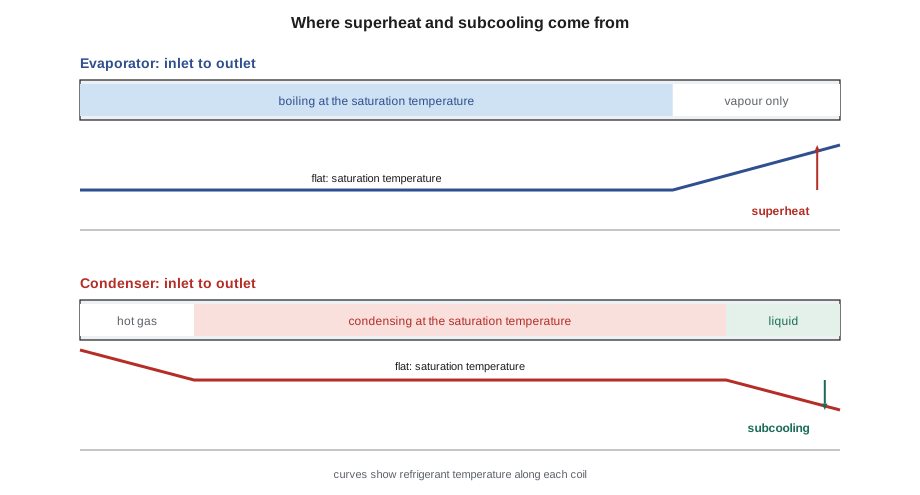
Technicians distinguish two kinds of superheat. Evaporator superheat is measured at the evaporator outlet, close to the coil, and it is the one an expansion valve controls, because its sensing bulb is clamped there. Total superheat, also called compressor superheat, is measured at the compressor suction or the condensing unit's service port, and it includes the heat the vapour picks up in the suction line. On a split system with a long line set, total superheat is larger than evaporator superheat. Both are useful; the important thing is to know which one you measured and which one the manufacturer's target refers to.
What superheat tells you
Superheat shows how well the evaporator is fed. If the metering device lets too little refrigerant into the evaporator, the liquid boils off early, the rest of the coil only superheats vapour, and superheat is high. The evaporator is starved: part of its surface is wasted, capacity falls, and the compressor, which relies on cool suction vapour to cool its motor, runs hot. If the metering device lets too much refrigerant in, liquid reaches the outlet, superheat falls toward zero, and droplets of liquid can carry over to the compressor. The evaporator is flooded, and the compressor is at risk.
Superheat also responds to the load. More heat into the evaporator boils the liquid off sooner and raises superheat; less heat, for example from a dirty filter or a failed indoor fan, leaves liquid in more of the coil and lowers superheat. A system with an expansion valve adjusts its feed to hold superheat roughly steady as the load changes. A system with a fixed metering device, such as a capillary tube or fixed orifice, cannot adjust, so its superheat swings with the load and with the charge, and manufacturers give target superheat charts for those systems based on the indoor and outdoor conditions.
As a general guide for teaching, many systems with thermostatic expansion valves run with an evaporator superheat of about 3 to 7 K (5 to 12 °F). Freezers often run toward the low end and air conditioners toward the middle. Always use the manufacturer's target for the actual equipment.
Subcooling
Subcooling is the number of degrees a liquid is below its saturation temperature at its pressure. In the condenser, the vapour first gives up its superheat, then condenses at the saturation temperature. Once the last vapour has condensed, the liquid keeps losing heat to the cooling air or water, and its temperature drops below saturation. The difference is the subcooling.
To measure it, read the pressure at the liquid line service port, convert it to the saturation temperature with the P-T chart, and measure the liquid line temperature near the same point. Subtract the line temperature from the saturation temperature. Some systems have only a discharge service port; the discharge pressure is close to the liquid pressure in most small systems, but the manufacturer's instructions say which port to use.
Worked problem
Subcooling on the ductless heat pump
On the same system, the liquid line pressure is 2,600 kPa gauge (375 psig) and the liquid line temperature is 38 °C (100 °F). What is the subcooling?
Show solution
- \[T_{\text{sat}}(2701\ \text{kPa abs}) \approx 44.5\ ^\circ\text{C} \quad \text{(from Lesson 5)}\]
- \[\text{subcooling} = 44.5 - 38 = 6.5\ \text{K} \approx 12\ ^\circ\text{F}\]
Answer: About 6.5 K (12 °F) of subcooling. The liquid line is full of liquid with a margin of several degrees, which is what the metering device needs.
Subcooling does two jobs. It guarantees that the liquid line is full of liquid, not a mix of liquid and vapour, so the metering device receives a solid column of liquid. A line that loses pressure on the way, from a long run, a vertical lift or a restriction such as a clogged filter drier, could otherwise start to flash before it reaches the metering device, which starves the evaporator. And it increases capacity: colder liquid flashes less at the metering device, so more of each kilogram is left to boil in the evaporator, as Lesson 6 showed.
What subcooling tells you
Subcooling shows how much liquid is backed up in the condenser. In systems with an expansion valve, the valve holds the superheat steady, so extra refrigerant collects as liquid in the condenser, where it fills tubes that would otherwise condense vapour, and subcooling rises. A system short of refrigerant has little liquid in the condenser and low subcooling. That is why manufacturers of equipment with expansion valves usually give a target subcooling for charging. Very high subcooling with low suction pressure, on the other hand, can point to a restriction: refrigerant cannot get through the liquid line or metering device, so it stacks up in the condenser while the evaporator starves.
As a general guide for teaching, many air-cooled systems run with about 4 to 8 K (8 to 14 °F) of subcooling, and many residential split systems are charged to a manufacturer's target near the middle of that range. Always use the nameplate or installation instructions for the actual equipment.
Putting the four readings together
Superheat and subcooling are most useful together, alongside the suction and head pressures and the temperatures of the air or water across each coil. The table below shows the classic patterns. Real systems can show combinations, and good diagnosis always checks airflow and the condition of the coils before adding or removing refrigerant. RAC-220 and RAC-430 develop this into a full diagnostic method.
| Condition | Suction pressure | Head pressure | Superheat | Subcooling |
|---|---|---|---|---|
| Undercharge (short of refrigerant) | Low | Low | High | Low |
| Overcharge | High or normal | High | Low or normal | High |
| Restriction in the liquid line or metering device | Low | Normal or high | High | High |
| Low airflow across the evaporator | Low | Low or normal | Low | Normal |
| Dirty condenser or failed condenser fan | High | High | Normal | Normal or low |
| Normal operation | Normal | Normal | At target | At target |
Dana showed Theo how the dental clinic's readings fit the table. The head pressure was high and the condensing temperature was about 22 degrees above the outdoor air instead of the usual 10 to 15. Superheat was normal and subcooling was slightly low, because hot, high-pressure liquid was not cooling well. The pattern pointed to the condenser, not the charge, and the condenser coil was matted with cottonwood fluff from a tree beside the building. After a careful cleaning, the head pressure dropped and the trips stopped. Had Theo added refrigerant because the subcooling looked low, he would have made the high pressure worse.
# Superheat and subcooling from field readings (R-410A, approximate table in kPa abs)
import math
table = [(-10, 573), (0, 799), (10, 1088), (20, 1445), (30, 1883), (40, 2416), (50, 3054), (60, 3800)]
P_ATM = 101.3

def t_sat(gauge_kpa):
    p = gauge_kpa + P_ATM
    for (t1, p1), (t2, p2) in zip(table, table[1:]):
        if p1 <= p <= p2:   # interpolate on the logarithm of pressure
            return t1 + (t2 - t1) * (math.log(p) - math.log(p1)) / (math.log(p2) - math.log(p1))
    raise ValueError("pressure outside the table")

def check(name, suction, suction_line, liquid, liquid_line):
    sh = suction_line - t_sat(suction)
    sc = t_sat(liquid) - liquid_line
    note = []
    if sh > 10: note.append("high superheat")
    if sh < 2: note.append("low superheat")
    if sc > 10: note.append("high subcooling")
    if sc < 3: note.append("low subcooling")
    print(f"{name:20s} SH {sh:4.1f} K  SC {sc:4.1f} K  {', '.join(note) or 'within the guide range'}")

check("ductless, normal", 820, 10.0, 2600, 38.0)
check("readings A", 600, 14.5, 1900, 30.5)
check("readings B", 640, 17.0, 2550, 30.0)ductless, normal SH 5.4 K SC 6.8 K within the guide range readings A SH 18.4 K SC 1.9 K high superheat, low subcooling readings B SH 19.3 K SC 14.0 K high superheat, high subcooling
Readings A show high superheat and low subcooling with low pressures on both sides: the classic undercharge pattern. Readings B show high superheat and high subcooling with low suction pressure: refrigerant is backed up in the condenser and not reaching the evaporator, which points to a restriction. The program only does the arithmetic and flags the numbers; the diagnosis still needs the technician to look at airflow, coils and the whole system.
Measuring well
Small measurement errors make large diagnosis errors, because superheat and subcooling are small differences between larger numbers. A gauge that reads a few kilopascals or a psi off, a thermometer probe that is loose or not insulated, or a reading taken before the system has stabilized can change the answer by several degrees. Good practice is to let the system run at least ten to fifteen minutes with doors closed and the load steady, clamp probes to clean bare copper and wrap them with insulation, take pressure and temperature at the same location, check gauges at zero before connecting, and repeat the readings a few minutes apart to make sure they are stable.
For zeotropic blends with glide, use the dew-point temperature for superheat and the bubble-point temperature for subcooling, as Lesson 5 explained. Most digital gauge sets handle this automatically once the refrigerant is selected, which is one reason they are now standard.
Superheat, subcooling and the charge
Superheat and subcooling are also the main tools for setting the refrigerant charge, which RAC-220 covers in detail. For systems with fixed metering devices, the manufacturer provides a chart of target superheat that depends on the indoor wet-bulb temperature and the outdoor dry-bulb temperature, because the right superheat changes with the load. Refrigerant is added if the measured superheat is above the target and recovered if it is below. For systems with expansion valves, the manufacturer usually gives a target subcooling, because the valve holds superheat steady and the extra refrigerant shows up in the condenser.
The best method of all, whenever the system allows it, is to weigh the charge: recover the refrigerant if necessary, evacuate the system, and weigh in the exact amount on the nameplate, adjusted for the length of the line set. Superheat and subcooling then confirm that the system is running as designed. Dana's rule for Theo was simple: never add or remove refrigerant on the strength of one number, and never before checking airflow, filters and coils.
Common mistakes
MistakeAdding refrigerant because the suction pressure is low.
InsteadLow suction can come from low airflow, a dirty filter, a restriction or a low load; check superheat, subcooling and airflow first.
MistakeMeasuring superheat with the pressure at one place and the temperature at another far away.
InsteadTake pressure and temperature at the same point, or account for the line between them.
MistakeUsing the bubble point for superheat on a blend with glide.
InsteadSuperheat uses the dew point; subcooling uses the bubble point.
MistakeTreating zero superheat as good because the evaporator is full.
InsteadZero superheat means liquid may reach the compressor; there must be some superheat.
Summary and key terms
- Superheat is vapour temperature minus saturation temperature at its pressure.
- Subcooling is saturation temperature minus liquid temperature at its pressure.
- Superheat shows how well the evaporator is fed: high means starved, near zero means flooded.
- Subcooling shows how much liquid is backed up in the condenser and guarantees solid liquid at the metering device.
- Charge problems move superheat and subcooling in opposite directions; restrictions raise both.
- Good measurements need a stable system, matched pressure and temperature points and well-insulated probes.
- Superheat
- The temperature of a vapour above its saturation temperature at its pressure.
- Subcooling
- The temperature of a liquid below its saturation temperature at its pressure.
- Evaporator superheat
- Superheat measured at the evaporator outlet, controlled by an expansion valve.
- Total superheat
- Superheat measured at the compressor suction or condensing unit, including suction line heat gain.
- Starved evaporator
- An evaporator fed too little refrigerant, with high superheat and lost capacity.
- Flooded evaporator
- An evaporator fed too much refrigerant, with little or no superheat and a risk of liquid at the compressor.
- Restriction
- A partial blockage, such as a clogged filter drier, that limits refrigerant flow.
Practice problems
Work each problem on paper first, then reveal the answer to check.
Saturated suction temperature is −5 °C (23 °F) and the suction line is 2 °C (36 °F). What is the superheat?
Show answer
2 − (−5) = 7 K.
Saturated condensing temperature is 45 °C (113 °F) and the liquid line is 40 °C (104 °F). What is the subcooling?
Show answer
45 − 40 = 5 K.
A system has high superheat and low subcooling with both pressures low. What is the likely cause?
Show answer
An undercharge, short of refrigerant, after airflow and coils have been checked.
Why does a long liquid line lift make subcooling more important?
Show answer
The lift lowers the liquid's pressure, and without enough subcooling the liquid could start to flash before the metering device.
Lesson quiz · 5 questions
Score 60% or more to complete this lesson.
Create a free account to save your progress, take quizzes and earn a certificate.