
RAC-110 · Lesson 12 of 12 · 21 min
Psychrometrics, air conditioning and first tools of the trade
By early summer, Theo had worked through the theory with Dana on dozens of calls, and the dental clinic called again. This time the rooftop unit was running fine and the pressures were normal, but the staff said the clinic felt sticky. Dana handed Theo a digital psychrometer, a probe that measures air temperature and humidity, and sent him to the return grille and to a supply diffuser. "Refrigeration moves heat," she said. "Air conditioning moves heat and water. To see the water, you need a different chart."
This lesson introduces psychrometrics, the study of moist air, and shows how an air conditioner changes the air passing through it. It ends with the first tools an apprentice needs and how they connect to the theory in this course. RAC-330 covers psychrometrics and air distribution in depth.
Moist air
The air around us is a mixture of dry air, mostly nitrogen and oxygen, and water vapour. The amount of water vapour varies from almost none on a very cold winter day to a few per cent by mass on a hot, humid summer day. That small amount matters a great deal: it decides whether people feel comfortable, whether windows fog, whether mould grows in walls, and how much of an air conditioner's capacity goes to drying the air rather than cooling it.
Air can hold only so much water vapour at a given temperature. When it holds the maximum, it is saturated. Warm air can hold much more than cold air: roughly, the maximum doubles for every 11 °C (20 °F) rise in temperature. When moist air is cooled, it eventually reaches the temperature at which it is saturated. That is its dew point, and cooling it further makes some of the vapour condense as dew, fog, frost or water on an evaporator coil.
The properties of moist air
Psychrometrics uses a handful of properties to describe moist air. Any two of them, together with the atmospheric pressure, fix all the others.
- Dry-bulb temperature: the ordinary air temperature, read on a normal thermometer shielded from radiation.
- Wet-bulb temperature: the temperature read by a thermometer whose bulb is covered with a wet wick in moving air. Evaporation from the wick cools it, and the drier the air, the more evaporation and the lower the wet-bulb reading. At saturation, wet bulb equals dry bulb.
- Dew point: the temperature at which the air would become saturated if cooled without changing its moisture content. It depends only on the amount of moisture in the air.
- Relative humidity: the water vapour in the air as a percentage of the most it could hold at the same temperature. Relative humidity changes with temperature even when the moisture content does not: cooling air raises its relative humidity, and heating it lowers it.
- Humidity ratio: the mass of water vapour per mass of dry air, given in grams per kilogram (g/kg). It is the true measure of how much water the air holds.
- Enthalpy: the heat content of the air per kilogram of dry air, including both the sensible heat of the air and the latent heat of its water vapour, in kJ/kg.
Relative humidity is the number people hear in weather forecasts, but it is the hardest to use for calculations because it depends on temperature. Technicians and designers work with dew point and humidity ratio, which stay the same as air is heated or cooled without adding or removing water.
In these formulas, p is the atmospheric pressure and p_v is the partial pressure of the water vapour in the air. The saturation pressure of water at the air temperature, p_sat, rises steeply with temperature, exactly like the refrigerant saturation curves in Lesson 5: it is about 1.5 kPa at 13 °C and about 3.0 kPa at 24 °C.
The psychrometric chart
The psychrometric chart puts all these properties on one diagram for a given atmospheric pressure. Dry-bulb temperature runs along the bottom. Humidity ratio, which is also the dew point, runs up the right side. The curved left edge is the saturation line, where relative humidity is 100 per cent, and the curves inside it are lines of constant relative humidity. Wet-bulb lines slope down to the right, and enthalpy is read on a scale along the saturation line. Any point on the chart is one state of air, and a process, like air passing through a coil, is a line from one point to another.
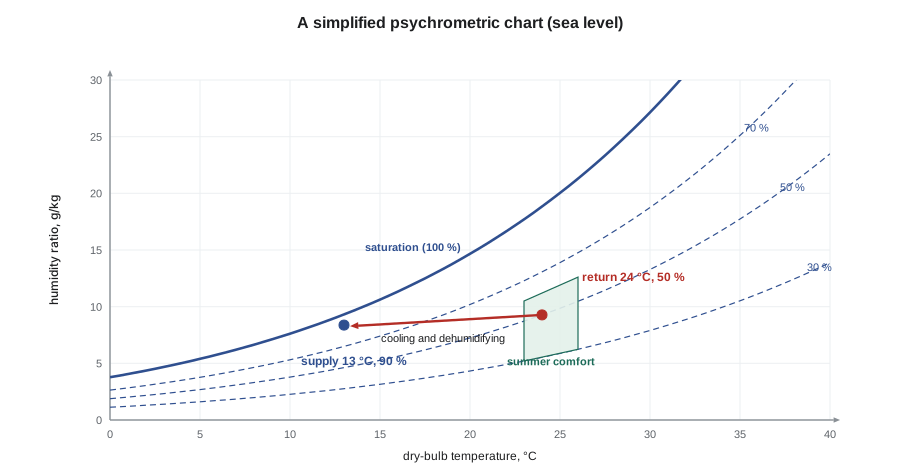
The chart shows the basic processes. Sensible heating or cooling, with no change in moisture, is a horizontal line: the dry bulb changes but the humidity ratio and dew point do not. Humidifying or dehumidifying at constant temperature is a vertical line. Cooling and dehumidifying, which is what an air conditioner's evaporator does in summer, is a line down and to the left, because the coil cools the air and condenses some of its moisture at the same time. Evaporative cooling follows a wet-bulb line, up and to the left.
What an air conditioner does to air
An air conditioner's evaporator coil runs colder than the dew point of the air crossing it, typically with refrigerant boiling at about 4 to 8 °C in comfort cooling. As the air passes, it cools; the air touching the coil's surface is cooled below its dew point, and water condenses on the fins and drains away. The air leaves the coil cooler and drier, often close to saturation. A typical comfort cooling system cools the air by about 10 to 12 °C (18 to 22 °F) across the coil, a measurement technicians call the temperature split or delta T.
The heat removed from the air has two parts, like the loads in Lesson 11. The sensible part lowers the temperature. The latent part removes moisture, and it is the latent heat of condensation of the water that drips into the drain pan. The sensible heat ratio, SHR, is the sensible part divided by the total. Comfort cooling coils usually run with an SHR of about 0.7 to 0.8 in humid climates; a higher SHR means less dehumidification.
The constants in these formulas come from the density and specific heat of air at normal conditions and from the latent heat of water, so they are approximations that work well near sea level and room temperature.
Worked problem
The sticky dental clinic
Theo measured return air at 24 °C and 50 per cent relative humidity, and supply air at 13 °C and 90 per cent. The unit moves about 566 L/s (1,200 cfm). Using the properties below, find the sensible, latent and total cooling, and the sensible heat ratio. At these points, the humidity ratios are about 9.28 and 8.37 g/kg, and the enthalpies about 47.8 and 34.2 kJ/kg.
Show solution
- \[\dot{Q}_s = 1.23 \times 566 \times (24 - 13) \approx 7660\ \text{W}\]
- \[\dot{Q}_l = 3010 \times 566 \times (0.00928 - 0.00837) \approx 1550\ \text{W}\]
- \[\dot{Q}_t = 1.2 \times 566 \times (47.8 - 34.2) \approx 9240\ \text{W}\]
- \[\text{SHR} = \frac{7660}{7660 + 1550} \approx 0.83\]
Answer: The coil removes about 9.2 kW (about 2.6 tons), of which 83 per cent is sensible and only 17 per cent latent. The supply air is cool but not very dry: its dew point, about 11.5 °C, is only a little below the return air's dew point of about 13 °C. Dana found the reason: the unit's fan had been set to run continuously, so between compressor cycles it blew air across the wet coil and evaporated the condensed water back into the clinic. Setting the fan to cycle with the compressor, and slowing it slightly, improved dehumidification.
# Psychrometric properties of moist air (sea-level pressure, approximate formulas)
import math
P = 101.325                                   # kPa

def p_sat(t):                                 # saturation pressure of water, kPa (Magnus form)
    return 0.61094 * math.exp(17.625 * t / (t + 243.04))

def state(t, rh):
    pv = rh * p_sat(t)
    w = 0.622 * pv / (P - pv)                 # kg water per kg dry air
    h = 1.006 * t + w * (2501 + 1.86 * t)     # kJ per kg dry air
    a = math.log(pv / 0.61094)
    dew = 243.04 * a / (17.625 - a)           # dew point, C
    return w, h, dew

flow = 566                                    # L/s
for name, t, rh in [("return", 24, 0.50), ("supply", 13, 0.90)]:
    w, h, dew = state(t, rh)
    print(f"{name}: {t} C, {rh:.0%} RH -> W {w * 1000:.2f} g/kg, h {h:.1f} kJ/kg, dew point {dew:.1f} C")
w1, h1, _ = state(24, 0.50)
w2, h2, _ = state(13, 0.90)
qs = 1.23 * flow * (24 - 13)
ql = 3010 * flow * (w1 - w2)
print(f"sensible {qs:.0f} W, latent {ql:.0f} W, total {qs + ql:.0f} W, SHR {qs / (qs + ql):.2f}")
print(f"water removed: {flow * 1.2 / 1000 * (w1 - w2) * 3600:.1f} kg per hour of running")return: 24 C, 50% RH -> W 9.28 g/kg, h 47.8 kJ/kg, dew point 12.9 C supply: 13 C, 90% RH -> W 8.37 g/kg, h 34.2 kJ/kg, dew point 11.4 C sensible 7658 W, latent 1544 W, total 9202 W, SHR 0.83 water removed: 2.2 kg per hour of running
The program calculates the properties from the temperatures and humidities and repeats the coil calculation. It also shows the water the coil removes, the condensate that runs down the drain line. A blocked drain line, a cracked pan or a failed condensate pump turns that water into a ceiling stain, which is one of the most common air conditioning service calls.
Comfort and airflow
People feel comfortable over a range of conditions that depends on clothing, activity and air movement. As a broad guide, many people are comfortable indoors at about 20 to 24 °C in winter and 23 to 26 °C in summer, with relative humidity between about 30 and 60 per cent. Above about 60 per cent, mould and dust mites thrive; below about 30 per cent, skin and eyes dry out and static builds up. Air conditioning design aims to hold the space inside that zone.
Airflow across the evaporator controls the balance between cooling and drying. A common starting point for comfort cooling is about 54 L/s per kW of cooling, or about 400 cfm per ton, adjusted by the manufacturer for the climate. Lower airflow makes the coil colder and drier, which removes more moisture but risks freezing the coil; higher airflow gives more sensible capacity but less dehumidification. Low airflow from dirty filters, closed registers or undersized ducts is one of the most common causes of poor air conditioning performance, and it shows up on the gauges as low suction pressure and low superheat.
First tools of the trade
Everything in this course is measured with a small set of tools that Theo carried in his first months. Each one connects to an idea from the lessons.
| Tool | What it measures or does | Theory it uses |
|---|---|---|
| Gauge manifold, analog or digital, with hoses | Suction and high-side pressures; saturation temperatures from built-in P-T tables | Lessons 4 and 5 |
| Clamp-on pipe thermometers | Suction and liquid line temperatures for superheat and subcooling | Lesson 7 |
| Micron gauge and vacuum pump | Deep vacuum during evacuation | Lesson 4 |
| Digital psychrometer | Dry bulb, wet bulb, relative humidity and dew point of air | This lesson |
| Infrared and probe thermometers | Surface and air temperatures | Lessons 2 and 3 |
| Refrigerant scale | Weighing refrigerant in and out of systems and cylinders | Lesson 5 (pressure cannot show quantity) |
| Leak detectors: electronic, bubble solution, ultraviolet dye | Finding refrigerant leaks | Lesson 8 and RAC-120 |
| Nitrogen cylinder and regulator | Pressure testing and purging during brazing | Lesson 4 |
| Recovery machine and recovery cylinders | Removing refrigerant without venting it | RAC-120 |
| Multimeter and clamp meter | Voltage, current, resistance and capacitance | RAC-130 |
| Anemometer and manometer | Air velocity and duct static pressure | RAC-330 |
| Tubing cutter, reamer, flaring and swaging tools, benders, brazing torch | Making refrigerant piping joints | RAC-210 |
| Personal protective equipment | Safety glasses, gloves, hearing protection, fall protection where needed | Every lesson |
Dana's advice about tools had nothing to do with buying them. Check them: a gauge that does not read zero open to the air, a thermometer that does not read 0 °C (32 °F) in a proper ice bath, or a micron gauge that has been contaminated with oil will mislead you, and every diagnosis built on a wrong reading will be wrong. Keep them clean and capped, because a hose full of moisture or debris contaminates every system it touches. And understand what each one tells you, because the tool only gives you a number; the theory turns it into an answer.
Looking back and looking ahead
Over these twelve lessons, Theo learned the language Dana talked about on his first day. Heat moves from hot to cold by conduction, convection and radiation. Sensible heat changes temperature and latent heat changes state. Pressure fixes the boiling temperature of a saturated refrigerant, which turns a gauge reading into a temperature. The vapour-compression cycle moves heat by boiling refrigerant at low pressure and condensing it at high pressure, and superheat and subcooling show how it is running. A P-h diagram draws the cycle, and loads, capacity and COP connect it to what the customer needs and pays for. Psychrometrics adds the water in the air.
The next courses build directly on this. RAC-120 covers refrigerant handling, recovery and the environmental rules. RAC-130 covers the electrical side: motors, capacitors, contactors and wiring diagrams. RAC-210 and RAC-220 go deeper into the components, metering devices and charging. The same brewery, clinic, arena and homes will keep appearing, and Theo will keep his notebook.
Common mistakes
MistakeUsing relative humidity to compare moisture at different temperatures.
InsteadRelative humidity changes with temperature; compare dew points or humidity ratios.
MistakeExpecting a bigger air conditioner to fix a humid house.
InsteadOversized systems short-cycle and remove little moisture; correct sizing, airflow and fan settings matter more.
MistakeRunning the indoor fan continuously in humid weather without checking the effect.
InsteadAir across a wet coil between cycles can evaporate condensate back into the space.
MistakeTrusting a tool that has not been checked.
InsteadZero gauges in open air and check thermometers in an ice bath before relying on them.
Summary and key terms
- Moist air is dry air plus water vapour; warm air can hold more vapour than cold air.
- Dry bulb, wet bulb, dew point, relative humidity, humidity ratio and enthalpy describe moist air; any two fix the rest.
- On the psychrometric chart, sensible processes are horizontal and cooling with dehumidification runs down and to the left.
- An air conditioner removes sensible and latent heat; the sensible heat ratio shows the split.
- Airflow of about 400 cfm per ton is a common starting point; low airflow lowers suction pressure and superheat.
- Tools must be checked and understood: gauges, thermometers, micron gauges, psychrometers, scales and leak detectors.
- Psychrometrics
- The study of the properties and processes of moist air.
- Dry-bulb temperature
- The ordinary air temperature.
- Wet-bulb temperature
- The temperature of a wetted thermometer in moving air, lowered by evaporation.
- Dew point
- The temperature at which air becomes saturated when cooled at constant moisture content.
- Relative humidity
- Water vapour present as a percentage of the maximum at the same temperature.
- Humidity ratio
- Mass of water vapour per unit mass of dry air.
- Sensible heat ratio
- The sensible part of a cooling load divided by the total.
- Temperature split
- The drop in air temperature across an evaporator coil.
Practice problems
Work each problem on paper first, then reveal the answer to check.
Air at 24 °C (75 °F) is heated to 30 °C (86 °F) with no moisture added. What happens to its dew point and relative humidity?
Show answer
The dew point stays the same; the relative humidity falls.
A coil moves 470 L/s (1,000 cfm) and drops the air temperature by 11 K (20 °F). What is the sensible cooling?
Show answer
1.23 × 470 × 11 ≈ 6,360 W.
A coil removes 8 kW (27,000 Btu/h) total, of which 6 kW (20,000 Btu/h) is sensible. What is the SHR?
Show answer
6 / 8 = 0.75.
Why does a micron gauge need to be kept clean of oil?
Show answer
Oil contamination of the sensor makes it read falsely, so an evacuation could look complete when it is not.
Lesson quiz · 5 questions
Score 60% or more to complete this lesson.
Create a free account to save your progress, take quizzes and earn a certificate.