
RAC-110 · Lesson 2 of 12 · 26 min
Matter, energy and heat transfer
On Theo's second week, the brewery called because its walk-in cooler would not hold temperature on brewing days. Before touching the refrigeration system, Dana walked around the outside of the box with her hand on the panels and an infrared thermometer. One panel near the floor was cold to the touch and showed frost along a seam. "Heat is getting in somewhere it should not," she said. "Before you can fix a refrigeration problem, you have to know how heat gets into a space in the first place. There are only three ways, and you just felt one of them."
This lesson covers what heat is, how it is measured and the three ways it moves: conduction, convection and radiation. Every refrigeration load, every coil and every insulated wall is an application of these ideas.
Matter and molecules
All matter is made of molecules, and the molecules are always moving. In a solid, they vibrate about fixed positions, held by strong forces between them. In a liquid, they are still close together but can slide past one another, so a liquid flows and takes the shape of its container. In a gas, the molecules are far apart and move freely, filling whatever space is available. The same substance can exist in all three states. Water is ice, liquid water or steam depending on its temperature and pressure, and refrigerant is liquid or vapour depending on where it is in the system.
Moving from solid to liquid is melting, or fusion; from liquid to gas is boiling, evaporation or vaporization; from gas back to liquid is condensation; and from liquid to solid is freezing. Each change of state needs a large amount of energy to be added or removed while the temperature stays the same. That energy, called latent heat, is the subject of Lesson 3, and it is the reason the refrigeration cycle works: refrigerant absorbs a great deal of heat when it boils in the evaporator and gives it up when it condenses in the condenser.
Energy, heat and work
Energy is the capacity to do work or to heat something. It comes in several forms that a technician meets every day: electrical energy that runs the compressor motor, mechanical work the compressor does on the refrigerant, kinetic energy of moving molecules, which we sense as temperature, and the internal energy stored in the forces between molecules, which changes when a substance changes state. Energy is never created or destroyed. It only changes form or moves from place to place. This is the first law of thermodynamics, and it is what makes the energy balance in Lesson 1 true.
Heat is energy moving because of a temperature difference. It always flows on its own from a warmer body to a cooler one, never the other way. This is the second law of thermodynamics in its simplest form. A cup of coffee cools down in a room; it never heats up by taking heat from the cooler air. Refrigeration does not break the second law. It moves heat from cold to hot by putting in work, the same way a pump lifts water uphill by putting in work. Without the work, heat goes downhill, from hot to cold.
Energy in SI units is measured in joules (J). One joule is a small amount, so heat quantities are usually given in kilojoules (kJ). The rate of energy flow, power, is measured in watts (W), where one watt is one joule per second, and in kilowatts (kW). In the imperial system used by much of the trade, heat is measured in British thermal units (Btu): one Btu is the heat needed to raise one pound of water by one degree Fahrenheit, and it equals about 1.055 kJ. Heat flow is measured in Btu per hour, and one watt is about 3.412 Btu per hour.
| Quantity | SI unit | Imperial unit | Conversion |
|---|---|---|---|
| Energy, heat | joule (J), kilojoule (kJ) | British thermal unit (Btu) | 1 Btu ≈ 1.055 kJ |
| Power, heat flow | watt (W), kilowatt (kW) | Btu per hour (Btu/h) | 1 W ≈ 3.412 Btu/h |
| Refrigeration capacity | kilowatt (kW) | ton of refrigeration | 1 ton = 12,000 Btu/h ≈ 3.517 kW |
| Temperature | degree Celsius (°C), kelvin (K) | degree Fahrenheit (°F), Rankine (°R) | °F = 1.8 °C + 32 |
| Pressure | kilopascal (kPa) | pound per square inch (psi) | 1 psi ≈ 6.895 kPa |
Worked problem
Converting heat units
A walk-in cooler's condensing unit is rated at 2.6 kW of cooling. What is that in Btu/h, and how many joules of heat does it remove in one hour?
Show solution
- \[2.6\ \text{kW} \times 3412\ \tfrac{\text{Btu/h}}{\text{kW}} \approx 8870\ \text{Btu/h}\]
- \[E = P\,t = 2600\ \text{W} \times 3600\ \text{s} = 9.36 \times 10^{6}\ \text{J} = 9360\ \text{kJ}\]
Answer: About 8,900 Btu/h, and 9,360 kJ, or 9.36 MJ, of heat each hour it runs at that capacity.
Conduction
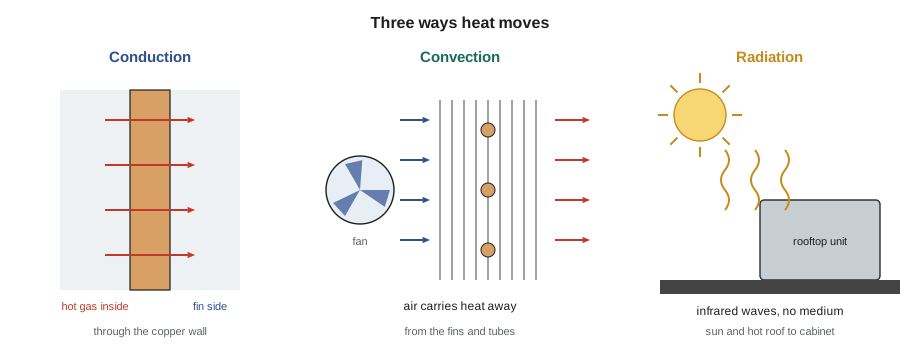
Conduction is heat moving through a material, or between materials in contact, from molecule to molecule. Faster-vibrating molecules on the hot side bump into their neighbours and pass energy along. Conduction is how heat passes through the wall of a copper tube from the refrigerant to the fins, through the panels of a walk-in cooler, and through the metal shell of a compressor. Metals conduct heat well because they have free electrons that carry energy quickly. Still air, foam and fibrous insulation conduct heat poorly because their molecules are far apart or trapped in tiny pockets.
The rate of conduction through a flat layer depends on four things: the material's thermal conductivity, the area, the temperature difference across the layer and the thickness. Double the area or the temperature difference and the heat flow doubles; double the thickness and it halves.
Here Q is the heat flow in watts, k is the thermal conductivity in watts per metre per kelvin, A is the area in square metres, ΔT is the temperature difference in kelvins (the same size as degrees Celsius), and L is the thickness in metres.
| Material | Approximate k, W/(m·K) | Where it appears |
|---|---|---|
| Copper | 390 | Refrigerant tubing, coil tubes |
| Aluminum | 205 | Coil fins, microchannel coils |
| Steel | 50 | Compressor shells, receivers, structural supports |
| Glass | 1.0 | Display case doors |
| Wood | 0.12 | Framing, door frames |
| Still air | 0.026 | Trapped in insulation and double glazing |
| Fibreglass insulation | 0.04 | Duct wrap, building walls |
| Polyurethane foam | 0.023 | Walk-in and refrigerated truck panels |
In practice, insulation is described by its thermal resistance rather than its conductivity. Resistance is the thickness divided by the conductivity, and the heat flow is the area times the temperature difference divided by the resistance. Resistances of layers in series simply add, which makes walls easy to calculate.
In Canada, building and equipment data often give the SI resistance, RSI, in square metre kelvins per watt. Imperial R-values, used on many product labels, are about 5.68 times larger: an R-20 panel has an RSI of about 3.5.
Worked problem
Heat gain through the brewery cooler's panels
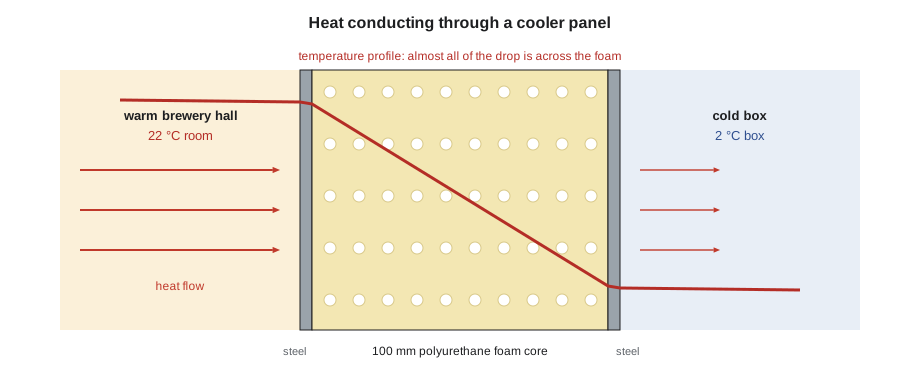
The brewery's walk-in cooler measures 3.0 m by 4.0 m by 2.6 m high (10 ft by 13 ft by 8.5 ft high). It is built from panels with 100 mm of polyurethane foam, RSI 4.3 (R-25). The box is held at 2 °C (36 °F) inside a brewery hall at 22 °C (72 °F). Ignoring the floor, how much heat conducts in through the walls and ceiling?
Show solution
- \[A_{\text{walls}} = 2\,(3.0 + 4.0) \times 2.6 = 36.4\ \text{m}^2, \quad A_{\text{ceiling}} = 3.0 \times 4.0 = 12.0\ \text{m}^2\]
- \[A = 36.4 + 12.0 = 48.4\ \text{m}^2, \quad \Delta T = 22 - 2 = 20\ \text{K}\]
- \[Q = \frac{48.4 \times 20}{4.3} \approx 225\ \text{W}\]
Answer: About 225 W (about 770 Btu/h) conducts in through sound panels. That is a small part of the box's load, but a panel with wet, crushed or missing foam can let in several times its share, which is what the frosted seam suggested.
# Conduction through walk-in cooler panels: Q = A * dT / RSI
length, width, height = 3.0, 4.0, 2.6     # m
t_room, t_box = 22.0, 2.0                 # deg C
area = 2 * (length + width) * height + length * width
for name, rsi in [("100 mm foam panel", 4.3), ("75 mm foam panel", 3.2), ("panel with wet foam", 1.2)]:
    q = area * (t_room - t_box) / rsi     # W
print(f"{name:22s} RSI {rsi:3.1f}: {q:5.0f} W = {q * 3.412:5.0f} Btu/h")100 mm foam panel RSI 4.3: 225 W = 768 Btu/h 75 mm foam panel RSI 3.2: 302 W = 1032 Btu/h panel with wet foam RSI 1.2: 807 W = 2752 Btu/h
The program shows how sharply the heat gain rises as insulation loses its resistance. Foam that has absorbed water conducts heat far better than dry foam, and in a freezer the water freezes, cracks the foam further and makes the problem worse each year. The fix at the brewery was a new panel and resealed joints, not a bigger refrigeration system.
Convection
Convection is heat carried by a moving fluid, a liquid or a gas. A fluid in contact with a warm surface picks up heat by conduction, then carries it away as it moves. In natural convection, the movement comes from buoyancy: warm air is less dense and rises, cool air sinks. That is why cold air pours out of the bottom of an open refrigerator and why a cooler's evaporator is mounted high, so that cold air falls through the box. In forced convection, a fan or pump moves the fluid, which carries heat much faster. Almost every coil in HVAC-R uses forced convection: fans push air across condenser and evaporator coils, and pumps push water or glycol through chillers and heat exchangers.
The convection coefficient h depends strongly on how fast the fluid moves and what it is. Still air carries little heat; air blown across a coil carries several times more; flowing water carries far more still, and boiling or condensing refrigerant carries the most of all. The design of a coil is a contest to get enough area and enough airflow to move the heat with a small temperature difference. Fins on a coil multiply the air-side area because the air side is always the weak link. When those fins are bent flat or packed with dust, the area and airflow drop, h drops, and the coil cannot move its heat. That was the brewery's summer problem in Lesson 1.
Radiation
Radiation is heat carried by electromagnetic waves, mostly infrared, from one surface to another. It needs no material between them and can cross a vacuum, which is how the sun heats the earth. Every surface radiates, and the amount rises steeply with temperature, as the fourth power of the absolute temperature. A surface also absorbs radiation from its surroundings, and the net flow goes from the hotter surface to the cooler one.
Temperatures in this equation must be absolute, in kelvins. The emissivity ε describes how well the surface radiates, from near 0 for polished metal to near 1 for dark, dull surfaces. In the trade, radiation matters in three places: the sun beating on a building, a roof or a rooftop unit; the glass doors of display cases, which radiate to warm surroundings; and the infrared thermometer, which reads temperature from the radiation a surface gives off and can be fooled by shiny surfaces with low emissivity.
Dana showed Theo the infrared trap on the brewery job. Aimed at a bare copper suction line, the thermometer read several degrees too warm, because polished copper has a low emissivity and reflects radiation from the warm room. A strip of black electrical tape on the line, left for a minute to reach the pipe temperature, gave the correct reading. For pipe temperatures in this course and in the field, a clamp-on contact thermometer is the right tool.
Worked problem
Why roofs matter
A dark rooftop unit cabinet in summer sun has a surface temperature of 60 °C (140 °F). It radiates to surroundings at an effective temperature of 30 °C (86 °F). Take ε = 0.9 and compare the net radiation per square metre (radiation is usually worked in SI units) with what it would be if the cabinet were at 40 °C (104 °F).
Show solution
- \[T_{60} = 333\ \text{K}, \quad T_{40} = 313\ \text{K}, \quad T_{30} = 303\ \text{K}\]
- \[q_{60} = 0.9 \times 5.67 \times 10^{-8} \times (333^4 - 303^4) \approx 200\ \text{W/m}^2\]
- \[q_{40} = 0.9 \times 5.67 \times 10^{-8} \times (313^4 - 303^4) \approx 59\ \text{W/m}^2\]
Answer: The hotter cabinet radiates about 200 W per square metre, more than three times the 59 W at the cooler temperature, for only twice the temperature difference, because of the fourth-power law. Sun-heated surfaces around condensers and rooftop units add to the heat a condenser must reject, which is why light-coloured cabinets, shade and good clearances help.
Heat transfer in the refrigeration system
Every part of the system uses these mechanisms. In the evaporator, warm air from the box is blown across the fins by forced convection; heat conducts through the fins and tube walls; and boiling refrigerant inside the tubes absorbs it. In the condenser, the process reverses: hot refrigerant vapour condenses inside the tubes, heat conducts out through the walls and fins, and outdoor air carries it away. The compressor and suction line pick up heat from the surroundings by convection and radiation, which is why suction lines are insulated. The refrigerated space gains heat through its walls by conduction, through open doors by convection, and through glass by radiation.
The driving force in every case is temperature difference. A coil only moves heat if the refrigerant inside is colder (in the evaporator) or hotter (in the condenser) than the air outside. A bigger temperature difference moves more heat through the same coil, but it costs efficiency: the compressor has to lift the heat over a larger temperature gap. Good design and good maintenance keep the coils clean and the airflow up so that the system moves its heat with the smallest temperature difference it can.
Common mistakes
MistakeSaying cold flows into a space.
InsteadHeat flows out of the space, or into it; cold is not a substance and does not flow.
MistakeUsing degrees Celsius or Fahrenheit in the radiation equation.
InsteadRadiation needs absolute temperatures, in kelvins (or degrees Rankine).
MistakeTrusting an infrared thermometer on shiny copper.
InsteadPolished metal has low emissivity; use a contact thermometer or cover the spot with dull tape.
MistakeAdding refrigeration capacity to make up for failed insulation.
InsteadFind and fix the heat leak; a larger system only hides it and costs more to run.
Summary and key terms
- Matter is made of moving molecules; solids, liquids and gases differ in how freely the molecules move.
- Heat is energy in motion from hot to cold; refrigeration moves it the other way by adding work.
- Conduction moves heat through materials: Q = kAΔT/L, or area times temperature difference over resistance.
- Convection carries heat with a moving fluid; forced convection across coils is the workhorse of HVAC-R.
- Radiation carries heat as infrared waves and rises with the fourth power of absolute temperature.
- Coils move heat only across a temperature difference; clean coils and good airflow keep that difference small.
- Heat
- Energy that moves from one body to another because of a temperature difference.
- Conduction
- Heat moving through a material or between touching materials, molecule to molecule.
- Convection
- Heat carried by a moving liquid or gas, natural (buoyancy) or forced (fan or pump).
- Radiation
- Heat carried by electromagnetic waves between surfaces, without any material between them.
- Thermal conductivity
- How well a material conducts heat, k.
- Thermal resistance
- Thickness divided by conductivity; the R-value or RSI of a layer.
- Emissivity
- How well a surface radiates compared with a perfect radiator, from 0 to 1.
- British thermal unit
- The heat that raises one pound of water by one degree Fahrenheit, about 1.055 kJ.
Practice problems
Work each problem on paper first, then reveal the answer to check.
A freezer panel has RSI 5.0 (R-28) and an area of 10 m² (108 ft²). The difference across it is 45 K (80 °F). What heat conducts through?
Show answer
Q = 10 × 45 / 5.0 = 90 W.
Which heat transfer mode does a fan increase across a condenser coil?
Show answer
Forced convection on the air side.
Why is an evaporator usually mounted near the ceiling of a walk-in?
Show answer
Cold air is denser and falls, so natural convection carries it down through the box and warm air rises back to the coil.
Convert 5 kW to Btu/h.
Show answer
5 × 3,412 ≈ 17,060 Btu/h.
Lesson quiz · 5 questions
Score 60% or more to complete this lesson.
Create a free account to save your progress, take quizzes and earn a certificate.