
RAC-110 · Lesson 11 of 12 · 24 min
Refrigeration load, capacity and system performance
With the glycol chiller working, Priya at the brewery asked a sensible question: was the walk-in cooler's own system big enough now that it no longer had to cool beer from fermentation temperature? Dana handed the job to Theo as a load calculation. "Add up every way heat gets into that box over a day," she said. "Walls, door, product, lights, fans, people. Then turn it into a rate the system has to meet in the hours it actually runs, and compare it with the nameplate. That is what a load calculation is."
This lesson covers refrigeration capacity and its units, the parts of a refrigeration load, a simple load estimate, and the measures of performance printed on equipment: COP, EER and their relatives.
Capacity and the ton of refrigeration
Refrigeration capacity is the rate at which a system removes heat. In SI units, it is measured in kilowatts. In North America, the trade still widely uses the ton of refrigeration, which comes from the days of ice: one ton is the cooling effect of melting one short ton, 2,000 lb, of ice at 0 °C over 24 hours. With the latent heat of fusion at 144 Btu/lb, that works out to exactly 12,000 Btu per hour by definition, or about 3.517 kW.
The ton has nothing to do with the weight of the equipment, and it is not a metric tonne. A residential central air conditioner is typically between 1.5 and 5 tons; a ductless head for one room, often a little under one ton; a walk-in cooler's system, a fraction of a ton to a few tons; a large office building's chiller, hundreds of tons. Capacities in this course are given both ways.
# Converting between tons, Btu/h and kW
BTUH_PER_TON = 12000
W_PER_BTUH = 1 / 3.412
for tons in [0.5, 1.0, 1.5, 2.0, 3.0, 5.0, 100.0]:
    btuh = tons * BTUH_PER_TON
    kw = btuh * W_PER_BTUH / 1000
    print(f"{tons:6.1f} tons = {btuh:9,.0f} Btu/h = {kw:7.2f} kW")
for kw in [2.6, 3.5, 7.0, 10.5]:
    tons = kw * 1000 * 3.412 / BTUH_PER_TON
print(f"{kw:6.1f} kW = {tons:5.2f} tons")0.5 tons = 6,000 Btu/h = 1.76 kW 1.0 tons = 12,000 Btu/h = 3.52 kW 1.5 tons = 18,000 Btu/h = 5.28 kW 2.0 tons = 24,000 Btu/h = 7.03 kW 3.0 tons = 36,000 Btu/h = 10.55 kW 5.0 tons = 60,000 Btu/h = 17.58 kW 100.0 tons = 1,200,000 Btu/h = 351.70 kW 2.6 kW = 0.74 tons 3.5 kW = 1.00 tons 7.0 kW = 1.99 tons 10.5 kW = 2.99 tons
Capacity always depends on conditions. A condensing unit rated at one capacity at one evaporating and condensing temperature will deliver less at a colder evaporator or a hotter condenser, as Lessons 9 and 10 showed. Manufacturers publish capacities at standard rating conditions so that equipment can be compared, and give tables for other conditions. When a nameplate or catalogue gives a capacity, the conditions it applies to matter as much as the number.
What makes up a refrigeration load
A refrigeration load is all the heat that must be removed from a space or product to keep it at the design temperature. For a walk-in cooler or freezer, it is usually divided into four parts.
- Transmission load: heat conducted through the walls, ceiling and floor, calculated as in Lesson 2 from area, temperature difference and insulation resistance. Sun on an outdoor box adds to it.
- Infiltration or air change load: warm, moist outside air that enters every time the door opens and must be cooled and dried. For busy boxes, it is often the largest single load, and strip curtains, fast-closing doors and good habits cut it sharply.
- Product load: heat removed from goods brought in warmer than the box, calculated with sensible and latent heat as in Lesson 3. Freezing product adds its latent heat of fusion, which is large. Some products, such as fruit and vegetables, also give off heat of respiration while stored.
- Internal load: heat from lights, evaporator fan motors, people working inside, forklifts and electric defrost heaters.
These parts are added over a day, a 24-hour total, and then divided by the number of hours the system is expected to run. Refrigeration systems are not sized to run 24 hours a day: a cooler's evaporator needs off time to defrost by letting the box air melt the frost, and a freezer needs time for defrost cycles. As a common rule of thumb for teaching, coolers are sized to carry the daily load in about 16 hours of running, and freezers with electric or hot gas defrost in about 18 to 20 hours. A safety factor, often about 10 per cent, covers uncertainty in the estimate.
A load estimate for the brewery cooler
Theo's estimate for the brewery's walk-in cooler, held at 2 °C in a brewery hall at 22 °C, used the approximate values below. The transmission load came from Lesson 2. The product is about twenty 50 L kegs a day, delivered from the filling line at 8 °C and cooled to 2 °C. The infiltration figure is a rough estimate based on door openings, which RAC-310 shows how to calculate properly.
| Load | How it was estimated | Average, W |
|---|---|---|
| Walls and ceiling | 48.4 m² × 20 K ÷ RSI 4.3 | 225 |
| Floor | 12 m² × about 10 K ÷ RSI 2.0 | 60 |
| Infiltration | About 40 door openings a day (rough estimate) | 300 |
| Product | 1,160 kg × 4.0 kJ/(kg·K) × 6 K ÷ 86,400 s | 322 |
| Lights | LED fixtures, on all day | 100 |
| Evaporator fans | 2 × 60 W, running continuously | 120 |
| People | One person, about 1 hour a day, about 270 W | 11 |
| Total | Average over 24 hours | 1,138 |
Worked problem
From daily load to required capacity
Using the table, find the capacity the cooler's system must have if it runs 16 hours a day, with a 10 per cent safety factor, and compare it with the 2.6 kW (9,000 Btu/h) condensing unit installed.
Show solution
- \[Q_{\text{24 h}} = 1138\ \text{W} \times 24\ \text{h} = 27.3\ \text{kWh}\]
- \[\dot{Q}_{\text{required}} = \frac{27.3\ \text{kWh}}{16\ \text{h}} \times 1.10 \approx 1.88\ \text{kW}\]
- \[\frac{1.88}{2.6} \approx 0.72\]
Answer: The cooler needs about 1.9 kW (about 6,400 Btu/h, a little over half a ton), and the installed unit has about 2.6 kW. With the beer crash-cooling moved to the glycol chiller, the cooler's system has a comfortable margin. Before the change, the extra 1.4 kW from crash-cooling would have pushed the requirement to about 3.3 kW, well beyond what was installed, which matches what the brewery saw.
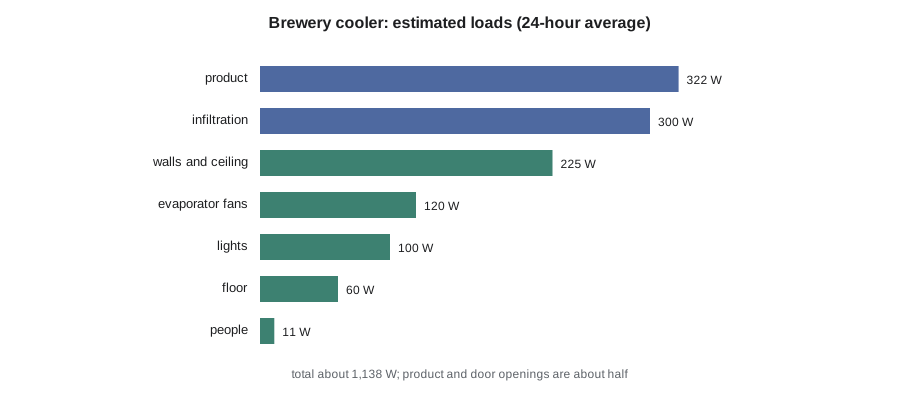
# Walk-in cooler load estimate (approximate values, W averaged over 24 h)
loads = {
    "walls and ceiling": 48.4 * 20 / 4.3,
    "floor": 12 * 10 / 2.0,
    "infiltration": 300,
    "product": 1160 * 4.0 * 6 / 86400 * 1000,
    "lights": 100,
    "evaporator fans": 2 * 60,
    "people": 270 * 1 / 24,
}
total = sum(loads.values())
for name, w in sorted(loads.items(), key=lambda kv: -kv[1]):
    print(f"{name:18s} {w:6.0f} W  {100 * w / total:4.1f} %")
for run_hours in [16, 18, 20]:
    need = total * 24 / run_hours * 1.10
print(f"run {run_hours} h/day: required {need / 1000:4.2f} kW = {need * 3.412:6.0f} Btu/h")product 322 W 28.3 % infiltration 300 W 26.3 % walls and ceiling 225 W 19.8 % evaporator fans 120 W 10.5 % lights 100 W 8.8 % floor 60 W 5.3 % people 11 W 1.0 % run 16 h/day: required 1.88 kW = 6410 Btu/h run 18 h/day: required 1.67 kW = 5698 Btu/h run 20 h/day: required 1.50 kW = 5128 Btu/h
The program sorts the loads and repeats the sizing for longer run times. Product and infiltration are the largest parts, which is typical of a busy walk-in: the box's walls are a small share. That is why a technician asked to fix a struggling cooler looks first at what goes in and how often the door opens, not only at the refrigeration system.
Air conditioning loads
Air conditioning loads are calculated in a similar way, with a few differences. Heat enters a building through walls, roofs and windows by conduction, through windows by solar radiation, which is often the largest part, and with outside air that leaks in or is brought in for ventilation. Inside, people, lighting and equipment add heat. The load also has two parts: the sensible load, which raises the air temperature, and the latent load, which is moisture from people, cooking, showers and humid outside air. An air conditioner must handle both, as Lesson 12 explains. Residential loads are calculated room by room with a recognized method, and equipment is chosen to match: an oversized air conditioner cools the air quickly, shuts off before it has removed much moisture, and leaves the house cold and clammy.
Performance: COP
Capacity says how much heat a system moves. Performance says how much electricity it uses to do it. The basic measure is the coefficient of performance, COP: the heat moved divided by the power used, both in the same units. For cooling, it is the heat removed; for a heat pump in heating, it is the heat delivered.
Because a heat pump delivers the heat it absorbs plus the compressor's work, its heating COP for a given cycle is one higher than its cooling COP for the same cycle. A heat pump with a heating COP of 3 delivers three units of heat for each unit of electricity, where an electric baseboard heater delivers exactly one. As outdoor temperatures fall, the heat pump has to lift heat across a larger temperature difference and its COP falls, but cold-climate heat pumps keep a COP well above 1 far below freezing.
Theory sets a ceiling on COP. The ideal Carnot COP depends only on the absolute temperatures the heat is moved between, and no real machine can beat it. The closer the evaporating and condensing temperatures, the higher the ceiling, which is the deepest reason why clean coils, good airflow and correctly set temperatures save energy.
Worked problem
How close is the glycol chiller to the ideal?
The glycol chiller evaporates at −10 °C (14 °F) and condenses at 40 °C (104 °F). Lesson 9 gave a real cycle COP of 3.03. What is the Carnot COP, and how does the real cycle compare?
Show solution
- \[T_{\text{cold}} = 263.15\ \text{K}, \quad T_{\text{hot}} = 313.15\ \text{K}\]
- \[\text{COP}_{\text{Carnot}} = \frac{263.15}{313.15 - 263.15} = \frac{263.15}{50} \approx 5.26\]
- \[\frac{3.03}{5.26} \approx 0.58\]
Answer: The ideal limit is about 5.3, and the real refrigerant cycle reaches about 58 per cent of it. The losses come from the throttling at the metering device, the superheated discharge vapour and the compressor's own inefficiency. The whole unit, with its fans and pump, does a little worse again.
Performance ratings: EER, SEER and others
Equipment in North America is usually rated with measures that mix units. The energy efficiency ratio, EER, is the cooling capacity in Btu per hour divided by the electrical power in watts at one set of rating conditions. Because one watt is 3.412 Btu per hour, EER is simply 3.412 times the COP. Chillers are often rated in kilowatts of electrical input per ton of cooling, where lower is better. Seasonal ratings average performance over a typical cooling or heating season: the seasonal energy efficiency ratio for air conditioners, now tested under updated rules and written SEER2, and the heating seasonal performance factor, HSPF2, for heat pumps. Minimum ratings for new equipment are set by regulation.
| Measure | Definition | Typical use | Better is |
|---|---|---|---|
| COP | Heat moved ÷ power, same units | Any system; heat pumps in heating | Higher |
| EER | Btu/h of cooling ÷ watts, at rating conditions | Air conditioners, refrigeration units | Higher |
| SEER2 | Seasonal cooling Btu ÷ watt-hours, updated test rules | Residential air conditioners and heat pumps | Higher |
| HSPF2 | Seasonal heating Btu ÷ watt-hours, updated test rules | Heat pumps in heating | Higher |
| kW per ton | Electrical kW ÷ tons of cooling | Chillers | Lower |
Worked problem
Rating the ductless heat pump
The ductless heat pump removes 3.42 kW (11,700 Btu/h) of heat in cooling while drawing 0.90 kW (900 W) at its rating conditions. What are its COP, EER and kW per ton?
Show solution
- \[\text{COP} = \frac{3.42}{0.90} = 3.8\]
- \[\text{EER} = 3.412 \times 3.8 \approx 13.0 \quad \Big(\frac{11\,670\ \text{Btu/h}}{900\ \text{W}}\Big)\]
- \[\frac{\text{kW}}{\text{ton}} = \frac{0.90}{3.42 / 3.517} \approx 0.93\]
Answer: A COP of 3.8, an EER of 13 and about 0.9 kW per ton. Its seasonal ratings are higher, because a variable-speed system spends most of the season at part load and mild outdoor temperatures, where it runs more efficiently.
Ratings describe equipment tested in a laboratory under standard conditions. Installed systems fall short when airflow is low, coils are dirty, the charge is wrong or ducts leak. Field studies have found that installation and maintenance problems can cost a large share of rated efficiency, which is why the measurement skills in this course matter to customers' bills as well as to comfort.
Common mistakes
MistakeConfusing a ton of refrigeration with the weight of equipment or a metric tonne.
InsteadA ton of refrigeration is 12,000 Btu/h, about 3.517 kW.
MistakeSizing a walk-in system for 24-hour running.
InsteadDivide the daily load by the design run time, often about 16 hours for a cooler, to allow for defrost and cycling.
MistakeIgnoring infiltration and product loads.
InsteadIn busy boxes they often outweigh the walls.
MistakeComparing a SEER2 rating directly with a COP measured at one condition.
InsteadSeasonal ratings average many conditions; compare like with like.
Summary and key terms
- Capacity is the rate of heat removal, in kW, Btu/h or tons; one ton is 12,000 Btu/h, about 3.517 kW.
- Refrigeration loads include transmission, infiltration, product and internal loads, totalled over 24 hours.
- Required capacity is the daily load divided by run time, plus a safety factor.
- COP is heat moved per unit of power; a heat pump's heating COP exceeds its cooling COP for the same cycle.
- The Carnot COP sets an upper limit that depends on the absolute evaporating and condensing temperatures.
- EER = 3.412 × COP; kW per ton = 12 ÷ EER; seasonal ratings (SEER2, HSPF2) average a whole season.
- Ton of refrigeration
- 12,000 Btu/h, the cooling effect of melting 2,000 lb of ice in 24 hours; about 3.517 kW.
- Refrigeration load
- All the heat that must be removed to hold a space or product at its design temperature.
- Infiltration load
- Heat and moisture brought in with outside air, mainly through door openings.
- Product load
- Heat removed from goods brought in warmer than the space.
- Run time
- The hours per day a refrigeration system is designed to run to carry the daily load.
- COP
- Coefficient of performance: heat moved divided by power used, in the same units.
- EER
- Energy efficiency ratio: Btu/h of cooling per watt of electrical input.
- SEER2
- Seasonal energy efficiency ratio under the updated test procedure.
Practice problems
Work each problem on paper first, then reveal the answer to check.
Convert 10.5 kW (36,000 Btu/h) to tons.
Show answer
10.5 × 3,412 / 12,000 ≈ 2.99 tons, about 3 tons.
A walk-in has a daily load of 40 kWh (136,500 Btu). What capacity does it need for 16 hours of running and a 10 per cent safety factor?
Show answer
40 / 16 × 1.1 = 2.75 kW.
An air conditioner has an EER of 11. What is its COP and its kW per ton?
Show answer
COP = 11 / 3.412 ≈ 3.2; kW per ton = 12 / 11 ≈ 1.09.
A heat pump cycle has a cooling COP of 3.0. What heating COP would the same cycle give?
Show answer
About 4.0, because the heat delivered includes the compressor's work.
Lesson quiz · 5 questions
Score 60% or more to complete this lesson.
Create a free account to save your progress, take quizzes and earn a certificate.