
RAC-110 · Lesson 10 of 12 · 23 min
Compressors, condensers, evaporators and metering devices
Northfield's shop keeps a shelf of failed parts, and Dana uses it as a classroom. On a slow Friday she set out four of them in a row on the bench: a cut-open hermetic compressor from a walk-in, a section of condenser coil with bent fins, an evaporator from a reach-in cooler and a thermostatic expansion valve with its sensing bulb still attached. "These are the four parts every system has," she said. "Each one comes in a dozen designs. You will spend years learning them all. Today you just need to know what each one does, what kinds there are and how each fits the cycle."
This lesson introduces the four main components and the accessories around them. RAC-210 covers compressors, condensers and evaporators in depth, and RAC-220 covers metering devices.
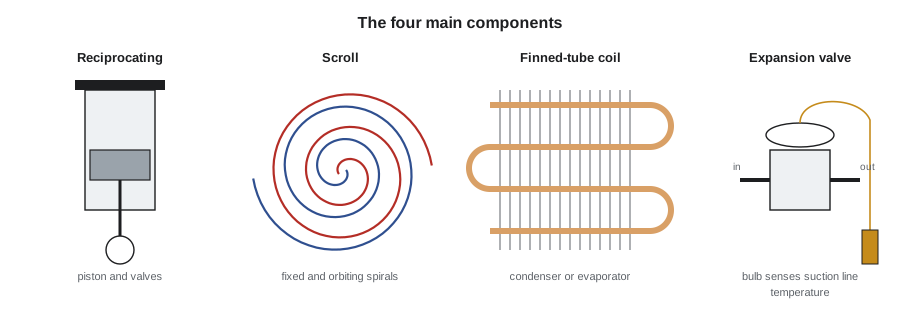
Compressors: the pump of the system
The compressor draws vapour from the evaporator and raises it to condensing pressure. Its capacity depends on how much vapour it can move, its displacement, and on how dense that vapour is. Compressors are grouped in two ways: by how they compress the vapour, and by how the motor is housed.
| Type | How it compresses | Where it is used |
|---|---|---|
| Reciprocating | Pistons move up and down in cylinders, with suction and discharge valves | Commercial refrigeration, older air conditioners, many semi-hermetic units |
| Scroll | One spiral orbits inside a fixed spiral, trapping pockets of vapour and squeezing them toward the centre | Most residential and light commercial air conditioners and heat pumps, many refrigeration units |
| Rotary (rolling piston) | An eccentric roller turns inside a cylinder, with a sliding vane separating suction from discharge | Ductless systems, window units, small refrigerators |
| Screw | Two meshing helical rotors trap and compress vapour along their length | Large commercial and industrial systems, chillers |
| Centrifugal | A high-speed impeller flings vapour outward, converting speed into pressure | Large chillers in big buildings |
By housing, a hermetic compressor has its motor and compressor sealed together in a welded steel shell. It cannot be opened for repair, and the motor is cooled by suction vapour. Most small systems use hermetic compressors. A semi-hermetic compressor has a bolted shell that can be opened to repair valves, pistons or the motor; it is common in commercial refrigeration. An open compressor has its motor outside, driving the compressor through a shaft seal; it is used mainly in large industrial ammonia systems, where the refrigerant would attack copper motor windings.
Many modern compressors run at variable speed, driven by an inverter that changes the motor's frequency. Instead of cycling on and off at full capacity, the compressor slows down to match the load. That saves energy, holds temperature more steadily and handles humidity better in air conditioning. Most ductless heat pumps and many new central systems use variable-speed compressors.
A compressor's capacity falls as the evaporating temperature falls, because the suction vapour gets thinner. The compressor's displacement, the volume it sweeps each revolution, stays the same, but each litre of vapour contains less refrigerant. A volumetric efficiency, below 1, accounts for vapour that re-expands from the clearance space and for leakage; it also falls as the compression ratio rises.
Worked problem
Why a freezer needs a bigger compressor
The glycol chiller's scroll compressor displaces 92 cm³ per revolution at 3,500 rpm. At −10 °C evaporating, the suction vapour density is about 9.8 kg/m³, the volumetric efficiency is about 0.90 and the refrigerating effect is 148 kJ/kg. At −20 °C, the density is about 6.6 kg/m³, the volumetric efficiency about 0.85 and the effect about 141.5 kJ/kg. What is the capacity at each condition?
Show solution
- \[V = 92 \times 10^{-6}\ \text{m}^3 \times \frac{3500}{60} \approx 0.00537\ \text{m}^3\text{/s}\]
- \[\dot{Q}_{-10} = 0.00537 \times 0.90 \times 9.8 \times 148 \approx 7.0\ \text{kW}\]
- \[\dot{Q}_{-20} = 0.00537 \times 0.85 \times 6.6 \times 141.5 \approx 4.3\ \text{kW}\]
Answer: The same compressor loses about 40 per cent of its capacity when the evaporating temperature drops by 10 K (18 °F). A freezer that needs the same capacity as a cooler needs a much larger compressor, and a system whose evaporator ices up or loses airflow loses capacity in the same way.
# Compressor capacity against evaporating temperature (approximate R-134a data)
displacement = 92e-6        # m3 per revolution
rpm = 3500
conditions = [  # evaporating C, suction density kg/m3, volumetric efficiency, refrigerating effect kJ/kg
    (0, 13.9, 0.92, 153.0),
    (-10, 9.8, 0.90, 148.0),
    (-20, 6.6, 0.85, 141.5),
    (-30, 4.3, 0.78, 135.0),
]
swept = displacement * rpm / 60          # m3/s
for t, rho, eta, re in conditions:
    m = swept * eta * rho                 # kg/s
print(f"evaporating {t:4d} C: {m * 3600:5.0f} kg/h, capacity {m * re:4.1f} kW")evaporating 0 C: 247 kg/h, capacity 10.5 kW evaporating -10 C: 170 kg/h, capacity 7.0 kW evaporating -20 C: 108 kg/h, capacity 4.3 kW evaporating -30 C: 65 kg/h, capacity 2.4 kW
The program extends the example across four evaporating temperatures. Capacity falls steadily as the evaporator gets colder, from the thinning vapour, the falling volumetric efficiency and the shrinking refrigerating effect all at once. Compressor manufacturers publish this as a table or set of curves of capacity and power against evaporating and condensing temperature, and technicians use those curves to check whether a compressor is pumping properly.
Condensers: getting rid of the heat
The condenser rejects the heat absorbed in the evaporator plus the heat of compression. Inside, the refrigerant passes through three zones: desuperheating, where the hot discharge vapour cools to its condensing temperature; condensing, the largest part, where it turns to liquid at constant temperature; and subcooling, near the outlet, where the liquid cools below saturation. Condensers are grouped by what carries the heat away.
- Air-cooled condensers use fans to blow outdoor air across finned tubes or flat microchannel tubes. They are simple and need no water, and they are used on almost all residential and light commercial systems. Their weak point is the air side: dirt, debris, bent fins, blocked clearances and recirculating hot air all raise the condensing temperature.
- Water-cooled condensers pass refrigerant and water through a shell-and-tube, tube-in-tube (coaxial) or brazed plate heat exchanger. Water carries heat far better than air, so they run at lower condensing temperatures, but they need a water supply, usually a cooling tower that rejects the heat to the air by evaporation, and water treatment to prevent scale and biological growth.
- Evaporative condensers spray water over a coil while fans blow air through, combining the two. They are common in industrial ammonia plants.
An air-cooled condenser is usually designed to condense at about 8 to 17 K above the outdoor air temperature, depending on its size and efficiency. The airflow it needs comes straight from the sensible heat equation for air: the heat rejected divided by the air density, its specific heat and the air's temperature rise across the coil.
Worked problem
Airflow across the glycol chiller's condenser
The chiller removes 7.0 kW (24,000 Btu/h) with a cycle COP of about 3.0. The condenser air warms by 10 K (18 °F) as it crosses the coil. How much heat does the condenser reject, and how much air must its fan move?
Show solution
- \[\dot{Q}_{\text{rej}} = 7.0 \times \Big(1 + \frac{1}{3.0}\Big) \approx 9.3\ \text{kW}\]
- \[\dot{V} = \frac{9.3}{1.2 \times 1.006 \times 10} \approx 0.77\ \text{m}^3\text{/s} = 770\ \text{L/s}\]
Answer: The condenser rejects about 9.3 kW (32,000 Btu/h), a third more than the cooling capacity, and its fan must move about 770 L/s (1,630 cfm) (1,650 cfm) of outdoor air. If the coil is half blocked, the airflow falls, the air leaving the coil gets hotter, and the condensing temperature climbs to compensate.
Evaporators: absorbing the heat
The evaporator is where the useful work happens. Most evaporators in air conditioning and commercial refrigeration are finned-tube coils with fans, called forced-air or forced-convection evaporators: unit coolers in walk-ins, cooling coils in air handlers and furnaces, indoor units of ductless systems. Liquid chillers use plate heat exchangers or shell-and-tube evaporators to cool water or glycol. Some older or simple equipment uses plate or bare-tube evaporators cooled by natural convection, such as the shelves of an old chest freezer.
Evaporators are also classified by how they are fed. In a dry-expansion, or direct-expansion, evaporator, the metering device feeds just enough liquid that it all boils off before the outlet, leaving the vapour superheated; this is by far the most common. In a flooded evaporator, the evaporator is kept full of boiling liquid by a float or level control, and vapour is drawn off the top; flooded evaporators transfer heat very well and are used in large chillers and industrial systems.
An evaporator's capacity depends on its temperature difference, TD: the difference between the air or fluid entering it and the refrigerant's saturation temperature. Walk-in coolers often run with a TD of about 5 to 8 K, which keeps the coil from drying out the stored product. A larger TD gives more capacity from the same coil but removes more moisture, which dries out produce and meat, and it lowers the suction pressure, which costs efficiency. When an evaporator runs below 0 °C, frost builds up on the fins and must be melted off regularly by a defrost cycle.
Metering devices: controlling the flow
The metering device drops the pressure and controls how much refrigerant reaches the evaporator. There are two broad kinds: fixed restrictions, which cannot adjust, and valves, which can.
- Capillary tubes are long, very small-bore copper tubes. The length and bore set the flow. They are cheap, reliable and have no moving parts, and they are used in household refrigerators, window units and small commercial equipment. They need a precise charge, because they cannot adjust to changes in load.
- Fixed orifices, or pistons, are short restrictions with a calibrated hole, used in many older residential air conditioners and heat pumps. Like capillary tubes, they are charged by superheat, using the manufacturer's chart for the indoor and outdoor conditions.
- Thermostatic expansion valves (TXVs) adjust their opening to hold a steady superheat at the evaporator outlet. A sensing bulb clamped to the suction line contains a charge that turns its temperature into a pressure; that pressure pushes on a diaphragm to open the valve, while evaporator pressure and an adjustable spring push to close it. When superheat rises, the bulb warms, the valve opens and feeds more refrigerant; when superheat falls, it closes. Large evaporators, or ones with a pressure drop, use an external equalizer line to sense the outlet pressure.
- Electronic expansion valves (EEVs) are driven by a stepper motor under the control of a circuit board that reads pressure and temperature sensors. They hold superheat more precisely across a wide range of loads and are standard in variable-speed systems.
- Float valves and automatic expansion valves are used in particular applications: floats in flooded evaporators, and constant-pressure automatic valves in a few small systems.
Dana's failed expansion valve had lost the charge in its sensing bulb through a crack in the capillary. With no bulb pressure pushing it open, the spring closed it, the evaporator was starved, superheat was very high and the reach-in cooler warmed up. That is one of the faults the superheat measurement in Lesson 7 is designed to catch.
Accessories in the refrigerant circuit
Around the four main components, most systems have several accessories, and technicians need to recognize them.
| Accessory | Where it is | What it does |
|---|---|---|
| Filter drier | Liquid line, before the metering device | Traps moisture, acid and debris; replaced whenever the system is opened |
| Sight glass with moisture indicator | Liquid line | Shows whether the liquid is solid or bubbling, and whether moisture is present |
| Receiver | After the condenser in systems with expansion valves | Stores liquid refrigerant so the charge can vary with load and season |
| Accumulator | Suction line, before the compressor | Catches liquid that would otherwise reach the compressor, common on heat pumps |
| Service valves and access ports | Suction, liquid and discharge lines | Let technicians connect gauges, isolate parts and recover refrigerant |
| Pressure controls | On high and low sides | Shut the compressor off at unsafe high pressure or control it on low pressure |
| Solenoid valve | Liquid line | Opens and closes electrically to stop refrigerant flow, for pump-down and zoning |
| Crankcase heater | On the compressor shell | Keeps oil warm so refrigerant does not condense in it during the off cycle |
The filter drier deserves a special mention. Moisture and acid are the main chemical enemies of a refrigeration system, and the drier is the system's defence. Whenever a system is opened for repair, the drier is replaced, because it may already be saturated and because it is open to the air during the work. A drier with a large temperature drop across it is restricted, which shows up as high subcooling and high superheat, the restriction pattern from Lesson 7.
Matching the components
The four components must be matched. The compressor's pumping capacity must equal the evaporator's ability to boil refrigerant at the design temperature, the condenser must reject the total heat at an acceptable condensing temperature, and the metering device must pass the right flow at the pressures that result. When the parts are balanced, the system settles at a steady evaporating and condensing temperature where all four agree. When a part is undersized or fails, the balance point moves. A dirty condenser raises the condensing temperature until the condenser can again reject the heat; an iced evaporator lowers the evaporating temperature until the compressor's lower capacity matches the coil's reduced output. A technician who understands this balance can read the gauges and see which part has moved it.
Common mistakes
MistakeThinking a scroll compressor can be repaired in the field like a semi-hermetic one.
InsteadHermetic compressors, including most scrolls, are welded shut and replaced as a unit.
MistakeExpecting a compressor to deliver its rated capacity at any evaporating temperature.
InsteadCapacity falls as the evaporating temperature falls, because the suction vapour gets thinner.
MistakeReusing the old filter drier after opening a system.
InsteadReplace the drier whenever the system is opened.
MistakeAdjusting an expansion valve before checking airflow and charge.
InsteadMost superheat problems come from load, airflow or charge; adjust the valve last, and only with good reason.
Summary and key terms
- Compressors are reciprocating, scroll, rotary, screw or centrifugal, and hermetic, semi-hermetic or open.
- Compressor capacity is displacement times speed times volumetric efficiency times suction density times refrigerating effect.
- Condensers are air-cooled, water-cooled or evaporative, with desuperheating, condensing and subcooling zones.
- Evaporators are forced-air coils, plate or shell-and-tube exchangers, fed dry-expansion or flooded.
- Metering devices are fixed (capillary, orifice) or adjustable (TXV, EEV); TXVs hold superheat with a sensing bulb.
- Accessories include filter driers, sight glasses, receivers, accumulators, service valves and controls.
- Hermetic compressor
- A compressor and motor sealed in a welded shell, replaced as a unit.
- Semi-hermetic compressor
- A compressor and motor in a bolted, serviceable housing.
- Volumetric efficiency
- The actual vapour volume pumped divided by the swept displacement.
- Temperature difference (TD)
- The difference between the air or fluid entering a coil and the refrigerant saturation temperature.
- Direct expansion
- An evaporator fed so that all liquid boils off before the outlet.
- Thermostatic expansion valve
- A valve that holds evaporator superheat using a sensing bulb, diaphragm and spring.
- Filter drier
- A liquid line filter that removes moisture, acid and debris.
- Accumulator
- A suction line vessel that keeps liquid from reaching the compressor.
Practice problems
Work each problem on paper first, then reveal the answer to check.
Which compressor type is most common in residential central air conditioners?
Show answer
The scroll compressor.
A condenser rejects 12 kW (41,000 Btu/h) with an air temperature rise of 12 K (21 °F). About how much air does it move?
Show answer
12 / (1.2 × 1.006 × 12) ≈ 0.83 m³/s.
What does a TXV's sensing bulb measure, and what does the valve do when superheat rises?
Show answer
The suction line temperature at the evaporator outlet; the valve opens to feed more refrigerant.
Why do heat pumps often have a suction line accumulator?
Show answer
Reversing and defrost cycles can send liquid toward the compressor, and the accumulator catches it.
Lesson quiz · 5 questions
Score 60% or more to complete this lesson.
Create a free account to save your progress, take quizzes and earn a certificate.