
PWR-330 · Lesson 9 of 12 · 28 min
Boiler startup, cycling and shutdown
▶ Video coming soon A video version of this lesson is on the way.
PWR-120 had walked Tamar through a Cantwell boiler's start-up: fill to a third of the glass with the drum vent open, light off at low fire, warm up at no more than about 55 °C (100 °F) an hour, close the vent when steam blows freely, test the safety valves when required, and cut in on the header. Okonkwo had done it a dozen times. The Third Class course asked him to do it for a boiler with a superheater, a reheater, an economizer that could steam, an air heater that could catch fire and a turbine waiting downstream for steam of the right temperature and purity.
Grazyna gave him Keswold's start-up of October 20 to study, the day the gas turbine was lit after the outage and the HRSG was warmed, as recorded in the logs Anselm had sent her. "A cold start is the most dangerous few hours a boiler has," she said, "and the most expensive in fatigue life. Everything is changing at once, and every limit in the procedure is there because something was cracked or burned on somebody's boiler the hard way."
This lesson covers the start-up of large drum boilers: preparation, filling, protecting the superheater and economizer, warm-up limits and how they translate into pressure, and the chemistry hold points before steam goes to a turbine. It then covers the damage that cycling does, the classes of start, normal and emergency shutdown, and layup.
Preparing for a start
A start after an outage begins long before light-off. Every permit is closed and every lock removed under the plant's lockout procedure; manholes, handholes and inspection doors are closed and their gaskets checked; temporary blanks and test plugs are removed; and the safety valves' gags, if any were fitted for a hydrostatic test, are removed and accounted for. The furnace and gas passes are inspected for tools, scaffolding and debris. The water treatment plant and deaerator are in service and the feedwater is within its chemistry limits. Drum level gauges and transmitters are blown down and compared. The burner management system's trip tests that are due before start-up are done and recorded.
The boiler is filled slowly with treated, deaerated feedwater at a temperature close to the boiler metal's, so as not to shock thick drums and headers. The drum is filled only to its start-up level, below the normal operating level, because the water will swell as it heats and begins to boil, and a drum filled to the normal level when cold will rise above its high level trip once steaming begins. Drum vents and superheater vents are open, and superheater and reheater drains are open to remove any condensate that has collected in their tubes since shutdown.
Protecting the superheater and economizer
A superheater has no water in it to keep it cool. In normal operation it is cooled by the steam flowing through it; at light-off there is no steam yet, and the tubes are heated by furnace gas alone. Two measures protect it:
- The superheater drains and start-up vents are left open so that, as soon as steam begins to form, it flows through the superheater and out to atmosphere or to a start-up drain, cooling the tubes. Undrained condensate in pendant superheater loops can block the flow through those loops completely, and they overheat while their neighbours stay cool.
- The furnace exit gas temperature is limited, typically to about 540 °C (1,000 °F) (typical; the boiler maker sets the actual limit), until steam flow through the superheater and reheater is established. A temperature probe, often retractable, is inserted at the furnace outlet during start-up to measure it, and the firing rate is held down to stay within the limit.
Reheaters are protected the same way, and on utility units a turbine bypass system takes steam from the main steam line around the high-pressure turbine, through the reheater and around the low-pressure turbine to the condenser, so that both superheater and reheater have flow before the turbine is rolled. Keswold's HRSG has a steam bypass to the condenser for the same reason, as PWR-320 described.
The economizer has the opposite problem: water but little flow. At start-up, when the drum is being warmed but little feedwater is entering, the water in the economizer can be heated to boiling, forming steam pockets that cause water hammer and uneven heating, and on some designs can flash into the drum when feed flow resumes. An economizer recirculation line from the drum back to the economizer inlet keeps water moving through it until steady feed flow is established, and is closed once it is.
On oil- and coal-fired boilers, the air heater needs attention too. Unburned oil and carbon from a poorly firing start-up can collect on the cold elements of a regenerative air heater and ignite later, causing an air heater fire. Air heaters are sootblown frequently during start-ups, and their gas and air outlet temperatures are watched for the sudden rise that signals a fire.
Warm-up limits and pressure
Thick drums and headers must be warmed slowly because their inside surfaces heat faster than their outside surfaces and faster than their other parts. Two limits are common:
- A limit on the rate of rise of the saturation temperature, typically about 55 °C (100 °F) per hour for drum boilers (typical).
- A limit on the temperature difference between the top and bottom of the drum, or between the inside and outside of a thick header, typically about 50 °C (90 °F) (typical). At light-off, the steam forming in the top of the drum condenses on the drum's cold upper shell and heats it quickly, while the water in the bottom heats more slowly, so the top runs hotter than the bottom until circulation is well established.
The temperature difference produces thermal stress. If a part of the shell were fully restrained, the stress would be about EαΔT, as PWR-310 lesson 3 showed.
Worked problem
Why the top-to-bottom limit matters
Estimate the thermal stress in a carbon steel drum shell for a temperature difference of 50 K between top and bottom, taking full restraint as an upper bound. Use E = 200 GPa and α = 12 × 10⁻⁶ per K.
Show solution
- \[\sigma = E \alpha \Delta T = 200{,}000 \times 12 \times 10^{-6} \times 50 = 120 \text{ MPa}\]
Answer: Up to about 120 MPa, of the same order as the drum's allowable stress from pressure, about 138 MPa. The real thermal stress is lower because the shell is not fully restrained, but it adds to the pressure stress, and it is concentrated at nozzles and tube holes. Each start and shutdown applies it once: that is the fatigue cycle that cycling counts.
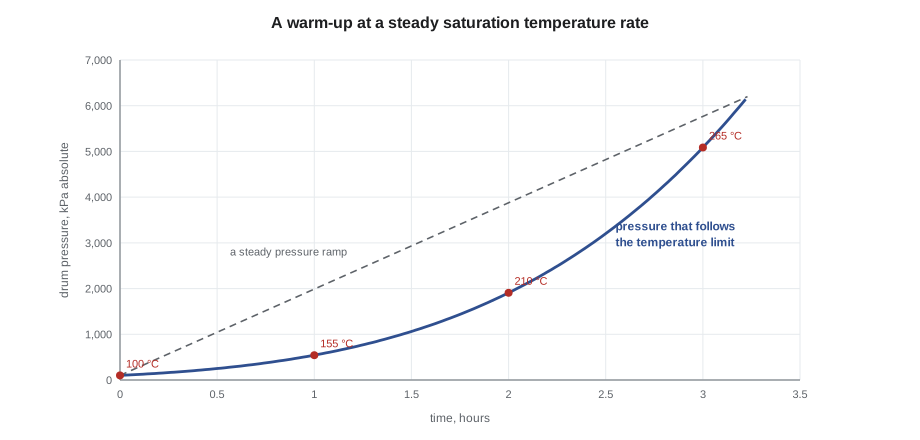
Because the water and steam in the drum are saturated, the saturation temperature limit becomes a pressure schedule. The relationship between saturation temperature and pressure is far from linear: at low pressure, a large temperature rise gives a small pressure rise, and at high pressure the reverse. An operator who raises the pressure at a steady rate will heat the drum far too fast at the beginning.
Worked problem
A pressure schedule for a cold start
A drum boiler operating at 6,200 kPa absolute is warmed from a drum temperature of 100 °C at 55 °C per hour. Using IAPWS-IF97 saturation pressures, find the drum pressure at the end of each hour, and the time to reach operating pressure.
Show solution
- The saturation temperature rises 55 °C each hour, so after n hours it is 100 + 55n °C, and IAPWS-IF97 gives the matching pressure:
- \[T_1 = 155 \text{ °C} \rightarrow 543 \text{ kPa}, \quad T_2 = 210 \text{ °C} \rightarrow 1{,}907 \text{ kPa}, \quad T_3 = 265 \text{ °C} \rightarrow 5{,}085 \text{ kPa}\]
- Time to reach 277.7 °C, the saturation temperature at 6,200 kPa:
- \[t = \frac{277.7 - 100}{55} = 3.2 \text{ h}\]
Answer: About 3.2 hours. In the first hour the pressure rises by only about 440 kPa; in the third it rises by more than 3,100 kPa. Start-up curves are therefore drawn in temperature, or in pressure against time as a curve, and the operator follows the curve, not a steady pressure ramp. The first hours of warm-up feel slow and the last hour feels fast, and both are correct.
The drum vents are closed once steam is blowing freely from them and the air has been expelled, usually at a pressure of the order of 150 to 200 kPa (25 to 30 psi) (typical); the superheater start-up vents or drains stay open, or are throttled, until the steam flow is established elsewhere. Drum level control usually starts on single-element control at low load, because the steam flow measurement is too small to be useful, and is transferred to three-element control once the steam flow is high enough, as PWR-220 lesson 5 described.
Chemistry hold points
On a boiler that supplies a turbine, steam is not admitted to the turbine until its purity is within the start-up limits. During a start, the iron oxide and silica that collected in the system during the outage are released, and the first steam is often far outside the normal limits. Plants set hold points: the boiler is held at a given pressure or the steam is sent to the bypass or atmosphere, while the blowdown is opened wide and the chemistry is brought in, until cation conductivity, sodium and silica in the steam are within their start-up values. Iron is measured too, often by filtering a known volume of sample, because the oxides stripped from the system can erode the turbine's first stages and settle in its control valves.
Keswold's log for October 20 showed the HRSG held at about 4,000 kPa for almost two hours on its steam purity hold, with the continuous blowdown wide open and an extra intermittent blowdown, until the steam silica came down to the start-up limit. Only then was the steam turbine rolled, the next day, as PWR-320 described.
Classes of start
Starts are classified by how cool the boiler and turbine have become since they were shut down, because that sets how much warming they need. A typical scheme is:
- Hot start: after a shutdown of less than about 8 to 12 hours, with drums and headers still near operating temperature (typical).
- Warm start: after about 12 to 72 hours (typical).
- Cold start: after a longer shutdown, with metal near ambient temperature.
Each class has its own start-up curve and time. A hot start may take an hour; a cold start of a large unit may take eight hours or more, most of it in controlled warming. The temperatures actually measured, not the hours, decide which curve to follow.
The cost of cycling
Boilers and HRSGs that were designed for steady operation are now often started and stopped daily or weekly, as power markets and renewable generation make steady running less valuable. Cycling consumes the life of the thick parts much faster than steady running. The main damage mechanisms are:
- Thermal fatigue: each start and shutdown is a stress cycle, and after enough cycles cracks start at the highest stress points, such as tube hole ligaments in drums and headers, nozzle corners and attachment welds.
- Creep-fatigue interaction in superheater and reheater outlet headers, which run hot enough to creep, so that the cycles and the creep damage combine.
- Corrosion fatigue in water-touched tubes, where cyclic stress and a corrosive environment together crack the tubes, often at attachments and supports.
- Oxide exfoliation: the oxide layer inside superheater and reheater tubes grows during operation and spalls off on cooling, blocking bends and eroding turbine stages on the next start.
- Oxygen ingress during shutdowns, and the corrosion and corrosion product release it causes, unless the boiler is properly laid up.
Fatigue damage from different kinds of cycles is commonly added by Miner's rule: each kind of cycle uses up a fraction of the life equal to the number of cycles divided by the number the part could withstand of that kind alone.
Worked problem
Fatigue life consumed by starts
An HRSG's maker estimates that its high-pressure drum can withstand 2,000 cold starts, 10,000 warm starts or 50,000 hot starts, each alone. In a year the unit makes 10 cold, 50 warm and 250 hot starts. What fraction of the drum's fatigue life is used each year, and how many years would the life last at that rate?
Show solution
- \[D = \frac{10}{2{,}000} + \frac{50}{10{,}000} + \frac{250}{50{,}000} = 0.005 + 0.005 + 0.005 = 0.015\]
- \[\text{life} = \frac{1}{0.015} = 67 \text{ years}\]
Answer: About 1.5 in 100 of the life a year, or 67 years: comfortable. But the same drum making 250 cold starts a year would use 0.125 a year and last eight. That is why plants that cycle heavily invest in faster, gentler warming, keep units warm between runs, and track their starts by class. The numbers in such estimates are the maker's; the method is what the examinations ask about.
Shutdown
A normal shutdown reverses the start-up. Load is reduced gradually, burners are removed from service in sequence, the steam is taken off the header or the turbine is unloaded and tripped, and the last burners are shut off through the burner management system with a post-purge. Drum level is kept normal through the shrink that occurs as firing stops. The boiler then cools at a controlled rate, usually the same rate limit as for warming, by natural cooling with the dampers closed to hold heat in, and sometimes with the fans run at low speed once the maker's limits allow. Forced cooling with the fans at high speed, to get an inspection crew in sooner, is allowed only within the maker's limits, because it chills the tube surfaces and drums much faster than their thick parts.
Drum vents are opened as the pressure approaches atmospheric, before the boiler can draw a vacuum as the steam condenses. Drains are opened when the boiler is to be emptied, which may be done while it is still warm so that the heat dries the metal for dry layup.
An emergency shutdown, by master fuel trip, stops all fuel at once. What follows depends on the cause. After a trip for low drum level, feedwater is *not* added to the hot boiler until the cause is understood and the tubes are known not to have overheated, as lesson 10 explains. After a trip for other causes, the drum level is restored normally, the furnace is post-purged, and the boiler is either restarted, following its hot start procedure, or cooled.
Layup
A boiler out of service for more than a few days must be protected from corrosion, because oxygen and moisture together attack steel quickly. PWR-220 lesson 12 described what happened to Cantwell's boiler 3 after its summer wet layup: oxygen pitting, because the sulphite residual was not tested after June and the drum was opened twice. The revised layup procedure, going to the November operations meeting, applies the general rules:
- Wet layup: the boiler is filled completely, to exclude air, with treated water at an elevated pH and with a higher than normal oxygen scavenger residual, and kept under a slight positive pressure of nitrogen in the drum (a nitrogen cap) or with a head tank. The water is circulated and tested regularly, and the scavenger and pH restored when they fall. Wet layup suits a boiler that may be needed at short notice.
- Dry layup: the boiler is drained, preferably while warm, and kept dry, either by circulating dehumidified air, holding the relative humidity below about 30 to 40 in 100 (typical), or by filling it with nitrogen. Dry layup suits longer outages and boilers with superheaters that cannot be drained, where wet layup would leave stagnant water in the loops.
Superheaters, reheaters and turbines need their own layup, usually dry, with dehumidified air or nitrogen, because condensate standing in their tubes and casings is an excellent place for pitting to start. Whatever the method, the layup is recorded, tested on a schedule, and checked before the boiler returns to service.
Okonkwo drew the warm-up curve for Keswold's HRSG from the October 20 log, with the hold point marked, and set it beside his memory of a Cantwell start. The shape was the same. The difference was the number of things that had to be right at the same time.
Common mistakes
MistakeFilling a drum to its normal level before a cold start.
InsteadFill only to the start-up level; the water swells as it heats and boils.
MistakeRaising drum pressure at a steady rate.
InsteadFollow the saturation temperature curve; at low pressure a steady pressure rate heats the drum far too fast.
MistakeClosing superheater drains and vents at light-off.
InsteadThey provide the flow that cools the superheater until normal steam flow is established.
MistakeRolling a turbine as soon as steam reaches its temperature.
InsteadWait for the chemistry hold point; the first steam after an outage carries silica, sodium and oxides.
MistakeForcing a boiler to cool quickly so the crew can start sooner.
InsteadCooling too fast stresses thick parts just as warming does; stay within the maker's cooling limits.
Summary and key terms
- Before a start, permits are closed, the boiler is inspected and filled slowly with treated water to its start-up level, with vents and drains open.
- Superheaters are protected by open drains and vents and a furnace exit gas temperature limit; economizers by recirculation.
- Warm-up is limited by the saturation temperature rate and the drum's top-to-bottom difference; the pressure schedule is a steep curve.
- Chemistry hold points keep impure start-up steam out of the turbine.
- Cycling damages thick parts by thermal fatigue, creep-fatigue, corrosion fatigue and oxide exfoliation; Miner's rule adds the damage.
- Shutdowns cool at controlled rates; layup is wet with scavenger and a nitrogen cap, or dry with dehumidified air or nitrogen.
- Start-up level
- The drum water level set before a start, below normal level to allow for swell.
- Furnace exit gas temperature
- The gas temperature leaving the furnace, limited during start-up to protect unflowed superheaters and reheaters.
- Economizer recirculation
- A line returning water from the drum to the economizer inlet to keep water moving through it during start-up.
- Turbine bypass
- A system that passes steam around the turbine to the condenser so that the boiler can start before the turbine.
- Hold point
- A step in a start-up at which the process waits until a condition, such as steam purity, is met.
- Thermal fatigue
- Cracking caused by repeated thermal stress cycles.
- Miner's rule
- The rule that fatigue damage from different cycles adds as the sum of cycles used divided by cycles allowed.
- Nitrogen cap
- A slight positive pressure of nitrogen held over the water in a boiler on wet layup.
Practice problems
Work each problem on paper first, then reveal the answer to check.
A drum warms from 20 °C to 250 °C at 50 °C per hour. How long does it take?
Show answer
230 ÷ 50 = 4.6 h.
Find the full-restraint thermal stress for a 40 K difference with E = 200 GPa and α = 12 × 10⁻⁶ per K.
Show answer
200,000 × 12 × 10⁻⁶ × 40 = 96 MPa.
A header can withstand 5,000 cold starts or 40,000 hot starts. In a year it makes 20 cold and 200 hot starts. What fraction of its life is used?
Show answer
20 ÷ 5,000 + 200 ÷ 40,000 = 0.004 + 0.005 = 0.009.
Why is the superheater warmed with its drains open?
Show answer
So that steam flows through it and cools the tubes, and condensate is cleared from the loops.
Lesson quiz · 5 questions
Score 60% or more to complete this lesson.
Create a free account to save your progress, take quizzes and earn a certificate.