
PRIN-150 · Lesson 8 of 12 · 25 min
Practitioner scenario analysis
The Practitioner exam is different from the Foundation exam in one important way. Foundation asks whether you know what PRINCE2 says. Practitioner asks whether you can apply it: given a scenario, which action, role, product or tailoring choice is appropriate, and why. That calls for a method of reading scenarios and questions, not just knowledge of the manual. This lesson builds that method; lessons 9 to 11 apply it to the principles, practices and processes, and PRIN-160 covers full mock exams and timing in depth.
The exam in brief
Study guides describe the PRINCE2 7 Practitioner exam as an open-book exam of 150 minutes with 70 marks and a pass mark of 60 %, or 42 marks. The only permitted reference is the official PRINCE2 7 manual, in print or in the approved digital form. Questions are based on a scenario booklet that describes a project, with additional information for some sections. Question styles include one-mark multiple-choice questions and matching questions, often worth several marks, where items from one list are matched with another. Some questions ask whether a proposed action is appropriate and require you to identify the correct reason. Details of the format can change between versions, so candidates should always check the current guidance from the examination institute before sitting the exam.
| Feature | Practitioner (PRINCE2 7, as described in 2026 study guides) |
|---|---|
| Duration | 150 minutes |
| Marks | 70 |
| Pass mark | 60 % (42 marks) |
| Reference material | Official PRINCE2 7 manual only, printed or approved digital |
| Question basis | A project scenario, with extra information for some questions |
| Question styles | One-mark multiple choice; multi-mark matching; questions on whether actions are appropriate and why |
| Prerequisite | A recognized foundation-level or project management qualification, as set by the examination institute |
At roughly two minutes per mark, the exam is not rushed, but it does not leave time to read the manual cover to cover during the exam either. The open book is for checking, not for learning.
A five-step method for scenario questions
Almost every Practitioner question can be tackled with the same five steps. They take a few seconds each once practised, and they prevent the most common errors.
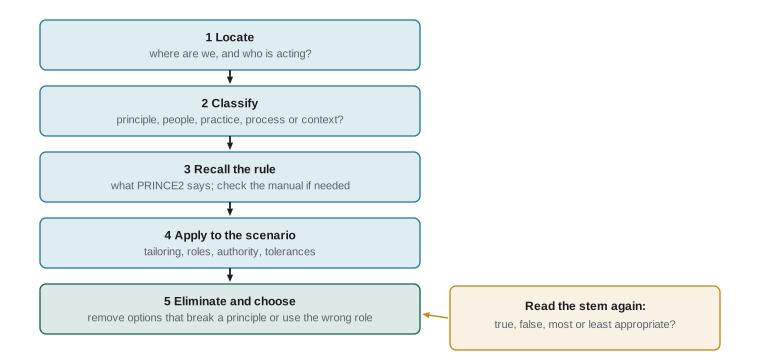
Step 1, locate, means identifying where the project is: which stage, which process is running, who is speaking or acting, and what has just happened. Many wrong answers are good actions at the wrong time, such as producing a lessons report in the middle of a stage or authorizing a work package before the stage is authorized.
Step 2, classify, means deciding what the question is really testing. A question about whether the project manager should accept a change might look like an issues question but actually turn on the project manager's change authority, which is part of organizing and the PID's controls. Classifying tells you where to look in the manual.
Step 3, recall the rule, is where knowledge matters. If you are unsure, the manual is open. The best candidates use it to confirm a specific detail, such as who is responsible for an activity or what a product contains, rather than to search for the topic from scratch.
Step 4, apply to the scenario, is where the scenario's tailoring comes in. If the scenario says the project uses agile delivery with highlight reports every sprint, an option that criticizes the project manager for not producing monthly highlight reports is wrong for this project, even though monthly reports might be normal elsewhere. Roles, authority limits and tolerances in the scenario override general expectations.
Step 5, eliminate and choose, removes options that break a principle, give a decision to the wrong role or level, or use the wrong product. Read the stem again before choosing: questions may ask for the most appropriate action, the least appropriate one, or which statements are true, and misreading the direction of the question is an expensive mistake.
Reading the scenario booklet
The scenario booklet describes the organization, the project's objectives, the people involved and often extracts from management products: part of a business case, a project product description, a risk register or a highlight report. Read it once quickly for the big picture, then return to the relevant section for each question. Useful things to mark on a first read are the delivery approach, any stated tailoring, the board members and their roles, tolerances and authority limits, and anything unusual, such as a regulator, a supplier with its own project manager or a programme above the project.
| Scenario detail | Why it matters for questions |
|---|---|
| Delivery approach (predictive, agile, hybrid) | Changes what counts as an appropriate plan, report or product description |
| Stated tailoring | Overrides the standard method for that project |
| Who holds each role, including combined roles | Tells you who can decide and who must escalate |
| Tolerances and change authority limits | Tells you whether an issue can be handled or must be escalated |
| Current stage and recent events | Tells you which process is running |
| Commercial and programme context | Tells you who the business layer is and how suppliers fit |
A worked scenario: the digital card at stage 2
Here is a short scenario in the style of the exam, based on the digital card project from lesson 7. It is followed by three questions and an analysis using the five steps.
Scenario. Harbour City Libraries' digital card project is in stage 2, which builds the account sign-up and wallet pass in four two-week sprints. The PID states that highlight reports are produced at the end of each sprint as a dashboard, that the product owner (the head of collections and digital services, acting for the senior user) can reprioritize backlog items within the stage's scope tolerance, and that the project manager's change authority is 3 thousand per change. Stage 2 has a cost tolerance of 6 thousand. In sprint 3, the vendor reports that the wallet pass needs an extra security certificate costing 4.5 thousand a year. Separately, branch staff ask for a printable temporary card for patrons whose phones are not compatible.
| Question | Analysis using the five steps | Answer |
|---|---|---|
| Can the project manager approve the 4.5 thousand certificate? | Locate: stage 2, controlling a stage. Classify: change authority. Rule: changes above the PM's authority go to whoever holds it, usually the board. Apply: 4.5 thousand exceeds the 3 thousand limit, though it is within stage tolerance. Eliminate options letting the PM decide. | No. The PM raises it with the board (or the board's delegated change authority), even though it is within stage tolerance |
| Should the printable temporary card be added? | Classify: request for change affecting the project product. Apply: it changes what the project delivers, not just backlog order. Product owner authority covers reprioritizing, not new scope outside tolerance. Rule: capture as an issue and assess. | Capture as a request for change, assess impact, decide at the right level; not simply added by the team |
| The board asks why there was no monthly highlight report. Is the PM at fault? | Apply: the PID tailored highlights to every sprint as a dashboard. Rule: tailoring recorded in the PID governs the project. | No. The PM followed the approved tailoring |
marks = [1] * 40 + [3] * 10              # an illustrative mix: 40 one-mark, 10 three-mark items
total_marks, minutes = sum(marks), 150
read_time, review_buffer = 10, 15
work_time = minutes - read_time - review_buffer
per_mark = work_time / total_marks
print(f"total marks: {total_marks}; working minutes: {work_time}")
print(f"budget: {per_mark:.2f} min per mark -> one-mark item {per_mark:.1f} min, three-mark item {3 * per_mark:.1f} min")
check = [10, 30, 60, 90, 120]
for c in check:
print(f" by minute {c + read_time:>3}: about {c / per_mark:.0f} marks attempted")total marks: 70; working minutes: 125 budget: 1.79 min per mark -> one-mark item 1.8 min, three-mark item 5.4 min by minute 20: about 6 marks attempted by minute 40: about 17 marks attempted by minute 70: about 34 marks attempted by minute 100: about 50 marks attempted by minute 130: about 67 marks attempted
The budget allows about 1.8 minutes per mark after ten minutes of reading and fifteen of review. A useful habit is to check progress at a few fixed times. If at minute 70 you have attempted fewer than about 33 marks, you are falling behind and should stop searching the manual for marginal details.
Using the manual well
Open-book exams reward preparation of the book, not just the candidate. Candidates commonly tab the sections on principles, the people element, each practice and each process, plus the appendix of management products and the glossary. Some write short page references on the tabs for the most-checked tables, such as the responsibilities for each process activity or the composition of each management product. Rules about what may be written in or attached to the manual are set by the examination institute and should be checked in advance. Whatever the rules, the manual is fastest when you already know roughly what you are looking for.
Candidates in Canada can sit the exam online with remote proctoring or through accredited training organizations, and should check the time zone shown in their booking. Employers that fund certification sometimes expect a record of study time for professional development plans.
Worked problem
Most appropriate, not merely acceptable
A question asks: 'The outage alert app's product owner wants to add a new could-have feature in stage 3. It fits within the sprint capacity without displacing must-have or should-have items. What is the MOST appropriate action?' Options: (a) the product owner adds it to the backlog and prioritizes it; (b) the project manager raises an exception report; (c) the board decides at the next stage boundary; (d) the team adds it without telling anyone because it fits.
Show solution
- Locate: stage 3, controlling a stage and managing product delivery, agile delivery.
- Classify: change within a stage, change authority.
- Recall: in the outage alert app, the product owner has delegated change authority for backlog items within scope tolerance.
- Apply: the feature fits without affecting must-haves or should-haves, so it is within tolerance and authority.
- Eliminate: (b) is wrong because no tolerance is threatened; (c) delays a decision that has been delegated; (d) bypasses the product owner's authority and transparency.
Answer: (a) is the most appropriate action. (d) might look efficient, but it breaks the agreed change authority.
Building speed before the exam
Speed in the exam comes from practice with scenarios, not from rereading the manual. A useful routine is to take one scenario from this course each day, write five questions about it in the exam's styles, and answer them a day later without notes, then check the answers against the manual. Writing questions forces you to think like the examiner: what would a plausible but wrong option look like for this situation? Most good distractors are actions that are sensible in general but belong to a different process, a different role or an untailored version of the method. Candidates who can generate such distractors themselves rarely fall for them. Keep a short error log of every question you get wrong, noting which step of the five-step method failed, so that you can see whether your weakness is locating, classifying, recalling or applying.
Common mistakes
MistakeChoosing an answer that is good general management but belongs to a different process or role.
InsteadLocate the process and role first, then choose.
MistakeApplying the standard method when the scenario describes tailoring.
InsteadFollow the scenario's stated tailoring, provided it keeps the principles.
MistakeSearching the manual for every question.
InsteadUse the manual to confirm specific details you already roughly know.
MistakeMisreading 'least appropriate' as 'most appropriate'.
InsteadReread the stem before choosing.
MistakeIgnoring authority limits because the amount is within tolerance.
InsteadCheck both tolerance and authority; either can require escalation.
Summary and key terms
- Practitioner tests application: choosing appropriate actions, roles, products and tailoring for a scenario.
- Study guides describe the exam as 150 minutes, 70 marks, 60 % to pass, with the official manual as the only reference.
- A five-step method helps: locate, classify, recall the rule, apply to the scenario, eliminate and choose.
- The scenario's tailoring, roles, tolerances and authority limits override general expectations.
- Mark the delivery approach, tailoring, roles, tolerances, current stage and commercial context on a first read.
- Use the manual to confirm details, keep to a time budget and reread the question stem.
- Scenario booklet
- The description of a project on which Practitioner questions are based.
- Matching question
- A question in which items from one list are matched with items in another, often for several marks.
- Stem
- The part of a question that states what is asked.
- Distractor
- An incorrect option designed to look plausible.
- Open-book exam
- An exam in which a specified reference may be used.
- Time budget
- A plan for how many minutes to spend per mark or question.
Practice problems
Work each problem on paper first, then reveal the answer to check.
How long is the PRINCE2 7 Practitioner exam, according to 2026 study guides?
Show answer
150 minutes.
What is the pass mark?
Show answer
60 %, or 42 of 70 marks.
What reference may be used?
Show answer
The official PRINCE2 7 manual only.
Name the five steps of the scenario method.
Show answer
Locate, classify, recall the rule, apply to the scenario, eliminate and choose.
Why does the delivery approach matter for questions?
Show answer
It changes what counts as an appropriate plan, report or product description.
Can the PM approve the 4.5 thousand certificate in the worked scenario?
Show answer
No; it exceeds the 3 thousand change authority, even though it is within stage tolerance.
Was the PM wrong not to produce a monthly highlight report?
Show answer
No; the PID tailored highlights to every sprint.
What is the time budget per mark in the example?
Show answer
About 1.8 minutes.
Name three things candidates commonly tab in the manual.
Show answer
Any three of principles, people, each practice, each process, the management products appendix and the glossary.
In the worked example, why is option (d) wrong?
Show answer
It bypasses the product owner's change authority and transparency.
Lesson quiz · 5 questions
Score 60% or more to complete this lesson.
Create a free account to save your progress, take quizzes and earn a certificate.