
PRIN-150 · Lesson 1 of 12 · 26 min
Why PRINCE2 is tailored and what tailoring means
Every course in this program so far has described PRINCE2 at its full size: seven principles, seven practices, seven processes, a project board, stages, tolerances and a set of management products. Real projects rarely use all of that in exactly the form the manual describes. A two-month library makerspace refit does not need the same paperwork as a nine-million-dollar smart metering rollout, and an agile software team does not plan the same way as a crew installing water meters street by street. Tailoring is how PRINCE2 deals with that variety. This course is about doing it well, and about the Practitioner exam, which tests whether you can apply and tailor the method to a scenario rather than recite it.
This first lesson sets out what tailoring is, why the method insists on it, what may be tailored and what may not. Lesson 2 turns that into a repeatable way of making and recording tailoring decisions, and lessons 3 to 7 apply it to small, agile, large, regulated and people-centred contexts. Lessons 8 to 11 move to Practitioner scenarios, and lesson 12 brings everything together in a capstone.
Tailoring is a principle, not an option
PRINCE2 treats tailoring as one of its seven principles: the method is adapted to suit the project's environment, size, complexity, importance, team capability and risk. That has a sharp consequence. A project that applies PRINCE2 mechanically, producing every product in full whether or not anyone reads it, is not applying the method properly, because it is ignoring one of the principles. Equally, a project that drops the parts of PRINCE2 it finds inconvenient is not tailoring; it has simply stopped using the method.
The balance point is purpose. Each practice, process and management product exists to do a job: give the board confidence that the project is still justified, make sure products meet quality expectations, keep risks visible, and so on. Tailoring changes how those jobs are done, how often, by whom and in what format. It does not remove the jobs. A useful test, which the Practitioner exam uses repeatedly, is to ask of any proposed change: does the purpose of this element still get met? If yes, the change is probably legitimate tailoring. If no, something essential has been lost.
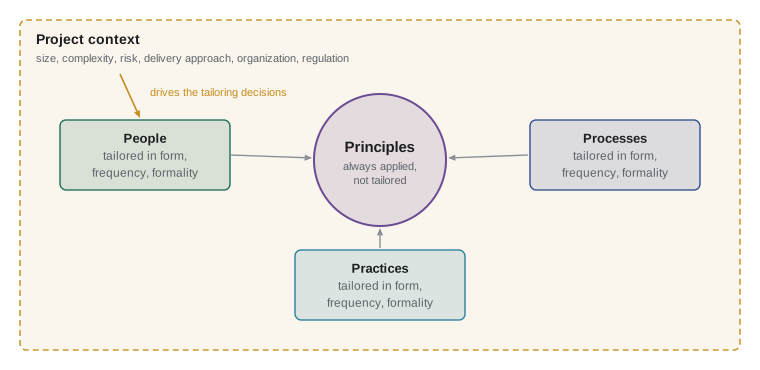
What can be tailored
The manual's guidance on tailoring can be grouped into a few families of adjustment. Each family has a typical use and a typical way of going wrong.
| What is adjusted | Typical tailoring | Typical misuse |
|---|---|---|
| Practices | Scale the depth of risk analysis, quality planning or benefits work to the project | Skipping risk management on a small project because 'nothing can go wrong' |
| Processes | Combine starting up and initiating on a simple project; run closure as a short meeting | Dropping stage boundaries so the board never re-checks justification |
| Management products | Merge, rename, shorten or hold them in a tool instead of a document | Deleting the business case because the project is mandatory |
| Roles | Combine roles in one person; share some roles across projects | Splitting the executive role between two people |
| Terminology | Use the organization's own names for products and meetings | Renaming so much that nobody can tell which PRINCE2 purpose a document serves |
| Reporting and controls | Change the frequency and format of reports, or report by exception through a dashboard | Stopping highlight reports with no other way for the board to stay informed |
| Management approaches | Write brief approaches or adopt corporate standards by reference | Leaving out approaches the project clearly needs, such as data handling |
Two points from the table deserve emphasis. First, tailoring often means doing less, but not always. A project with a regulator, several contractors or an unusual safety risk may need more than the standard method: extra assurance, more frequent reporting, a dedicated configuration management role. Tailoring up is just as much tailoring as tailoring down. Second, the form of a product is the most flexible thing in PRINCE2. A business case can be a slide deck, a highlight report can be a dashboard tile, and a lessons log can be a shared spreadsheet. What matters is that the content serves its purpose and that people know where to find it.
What should not be tailored away
Some features of PRINCE2 are so close to the principles that removing them means the project is no longer being run as a PRINCE2 project. Study guides and the official material express this in slightly different ways; the list below is a practical summary rather than a quotation.
| Feature | Why it stays | What tailoring can still change |
|---|---|---|
| A business justification, recorded and reviewed | Continued business justification is a principle | Length and format; a mandatory project can justify its chosen option rather than the need |
| Defined roles, including a single executive | Defined roles and responsibilities are a principle; accountability needs one person | Who holds the roles, and which roles are combined |
| At least two management stages | Manage by stages: initiation plus at least one delivery stage | Number and length of delivery stages |
| Tolerances and escalation | Manage by exception | Which tolerances are set and how they are measured |
| Product focus | Focus on products | How products are described: full product descriptions, user stories or acceptance criteria in a tool |
| Learning from experience | Learn from experience is a principle | How lessons are captured and shared |
A project that keeps these features but strips everything else to the minimum can still be a well-run PRINCE2 project. A project that produces every document in the manual but has no real business justification, no single accountable executive or no stage boundaries is not, however impressive its paperwork looks. People sometimes call the second situation PRINCE2 in name only: the vocabulary is used, but the principles are not.
The factors that drive tailoring
PRINCE2 7 places tailoring in the project context element: the organization the project sits in, its commercial arrangements, its delivery approach and the wider environment. In practice, the factors that most often shape tailoring decisions are these:
| Factor | Questions to ask | Effect on tailoring |
|---|---|---|
| Scale and duration | How much money, time and how many people? | Larger projects need more formality and more stages |
| Complexity and novelty | How many interfaces, how new is the work? | Novel work needs shorter stages and more risk attention |
| Risk and importance | What happens if it fails, and who notices? | High-impact projects need more assurance and closer reporting |
| Delivery approach | Predictive, iterative, agile or mixed? | Agile delivery changes planning, reporting and product descriptions |
| Organizational standards | What does the organization already require? | Use existing tools and terms rather than duplicating them |
| Commercial context | Is the work done by external suppliers? | Contracts and work packages must line up; two project managers may be involved |
| Regulation and public scrutiny | Who can audit or stop the project? | Records, approvals and assurance increase |
| Team capability and culture | How experienced are the people? How do they work best? | Experienced teams need less instruction; new teams need clearer structure |
| Sustainability and data | What environmental, social and data obligations apply? | Add targets, measures and approaches where they matter |
No single factor decides the answer. A small project can be high-risk, and a large project can be routine. The skill is to weigh the factors together and explain the choices, which is exactly what a Practitioner exam scenario asks you to do when it describes a project and asks whether a proposed adjustment is appropriate.
factors = {                 # 1 = low, 3 = high
    "scale": 1, "complexity": 1, "risk": 2, "novelty": 1,
    "external_suppliers": 0, "regulation": 2, "team_experience": 3,
}
weights = {"scale": 2, "complexity": 2, "risk": 3, "novelty": 2,
           "external_suppliers": 2, "regulation": 2, "team_experience": -1}
score = sum(factors[k] * weights[k] for k in factors)
low, high = 10, 22
level = "light" if score < low else "standard" if score <= high else "extended"
print(f"context score: {score}")
print(f"suggested starting point: {level} tailoring")
for k in sorted(factors, key=lambda k: -factors[k] * weights[k])[:3]:
print(f" biggest driver: {k} (contribution {factors[k] * weights[k]})")context score: 13 suggested starting point: standard tailoring biggest driver: risk (contribution 6) biggest driver: regulation (contribution 4) biggest driver: scale (contribution 2)
A scorecard like this is not a PRINCE2 product and should never replace judgment. Its value is in the conversation it starts. Here the project scores as light overall, but the risk and regulation factors stand out, so the tailoring would keep a light touch in most areas while strengthening risk management and record keeping. That is the typical shape of good tailoring: uneven, deliberate and explained.
Who tailors, and where the decisions are recorded
Tailoring starts before the project begins. The organization may already have its own project management method, based on PRINCE2, with templates and rules for different sizes of project. Within that, the project manager proposes how this particular project will be run, usually during starting up and initiation, and the project board approves the proposal as part of authorizing the project. The decisions are recorded in the project initiation documentation, where anyone joining later can see how the method has been adapted and why. Project assurance checks that the tailoring is sensible and is being followed.
Tailoring is not fixed once approved. At each stage boundary, the project manager reviews whether the tailoring still fits. A project that discovered unexpected risk may need more frequent reporting; a project that has settled into a steady rhythm may be able to reduce it. Changes to the tailoring are changes to the project initiation documentation and go through the same control as any other baseline.
In Canadian municipalities, the project management framework is often set by council policy or an administrative directive for capital projects, which may already define project sizes, approval thresholds and required documents. Federal departments work within the Treasury Board's policy on planning and managing investments. A project's tailoring should reference these rather than invent parallel rules.
The running cases
This course continues the two invented organizations from earlier PRINCE2 courses. Ridgeline Water is a mid-sized municipal water utility with about 60,000 customer connections. Its smart metering project, followed through PRIN-130, PRIN-131, PRIN-140 and PRIN-141, closed at week 101 and has left the utility with a mature project culture. Its next projects include a small customer app, a lead service line replacement project and a large treatment plant upgrade, each needing very different tailoring. Harbour City Libraries is a public library system with six branches that has just finished installing self-service kiosks and RFID tags. Its next projects are smaller: a makerspace refit, a digital card launch and an accessibility upgrade.
| Project | Organization | Scale (illustrative) | Where it appears |
|---|---|---|---|
| Makerspace refit | Harbour City Libraries | 85 thousand, 10 weeks | Lesson 3 |
| Outage alert app | Ridgeline Water | 420 thousand, 6 months, agile | Lesson 4 |
| Treatment plant upgrade | Ridgeline Water | 38 million, 4 years, several contractors | Lesson 5 |
| Lead service line replacement | Ridgeline Water | 6.2 million, regulated | Lessons 6 and 12 |
| Digital library card | Harbour City Libraries | 140 thousand, hybrid | Lessons 7 to 11 |
Worked problem
Tailoring or abandoning the method?
Harbour City Libraries proposes to run its 85 thousand makerspace refit with one combined startup and initiation meeting, the head of branch services as both executive and senior user, a one-page business case, fortnightly email highlights and no separate quality register. A second proposal for the same project removes the business case 'because the board has already approved the money' and has no stage boundary after initiation. Which proposal is legitimate tailoring?
Show solution
- Check each change against the purpose of what it changes.
- Combining startup and initiation keeps both purposes: the project is still checked and planned before delivery starts.
- One person as executive and senior user is a permitted combination; there is still a single executive.
- A one-page business case and email highlights change the form, not the purpose.
- Recording quality checks in the plan or a simple checklist can serve the quality register's purpose.
- Removing the business case loses continued business justification; approval of funds is not the same as ongoing justification.
- Having no boundary after initiation means only one stage, which breaks manage by stages.
Answer: The first proposal is legitimate tailoring because every purpose is still met. The second abandons two principles and is not PRINCE2.
Common mistakes
MistakeTreating tailoring as optional extra work for experienced project managers.
InsteadTailoring is a principle; every PRINCE2 project must be tailored to its context.
MistakeAssuming tailoring always means doing less.
InsteadTailor up as well as down: some contexts need more control than the standard method.
MistakeRemoving a management product because its usual format is too heavy.
InsteadChange the format and keep the purpose.
MistakeTailoring the principles to fit the project.
InsteadThe principles always apply; tailoring changes the other elements.
MistakeDeciding the tailoring once and never revisiting it.
InsteadReview the tailoring at each stage boundary and change it under control.
Summary and key terms
- Tailoring is one of the seven principles: PRINCE2 must be adapted to each project's context.
- Practices, processes, management products, roles, terminology and reporting can all be tailored.
- The principles themselves are not tailored, and their essential features remain: justification, defined roles, stages, tolerances, product focus and learning.
- The test for any adjustment is whether the purpose of the element is still met.
- Tailoring can increase formality as well as reduce it.
- The project manager proposes the tailoring, the board approves it, it is recorded in the PID and reviewed at stage boundaries.
- Tailoring
- Adapting PRINCE2 to suit the context of a particular project.
- Project context
- The organizational, commercial, delivery and environmental setting of a project, which drives tailoring.
- PRINCE2 in name only
- Using PRINCE2 vocabulary and documents without applying its principles.
- Tailoring up
- Adding formality or control beyond the standard method because the context demands it.
- Embedding
- Building PRINCE2 into an organization's own project management method and standards.
- Minimum features
- The elements that remain whenever PRINCE2 is tailored, because the principles require them.
Practice problems
Work each problem on paper first, then reveal the answer to check.
Which element of PRINCE2 is never tailored?
Show answer
The principles.
What single question tests whether an adjustment is legitimate tailoring?
Show answer
Does the purpose of the element still get met?
Name three things that can be tailored.
Show answer
Any three of practices, processes, management products, roles, terminology, reporting and management approaches.
Can the executive role be shared between two people?
Show answer
No. There must be a single executive.
What is the minimum number of management stages?
Show answer
Two: initiation and at least one delivery stage.
Give an example of tailoring up.
Show answer
Adding extra assurance or more frequent reporting for a regulated or high-risk project.
Where are tailoring decisions recorded?
Show answer
In the project initiation documentation.
Who approves the tailoring?
Show answer
The project board, on the project manager's proposal.
When should the tailoring be reviewed?
Show answer
At each stage boundary, and whenever the context changes significantly.
What does PRINCE2 in name only mean?
Show answer
Using the method's vocabulary and products without applying its principles.
Lesson quiz · 5 questions
Score 60% or more to complete this lesson.
Create a free account to save your progress, take quizzes and earn a certificate.