
PRIN-120 · Lesson 10 of 12 · 31 min
Tailoring people and context
Tailoring is a PRINCE2 principle and part of the project context element. PRIN-110 explained the principle in general: everything except the principles can be adapted, tailoring happens at organizational and project level, and decisions should be recorded. This lesson applies tailoring to the people element. How should board composition, change management, team leadership and communication be scaled for a small internal project, a large multi-supplier program component, an agile product team, a public sector initiative or an international partnership? The aim is the same in every case: enough structure to make the people aspects work, and no more.
What drives people-related tailoring
Several features of a project's context determine how much effort the people element needs. The more people affected by change, the more change management is needed. The more organizations involved, the more effort goes into relationships and joint ways of working. The more stakeholders with power and interest, the more structured communication becomes. The less experienced the team, the more support and closer delegation it needs. And the more the culture differs from the project's way of working, the more deliberate the adaptation must be.
| Context factor | Low | High | Tailoring implication when high |
|---|---|---|---|
| People affected by change | A few specialists | Thousands of staff or customers | Dedicated change lead, impact assessment, readiness tracking |
| Organizations involved | One department | Several suppliers and partners | Joint ways of working, multi-party board, relationship health checks |
| Stakeholder power and interest | Few, aligned | Many, conflicting, high profile | Formal stakeholder analysis, communication approach with feedback routes |
| Team experience | Experienced, stable | New, mixed, high turnover | Tighter tolerances at first, coaching, onboarding |
| Cultural distance | Shared culture | Different sectors or countries | Explicit norms, translation, extra time for decisions |
| Distribution | Co-located | Several sites and time zones | Written ways of working, deliberate social contact |
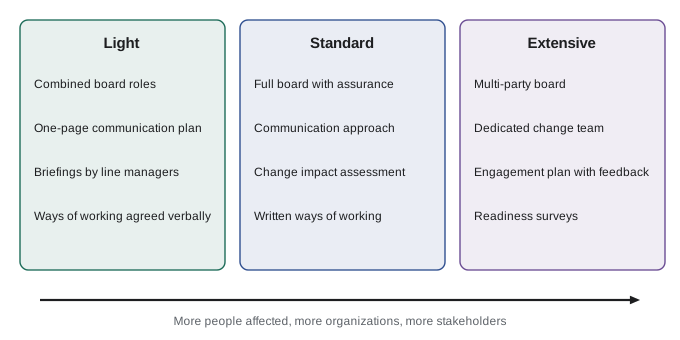
A people tailoring score
As with general tailoring, a simple scoring matrix helps make people-related tailoring decisions consistent and explainable. It does not replace judgment, but it prompts the right questions and gives assurance a basis for checking the decisions.
Worked problem
Scoring people-related tailoring
An organization scores five factors from 1 to 5 with weights: people affected 30 %, organizations involved 20 %, stakeholder complexity 20 %, team inexperience 15 % and cultural distance 15 %. Totals up to 2.0 suggest light arrangements, 2.1 to 3.4 standard and 3.5 or more extensive. A project to roll out a new expense system to 4,000 staff, built by one external supplier, scores 4, 2, 3, 2, 2. Which level is suggested?
Show solution
- People affected: 4 × 0.30 = 1.20.
- Organizations: 2 × 0.20 = 0.40.
- Stakeholder complexity: 3 × 0.20 = 0.60.
- Team inexperience: 2 × 0.15 = 0.30.
- Cultural distance: 2 × 0.15 = 0.30.
- Total: 1.20 + 0.40 + 0.60 + 0.30 + 0.30 = 2.80.
Answer: A score of 2.80 suggests standard people arrangements. Because the people-affected score is high, the project may still choose extensive change management, such as readiness surveys, while keeping other arrangements standard. Tailoring can differ by topic.
Small projects
On a small internal project with a handful of people and limited change, the people element can be very light. The executive and senior user may be one person. Communication may be a short section of the project initiation document listing who needs to know what. Change management may consist of a briefing by the affected team's manager and a short how-to guide. Team ways of working may be agreed in a 20-minute conversation. None of this removes the need to think about people; it simply scales the response.
Worked problem
A light people plan
Write five people-related arrangements for a six-week project to move a 12-person team to a new shared drive structure.
Show solution
- Board: the team's manager acts as executive and senior user; the IT lead acts as senior supplier.
- Change: the manager explains the reason at a team meeting; a one-page guide shows where files now live.
- Readiness: two volunteers test the structure for a week and suggest changes before the full move.
- Communication: a short email the week before, a reminder the day before and a 15-minute question session after the move.
- Team: the IT technician and the two volunteers agree a daily 10-minute check during move week.
Answer: Every people topic is covered in a few lines. The arrangements are recorded in the project initiation document so the board can approve them.
Agile environments
Agile ways of working place strong emphasis on people: self-organizing teams, close collaboration with users, frequent feedback and servant leadership. In many ways they align naturally with the PRINCE2 7 people element. Tailoring typically maps PRINCE2 roles onto agile roles, as discussed in lesson 4, and uses agile practices to deliver people-related outcomes. Daily stand-ups and retrospectives support team communication and learning. Sprint reviews give users a regular, two-way channel. Product owners embed user input into delivery.
Two tailoring points need care. First, management by exception still applies: the board sets tolerances, usually with scope as the main flexible target and time and cost fixed, and the team self-organizes within them. Second, agile teams can become isolated from wider stakeholders if communication is left entirely to sprint reviews. The communication management approach should still cover stakeholders beyond the immediate product owner, such as operations, support, finance and affected staff who never attend a review.
| People topic | Typical agile practice | PRINCE2 check |
|---|---|---|
| Leading teams | Self-organizing teams, servant leadership | Work package or release tolerances still agreed |
| Communication within the team | Stand-ups, information radiators | Checkpoint reporting may use the same information |
| Communication with users | Sprint reviews, product owner | Wider stakeholders still covered by the communication approach |
| Learning | Retrospectives | Lessons are also passed to the lessons log and future projects |
| Leading change | Incremental releases with early feedback | Change products still planned for each release |
Projects within programs
When a project sits inside a program, many people arrangements are provided at program level. The program may run a central communications team, own stakeholder relationships with senior external parties, employ business change managers and set standards for engagement. The project should tailor its own arrangements to fit, using program channels rather than duplicating them, and agreeing clearly which stakeholders it engages directly and which the program handles. Duplicate or conflicting messages from a project and its program confuse stakeholders quickly.
Multi-organization projects
Where several organizations work together, as customer, suppliers, partners or joint venture members, the people element needs more structure. The board may include representatives of several organizations, each bringing different cultures and commercial interests. Joint ways of working, a shared risk register where possible, an agreed decision-making process and an escalation ladder that crosses organizational boundaries become essential. The relationship health check from lesson 3 is a useful tool here, as are joint workshops at the start of each stage.
Worked problem
Designing an escalation ladder across organizations
A project involves a city, a design firm and a construction contractor. Design a three-step escalation ladder for disagreements between teams, with time limits.
Show solution
- Step 1: team managers from the organizations concerned try to resolve the matter within 3 working days.
- Step 2: if unresolved, the city's project manager and the firms' delivery managers meet within a further 5 working days.
- Step 3: if still unresolved, the matter goes to the project board, with the executive deciding within 10 working days after hearing the senior suppliers.
- Contractual disputes that cannot be resolved this way follow the contract's dispute procedure, which runs in parallel.
Answer: A ladder with time limits keeps disagreements moving and prevents small issues from festering into contract disputes. It should be recorded in the project initiation documentation and agreed by all parties.
Public sector and regulated contexts
Public sector projects often have additional people requirements: transparency obligations, consultation duties, official languages, accessibility standards, union agreements and political oversight. Regulated industries may require specific competencies, documented training and formal sign-offs. These requirements shape tailoring by adding formality to communication, consultation and roles.
In Canada, federal projects may need to meet official languages requirements, the Accessible Canada Act, duties to consult Indigenous peoples where Crown decisions may affect Aboriginal or treaty rights, and collective agreements that govern changes to public servants' work. Provincial projects have equivalent requirements. These are part of the context to be recognized at initiation and reflected in communication and change plans.
International and distributed projects
Projects that span countries combine cultural distance, time zones and sometimes language differences. People tailoring may include translation of key communications, scheduling meetings fairly across time zones, choosing tools that work in all locations and allowing more time for decisions that require consultation in several cultures. Ways of working should be explicit and written. Social contact, which builds the trust that delegation depends on, needs deliberate planning when people rarely meet in person.
Recording people-related tailoring
People-related tailoring decisions belong in the project initiation documentation alongside other tailoring decisions. Typical entries cover board composition and any combined roles, the scale of change management, the communication management approach, team ways of working, arrangements with program or supplier organizations and any context-specific requirements. Recording them allows the board to approve the approach, assurance to check that the people element has not been neglected and future projects to learn from what worked.
Tailoring as the project evolves
People-related tailoring should be reviewed at each stage boundary, just like other tailoring. Projects often change shape: a design stage with a small core team may give way to a rollout stage affecting thousands of people, or a single supplier may be joined by several subcontractors. The arrangements that fitted the early stages may be inadequate later. A useful habit is to re-run the people tailoring score at each boundary and compare it with the arrangements in place. If the score has moved up a band, the project manager should propose stronger arrangements to the board, such as a dedicated change lead, a formal stakeholder engagement plan or a joint governance forum with suppliers.
The reverse also happens. A project that began with extensive arrangements because of uncertainty may be able to simplify once relationships are established and risks have reduced. Reducing reporting frequency, merging meetings or widening tolerances as trust grows frees time for delivery. Either way, the change and its reason should be recorded so that assurance can see that the people element is still being managed deliberately.
Worked problem
Re-scoring at a stage boundary
At initiation a project scored 2.3 on the people tailoring scale, with standard arrangements. At the end of the design stage the scope has grown to include 6,000 staff rather than 1,500, and a second supplier has joined. The people-affected score rises from 3 to 5 and the organizations score from 2 to 3; other scores stay the same. Using the weights from earlier in this lesson, what is the new total?
Show solution
- Change in people affected: (5 − 3) × 0.30 = +0.60.
- Change in organizations: (3 − 2) × 0.20 = +0.20.
- New total: 2.3 + 0.60 + 0.20 = 3.1.
Answer: The score rises to 3.1, still in the standard band but close to extensive. Given the large rise in people affected, the project manager should propose extensive change management for the rollout stage and record the decision.
Common mistakes
MistakeApplying the same communication and change effort to every project.
InsteadScale people arrangements to the people affected, organizations and stakeholders involved.
MistakeAssuming agile practices make the communication approach unnecessary.
InsteadCover wider stakeholders who never attend sprint reviews.
MistakeDuplicating program communications at project level.
InsteadUse program channels and agree who engages which stakeholders.
MistakeLeaving cross-organization disagreements without a process.
InsteadAgree an escalation ladder with time limits.
MistakeTailoring people arrangements informally.
InsteadRecord people-related tailoring in the initiation documentation.
Summary and key terms
- People-related tailoring scales arrangements to the context.
- Key drivers are people affected, organizations involved, stakeholder complexity, team experience, culture and distribution.
- A weighted score helps make decisions consistent, and tailoring can differ by topic.
- Small projects can cover every people topic in a few lines.
- Agile practices deliver many people outcomes, but wider stakeholders still need coverage.
- Projects in programs and multi-organization projects need agreed channels and escalation routes.
- Public sector and international contexts add requirements that shape communication and change.
- Tailoring
- Adapting PRINCE2 to suit the project's context.
- People tailoring score
- A weighted assessment of context factors that suggests the scale of people arrangements.
- Servant leadership
- A leadership approach focused on enabling the team and removing obstacles.
- Self-organizing team
- A team that decides how to do its work within agreed boundaries.
- Retrospective
- A regular team meeting to reflect on how work went and agree improvements.
- Sprint review
- An agile event where the team shows completed work to stakeholders for feedback.
- Escalation ladder
- A sequence of steps and time limits for resolving disagreements.
- Joint venture
- An arrangement where organizations combine to deliver a shared undertaking.
- Duty to consult
- A legal or policy obligation to consult affected groups before certain decisions.
- Cultural distance
- The degree of difference in norms and expectations between groups.
Practice problems
Work each problem on paper first, then reveal the answer to check.
Scores 3, 3, 2, 2, 1 with weights 30, 20, 20, 15, 15 %. Total?
Show answer
0.9 + 0.6 + 0.4 + 0.3 + 0.15 = 2.35.
Which level does 2.35 suggest in this lesson's bands?
Show answer
Standard.
Can tailoring levels differ between people topics?
Show answer
Yes, for example extensive change management with standard communication.
On agile projects, which target is usually the main flexibility?
Show answer
Scope.
What risk arises if agile teams rely only on sprint reviews for communication?
Show answer
Wider stakeholders who never attend are left out.
What should a project in a program avoid in its communications?
Show answer
Duplicating or contradicting program messages.
Name one element of an escalation ladder.
Show answer
Time limits for each step.
Where are people-related tailoring decisions recorded?
Show answer
In the project initiation documentation.
Give one public sector requirement that affects communication.
Show answer
Official languages or accessibility standards.
Why plan social contact in distributed teams?
Show answer
It builds the trust that delegation depends on.
Lesson quiz · 5 questions
Score 60% or more to complete this lesson.
Create a free account to save your progress, take quizzes and earn a certificate.