
PMP-160 · Lesson 7 of 12 · 29 min
Practising Business Environment questions
The Business Environment domain grew from about 8 % of the exam to about 26 % in July 2026, roughly 44 scored questions. It covers governance, compliance, change control, impediments and issues, risk, continuous improvement, organizational change and changes in the external environment. PMP-150 taught it in depth, with risk and change control taught in PMP-131. Because the domain is now so large, and because many candidates have less experience with it than with People or Process topics, it deserves deliberate practice.
Business Environment questions share one underlying test: does the answer protect the value the project was started to create, within the organization's rules and decision rights? Keep that test in mind as you work through the patterns below.
The eight tasks and their question patterns
| Task (paraphrased) | Typical question | Strong answer pattern |
|---|---|---|
| Governance | Who should approve this? Is the structure right for the project? | Route to the body with authority; tailor governance to size and risk |
| Compliance | A new rule applies, or a requirement was missed | Identify, classify, assess and build compliance in; involve specialists |
| Change control | Someone wants a change to a baseline or contract | Analyse impact and follow the agreed process |
| Impediments and issues | Something is blocking the team or a risk has occurred | Triage, act within authority, escalate with options |
| Risk | A new threat or opportunity appears | Analyse, plan a response with an owner, monitor |
| Continuous improvement | Lessons are not being applied | Capture, share and act on lessons; update process assets |
| Organizational change | Users resist or are not ready | Assess readiness, involve leaders, train and support adoption |
| External changes | A regulation, market price or technology changes | Assess impact on scope, backlog, risks and business case |
Governance and decision rights
Many Business Environment questions are really about who decides. Projects have thresholds that determine which decisions the project manager can make, which go to a change control board or steering committee, and which go to the sponsor or board. In adaptive work, some decisions are delegated to the product owner within guardrails. A strong answer prepares the analysis and routes the decision to the right level; a weak answer either decides beyond authority or escalates something the project manager could handle.
# Routing Project Compass decisions to the right authority, using the thresholds set in PMP-131.
def route(cost, days, uses_reserve=False, new_money=False, backlog_only=False):
    if new_money:
        return "library board"
    if backlog_only:
        return "product owner (within release goal and budget)"
    if uses_reserve or cost > 50_000 or days > 5:
        return "sponsor"
    if cost >= 10_000 or days > 0:
        return "change control board"
    return "project manager"

cases = [
    ("Swap two app stories of equal size", 0, 0, False, False, True),
    ("Extra outlets in the workroom", 6_500, 0, False, False, False),
    ("Storage room for donated shelving", 12_000, 4, False, False, False),
    ("Second community room", 66_000, 9, False, False, False),
    ("Draw management reserve for tariff increase", 19_000, 0, True, False, False),
    ("Funding top-up beyond the approved budget", 50_000, 0, False, True, False),
]
for name, cost, days, res, new, blog in cases:
print(f"{name:44} -> {route(cost, days, res, new, blog)}")Swap two app stories of equal size -> product owner (within release goal and budget) Extra outlets in the workroom -> project manager Storage room for donated shelving -> change control board Second community room -> sponsor Draw management reserve for tariff increase -> sponsor Funding top-up beyond the approved budget -> library board
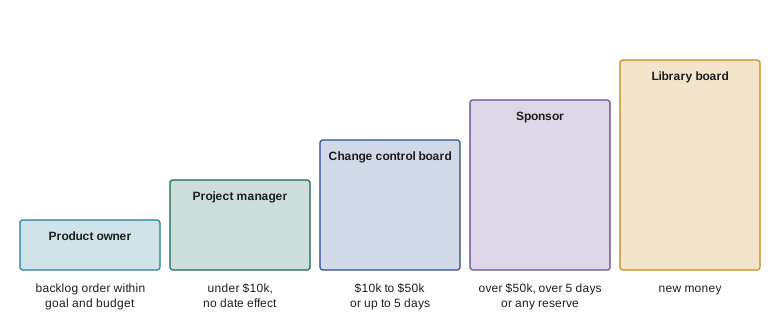
The program applies the thresholds Project Compass adopted in PMP-131: the project manager can approve changes under $10,000 with no effect on the end date; the change control board handles changes from $10,000 to $50,000 or up to five days; the sponsor handles anything larger, anything over five days and any use of management reserve; the library board approves new money; and the product owner reorders the app backlog within the release goal and budget. On the exam you will not be given code, but you will be given thresholds, and you should apply them just as mechanically.
Compliance
Compliance questions often describe a requirement that has been missed, a new law or standard that has just appeared, or a team that wants to skip a control to save time. Strong answers identify the requirement and its source, assess its impact, involve the right specialists, such as legal, privacy, safety or accessibility experts, and build compliance into the work. In adaptive settings, shared requirements often go into the definition of done. When a serious breach occurs, follow the required procedure immediately and inform the people who must know; never conceal it.
Worked problem
A compliance gap discovered late
In month 6 of Project Compass, an accessibility review finds that two app screens fail the contrast and screen reader requirements in the library's accessibility policy. The soft opening is in five weeks. The product owner suggests releasing on time and fixing the screens later. What should Priya do?
Show solution
- Recognize that this is a compliance requirement, not a preference. The library's policy and the applicable accessibility law require accessible digital services.
- Assess the gap with the accessibility specialist and the team: how much work is needed, and can it fit in the remaining sprints?
- Work with the product owner to reorder the backlog so the fixes come first, moving lower-priority features if needed, and confirm the definition of done includes the accessibility checks so the gap does not recur.
- If the fixes cannot fit, escalate to the sponsor with options, such as delaying the app release or releasing without the failing screens; do not release noncompliant screens quietly.
Answer: Treat the gap as a compliance requirement, prioritize the fixes with the product owner and strengthen the definition of done; escalate with options if they cannot fit.
In Canada, accessibility obligations for a library come from provincial legislation and standards, such as Ontario's accessibility standards in that province, and from the library's own policies. The exam will not test provincial details, but it does expect compliance requirements to be met, not deferred.
Impediments, issues and risks
These three are easily confused. A risk is an uncertain event that may happen. An issue is a current problem that must be dealt with, often a risk that has occurred. An impediment is anything blocking the team's progress, a term used mostly in agile settings. Questions test whether you treat each correctly: risks are analysed and given responses in advance; issues are logged, owned and resolved; impediments are removed quickly, by the team if possible and by the servant leader if not.
When a risk occurs, the best first step is usually to implement the planned response from the risk register and record the issue. If there was no planned response, assess the situation and develop a workaround. If the impact exceeds the project manager's authority, escalate with analysis and options. Questions that ask what should have been done often point to earlier risk identification.
Worked problem
An occurred risk with a planned response
The Project Compass risk register included the risk that tariffs on imported kiosks might rise, with a response of drawing on contingency and invoking the price adjustment clause in the kiosk contract. In month 6 the tariff rises and the kiosk cost increases by about $19,000. What should Priya do?
Show solution
- The risk has occurred, so it is now an issue. Record it in the issue log and link it to the risk.
- Implement the planned response: apply the contract's price adjustment clause and fund the increase from the contingency reserve set aside for that risk.
- Check the effect on the remaining contingency and the forecast, and report it in the next status update.
- Escalating to the sponsor first, or holding a new risk workshop before acting, would ignore the planned response.
Answer: Log the issue, implement the planned response using contingency and the contract clause, and update the forecast and reports.
Organizational change
Organizational change questions describe users who resist, managers who are not supporting a new system, or a transition that is going badly. Strong answers diagnose readiness, often using a model such as ADKAR (awareness, desire, knowledge, ability, reinforcement), and respond to the specific gap. If people do not understand why the change is happening, communicate the reasons through credible leaders. If they lack skills, train and support them. If they revert to old ways after launch, reinforce the change through recognition, measures and leadership attention. Forcing adoption or blaming users is rarely right.
Remember from PMP-150 that sponsors and direct managers are usually the most effective messengers of change. A question that asks how to increase support for a new process among circulation staff is likely to point to involving the branch manager and supervisors, not to a memo from the project team.
External changes and sustainability
External change questions describe events outside the project, such as a new regulation, a price rise, a new technology or a change in the community. The best answer assesses the impact on the project's scope, backlog, risks and business case, and then responds through the right channel: a change request, a backlog update, a risk response or, if the change undermines the business case, a recommendation to governance. Sustainability appears both as a compliance matter, where rules require it, and as a value matter, where the organization's goals favour it.
Continuous improvement
Continuous improvement questions often describe lessons that were recorded but never used, or a project that repeats mistakes from earlier projects. Strong answers capture lessons throughout the project, not only at the end, review relevant lessons at the start of new work, act on them, and update organizational process assets such as templates, checklists and standards. In adaptive teams, the retrospective is the main improvement mechanism.
Quick patterns for Business Environment questions
- Protect the value the project exists for; revisit the business case when value changes.
- Route decisions to the right level using the agreed thresholds.
- Meet compliance requirements; build them in; never conceal a breach.
- Risks are planned for, issues are resolved, impediments are removed.
- Diagnose readiness and use credible leaders for change.
- Assess external changes for impact and respond through the right channel.
- Use lessons learned during the project and update process assets.
One more Business Environment question worked through
Worked problem
A lesson ignored
At the start of Project Compass, the library's lessons register included an entry from a previous branch project: self-checkout kiosks failed during the first week because they had not been tested under real network load. Midway through the project, the kiosk installation plan still has no load test. What should Priya do?
Show solution
- Recognize that this is a continuous improvement and risk question: a known lesson has not been applied.
- Raise the gap with the team and the supplier, add a soak or load test to the plan, and record the related risk with an owner.
- If the test adds cost or time beyond Priya's authority, submit it through change control; on Project Compass this became a small preventive change.
- Update the lessons register to show the lesson was applied, so that the organization can see it working.
Answer: Apply the lesson by adding a load test, record the risk and route any change through the agreed process.
Common mistakes
MistakeTreating compliance as negotiable when deadlines are tight.
InsteadMeet compliance; adjust scope or escalate with options instead.
MistakeHolding a risk workshop when a planned response exists.
InsteadImplement the planned response and record the issue.
MistakeEscalating every change to the sponsor.
InsteadUse the thresholds; escalate only what exceeds lower authorities.
MistakeBlaming users who resist a new system.
InsteadDiagnose the readiness gap and address it.
MistakeIgnoring an external change because the plan is approved.
InsteadAssess impact on scope, risks and the business case.
Summary and key terms
- The Business Environment domain is about 26 % of the exam, roughly 44 scored questions.
- Governance questions are mostly about routing decisions to the body with authority.
- Compliance requirements are identified, built in and never concealed when breached.
- Risks, issues and impediments are different and are handled differently.
- Organizational change questions reward diagnosis of readiness and leadership involvement.
- External changes are assessed for impact on scope, backlog, risk and the business case.
- Governance
- The framework of authority, accountability and decision making that directs and oversees a project.
- Change authority
- The level authorized to approve a change of a given size or type.
- Compliance requirement
- An obligation arising from law, regulation, standard, contract or policy.
- Issue
- A current problem that must be addressed, often an occurred risk.
- Impediment
- Anything that blocks a team's progress.
- ADKAR
- A change model: awareness, desire, knowledge, ability and reinforcement.
- PESTLE
- A framework for scanning political, economic, social, technological, legal and environmental factors.
- Organizational process assets
- Plans, processes, templates and lessons that an organization uses and updates across projects.
Practice problems
Work each problem on paper first, then reveal the answer to check.
About how many scored questions are in the Business Environment domain?
Show answer
About 44.
Under Project Compass thresholds, who approves a $12,000 change that adds four days?
Show answer
The change control board.
Who approves any use of management reserve on Project Compass?
Show answer
The sponsor.
Where should a shared accessibility requirement go in an agile project?
Show answer
Into the definition of done.
What should happen first when a risk with a planned response occurs?
Show answer
Implement the planned response and record the issue.
What is the difference between a risk and an issue?
Show answer
A risk may happen; an issue is happening now.
What does ADKAR stand for?
Show answer
Awareness, desire, knowledge, ability and reinforcement.
Who are usually the most effective messengers of change?
Show answer
Sponsors and direct managers.
What should you do when an external change undermines the business case?
Show answer
Revisit the business case with the sponsor and governance.
What should happen to lessons learned during the project?
Show answer
They should be captured, shared, acted on and used to update process assets.
Lesson quiz · 5 questions
Score 60% or more to complete this lesson.
Create a free account to save your progress, take quizzes and earn a certificate.