
PMP-160 · Lesson 12 of 12 · 27 min
The final two weeks and exam day
The last two weeks before the exam are different from the months before them. This is not the time to learn large new topics or to read the PMBOK Guide from cover to cover. It is the time to consolidate what you know, sharpen recall and timing, fix the few errors that keep recurring, and arrive at the exam rested and confident. This final lesson sets out a two-week plan, explains how to manage nerves and energy, walks through exam day, and closes the PMP preparation program with a look at what comes after the exam.
Principles for the final two weeks
- Practise more than you read. Full-length exams, mixed sets and review cards are worth more now than rereading notes.
- Follow the evidence. Spend time on the top causes in your error log and your weakest domain, without dropping mixed practice.
- Protect your energy. Sleep, regular meals and short breaks matter as much as extra hours.
- Taper. Reduce the load in the last few days, as athletes do before a race, so that you arrive fresh.
- Settle the logistics early, so that the day itself holds no surprises.
A two-week plan
The plan below suits a candidate who works full time and can study a couple of hours on most weekdays and longer at weekends. It includes two full-length practice exams, each followed by a full review day, focused work on weak areas, a rest day in the middle and a taper at the end.
# A 14-day final plan counting down to exam day (day 0). Hours are a guide for a working candidate.
plan = {
    14: ("Full-length practice exam", 4), 13: ("Review exam fully; update error log", 4),
    12: ("Weakest domain: focused sets", 2), 11: ("Second weakest domain: focused sets", 2),
    10: ("Mixed set of 60; review", 2.5), 9: ("Formulas and calculation set", 1.5),
    8: ("Rest day: cards only", 0.5), 7: ("Final full-length practice exam", 4),
    6: ("Review exam fully; update error log", 4), 5: ("Top error-log causes; cards", 2),
    4: ("Mixed set of 40; review", 2), 3: ("Light review: decision ladder, formulas", 1),
    2: ("Logistics check; cards only", 0.5), 1: ("Rest; prepare ID, room or route", 0.25),
    0: ("Exam day", 0),
}
total = 0
for day in sorted(plan, reverse=True):
    task, hours = plan[day]
    total += hours
    label = f"day -{day:<2}" if day else "exam day"
    print(f"{label:8} {task:40} {hours:>4} h")
print(f"total study time {total:.2f} h")day -14 Full-length practice exam 4 h day -13 Review exam fully; update error log 4 h day -12 Weakest domain: focused sets 2 h day -11 Second weakest domain: focused sets 2 h day -10 Mixed set of 60; review 2.5 h day -9 Formulas and calculation set 1.5 h day -8 Rest day: cards only 0.5 h day -7 Final full-length practice exam 4 h day -6 Review exam fully; update error log 4 h day -5 Top error-log causes; cards 2 h day -4 Mixed set of 40; review 2 h day -3 Light review: decision ladder, formulas 1 h day -2 Logistics check; cards only 0.5 h day -1 Rest; prepare ID, room or route 0.25 h exam day Exam day 0 h total study time 30.25 h
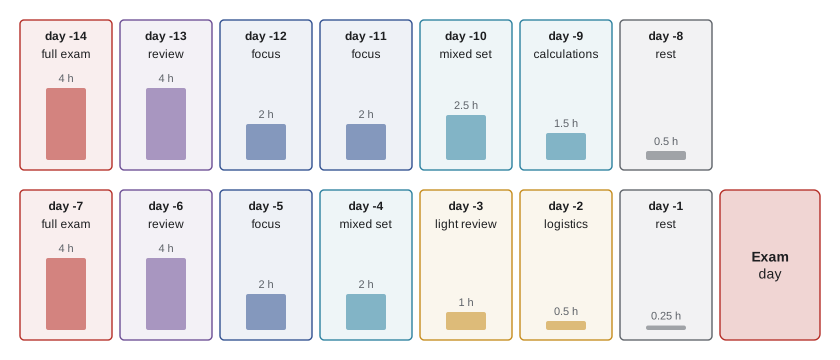
Adjust the plan to your situation. If your practice scores are comfortably above your readiness target, you might replace one focused day with a lighter mixed set. If one domain is still clearly weak, give it more of days 12, 11 and 5. If your appointment is in the morning, take the full-length practice exams in the morning too, so that your body is used to concentrating at that time.
What to review in the last days
In the final three or four days, review only material that is quick to recall and broadly useful:
- Your error-log cards, especially the top causes.
- The decision ladder and the habits of the PMI mindset from lesson 3.
- Decision rights in Scrum and in hybrid governance.
- The earned value, float, communication, PERT and EMV formulas from lesson 8.
- The distractor types from lesson 2.
Avoid starting a new question bank in the last days. Unfamiliar question styles can shake confidence without adding much skill. If you want practice, use short mixed sets from a source you know.
Managing nerves and energy
Some anxiety before an important exam is normal and even helpful, because it sharpens attention. Too much makes it harder to read carefully and recall what you know. Several simple techniques help:
- Prepare thoroughly. Confidence comes mostly from having practised under realistic conditions, which you will have done.
- Keep perspective. If the result is not a pass, you can retake within your eligibility period, with a score report showing what to work on.
- Use slow breathing. A few slow breaths, with longer exhalations than inhalations, calm the body quickly, including during the exam when a hard question unsettles you.
- Expect hard questions. Everyone meets questions they find difficult; they do not mean you are failing.
- Sleep. A good night's sleep in the days before the exam does more for performance than late-night study.
If you need testing accommodations, such as extra time or a separate room for a documented disability or medical condition, request them through PMI well before booking, because approval takes time. The same applies for religious or other needs that affect the testing arrangements.
Exam day
| When | What to do |
|---|---|
| Evening before | Lay out identification; check appointment time and address or the online check-in link; prepare the room or plan the route; light review at most |
| Morning | Normal breakfast; moderate caffeine if you usually have it; leave or start check-in early |
| First minutes | Take the optional tutorial if helpful; note down formulas you want handy if scratch work is allowed; settle your breathing |
| During each section | Follow your pacing plan; read every stem fully; eliminate, choose, flag and move on when stuck |
| Before each break | Review flagged questions; confirm nothing is blank |
| Breaks | Water, a small snack, a short walk or stretch; no study materials |
| End | Answer every question; complete the optional survey if you wish; note the provisional result |
Worked problem
The last week for Priya
Priya's exam is next Saturday morning. On Saturday a week before, she takes her final full-length practice exam and scores 74 % weighted, with all domains between 71 % and 77 %. What should her last seven days look like?
Show solution
- Sunday: review the practice exam fully and update her error log; misreading has fallen to third place, and compliance mindset errors are now top.
- Monday to Wednesday: short sessions on the top error-log causes, a mixed set of 40 questions with review, and daily card review.
- Thursday: light review of the decision ladder, decision rights and formulas, then an early night.
- Friday: check logistics, run the online system test, prepare the room and identification, review a few cards and rest. Saturday: follow the exam-day checklist.
Answer: Review the last practice exam, work on the top error causes and mixed sets early in the week, taper from Thursday and prepare logistics on Friday.
After the exam
If you pass, congratulations: you hold one of the most widely recognized credentials in project management. Your certification cycle lasts three years, during which you earn 60 professional development units to renew, spread across PMI's categories of ways of working, power skills and business acumen, with a limit on how many can come from giving back to the profession. Courses, self-directed study, reading and work as a practitioner can all contribute within PMI's rules and limits for each category, so keep records of what you complete as you go.
If you do not pass, the score report shows your performance in each domain. Rebuild your plan around the weakest domain, use the error-log method from lesson 11, take fresh full-length practice exams and retake within your eligibility period. Many successful PMPs did not pass the first time, and the second preparation is usually shorter and more focused.
Closing the PMP preparation program
This course completes the HSM University PMP preparation program. Across PMP-101 to PMP-160 you have followed Project Compass from its strategic case to its closing, through a hybrid life cycle with a predictive fit-out, an adaptive app and a procured kiosk system. You have planned scope, schedule and cost; managed quality, risk, procurement and change; led a team and engaged stakeholders; worked with agile practices and governed a hybrid project; and connected the project to its business environment. The exam asks you to apply the same judgement to many smaller situations.
Beyond the exam, the habits this program has stressed are the ones that make projects succeed: understanding before acting, involving the right people, respecting decision rights, building quality and compliance in, protecting value and learning continuously. They will serve you on your next project as much as on exam day.
If something goes wrong on the day
Most exam days go smoothly, but it helps to know what to do if they do not. If you feel unwell before an online exam, check PMI's rescheduling and emergency policies rather than pushing through; a poor attempt costs a retake fee and a slot in your eligibility period. If a technical problem interrupts an online exam, stay in view of the camera, use the proctor chat or follow the on-screen instructions, and note the time and what happened; the testing partner can often reconnect you. At a test centre, raise your hand and tell the staff immediately if anything on the computer or in the room is not working.
If a problem is not resolved on the day, report it to PMI and the testing partner promptly, with details. Candidates whose exams were disrupted by technical failures can usually arrange a new appointment. Keep your appointment confirmation and any messages you receive.
Sometimes the problem is not technical but personal: a difficult start, a run of hard questions, or a sudden worry that you have forgotten everything. Use the techniques from this lesson: slow breathing, a quick return to your reading routine, and the reminder that hard questions are expected. Many candidates who pass report feeling uncertain throughout the exam.
Worked problem
A mid-exam wobble
Forty minutes into the exam, Priya meets a case set about a construction project in a country she has never worked in, with an unfamiliar contract arrangement. She feels her confidence drop and starts rereading the scenario repeatedly. What should she do?
Show solution
- Pause for two slow breaths and remind herself that unfamiliar settings are deliberate: the questions test general principles, not local knowledge.
- Skim the questions first, as lesson 2 recommends, so she knows which facts matter.
- Answer each question from the facts given and the decision ladder; where unsure, choose the better option, flag it and move on.
- Return to the flagged questions before the break if time allows, rather than lingering now.
Answer: Calm down briefly, skim the questions, answer from general principles, flag uncertain items and keep to the pacing plan.
Common mistakes
MistakeStarting new topics or a new question bank in the last days.
InsteadConsolidate familiar material; use short mixed sets from known sources.
MistakeTaking a full-length practice exam the day before.
InsteadTake the last one about a week before and taper.
MistakeStudying late into the night before the exam.
InsteadLight review at most, and sleep.
MistakeLeaving logistics to the morning of the exam.
InsteadCheck identification, route or system the day before.
MistakeTreating a hard question as a sign of failure.
InsteadExpect hard questions; answer, flag and move on.
Summary and key terms
- In the final two weeks, practise more than you read and follow the evidence from your error log.
- A good plan includes two full-length exams with full reviews, focused work, a rest day and a taper.
- In the last days, review cards, the decision ladder, decision rights, formulas and distractor types.
- Manage nerves with preparation, perspective, slow breathing and sleep.
- Follow an exam-day checklist, pace each section and review flagged questions before each break.
- After passing, earn 60 PDUs every three years; if not, rebuild the plan around the score report.
- Taper
- Reducing study load in the final days so as to arrive rested.
- Final full-length exam
- The last realistic practice exam, best taken about a week before the real one.
- Accommodation
- An approved change to testing conditions, such as extra time, for a documented need.
- Provisional result
- The pass or fail result shown at the end of the exam, confirmed later.
- Certification cycle
- The three-year period after certification during which PDUs are earned for renewal.
- Talent Triangle
- PMI's grouping of PDU education into ways of working, power skills and business acumen.
- Retake
- A further attempt at the exam within the eligibility period.
- Consolidation
- Strengthening and connecting what has already been learned.
Practice problems
Work each problem on paper first, then reveal the answer to check.
What should dominate study in the final two weeks?
Show answer
Practice and review rather than reading new material.
When should the last full-length practice exam be taken?
Show answer
About a week before the real exam.
What is tapering?
Show answer
Reducing the study load in the final days to arrive rested.
Name three things to review in the last days.
Show answer
Any three of error-log cards, the decision ladder, decision rights, formulas and distractor types.
Why avoid a new question bank in the last days?
Show answer
Unfamiliar styles can shake confidence without adding much skill.
Give one technique for managing exam nerves.
Show answer
Slow breathing, thorough preparation, perspective or good sleep.
What should you do before each break?
Show answer
Review flagged questions and confirm nothing is blank.
When should accommodations be requested?
Show answer
Well before booking, because approval takes time.
How many PDUs are needed every three years?
Show answer
60.
What should a candidate do after not passing?
Show answer
Use the score report to rebuild the plan around the weakest domain and retake within the eligibility period.
Lesson quiz · 5 questions
Score 60% or more to complete this lesson.
Create a free account to save your progress, take quizzes and earn a certificate.