
PMP-160 · Lesson 11 of 12 · 27 min
Error logs and spaced review
Lesson 10 showed how to review practice exams. This lesson turns that review into a system. An error log captures every mistake and near miss so that patterns become visible. Spaced review makes sure that what you learn from those mistakes is still in your memory on exam day. Together they make the hours you spend on practice questions count for far more.
The underlying idea comes from research on learning. Two findings are especially well supported: actively retrieving information, as in answering questions or recalling a concept from memory, strengthens memory more than rereading it; and spreading study over time, with growing gaps between reviews, produces more lasting learning than cramming. Both are easy to apply to PMP preparation.
What an error log is
An error log is a simple record of every practice question you got wrong or got right by guessing. It can be a spreadsheet, a notebook or a set of digital flashcards. For each entry, record enough to learn from it later without needing the original question.
| Column | What to write | Example |
|---|---|---|
| Date and source | When and from which practice set | 12 Oct, full exam 2, question 47 |
| Domain and topic | Where it fits in the outline | Business Environment, compliance |
| Situation in brief | The scenario in one line | Accessibility gap found five weeks before launch |
| My answer and why | What you chose and your reasoning | Release now, fix later, to protect the date |
| Correct answer and why | The right answer and the principle | Prioritize fixes; compliance is not deferred |
| Error type | From the list in lesson 10 | Wrong mindset |
| Lesson for next time | One sentence you can apply | Compliance requirements are met; adjust scope or escalate |
The most important column is the last one. A lesson written as a rule you can apply, such as when a risk with a planned response occurs, implement the response first, will help with many future questions. A note that simply records the right letter will not.
Finding patterns
After a few practice exams the log will contain dozens of entries. Group them by error type and topic, and count. A Pareto view, sorted from most to least frequent, shows where a little effort will remove a lot of errors.
# Summarizing Priya's error log after three practice exams, then scheduling reviews.
from collections import Counter
log = (["knowledge: procurement"] * 6 + ["knowledge: compliance"] * 9 + ["misread stem"] * 11 +
       ["wrong mindset: escalated too soon"] * 8 + ["calculation slip"] * 4 +
       ["knowledge: agile roles"] * 5 + ["time pressure"] * 3)
counts = Counter(log)
total = sum(counts.values())
running = 0
print(f"{'Cause':36}{'Count':>6}{'Cum %':>7}")
for cause, n in counts.most_common():
    running += n
    print(f"{cause:36}{n:>6}{running / total:>7.0%}")
print()
# Expanding review intervals (days) for one error-log card, in the spirit of a Leitner system.
intervals, day = [1, 3, 7, 14], 0
for i in intervals:
    day += i
print(f"review on day {day}")Cause Count Cum % misread stem 11 24% knowledge: compliance 9 43% wrong mindset: escalated too soon 8 61% knowledge: procurement 6 74% knowledge: agile roles 5 85% calculation slip 4 93% time pressure 3 100% review on day 1 review on day 4 review on day 11 review on day 25
Priya's log after three practice exams has 46 entries. The largest group is misreading the stem, nearly a quarter of all errors. Next come knowledge gaps in compliance and a mindset error, escalating too soon. Those three causes account for about 61 % of her mistakes. Her plan follows the evidence: she adopts a deliberate reading routine for every stem, works through the compliance lessons of PMP-150 again with focused questions, and reviews the decision ladder from lesson 3 so that she assesses and acts within authority before escalating.
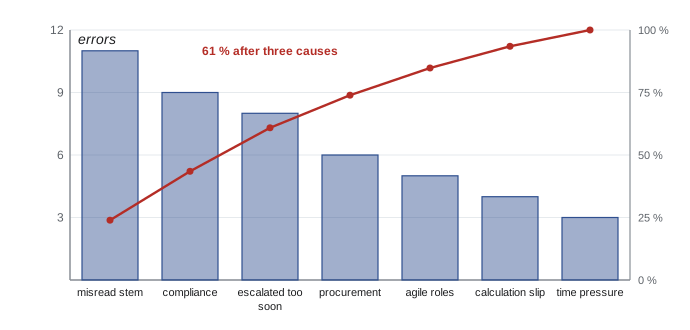
The biggest single cause is not a knowledge gap at all. Many candidates assume that more reading will fix their scores, when their real problem is how they read questions or how they reason about them. An error log makes that visible.
Spaced review
Lessons from the error log fade unless they are reviewed. Spaced review schedules each item for review at growing intervals: for example the next day, then three days later, then a week later, then two weeks later. If you recall the lesson easily, the interval grows; if you struggle, it shrinks back. This is the idea behind the Leitner box system and most flashcard apps.
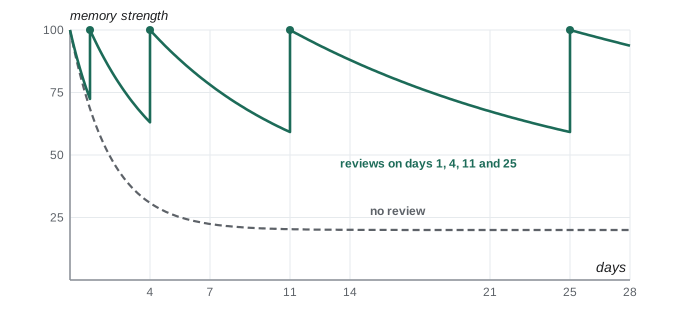
A practical approach for PMP preparation is to turn each error-log lesson into a question-and-answer card. The front states the situation in a sentence; the back gives the principle. Review cards for 10 to 15 minutes a day, rather than in long, occasional sessions. Cards for formulas, such as the earned value set, work the same way.
| Card front | Card back |
|---|---|
| A risk in the register occurs. What first? | Implement the planned response; record the issue. |
| Stakeholder asks to reorder the product backlog. | Refer to the product owner; facilitate. |
| Change exceeds my authority. | Analyse impact and options; route to the body with authority. |
| Formula for CPI? | EV / AC. |
| Team member's performance drops. | Private conversation to understand the cause. |
| Users revert to the old process after launch. | Reinforcement is missing; recognize, measure, lead. |
Retrieval practice beyond cards
Retrieval practice means pulling knowledge out of memory rather than looking at it again. Practice questions are retrieval practice, which is one reason they work so well. Other ways to retrieve include explaining a concept aloud as if teaching it, writing the earned value formulas from memory on a blank page, or drawing the decision ladder without looking. These take a few minutes and reveal gaps immediately.
Interleaving is a related technique: mixing topics within a study session rather than studying one topic at a time. It feels harder, but it builds the skill the exam requires, which is recognizing what kind of question you face. Mixed practice sets, recommended throughout this course, are interleaved by design.
Worked problem
Turning a mistake into a lasting lesson
In a practice exam, Priya chose to escalate to the sponsor when a vendor delayed a delivery. The correct answer was to assess the impact and review the contract first. How should she log and review this?
Show solution
- Log the entry: Process and Business Environment, vendor delay; my answer escalate; correct answer assess impact and review contract; error type wrong mindset.
- Write the lesson as a rule: assess and use the contract before escalating a vendor problem.
- Create a card with the front vendor misses a delivery: what first? and the back assess impact, review contract, communicate formally; escalate only if beyond authority.
- Schedule reviews on days 1, 4, 11 and 25, and look for similar questions in the next practice set to test whether the lesson has stuck.
Answer: Log the error with a rule-like lesson, turn it into a card and review it at growing intervals, checking in later practice.
Managing the volume
A busy candidate can log many errors in a single full-length exam. If the log becomes unmanageable, it stops being used. Keep it lean:
- Log every wrong answer and every right-but-unsure answer from full-length exams; from short quizzes, log only new lessons.
- Merge entries that teach the same lesson, keeping a count of how often it appears.
- Retire cards you have recalled easily on three consecutive reviews, but bring them back if the same error reappears.
- Spend most review time on the top causes in your Pareto view.
If you study with colleagues, a shared error log can help, but keep personal reasoning in your own log. Several PMI chapters in Canada run study groups where members compare reasoning on practice questions; explaining your thinking to others is excellent retrieval practice.
Building an error log step by step
Setting up an error log takes about fifteen minutes. If you use a spreadsheet, create the columns from the table above, add a column for the review date, and freeze the header row. If you use a flashcard app, create one deck for situational lessons and one for formulas and terms, and use tags for domain and error type so that you can filter later. Whatever the tool, keep the entry format consistent, because consistency makes patterns easy to see.
Fill in the log during your review sessions, not during practice tests. While taking a test, simply flag questions and note whether you were sure; record the details afterwards when you read the explanations. After each full-length exam, update the counts by error type and topic and look at the top three. Those three causes should shape the next week of study.
Over time, the log tells a story. Early in preparation, most entries are knowledge gaps. As you study, knowledge errors fall and reading and mindset errors become a larger share. Late in preparation, the remaining errors are often close calls between two good options. That progression is normal, and it means the kind of practice you need changes: from learning content, to reading carefully, to sharpening judgement on fine distinctions.
| Stage of preparation | Typical top error types | Best response |
|---|---|---|
| Early | Knowledge gaps | Restudy topics; topic quizzes |
| Middle | Misreading and mindset errors | Reading routine; decision ladder; mixed sets |
| Late | Close calls between two good options | Compare options against signal words and role; review explanations closely |
A week of spaced review in practice
A sample week shows how little time spaced review needs. Each morning, Priya spends ten minutes on her review cards over coffee: new cards from the last review session, plus the cards scheduled for that day. On two evenings she adds a twenty-minute retrieval session, writing the formulas from memory and explaining two error-log lessons aloud. At the weekend she takes a full-length exam or a mixed set and logs new lessons. The total extra time is under two hours a week, yet by exam day each important lesson has been retrieved four or five times at growing intervals.
Worked problem
Spotting a recurring error
In three consecutive practice sets, Priya misses questions in which an agile team member asks the project manager to settle a priority dispute between two stakeholders. Each time she chooses to decide herself based on business value. What does the error log reveal, and what should she do?
Show solution
- The repeated entries share one cause: a mindset error about decision rights in agile settings.
- The principle is that the product owner orders the backlog and resolves priority questions with stakeholders; the project manager facilitates.
- She merges the three entries into one card with a count of three, and moves it to frequent review.
- She also does a focused set of agile decision-rights questions to test the lesson, and checks the next full-length exam for the same pattern.
Answer: A recurring decision-rights error: merge the entries into one high-priority card, review it often and test it with focused questions.
Common mistakes
MistakeRecording only the correct option letter.
InsteadRecord the principle as a rule you can apply.
MistakeAssuming every error is a knowledge gap.
InsteadClassify errors; misreading and mindset errors are common.
MistakeRereading notes as the main review method.
InsteadUse retrieval: questions, cards, explaining aloud.
MistakeCramming all review into a few long sessions.
InsteadReview a little every day at growing intervals.
MistakeLetting the log grow without pruning.
InsteadMerge, retire and focus on the top causes.
Summary and key terms
- An error log records mistakes and lucky guesses with the principle behind the right answer.
- Sorting errors by cause shows where a small effort removes many errors.
- Misreading and mindset errors are often as common as knowledge gaps.
- Spaced review at growing intervals keeps lessons in memory.
- Retrieval practice and interleaving build the skills the exam requires.
- Keep the log lean so that it is used: merge, retire and focus.
- Error log
- A record of practice mistakes and guesses with the lesson learned from each.
- Pareto analysis
- Sorting causes by frequency to focus on those producing most of the effect.
- Spaced review
- Reviewing material at increasing intervals over time.
- Leitner system
- A flashcard method in which cards move to less frequent review as they are recalled correctly.
- Retrieval practice
- Strengthening memory by recalling information rather than rereading it.
- Interleaving
- Mixing different topics within a study session.
- Review card
- A question-and-answer prompt used for spaced review.
- Forgetting curve
- The decline of memory over time without review.
Practice problems
Work each problem on paper first, then reveal the answer to check.
What two findings from learning research does this lesson apply?
Show answer
Retrieval strengthens memory more than rereading, and spaced study lasts longer than cramming.
What is the most important column in an error log?
Show answer
The lesson for next time, written as a rule.
What was Priya's largest cause of error?
Show answer
Misreading the stem.
What share of her errors came from the top three causes?
Show answer
About 61 %.
Give a typical sequence of review intervals.
Show answer
For example 1, 3, 7 and 14 days, reviewing on days 1, 4, 11 and 25.
What should happen to a card you recall easily three times?
Show answer
Retire it, but bring it back if the error recurs.
What is interleaving?
Show answer
Mixing topics within a study session.
Name one retrieval method other than flashcards.
Show answer
Explaining aloud, writing formulas from memory or drawing a model without looking.
Which practice answers should be logged from full-length exams?
Show answer
All wrong answers and all right-but-unsure answers.
How long should daily card review take?
Show answer
About 10 to 15 minutes.
Lesson quiz · 5 questions
Score 60% or more to complete this lesson.
Create a free account to save your progress, take quizzes and earn a certificate.