
PMP-160 · Lesson 10 of 12 · 27 min
Building and reviewing practice exams
Practice exams are the most powerful preparation tool you have, but only if you use them well. Taking practice test after practice test and checking the score teaches surprisingly little. What builds exam skill is taking realistic tests under realistic conditions and then reviewing every question, right and wrong, to understand the reasoning. This lesson explains how to choose practice material, when to take full-length tests, how to review them and how to read your results.
Choosing practice material
Practice questions vary enormously in quality. Some are close to the style and difficulty of the real exam; others test trivia, use outdated content or have answers that conflict with PMI's standards. Look for material that:
- Is written for the July 2026 exam content outline, with the 33 / 41 / 26 domain balance and about 60 % adaptive or hybrid contexts.
- Includes case or scenario sets and graphic-based questions, and multiple-response items.
- Explains why the correct answer is right and why each wrong answer is wrong.
- Comes from a reputable provider, such as PMI's own study resources, an Authorized Training Partner or a well-reviewed preparation company.
Be wary of collections claiming to contain real exam questions. Using leaked exam content breaches PMI's candidate agreement and can lead to the loss of certification, and such collections are usually inaccurate anyway. Original practice questions that teach the reasoning are far more valuable.
Kinds of practice
| Kind | Purpose | When |
|---|---|---|
| Topic quizzes | Check understanding of one area, such as procurement or conflict | While studying each area |
| Mixed sets of 30 to 60 questions | Practise switching between domains and approaches | Throughout preparation, several times a week |
| Diagnostic exam | Find strengths and weaknesses early | At the start of focused preparation |
| Full-length timed exams | Build stamina, pacing and realistic results | Every week or two in the final month |
| Review sessions | Learn from every question | After every practice set, especially full exams |
Full-length exams matter because the real exam tests endurance as well as knowledge. Many candidates do well on short sets and then find their accuracy falling in the last hour of a four-hour test. Take at least two or three full-length exams under realistic conditions before the real one: the same time of day as your appointment, the full 240 minutes, two 10-minute breaks, no notes or phone, and only an on-screen or simple calculator.
Reviewing a practice exam
Reviewing a full-length exam takes as long as taking it, sometimes longer. That time is the most valuable study you will do. For each question, ask four things.
- Did I get it right, and was I confident or guessing?
- Why is the correct answer correct, in terms of the standards and the situation?
- Why is each wrong answer wrong? Which distractor type is it?
- If I got it wrong, what kind of error was it?
Reviewing questions you answered correctly but guessed is as important as reviewing wrong answers. A lucky guess hides a gap that will cost you on the real exam. Mark each question as right and sure, right but unsure, or wrong, and review both of the last two groups in depth.
| Error type | What it looks like | Fix |
|---|---|---|
| Knowledge gap | You did not know the concept or term | Restudy that topic in the relevant course; do a focused quiz |
| Misread question | You missed a word such as first or not, or a key fact | Slow down on the stem; underline signal words mentally |
| Wrong mindset | You chose what your workplace would do | Review the decision ladder and servant leadership |
| Calculation slip | Right formula, wrong number, or wrong formula | Practise formulas; check sign and size against the story |
| Time pressure | Rushed answers near the end | Adjust pacing; practise full-length tests |
| Changed a right answer | Second-guessed without a reason | Change answers only with a clear reason |
Reading your results
Scores by domain matter more than the overall score, because they show where to spend time. Track them across practice exams to see trends.
# Priya's four full-length practice exams: percentage correct by domain.
exams = {
    "Exam 1": {"People": 72, "Process": 61, "Business Environment": 55},
    "Exam 2": {"People": 74, "Process": 66, "Business Environment": 60},
    "Exam 3": {"People": 73, "Process": 70, "Business Environment": 66},
    "Exam 4": {"People": 76, "Process": 72, "Business Environment": 71},
}
weights = {"People": 0.33, "Process": 0.41, "Business Environment": 0.26}
print(f"{'':8}{'People':>8}{'Process':>9}{'Bus. Env.':>11}{'Weighted':>10}")
for name, s in exams.items():
    w = sum(s[d] * weights[d] for d in weights)
    print(f"{name:8}{s['People']:>8}{s['Process']:>9}{s['Business Environment']:>11}{w:>10.1f}")
first, last = exams["Exam 1"], exams["Exam 4"]
print()
for d in weights:
    print(f"{d:22} change {last[d] - first[d]:+d} points")
weakest = min(last, key=last.get)
print("focus next on:", weakest)People Process Bus. Env. Weighted Exam 1 72 61 55 63.1 Exam 2 74 66 60 67.1 Exam 3 73 70 66 70.0 Exam 4 76 72 71 73.1 People change +4 points Process change +11 points Business Environment change +16 points focus next on: Business Environment
Priya's results show steady improvement. Her weighted score rose from about 63 % to about 73 %, and the Business Environment, her weakest domain, gained the most, 16 points, after she worked through PMP-150 again and did focused question sets. It is still her lowest domain, though now only a point behind Process, so her next week's practice leans toward those two domains, while keeping mixed sets in every session.
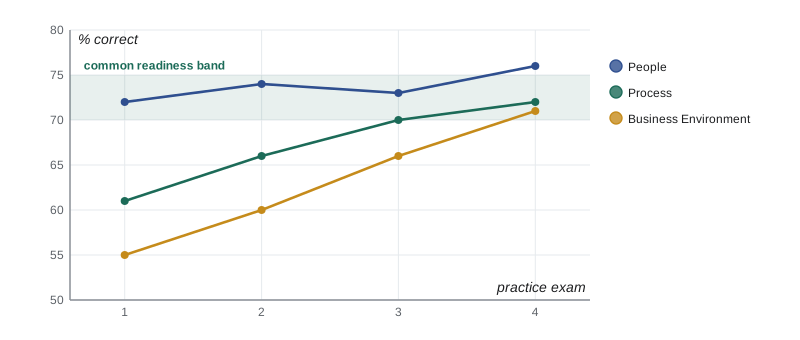
Two warnings about practice scores. First, scores on questions you have seen before are inflated; repeat questions test memory, not reasoning, so prefer fresh questions for full-length exams. Second, one score is a noisy measure. A single exam that drops five points is not a disaster; a trend over three or four exams is what matters.
When are you ready?
There is no published pass mark, so readiness is a judgement. Many preparation providers suggest booking or confirming your exam when your scores on realistic full-length practice exams are consistently around 70 to 75 % or higher across all domains, with no domain well below the rest, and when you finish within time with a few minutes to spare. Those figures are rules of thumb that vary by question bank, but the pattern behind them is sound: consistent, balanced results under realistic conditions.
Worked problem
Deciding whether to move the exam date
Priya's exam is booked for three weeks from now. After four full-length exams her weighted score is 73 %, with all domains between 71 % and 76 %, and she finished the last exam with 15 minutes to spare. A colleague suggests postponing a month to be safe. What should she do?
Show solution
- Her results meet the common readiness pattern: consistent scores in the low to mid 70s across all domains, improving steadily, and comfortable pacing.
- Postponing has costs: it extends preparation fatigue, may require a rescheduling fee if done late, and risks forgetting material.
- A better plan is to keep the date, use the next week for focused practice on the Business Environment and Process and one more full-length exam, then follow a final two-week plan as described in lesson 12.
- If her next full-length result dropped sharply, she could reconsider, but one weaker result alone would not justify postponing.
Answer: Keep the date, focus the next week on the Business Environment and Process, take one more full-length exam and follow a final two-week plan.
Rescheduling and cancellation rules depend on how close to the appointment you change it, and fees may apply inside a set window. Check the current policy before deciding; candidates in Canada pay any fee in US dollars.
A practice routine that works
- Early: one diagnostic exam, then focused study and topic quizzes on weak areas.
- Middle: mixed sets several times a week, reviewing every question and keeping an error log.
- Final month: a full-length timed exam every week or so, with a full review session after each.
- Throughout: record scores by domain and error type, and adjust your study plan to the evidence.
How to run a review session
A review session for a full-length exam is best split into two sittings, because reviewing 180 questions in one go is exhausting. In the first sitting, go through every wrong answer and every question you marked as unsure. In the second, skim the questions you got right with confidence, checking that your reasoning matched the explanation; occasionally you will find that you reached the right answer for the wrong reason, which is worth knowing.
For each question you review in depth, read the explanation and then close it and explain the answer to yourself in your own words. If you cannot, read it again. Then record the lesson in your error log, as lesson 11 describes. Resist the temptation to look only at the correct letter and move on; the value lies in understanding why the other options are wrong, because the same distractor patterns will appear on the real exam.
It helps to group questions by theme during review. If six of your wrong answers involve change control, look at them together: is the problem knowing the process, or applying it in adaptive contexts? Seeing errors side by side often reveals a single misunderstanding behind several mistakes.
| Sitting | Questions | Time | Output |
|---|---|---|---|
| First | All wrong and unsure answers | About 2 to 3 hours | Error-log entries with lessons |
| Second | Correct and confident answers, skimmed | About 1 hour | Notes on any right-for-the-wrong-reason answers |
| Wrap-up | Domain and error-type summary | 15 minutes | Updated study plan for the next week |
Using study groups and instructors
Many candidates prepare with a study group or an instructor-led course. A group is most useful during review: members explain their reasoning on questions they disagreed about, which builds exactly the judgement the exam tests. Keep groups small and focused, agree on a question source, and spend the time on discussion rather than on taking tests together. An instructor can help most with mindset questions, where hearing an experienced practitioner explain why one action comes before another often makes the pattern click.
Worked problem
A disagreement in a study group
Two members of Priya's study group disagree about a question in which a team member asks the project manager to approve a minor change to a work package that does not affect cost, schedule or other work. One says any change must go to the change control board; the other says the project manager can handle it. How should they settle it?
Show solution
- Look at the facts: the change is minor and has no effect on baselines or other work.
- Recall that change control protects baselines and that organizations set thresholds; changes within the project manager's authority can be approved by the project manager and recorded.
- Check what the question says about authority. If it gives no thresholds, the usual reading is that minor changes with no baseline impact are within the project manager's delegated authority, still documented in the change log.
- Agree on the principle and record it in both members' error logs: route changes by their impact and the authority levels, not by a rule that every change goes to the board.
Answer: The project manager can approve and record a change with no baseline impact, unless the question sets a lower threshold.
Common mistakes
MistakeTaking many practice exams without reviewing them.
InsteadReview every question; the review is where learning happens.
MistakeReviewing only wrong answers.
InsteadReview right-but-unsure answers too; they hide gaps.
MistakeUsing collections claiming to be real exam questions.
InsteadUse reputable original practice material; leaked content breaches PMI rules.
MistakeComparing scores across providers.
InsteadCompare trends within one provider.
MistakeReacting to one bad score.
InsteadLook at trends across several exams.
Summary and key terms
- Choose practice material aligned with the 2026 outline that explains every answer.
- Use topic quizzes, mixed sets and full-length timed exams at different stages.
- Take full-length exams under realistic conditions to build stamina and pacing.
- Review every question, including right-but-unsure ones, and classify each error.
- Track domain scores over time; focus study on the weakest domain while keeping mixed practice.
- Readiness is a consistent, balanced pattern of realistic practice results, not a single score.
- Diagnostic exam
- A practice exam taken early to identify strengths and weaknesses.
- Full-length exam
- A practice test with the same number of questions and time as the real exam.
- Mixed set
- A practice set combining questions from all domains and approaches.
- Error type
- A category describing why a question was missed, such as a knowledge gap or misreading.
- Weighted score
- A score combining domain results according to their share of the exam.
- Right but unsure
- A correct answer reached by guessing, which may hide a gap.
- Readiness pattern
- Consistent, balanced practice results under realistic conditions.
- Candidate agreement
- The terms a candidate accepts, including keeping exam content confidential.
Practice problems
Work each problem on paper first, then reveal the answer to check.
What should practice material include for the 2026 exam?
Show answer
The 2026 domain balance, adaptive and hybrid contexts, case sets, graphics, multiple response and explanations.
Why avoid collections claiming to be real exam questions?
Show answer
They breach PMI's candidate agreement and are usually inaccurate.
How should a full-length practice exam be taken?
Show answer
Under realistic conditions: full time, two breaks, no notes, same time of day.
Which answers should you review besides wrong ones?
Show answer
Right but unsure answers.
Name three error types.
Show answer
Any three of knowledge gap, misread question, wrong mindset, calculation slip, time pressure, changed a right answer.
What was Priya's weighted score after exam 4?
Show answer
About 73 %.
Which domain improved most for Priya?
Show answer
Business Environment, by 16 points.
Why are repeated questions a problem?
Show answer
They test memory rather than reasoning and inflate scores.
What is a common readiness rule of thumb?
Show answer
Consistent realistic practice scores of about 70 to 75 % or better across all domains.
What matters more than one practice score?
Show answer
The trend across several exams.
Lesson quiz · 5 questions
Score 60% or more to complete this lesson.
Create a free account to save your progress, take quizzes and earn a certificate.